Weekend links 361

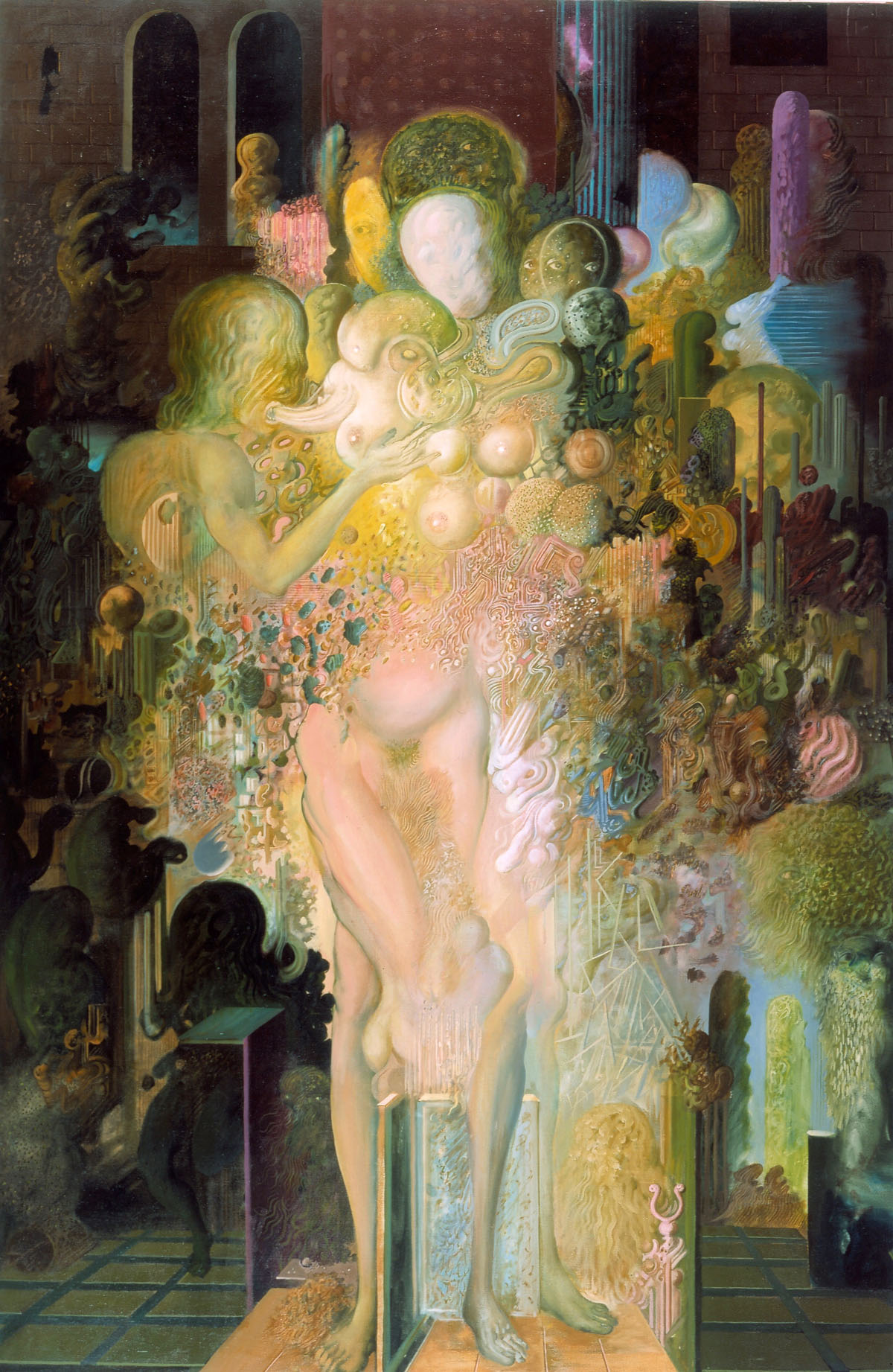
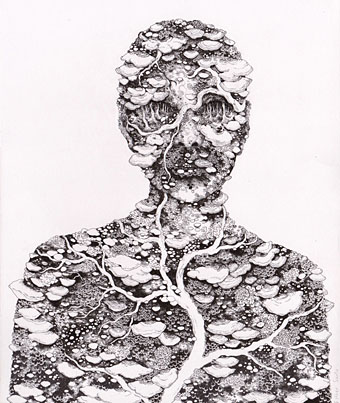
f1x-2.jpg

The Future Vol.2 (2016) by f1x-2.

• One of the notable things about the reaction to the original series of Twin Peaks was the way in which Americans were astonished that something so outré could be allowed on television. Here in the UK the response was a little more subdued; we had, after all been spoiled for years by The Prisoner, Sapphire and Steel, and numerous odd and challenging dramas by Dennis Potter and others. Pre-dating all of these was The Strange World of Gurney Slade (1960), a six-part series starring Anthony Newley that was unprecedented in its Surrealism. Andy Murray looks back at the series, and at the rest of Newley’s career.

Andrew Dickson on Peter Ackroyd whose latest book, Queer City: Gay London from the Romans to the Present Day, is published later this month.

Alyona Sokolnikova on a Soviet vision of the future: the legacy and influence of Tekhikia – Molodezhi (Technology for the Youth) magazine.

You know who weren’t cops? All the radicals and queers and artists and dreamers that were there while I grew up, my mom and dad’s old friends from New York and the wider bohemian world, the actors and the drag queens and the dilettantes and the ex junkies and the current junkies, the kind of queer people who wouldn’t get caught dead getting married, the people who actually made the “old New York” of the myth into what it was. They were smart and they were funny and they were tougher than I can imagine and they were possessed of an existential commitment to the idea that life is complicated and so we shouldn’t be quick to judge. They were tolerant, in the true sense, even while they were tireless advocates for actual justice. […] Now we’re Rudy Giuliani, trying to get offensive art pulled off the walls. Now we’re the book burners. Now we’re the censors. Now we attack the ACLU for defending free speech. Now we screech about community morals. Now we’re the prison camp screws. That’s us. Me, I could never be one of the good ones. Never. I can never live up to that ideal. I know I’m not good enough. I know when the judgment day comes, I go down. And so I decline. You can decline, too.

Planet of Cops by Freddie deBoer, or how inflexible morality makes everyone a cop

• Mixes of the week: FACT Mix 601 by Dark Entries, Secret Thirteen Mix 221 by Eli Keszler, and XLR8R Podcast 490 by Ben Lukas Boysen.

• At Dangerous Minds: Punk, Patti Smith, William Burroughs & capitalism: A “conceptual conversation” with RE/Search’s Vale.

Emily Wells on the strange, irreverent worlds of Down Below and The Complete Stories of Leonora Carrington.

Rick Poynor on Mike Halliwell’s montages based on JG Ballard’s The Atrocity Exhibition.

• “Why are the British so scared of cannabis?” asks Professor David Nutt.

Witchcraft and the Gay Counterculture (1978) by Arthur Evans.

• At Dennis Cooper’s: Jacques Rivette Day.

Designing Penguin Modern Classics

Future Dub (1994) by Mouse On Mars | Future Proof (2003) by Massive Attack | Future (2004) by Alva Noto

Typefaces of the occult revival

mmm.jpg

Man, Myth & Magic #1, January 1970; McCall’s, March 1970.

The announcement last week of the death of British character actor Geoffrey Bayldon prompted some discussion here about the typeface used for the titles of Bayldon’s TV series from the early 1970s, Catweazle. This was a humorous drama in which the actor portrayed a warlock transplanted by a time portal from the Norman era to the present day, a comic counterpart to another occult-themed series, Ace of Wands (1970–72). Being aimed at children, both Catweazle and Ace of Wands are at the lighter end of the great flourishing of occult-related media that runs in parallel with the rise and fall of psychedelic culture, a period roughly spanning the years 1965 to 1975. The two trends reflected and fed off each other; the hippie movement stimulated interest in the occult (Aleister Crowley is on the cover of Sgt Pepper) while giving to the commercial propagators of the supernatural a range of aesthetics lifted from the 19th century.

occult.jpg

Muller, 1972; TIME, June 1972.

Among the graphic signifiers is a small collection of typefaces from the Victorian or Edwardian eras, designs which vanished from sight after 1920 only to surface 50 years later in very different settings to their previous deployment. I’m always fascinated by the way context changes the perception of a typeface; the repurposing of Art Nouveau fonts—which hadn’t previously been associated with diabolism—to signify witchcraft or sorcery is a good example of this. In the case of the occult revival this was partly opportunism: the commercial application of post-psychedelic style made the previously untouchable trendy again, decoration and elaborate stylisation was no longer taboo. But it was also a solution to the problem of signifying the sorcerous with typography when there were no off-the-peg solutions as there were for, say, Westerns or stories about the Space Race. As well as carrying with them a flavour of old books, some of the more curious letterforms were reminiscent of the glyphs of magical alphabets which no doubt explains their popularity.

What follows is a chronological selection of the more striking examples (or my favourites…) which conveniently begins with Ringlet, the Catweazle font. With the trend being towards Art Nouveau you find popular Nouveau styles such as Arnold Bocklin also being used in the 1970s but I’ve avoided these in favour of the less common choices.


Ringlet (1882) by Hermann Ihlenburg

ringlet3.jpg

jullian08.jpg

Pall Mall, 1971.

Jullian’s landmark study of the Symbolist movement isn’t an occult text but it is a great favourite of mine whose original title—Esthètes et Magiciens—puts it in the right sphere. Inside, the author touches on the spiritual concerns of many of the artists which included Theosophy and fashionable Satanism.

ringlet1.jpg

ringlet2.jpg

Duckworth, 1973.

Aleister Crowley is represented here with the first reprinting of his erotic poetry, produced in a limited run by the venerable London house of Duckworth.

ringlet4.jpg

Rise Above Records, 2016.

Blood Ceremony are Canadians devoted to the occult rock of previous decades. Their presentation matches songs with titles like The Great God Pan and Morning Of The Magicians.


Rubens (1884) by John K. Rogers

rubens2.jpg

Rubens has long been a favourite of mine even though it gets used a great deal on horror novels and the like. Many Americans also regard it as “the Haunted Mansion font” owing to its use in Disney theme parks.

Peter Haining’s collection combined supernatural fiction with short non-fiction accounts of magical operations. The cover art is the full version of the drawing by Austin Osman Spare—The Elemental aka The Vampires are Coming—seen in detail on the cover of the first issue of Man, Myth & Magic.

rubens1.jpg

Coronet Books, 1972.


Eckmann (1900) by Otto Eckmann

eckmann2.jpg

eckmann1.jpg

Pan Books, 1969.

Many of the examples in this post tend towards the exploitational (see below…) but Cavendish’s overview of occult theory and history is a serious study, even if the cover does beckon to the Dennis Wheatley readership. My mother was among the latter which no doubt explains why she had a copy of this paperback; in due course it found its way into my hands. Richard Cavendish was enough of an authority to be hired by Purnell as editor-in-chief of Man, Myth & Magic.


Siegfried (c. 1900) by Wilhelm Woellmer

siegfried2.jpg

And speaking of which…Purnell offered their readership a sidereal start to 1971.

siegfried1.jpg

Man, Myth and Magic, 1970.

voodoo.jpg

Heinemann, 1977.


Pretorian (c. 1900) by PM Shanks & Sons

pretoria2.jpg

pretoria1.jpg

NEL, 1971.

This is where things shift from anthropology, history and children’s television to Satanic exploitation and hardcore porn. “Black magic” ceremonies in previous centuries were often a kind of orgiastic cosplay so it’s no surprise to find the same thing happening in the 20th century. New English Library dominated the British book world of the 1970s with a wide range of genre novels, as well as salaciously-packaged reprints of serious occult studies by Francis King and this volume by June Johns.

pretoria3.jpg

Undated.

Sexual Witchcraft and The Devil Made Me Do It are two works whose pornographic nature means their origin remains obscure; nobody seems to have any information about the latter title.

pretoria5.jpg

Undated.

pretoria6.jpg

Penguin, 1975.

pretoria4.jpg

Symbiosis by Demdike Stare. Modern Love, 2009.

Mancunian duo Demdike Stare hark back to the heyday of Ouija boards and witchcraft with sinister electronics and the monochrome art and design of Andy Votel. Pretorian is used on all their early releases.


De Vinne Ornamental (1900) by Nicholas J. Werner

devinne1.jpg

devinne2.jpg

Dell, 1978.

devinne3.jpg

Holt, Rinehart and Winston, 1984.


Marschall (1905) by Wilhelm Woellmer

marshall2.jpg

marshall3.jpg

Witchcraft magazine was a UK publication (dates unknown) whose revelatory stories ran alongside many photographs of naked ladies. There was a brief fad for this kind of thing, a diabolic counterpart to all those beefcake mags pretending to be devoted to body-building. Witchcraft did at least manage more than a single issue.

marshall1.jpg


Roberta (1962) by Robert Trogman

roberta1.jpg

Trogman’s type was based on a Belgian restaurant sign so this may be another Art Nouveau derivation. Not so the use to which it was put, however. Flaubert’s novel doesn’t feature any overt occultism (although there is a whole chapter of human sacrifice) but the cover is one of the first to establish Roberta as a signifier of the exotic/erotic .

roberta4.jpg

Berkley Medallion, 1966.

roberta2.jpg

The film equivalent of Witchcraft magazine from 1970. According to this review, Sex Rituals of the Occult also features some gay sex from the male performers, a rare thing in these boob-fests.

roberta3.jpg

Amicus Productions, 1971.


Davida (1965) by Louis Minott

davida1.jpg

Davida is one of those typefaces from the 60s that was very popular in the following decade so it’s no surprise to find one or two occult titles using it. I’ve included it here for the way its style refers back to Ringlet, and for Abragail and Valaria’s book of recipes.

davida3.jpg

Mattel, 1969.

davida2.jpg

Coronet Communications, 1971.

Previously on { feuilleton }
MMM in IT
The Book of the Lost
The Occult Explosion
Forbidden volumes
The Sapphire Museum of Magic and Occultism
Occultism for kids

Weekend links 358

higuchi.jpg

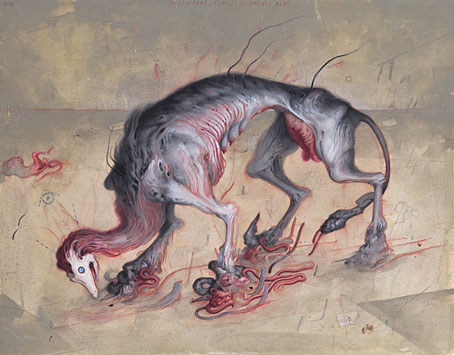
Painted beetle (2016) by Akihiro Higuchi.

David Horbury: The Tate’s Queer British Art exhibition ignores the pioneering scholarship of Emmanuel Cooper, author of The Sexual Perspective: Homosexuality and Art in the last 100 years in the West (1986).

L’Androgyne Alchemique is an exhibition at the Azzedine Alaïa Gallery, Paris, by pascALEjandro, a collaboration between Pascale Montandon-Jodorowsky and Alejandro Jodorowsky.

• At Strange Flowers: an interview with DJ Sheppard, biographer of poet Theodore Wratislaw (1871–1933), one of the models for Max Beerbohm’s hapless Enoch Soames.

Eloise or, the Realities is a new 122-page comic book by Ibrahim R. Ineke “inspired in part by Children of the Stones and The Owl Service“.

• Cormac McCarthy hasn’t published a novel for over ten years now but this new piece of writing addresses the mysterious origin of language.

• “…she invented a kind of symbolic code that channelled the occult and the Renaissance masters”. Yo Zushi on Leonora Carrington.

John O’Reilly on the Samuel Beckett cover designs created by Russell Mills and Gary Day-Ellison for Picador.

Porter Ricks (Thomas Köner & Andy Mellwig) have announced their first album in 18 years.

• At The Daily Grail: Alan Moore on science, imagination, language and spirits of place.

• All 66 issues of Performance Magazine (1979–1992) are now available online.

• The Throbbing Gristle catalogue is being reissued (again).

Lost Soul In Disillusion (1967) by The Power Of Beckett | Liquid Insects (1993) by Amorphous Androgynous | Biokinetics 2 (1996) by Porter Ricks

Weekend links 357

brzezanska.jpg

Ruth St Denis (2010) by Agnieszka Brzezanska.

As Above, So Below: Portals, Visions, Spirits & Mystics is an exhibition of occult-oriented art at IMMA, Dublin. “An alternative history of art of the last century,” says Aidan Dunne.

THIS IS THE SALiVATION ARMY: a Tumblr archive of Scott Treleavan’s queer-pagan-punk zine, 1996–1999.

• Mixes of the week: Secret Thirteen Mix 219 by Paper Dollhouse, and a Mika Vainio Tribute Mix by broken20.

• Valdimar Ásmundsson’s Icelandic translation of Bram Stoker’s Dracula has been translated back to English.

• First evidence for higher state of consciousness found (thanks to psychedelic drugs).

• At Bibliothèque Gay: Narkiss (1908) by Jean Lorrain.

Boyd White on finding Arthur Machen’s bookplate.

Barry Adamson’s favourite albums.

John Waters: By the Book.

Dread: Lustmord in dub.

XXY Oscilloscope

Vampire (1976) by Devon Irons | Keep On Dubbing (1976) by Augustus Pablo | African Dub (1977) by The Silvertones

Weekend links 356

toitoitoi.jpg

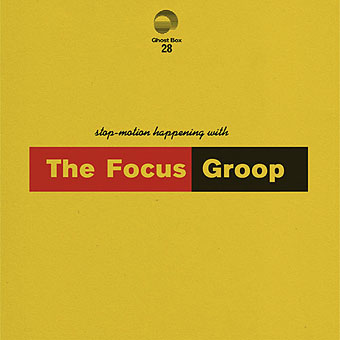
Im Hag by ToiToiToi will be Ghost Box 027, available from 12th May. Poster and album design, as always, by Julian House.

• The week in the electronic outer limits: The Haxan Cloak recorded a new piece of music using Moog’s Mother-32 modular synths; The Herzog Tapes is a new album by The Electric Pentacle; and Drew McDowall (ex-Coil, etc) has a new album, Unnatural Channel, out next month. (Vinyl-only, unfortunately, like his previous album.)

• More from Vinyl . Album . Cover . Art: The Complete Hipgnosis Catalogue by Aubrey Powell: How to design a record cover in 1977. The feature is a duplicate of Storm Thorgerson’s account in the first Hipgnosis book but since that volume has been out of print for decades it stands repeating.

• Talismanic Bookseller: Erik Davis talks to occult-book dealer and musician Richard Bishop talks about modern grimoires, scorpion gods, Orientalist imagery, and hunting down physical books in the age of the Internet.

Arbery Books, “the UK’s leading online dealer in rare and secondhand books and ephemera of gay, lesbian and transgender interest”, is closing its website at the end of May so there’s a sale on.

Amours Secrètes: Dans L’intimité Des Écrivains, an art book about the secret loves of five French writers: Marcel Proust, Pierre Loti, Renaud Icard, Roger Peyrefitte and Jean Genet.

• Ancient Methods and Futuristic Visions: Mark Pilkington & Michael J. York of Teleplasmiste answer 15 questions.

• Mix of the week: Homer Flynn, spokesperson of The Residents, compiles a playlist for The Wire.

Adrian Searle on Queer British Art 1861–1967 at Tate Britain: “strange, sexy, heartwrenching”.

Strange Flowers on August Endell (1871–1925) and the trees of spring.

Urania (1995) by Panasonic | Pan Finale (2010) by Pan Sonic | 5′ 42” (2014) by Pan Sonic