Weekend links 236

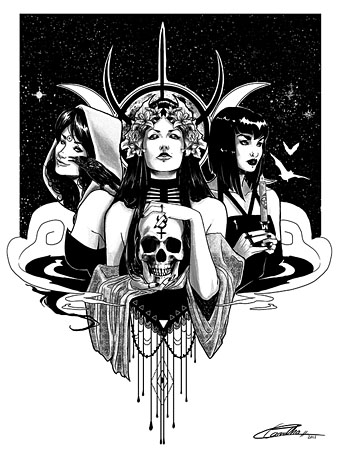
carvalho.jpg

The Three Witches (2014) by Lorena Carvalho.

Immersion, a new album by Grey Frequency, “…is a recording of the broken signals, wraiths in the ether from lost futures and utopias which were once promised…”. Box Of Secrets (1999) is an album of electronica by Ian Boddy that’s a free download until the end of December.

• “Hothouse flowers, Egyptian statuary, jewels, Nubian servants, crystal balls, cocaine, opium and champagne were just some of the things she spent her money on…” Lucy Davies explores the riotous world of Marchesa Luisa Casati.

• “London is a network of complete nexuses, coincidences, overlaps, references…” Stephanie Boland talks to Iain Sinclair about his new book 70×70: Unlicensed Preaching: A Life Unpacked in 70 Films.

My Women’s Studies professors would say: “You don’t know how hard we fought for you.” And yet, when they told me my sexuality was not correct, I felt embarrassed. I knew I had longings that didn’t line up with the politics, but I refused to repress them, particularly in my writing. I fought to unravel a political correctness that was censoring desire.

Screenwriter Erin Cressida Wilson on sex, cinema and secrets

Cthulhu, Fiction and Real Magic, a lecture by Ian ‘Cat’ Vincent at Treadwell’s, London, on December 3rd. For those who can’t attend, Erik Davis has just posted his essay about Lovecraft and contemporary occultism.

• “John Gielgud was obsessed with trousers, loved corduroy and leather. And so he wrote a film set in a menswear shop.” Gielgud’s unfilmed screenplay for gay porn director Peter de Rome may now be filmed.

• “The stories are even more fantastic and full of marvels than those in the Arabian Nights.” Robert Irwin on the newly-translated Tales of the Marvellous.

• Mixes of the week: The Advisory Circle present Winter From Out Here; Fall by The Ephemeral Man; Secret Thirteen Mix 136 by Cosmin TRG.

Danny Cooke‘s drone views of Pripyat, Chernobyl. Related: Into the Zone: Gasworks Park (Seattle, WA) by Christina Scholz.

• Watch Dragnet’s 1967 LSD episode. More psychedelics: “Magic mushrooms change brain connections“.

• Earth Magic: Peter Bebergal on photography of witches at play and at ritual.

• Düsseldorf 1970: The crucible of Krautrock by those who were there.

• It’s Alright Ma, It’s Only Witchcraft (1968) by Fairport Convention | Witch’s Will (1973) by Wilburn Burchette | Witches’ Multiplication Table (1982) by Holger Czukay
Weekend links 235

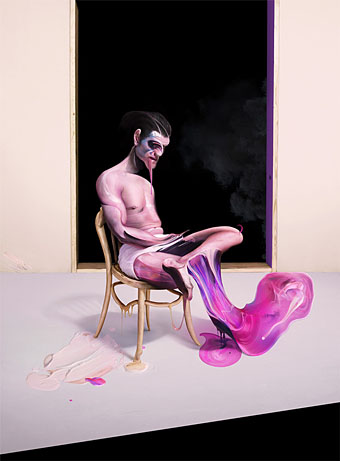
shadows.jpg

Shadows (1974) by Pawel Nolbert & Lukasz Murgrabia, one of three images recreating Francis Bacon’s Triptych–August 1972.

Breaking the Code (1996), a BBC film by Herbert Wise based on Hugh Whitemore’s stage play about Alan Turing. Wise’s film has been linked here before but it’s relevant again thanks to the release of The Imitation Game. Derek Jacobi played Turing on stage and screen, and Whitemore’s script managed to deal with Turing’s life and work without insulting the man or the intelligence of its audience.

• “…if you listen to A Beacon From Mars by Kaleidoscope or if you listen to some Turkish taxim then something starts happening.” Robert Plant talking to Julian Marszalek about the music that excites him.

• “CGI has become wearingly dull and clichéd. Can its deep weirdness be recovered and filmgoers’ minds stretched again?” asks Jonathan Romney.

The cult of the Thirty-Seven Nats is unique to Burma. […] The junta’s attempts to subdue nat worship had an unintended effect: the role of the nat wife was embraced by an already marginalized group. Homosexuality is illegal in Burma and has been since its British colonizers instituted a late-nineteenth-century ban on “intercourse against the order of nature”. Government restrictions opened a professional vacuum, says scholar Tamara C. Ho. Becoming a nat kadaw offered the achauk—a Burmese term for gay and transgender men—both “a vocation and queer visibility”.

After the Green Death by Will Boast

• “Cat memes and other frivolities aren’t the work of an Internet culture. They’re the work of an American one, ” says Caitlin Dewey.

• Hear the cavernous reverb of Berlin’s Kraftwerk captured by Emptyset’s James Ginzburg and Yair Elazar Glotman.

• Take part in the first #psychedelicpride photoshoot in central London on Saturday, December 13th.

• Mix of the week: FACT Mix 470 by Jonny Trunk who also appears in the list of vinyl hoarders below.

• Queer Noise: Abigail Ward on the history of LGB music and club culture in Manchester.

More photos of the steampunk exhibition at 751 D-Park, Beijing, China.

A chronological list of synth scores & soundtracks.

• Animated photography by Julien Douvier.

• A Third Ear Band archive at SoundCloud.

The secret lives of vinyl hoarders.

Taxim (1968) by Kaleidoscope | Water (1970) by Third Ear Band | Love Is The Devil (1998) by Ryuichi Sakamoto

Etidorhpa by John Uri Lloyd

etidorhpa01.jpg

I wouldn’t usually post so many illustrations but these depictions by J. Augustus Knapp for Etidorhpa by John Uri Lloyd add a great deal to the attractions of this early work of science fiction. Lloyd’s book is subtitled The End of Earth; The Strange History of a Mysterious Being; The account of a remarkable journey as communicated in manuscript to Llewellyn Drury who promised to print the same, but finally evaded the responsibility. The novel was published in 1895, and shares features with similar works that concern travellers exploring the interior of the Earth. What sets it apart is a degree of imagination that generated enough interest for it to be reprinted many times.

etidorhpa02.jpg

Science fiction and fantasy evolved so rapidly in the early 20th century that the products of previous centuries often seem uninventive in comparison. Whatever hidden cities, lost continents or subterranean kingdoms are promised, too many of them reveal a race of pompous individuals, usually clad in Greek, Roman or Egyptian attire with little variety to their civilisations unless their world is also populated by the odd monster or two. The manuscript in Lloyd’s novel relates a journey to the Earth’s interior by a bearded, white-haired character variously named I-Am-The-Man and The-Man-Who-Did-It who reads his adventures in a series of visits to the irresponsible Llewellyn Drury. I-Am-The-Man is kidnapped by a secret society who take him to a cave in Kentucky where he’s eventually delivered into the care of a mysterious, unnamed guide from the subterranean world:

The speaker stood in a stooping position, with his face towards the earth as if to shelter it from the sunshine. He was less than five feet in height. His arms and legs were bare, and his skin, the color of light blue putty, glistened in the sunlight like the slimy hide of a water dog. He raised his head, and I shuddered in affright as I beheld that his face was not that of a human. His forehead extended in an unbroken plane from crown to cheek bone, and the chubby tip of an abortive nose without nostrils formed a short projection near the center of the level ridge which represented a countenance. There was no semblance of an eye, for there were no sockets. Yet his voice was singularly perfect. His face, if face it could be called, was wet, and water dripped from all parts of his slippery person.

The illustrations by J. Augustus Knapp show the guide as naked but conveniently sexless. The pair descend into the Earth’s interior where they encounter a succession of wonders, from giant fungi (possibly derived from A Journey to the Centre of the Earth) and a sea of “crystal liquid” which the pair traverse in a metal boat, to a variety of strange fauna and flora. Knapp’s illustrations make the journey seem much more interesting than it is on the page where Lloyd spends far too much time lecturing the reader—there’s a chapter about the evils of drunkenness—or having I-Am-The-Man relate his continual bewilderment. “Etidorhpa”, it turns out, is “Aphrodite” reversed, and Etidorhpa herself appears as the embodiment of love at the culmination of what has become a spiritual journey rather like a weak precursor of David Lindsay’s extraordinary A Voyage to Arcturus (1920). Lindsay had the good sense to write a continuous narrative whereas Lloyd frequently interrupts his story with scientific speculations that seek to qualify some of the less outlandish features of his interior world. There’s also a curious note from the author on page 276 about the various properties of intoxicating drugs, and the possibility that they might be combined by a chemist to create strange visions for a writer. Lloyd was a chemist as well as a writer so the speculation that he might have experimented on himself—and thus produced this book—is understandable. Speculation aside, L. Sprague de Camp dismissed the novel as “unreadable” (despite its multiple reprintings) whereas HP Lovecraft apparently enjoyed it. You can judge for yourself here.

etidorhpa03.jpg

etidorhpa04.jpg

Continue reading “Etidorhpa by John Uri Lloyd”

Weekend links 229

drongelen.jpg

Untitled (2007) by Remko van Drongelen.

• Another week, another Kickstarter project: Frank Woodward’s 2008 documentary, Lovecraft: Fear of the Unknown, was an excellent study of HP Lovecraft’s life and work featuring interviews with John Carpenter, Neil Gaiman, Caitlín R. Kiernan, Peter Straub, Guillermo Del Toro and leading Lovecraft scholar ST Joshi; the film also included a few examples of my Cthulhoid artwork. Disc copies of the film have been out-of-print for a while so Frank’s fund is hoping to raise money for a new Blu-ray edition featuring extended interviews and other extras.

• David Cronenberg’s debut novel, Consumed, “reads somewhat like a mashup of William Gibson, the king of near-future SF cool, and 1970s horror maestro James Herbert,” says Steven Poole. I’d have thought a more obvious analogy would be with JG Ballard; descriptions of Cronenberg’s narrative make it sound like Ballard’s concerns repurposed for our current era of electronically-mediated everything. Related: Crash by Sanyú, “adaptación de un fragmento de la novela de J. Ballard”.

• “To commune with the music of Cyclobe is to enter not just a strange world, but strange constellations – interdimensional, atemporal zones of carefully cultivated auras bordering wild, unstable forces.” Russell Cuzner talks to Ossian Brown and Stephen Thrower about Derek Jarman, hurdy-gurdies and the deceptive nature of time.

…there are no rules in fiction even if creative writing programs everywhere have tried to make people believe there are. When I read fiction that has passed through the filter of too many workshops, I often get the feeling that I’m reading the same novel over and over again: the same way of being humorous, the same way of being candid, the same way of creating empathy.

Valeria Luiselli talking to Jennifer Kabat about fiction, cities and maps.

• The rationale behind Silent Partners: Artist & Mannequin from Function to Fetish is “to explore the way that the artificial human figure has routinely provided artists with the most direct and reliable route to visual realism. And then to work out why that makes us so upset.” Kathryn Hughes on a new exhibition.

• “It immediately throws up some interesting thoughts: Bowie as the young dandy and the obvious comparisons with Oscar Wilde and The Picture Of Dorian Gray, with the portrait that ages.” Designer Jonathan Barnbrook on the cover photos for David Bowie’s forthcoming album Nothing Has Changed.

• October brings all the music mixes. This week there’s a choice of FACT mix 463 by Dntel, Autumn’s Whirr by Café Kaput (aka Jon Brooks), and Suspected Rural Telephone Box Poltergeist by The Geography Trip.

• “…when you first go into the room it’s like entering a furnace… a furnace of sound.” Scott Walker talks to John Doran about recording with Sunn O))). The new album, Soused, is out on 20th October.

We are the Martians: the Legacy of Nigel Kneale, a new collection of Kneale-related essays and appreciations, edited by Neil Snowdon.

• Kim Newman is one of the contributors to the Kneale collection. Here he is on the main types of ghost story, and how to recognize them.

Issue 7 of Glitterwolf magazine is out on the 15th, and it’s a Halloween special.

Etai Rahmil makes mask-pipes from glass for weed smokers.

Accidental Cool Art

Hurdy Gurdy Man (1968) by Donovan | Hurdy Gurdy Man (1970) by Eartha Kitt | Hurdy Gurdy Man (2009) by Patrick Cowley & Jorge Socarras

Weekend links 226

na.jpg

Fly (2012, detail) by Zhao Na.

• This week in psychedelia: the UK now has its own Psychedelic Society (just in time for the mushroom season), and is using some of my psychedelic Wonderland/Looking-Glass artwork for its headers and things. Over at The Quietus John Doran asks what makes music psychedelic in 2014, while a number of the site’s writers offer suggestions for a survey of modern European psychedelia (bonus points for using the alien head from the cover of Heldon 6: Interface at the top of the page).

Rick Poynor looks at posters by Hans Hillmann for Jean-Luc Godard’s films while at the BFI site four directors pay tribute to Hillmann. “…poster art has stagnated over the last 30 or 40 years,” says Peter Strickland. “It’s an embarrassment for film when one considers how the music industry has completely embraced the graphic form.” Related: lots of Hans Hillmann at Pinterest.

• More psychedelics (and more of the usual suspects), neurologist Andrew Lees on William Burroughs’ experiences with yagé and apomorphine, and DJ Pangburn on a word-search puzzle containing “every word Borges wrote”. The life and work of William Burroughs is celebrated in London next month with a one-day event, Language is a Virus from Outer Space.

• At Dangerous Minds: Kenneth Anger – Magier des Untergrundfilms (1970), a 53-minute documentary by Reinold E. Thiel. The subtitles are obtrusive but the material itself, which includes footage of Anger filming Lucifer Rising, is priceless.

• 73 minutes of Pye Corner Audio playing in Ibiza last month. More electronica: Colm McAuliffe talks to former members of the BBC’s Radiophonic Workshop.

The Assassination of Margaret Thatcher – August 6th 1983, an excellent story by Hilary Mantel who talks about her own assassination fantasies here.

• Mixes of the week: Cosey Fanni Tutti‘s 2014 Mix for Dazed Digital, and Secret Thirteen Mix 128 by DSCRD.

Pond i, a video for a new piece of music by Jon Brooks.

Tomorrow Never Knows (1966) by The Mirage | Tomorrow Never Knows (1976) by 801 | Tomorrow Never Knows (1983) by Monsoon