The Invasion of Thunderbolt Pagoda II

invasion.jpgLong, Strange Trip for a Hypnotic Film

By James Gaddy
August 27, 2006
The New York Times

IT TOOK 38 years, but Ira Cohen’s cult film, The Invasion of Thunderbolt Pagoda, which was first screened in 1968 at the high point of the psychedelic hippie head rush, is now commercially available. Given the close calls, the long absences and his chaotic archival system, Mr. Cohen, 71, is a little surprised himself.

“It didn’t really involve patience,” he said in his apartment on West 106th Street in Manhattan, surrounded by books stacked waist high. “It was just reality.”

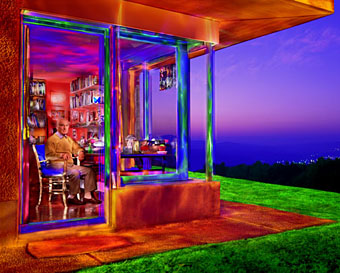
In 1961 Mr. Cohen built a room in his New York loft lined with large panels of Mylar plastic, a sort of bendable mirror that causes images to crackle and swirl in hypnotic, sometimes beautiful patterns. After a few years experimenting with the technique in photographs, he invited his friends from the downtown scene—like Beverly Grant, Vali Myers and Tony Conrad—to make a film.

The finished product sets languid images of opium smokers (in fantastic makeup and costumes) against a droning, chanting, tabla-beating soundtrack by Angus MacLise, the original drummer of the Velvet Underground. Xavier Garcia Bardon, film curator at the Palais des Beaux-Arts in Brussels, said the film is an important artifact of the era.

“It’s like going on an ecstatic journey to another planet, full of magical beings, animals and plants,” he said. “It’s a hallucinatory, almost trance-inducing experience.”

Mr. Cohen left New York in 1969, shortly after the film’s first screening, for art- and drug-filled travels in India, Ethiopia and Nepal. He roamed through the 1970s and 80s. While he was away, the film’s legend grew, even as the original few copies slowly disappeared.

Mr. Cohen said he dropped off the original print at DuArt Film Laboratories before he left; the staff reached him in Kathmandu in 1978, asking for $300 in storage fees. He asked the lab to send the print to the Museum of Modern Art, but the museum has no record of receiving it.

“If you have money, you can store it any way you want,” he said ruefully. “But for some people, $280, $300 changes the way things turn out.”

It wasn’t until a compilation of Mr. MacLise’s music came out in 1999, 20 years after his death, that interest in distributing the film began. Jay Babcock, editor of the underground magazine Arthur, and Will Swofford, a composer who was then studying at Wesleyan University, independently tracked Mr. Cohen down.

Mr. Babcock said he was curious to see how Mr. Cohen’s early Mylar photographs would look like in a film. “I had dreamed for years what it would look like,” Mr. Babcock said. He began pressing for distribution rights.

Meanwhile Mr. Swofford had persuaded Mr. Cohen, whose health has been failing (he’s had two strokes in the last year), to let him operate as an archivist and agent. Mr. Swofford eventually found 40 cans of unused outtakes in a green trunk, buried beneath books, papers, slides and assorted creative runoff.

“No one had touched the film for 25 years,” Mr. Swofford said.

Because the original version lasts only 22 minutes, he began beefing>up the content for the DVD age. Mr. Cohen wanted to use part of the found film, an eight-minute section in which he is buried in mud, as a prelude; Mr. Swofford used the nearly four hours of outtakes to fashion Brain Damage, a 30-minute coda. The DVD also features a slide show of Mr. Cohen’s photographs, audio recitations of his poetry and two alternate soundtracks to the film.

One of these versions was by the band Acid Mothers Temple, which had recorded a live soundtrack to the film at the music festival Kill Your Timid Notion, in Dundee, Scotland, in 2003.

“I had no idea what a DVD could be,” Mr. Cohen said. “I would have just put the film on there.”

The film was released last month, the result of a collaboration between Bastet, Arthur magazine’s music and video label, and Saturnalia, Mr. Swofford’s label, with distribution limited to the magazine’s Web site and a few independent music retailers. Thanks to labor donated by both parties, the initial 1,000-copy print run cost about $8,000.

But $8,000 is still a lot of money for a magazine like Arthur, a break-even labor-of-love venture. “It’s shameful, with the hundreds of millions of dollars spent on movies every year in Hollywood, it’s left to a penniless publication to put this out,” Mr. Babcock said.

Yet he remains optimistic. The film received positive reviews when screened at the 2006 Whitney Biennial. Next month Mr. Bardon will hold a screening with live music in Brussels, and Tony Conrad, now a professor in the department of media studies at the University of Buffalo, will screen the film in Atlanta.

Mr. Babcock is already making plans to release Mr. Cohen’s two other films if Arthur can recoup the investment on this one. “We hope this is just the beginning,” he says.

Previously on { feuilleton }
The Invasion of Thunderbolt Pagoda

Arthur #22

arthur22.jpg

America’s most vital cultural bulletin. Free PDF download.

How nature droners GROWING found their flow. By Peter Relic. Photography by Eden Batki.

Swiss anthropologist-author JEREMY NARBY talks with Jay Babcock about what hallucinogens like LSD and the Amazonian drink ayahuasca have to teach us in the 21st century. Introduction by author Erik Davis, with a full-color illustration by Arik Moonhawk Roper.

How columnist DOUGLAS RUSHKOFF learned to stop worrying about current events.

Why power duo Al Cisneros and Chris Haikus reunited to make the meditation-suitable
heavy metal sound of OM.

‘Do the Math’ columnist David Reeves on the main reason why the USA should seal its border with Mexico.

The life, work and astounding impact of North Indian vocalist PANDIT PRAN NATH, guru
to Western minimalists La Monte Young and Terry Riley. By Peter Lavezzoli.

‘New Herbalist’ columnist Molly Frances on Lord Byron’s secret elixir and the Prophet Muhammed’s top condiment: VINEGAR.

How to recognize—and use—OCCULT FORCES, by the Center for Tactical Magic.

Notes from Mardi Gras in New Orleans, 2006 by the intrepid Gabe Soria.

Comics by Vanessa Davis, Chris Wright and PShaw.

Scenes from ArthurBall 2006, featuring Joanna Newsom, The 5:15ers (Joshua Homme & Chris Goss) and Moris Tepper and Polly Harvey.

Bull Tongue columnists BYRON COLEY & THURSTON MOORE review Richard Youngs, Pink Mountaintops, Parts & Labor, Oneida/Plastic Crimewave, Ex Models, Mouthus, The Bummer Road, Idea Fire Company, Taurpis Tula, Spykes, Ong Ong, Carson Cistulli, Starbird, 2673, Ladderwoe, Tovah Olson, Pan Dolphinic Dawn, Gastric Female Reflex, ANP Quarterly, Matt Chambers, The Colonial, Mineshaft, Little Claw, Black Lips, Zaat, Mystical Footprints of Asia, Whysp, The Story, Skarerkauradio, Jerusalem & the Starbaskets, Noise Nomads, The Nightjar Review, Shannon Ketch, Jeremy Rendina, Carousel, Quantum Noise, Lambsbread, Carlos Batts, Trenton Doyle Hancock, S.M.S.R., Tchernoblyad, Narrowmind, Sudanstrain, Blod, Sharon’s Last Part, Mnem, Edwidge, The Rita, Mania, Ashtray Navigations, Evenings, Septic Sores, Bottom Dweller, Paul Metzger, Tombi and Glass organ.

C & D riff into the dawn on Marvin Gaye’s The Real Thing: In Performance, 1964-1981 dvd plus new albums from Gnarls Barkley, Rufus Harley, The Black Keys, The Raconteurs, Eagles of Death Metal, The Cuts, Future Pigeon, The Aggrolites, The Fiery Furnaces, Espers, Josephine Foster, Scott Walker, Fred Neil, Belong, Boris and Howlin Rain. Plus: Peter Relic’s Book Corner spotlights new poetry collections by Alex Mitchell and John Tottenham.

And more…