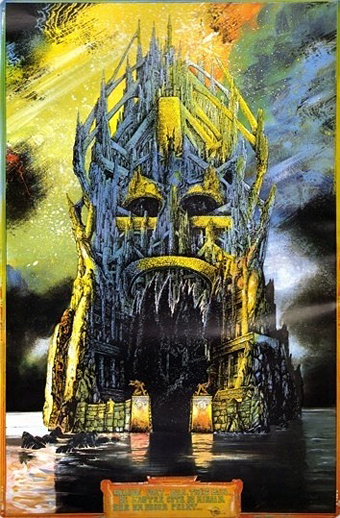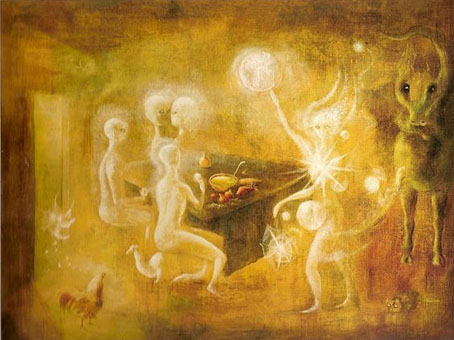
Weekend links 324

waliszewska.jpg

Untitled painting by Aleksandra Waliszewska. The artist is profiled by S. Elizabeth at Dirge Magazine.

• “…from my point of view, the only thing to do with any genre, any medium, is pretty much to break it, to transcend it, to find out what its limits are, and then go beyond them, and see what happens.” Alan Moore (again) talking to Heidi MacDonald about his novel, Jerusalem, which is out next month.

• A Monument to Outlast Humanity: Dana Goodyear gets the reclusive Michael Heizer to talk about his decade-spanning sculptural project, City, work on which is almost finished.

William Burroughs’ appearances in adult men’s magazines: a catalogue which includes some downloads of uncollected Burroughs essays and other writings.

• Mixes of the week: Homegirls & Handgrenades Mix by Moor Mother, Secret Thirteen Mix 194 by Kareem, and hieroglyphics #014 by Temples.

Remoteness of Light is a new album by The Stargazer’s Assistant inspired by the depths of the oceans and the vastness of space.

• RIP Gilli Smyth. “The silliness ran deep in Gong, but they could groove like mothers, too,” says Joe Muggs.

Guide to Computing: historic computers presented by James Ball as though they were new machines.

• “Oscar Wilde’s De Profundis is one of the greatest love letters ever written,” says Colm Tóibín.

• “Will You Dance With Me?” Derek Jarman films dancers in a gay club in 1984.

• Snapshots from an editor: Donald Weise on working with Edmund White.

Stupid by Wrangler (Stephen Mallinder, Phil Winter and Benge).

The Rutt-Etra-Izer

Dynamite/I Am Your Animal (1971) by Gong | Witch’s Song/I Am Your Pussy (1973) by Gong | Prostitute Poem (1973) by Gong

Weekend links 323

taylor.jpg

Mescaline Woods (1969) by Gage Taylor.

• The soundtrack to The Man Who Fell to Earth will be released for the first time next month in a double-disc set (CD & vinyl). This isn’t, as some people have hoped, David Bowie’s unheard music for the film, but a collection of the pre-existing songs and other pieces, plus the original compositions by John Phillips. Consequence of Sound has a track list.

• At Scream Addicts: Joe R. Lansdale talks about the only film adaptation of Shirley Jackson’s The Haunting of Hill House that you need to see: the 1963 version directed by Robert Wise.

• The new wave of new age: How music’s most maligned genre finally became cool by Adam Bychawski.

• Transmissions From The Abyss: Dark ambient music for the perfect headspace by S. Elizabeth.

Jason Farrago reviews Art Aids America, an exhibition at the Bronx Museum, New York.

Curse Go Back: a limited reissue of tape experiments by William Burroughs.

Samuel Wigley on Notorious at 70: toasting Hitchcock’s dark masterpiece.

Toyah Willcox remembers working with Derek Jarman on The Tempest.

• “Why are musicians so obsessed with David Lynch?” asks Selim Bulut.

• Read the original 32-page programme for Fritz Lang’s Metropolis.

David Parkinson chooses 10 essential films starring Oliver Reed.

• Mixes of the week: The Sounds of the Dawn NTS radio shows.

Keith Haring envisions Manhattan as a kingdom of penises.

Frank Guan on Massive Attack’s Blue Lines, 25 years on.

Honky Tonk Pts 1 & 2 (1956) by Bill Doggett | I’ve Told Every Little Star (1961) by Linda Scott | I’m Deranged (1995) by David Bowie

Weekend links 318

wellinger.jpg

The Meaning of Life by Alice Wellinger.

• A Kickstarter for A Hidden Landscape Once A Week edited by Mark Sinker: “How UK music-writing became a space for unruly curiosity, in the words of those who made it happen”.

• RIP Steven Young, one of the musicians in a cult group of mine, Colourbox, and the “S” in M|A|R|R|S, creators of Pump Up The Volume in 1987.

• At Greydogtales: The Pale Brown Thing & A Dose of De Quincy—Fritz Leiber, Dario Argento, Megapolisomancy, and The Three Mothers.

Pye Corner Audio lists some influences. Zones by Head Technician, another Martin Jenkins project, has just been reissued on vinyl.

• Mixes of the week: The Middle Eastern & African playlist For July by John Doran, and a Pye Corner Audio mix for 20jazzfunkgreats.

Evan Kindley on how the Proust Questionnaire went from literary curio to prestige personality quiz.

• To Surprise a Voice: Max Nelson on the subtitling and translation of foreign-language films.

• How the ’70s dethroned the ’60s as popular music’s Golden Age: Judy Berman investigates.

• “It puts a spell on people.” Ryan Gilbey on Stanley Kubrick’s Barry Lyndon.

• “Dennis Cooper fears censorship as Google erases blog without warning.”

Charlie Kaufman on freedom, the future, and the failure of Anomalisa.

Danny Heitman on why Nabokov’s Speak, Memory still speaks to us.

Daphne Oram‘s radical turntable experiments finally come to life.

Adam Kirsch on Walter Benjamin’s genius for surreal visions.

Shotgun (1983) by Colourbox | Baby I Love You So (1986) by Colourbox | Looks Like We’re Shy One Horse/Shoot Out (1986) by Colourbox

Weekend links 315

knights.jpg

The Deluge (1920) by Winifred Knights.

Dennis Cooper‘s favourite fiction, poetry, nonfiction, film, music, art & internet of 2016 so far. (Thanks again for the nod to this blog!)

• At Literary Hub: Jonathan Russell Clark on Jorge Luis Borges, and Jon Sealy on why indie presses [in the US] are opening bookstores.

• “It’s not just about the music.” A conversation on the occult practices in the arts between poet Janaka Stucky and Peter Bebergal.

• Daisy Woodward talks to Andreas Horvath about Helmut Berger, Actor, a documentary about Visconti’s muse and lover.

• More Fritz Leiber: Brian J. Showers on his decision to republish Leiber’s horror novel, The Pale Brown Thing.

• Mixes of the week: Sextape 4 by Drixxxe, and Radio Oscillations #96 (Richard Pinhas/Heldon) by Iron Blu.

• The 5th Young One: Pay No Attention to the Girl Behind the Sofa; John Reppion on a television mystery.

• More reading suggestions: Cheerless beach reads for gloomsters and saddies by S. Elizabeth.

• Never the same film twice: Seances by Guy Maddin, Evan Johnson, Galen Johnson.

• How painter Winifred Knights became Britain’s “unknown genius”.

• The Journey & The Destination: An interview with Hawthonn.

Robert Latona goes in search of the grave of Constance Wilde.

• Invisible by Day: photos by Mikko Lagerstedt.

• A Queer Lit Q&A with Evan J. Peterson.

• RIP Michael Herr and Bernie Worrell.

Bridget Riley: The Curve Paintings.

• The typography of Blade Runner.

Japanese matchbox labels

SOS by Portishead

A Rainbow In Curved Air (1969) by Terry Riley | The Great Curve (1980) by Talking Heads | Dangerous Curves (2003) by King Crimson

Weekend links 314

alderslade.jpg

Avebury Kite (2006) by David Alderslade.

• “Klaus Mann, son of Thomas Mann, author of Mephisto, was one of the first in Germany to write gay novels and plays.” Walter Holland reviews Cursed Legacy: The Tragic Life of Klaus Mann by Frederic Spotts.

The Pale Brown Thing, a shorter/alternate version of Fritz Leiber’s supernatural masterwork, Our Lady of Darkness, is given a limited reprinting by Swan River Press next month.

• “Not only is metal not directly harmful to adolescent minds, as the thinking goes, it may actually be helpful.” Christine Ro on the reappraisal of a once-suspect musical genre.

Something of that tension between past and future is visible in Beardsley’s work. It is the art of a dying era peering, with a mixture of excitement and trepidation, into the next. For all the prancing and bravado, Beardsley’s art was really about finding something in which to believe—and if Beardsley came to believe in anything it was the deep black line. Shading held little interest for Beardsley, and color fascinated him not at all. The black line and white space were all he needed.

Morgan Meis on Aubrey Beardsley

• More of my art for Bruce Sterling’s forthcoming Dieselpunk novella, Pirate Utopia, has been revealed. Tachyon will be publishing the book in November.

• “Secretly, though, I frequent junk shops because I am wishing for some kind of transcendence,” says Luc Sante.

• Mixes of the week: Gizehcast #28 by Christine Ott, and a mix for The Wire by Asher Levitas.

• “It took centuries, but we now know the size of the Universe.” Chris Baraniuk explains.

Barnbrook Studios creates identity for Kubrick exhibition at Somerset House.

• Watch a haunting video from Subtext Recordings and Eric Holm.

• Folklore Tapes: A Rum Music Special by Joseph Burnett.

Brion Gysin’s Dreamachine is on sale again.

Rhys Chatham’s favourite albums.

A Guide to Occult London

Skulls and Bones

Zero Time (1979) by Chrome | Zero-Gravity (1996) by Sidewinder |  Zero Moment (2016) by Contact