Weekend links 437

watson.jpg

Rawmarsh Road, Rotherham, 1975 by Peter Watson.

Steel Cathedrals (1985), a composition by David Sylvian (with Ryuichi Sakamoto, Kenny Wheeler, Robert Fripp & others) was originally available only on the cassette release of Sylvian’s Alchemy: An Index Of Possibilities, and a video cassette where the music accompanied views of Japanese industry by Yasuyuki Yamaguchi. The video hasn’t been reissued since but may be viewed here.

• “If, as Arthur C Clarke famously observed, any sufficiently advanced technology is indistinguishable from magic, then can we accept that any sufficiently advanced magic is also indistinguishable from technology?” asks Mark Pilkington.

• “I didn’t like the idea of cartoons as just funny jokes, they had to have some relevant piece of observation in them to do with the society we are living in,” says Ralph Steadman.

I listen to music all the time, and I’ll often seek connections across quite disparate genres of that whatever I’m looking for. Sometimes it’s an aesthetic or a feeling, sometimes a pattern or structure, but it tends to cut across genres. The thing I liked about black metal and doom metal is the slowness and weightiness of it, it’s like deep time but in music. Sunn O))), Xasthur, and other bands captured this black gravity of sound. And they also tend to eschew the traditional vocal-lead guitar set-up, and everything is in the slow-moving wash and texture of sound.

I found that in other genres like noise music (especially Keiji Haino), the European avant-garde with composers like Ligeti, Scelsi, and Dumitrescu, dark ambient artists such as Lustmord or vidnaObmana, and contemporary works like Chihei Hatakeyama’s Too Much Sadness, Rafael Anton Irisarri’s A Fragile Geography, or Christina Vantzou’s No.4. There’s a lot to talk about in terms of music and forms of sorrow or grief, certainly every musical tradition has that—the funeral dirge, requiem, lamentation, or whatever.

Eugene Thacker listing a few favourite musicians and composers during a discussion with Michael Brooks about Thacker’s new book, Infinite Resignation

• The fourth edition of Wyrd Daze—”The multimedia zine of speculative fiction + extra-ordinary music, art & writing”—is out now.

• The Library of Congress has opened its National Screening Room, an online service for viewing films in the library’s collection.

The London Library discovered some of the books that Bram Stoker used for research when he was writing Dracula.

• “Oscar Wilde’s stock has never been higher,” says John Mullan, reviewing Oscar: A Life by Matthew Sturgis.

• Mixes of the week: RA Podcast 648 by Sarah Davachi, and Secret Thirteen Mix 269 by Sstrom.

• David Lynch directs a video for A Real Indication by Thought Gang.

• “Edward Gorey lived at the ballet,” says his biographer, Mark Dery.

• A new version of Blue Velvet Blues by Acid Mothers Temple.

• Photos of cooling-tower interiors by Reginald Van de Velde.

Aaron Worth on Arthur Machen: “the HG Wells of horror”.

• The Strange World of…Barry Adamson.

Glass And Steel No. 1 (1983) by Marc Barreca | Death Is The Beginning (1996) by Steel | Painless Steel (2000) by Bohren & Der Club Of Gore
Weekend links 390

possession.jpg

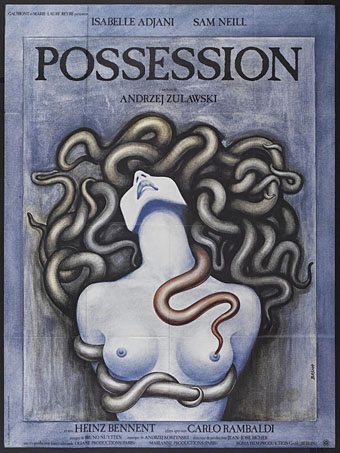
French poster by Basha (Barbara Baranowska) for Andrzej Żuławski’s extraordinary Possession (1981).

• “Alive from Off Center, renamed Alive TV in 1992, was an American arts anthology television series aired by PBS between 1984 and 1996. Each week, the series featured experimental short films by a mixture of up-and-coming and established directors. Notable episodes included As Seen on TV, starring comic actor Bill Irwin as an auditioning dancer who becomes trapped in a television, wandering among daytime dramas, MTV, and PBS’s own Sesame Street and the atmospheric puppet melodrama Street of Crocodiles, adapted by the Brothers Quay from the Bruno Schultz story. […] Arguably the series’ best-known episode was What You Mean We? a short film written by, directed by, and starring Laurie Anderson, which aired in 1986.” Alive from Off Center, 11 episodes at Ubuweb.

• “[Count] Stenbock was a homosexual convert to Roman Catholicism and owner of a serpent, a toad, and a dachshund called Trixie. It was said that toward the end of his life he was accompanied everywhere by a life-size wooden doll that he believed to be his son. His poems and stories are replete with queer, supernatural, mystical, and Satanic themes; original editions of his books are highly sought by collectors of recherché literature.” Of Kings and Things: Strange Tales and Decadent Poems by Count Eric Stanislaus Stenbock will be published by Strange Attractor in March, 2018.

• Music news of the week (in this house, anyway) is a new song, The Mysterious Vanishing of Electra, by Anna von Hausswolff. A new album, Dead Magic, is due in March, and I’m doubly-thrilled to read that Randall Dunn of Master Musicians of Bukkake (and producer/engineer for Earth, Sunn O))), etc.) is involved.

• “Why do Texas prisons ban Freakonomics but not Adolf Hitler’s Mein Kampf?” asks Lauren McGaughy. On the banned list is the three-volume The Graphic Canon, edited by Russ Kick, which includes my adaptation of The Picture of Dorian Gray.

• “To understand how other planets are made, exogeologists are synthesizing those planets in miniature in the earthbound equipment in their labs.” BLDGBLOG on speculative mineralogy.

• “What does the Bardo sound like?” Lauria Galbraith on Éliane Radigue‘s Trilogie de la Mort, three hour-long electronic compositions based on The Tibetan Book of the Dead.

• And speaking of Earth, Joseph Stannard talked to Dylan Carlson (Earth) and Kevin Martin (The Bug) about their recent collaboration.

• Mixes of the week: FACT mix 630 by Hanz, XLR8R Podcast 519 by Setaoc Mass, and Secret Thirteen Mix 239 by Blush Response.

• The League’s seven deadly sins: Reese Shearsmith on the cinematic influences behind The League of Gentlemen’s TV series.

Donnie & Laurie, a jam from the late 1970s with Laurie Spiegel on Electrocomp 101 synthesizer, and Don Christensen on drums.

• Guests and dates for the Dublin Ghost Story Festival have been announced.

David Bowie sang for Devo, and Mark Mothersbaugh might have the tapes.

• The albums of the year according to The Quietus.

• At Dennis Cooper’s: Isabelle Adjani Day.

Possessed (1979) by MX-80 Sound | Possession (1988) by Danzig | Possessed (1992) by Balanescu Quartet

Weekend links 382

yoshida.jpg

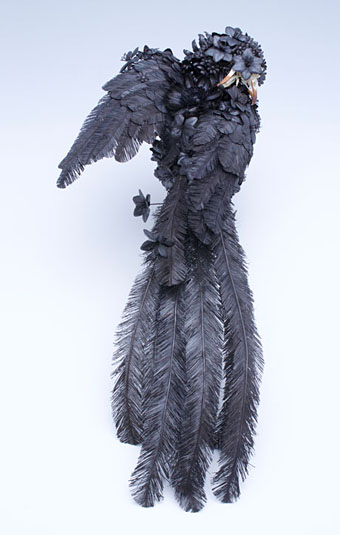
Raven (2015), a metal sculpture by Taiichiro Yoshida.

• “Lumia: Thomas Wilfred and the Art of Light [at the Smithsonian American Art Museum] restores Thomas Wilfred (1889–1968) to his rightful place in the history of modern art.”

• At Brown Noise Unit: a fascinating, lengthy interview by Philip Kaberry with Stephen O’Malley of Sunn O))) et al, with particular focus on O’Malley’s work with Japanese musicians.

• Erik Davis talks to scholar, writer, and mythographer William Rowlandson about Jorge Luis Borges, magical trees, Yankee mysticism, and the power of the weird and murky.

• The first issue of the world’s first magazine of fantastic art and literature, Der Orchideengarten (previously), has been reprinted in full with additional English translation.

• At Muddy Colors: the month in covers for September/October which includes my cover for Under the Pendulum Sun by Jeannette Ng (and which is on sale now).

• At 3:AM Magazine: Adam Scovell talks to horror author Ramsey Campbell about the ghost stories of MR James.

Paralysis: Live at Silent Night #8, a new release on (limited) cassette and digital by The House In The Woods.

• At Dangerous Minds: Jozef van Wissem buries the dead in his new video, Virium Illarum.

PKD Files — A podcast about the life and work of Philip K. Dick.

• Russell Cuzner on The Strange World of Nurse With Wound.

Clark Collis on the rise and fall of Fangoria.

• The North Star Grassman And The Ravens (1971) by Sandy Denny | Flight Of The Raven (1979) by Emerald Web | Kill The Great Raven (1979) by Snakefinger

Weekend links 364

focusgroup.jpg

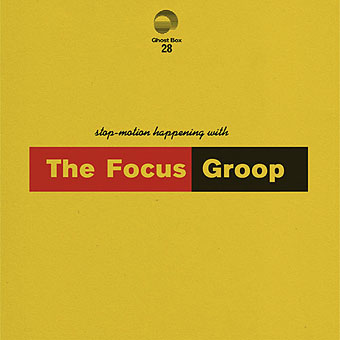
Stop-Motion Happening with The Focus Groop is a new album by The Focus Group (now a Groop, apparently, à la Stereolab), and the next release on the Ghost Box label. Design, as always, by Julian House.

• At Dennis Cooper’s: Sypha presents…Voyager en Soi-Même: a Tribute to JK Huysmans’ Là-Bas. Related: Henry Chapront’s illustrations for a 1912 edition of Huysmans’ novel.

• At the BFI: Graham Fuller on Penda’s Fen and the Romantic tradition in British film; Pamela Hutchinson and Alex Barrett choose 10 great German Expressionist films.

• The Provenance of Providence: Chris Mautner on the Lovecraftian comic series by Alan Moore and Jacen Burrows.

Luke Turner on Sunn O))): the ecstatic doom metallers turning rock concerts into “ritualist experiences”.

• At Dangerous Minds: The homoerotic “needleporn” art of Zachary Nutman.

Conor McGrady on the visual art of Nurse With Wound’s Steven Stapleton.

• Collage and Mechanism: Anita Siegel’s art for Doubleday Science Fiction.

• Mix of the week: My name is Legion: Chapter 1 by The Ephemeral Man.

ChrisMarker.org is asking for small donations to help keep it running.

• 1967 is the year pop came out, says Jon Savage.

Allen Ginsberg’s Howl goes online.

Groupmegroup (1981) by Liquid Liquid | If I Were A Groupie (1995) by Pizzicato Five | Group Four (1998) by Massive Attack

Weekend links 343

carrington.jpg

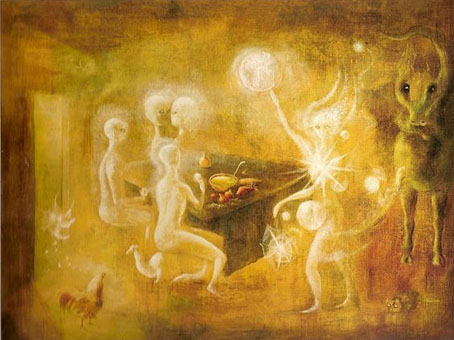
Sidhe, the white people of the Tuatha Dé Danann (1954) by Leonora Carrington.

• January brings a wealth of recommended-reading lists for the new year, together with the feeling that many of those lists are merely clones of each other. Not so the recommendations at Strange Flowers which also includes links to forthcoming events such as this exhibition of Symbolist art at the Guggenheim, New York.

Some Ceremonies are Better than Others, an exhibition of sound objects and drawings by Matthias König & Ibrahim R. Ineke inspired by Arthur Machen’s The White People, at The Bries Space, Borgerhout, Belgium, from 21st January. Previously: Ineke’s comic-strip adaptation of the Machen story.

• “These must-reads explore Dada, Futurism, Surrealism, and the art of opposition,” says Carol Cooper. One of the titles under discussion is the Bruce Sterling book I designed and illustrated last year, Pirate Utopia. Sterling talked to Wired about the book and its relation to the present moment.

RIP Mark Fisher, a cultural theorist whose death was announced just as extracts from his latest book, The Weird and the Eerie, were beginning to appear. One of those extracts is at The Quietus. Related: Fisher’s k-punk blog and its earlier incarnation.

James Cargill (ex of Broadcast) announces a debut release by his new group, Children of Alice. Related: Jonathan Miller’s 1966 TV film of Alice in Wonderland rescored with Broadcast songs.

We are the Martians: the Legacy of Nigel Kneale, a collection of Kneale-related essays and appreciations edited by Neil Snowdon, is finally appearing in print from PS Publishing.

• Pursuing paths hauntological, The Electric Pentacle offers “an unholy stew of library music, Kosmische, arcane ritual electronica, modular synthesisers and shortwave radio”.

• Mixes of the week: The Ivy-Strangled Path Vol. XVI by David Colohan, and Low Visibility Across Sunken Village by The Geography Trip.

• “With Reflection, [Brian Eno] offers generative music for a turbulent time,” says Geeta Dayal.

Anna Biller, director of The Love Witch, talks to New Jack Witch about her film.

• The story behind Gay Bob, the world’s first out-and-proud doll.

Alice (1969) by Jon Plum | Alice (1982) by The Sisters of Mercy | Alice (2009) by Sunn O)))