Weekend links 178

bantjes.jpg

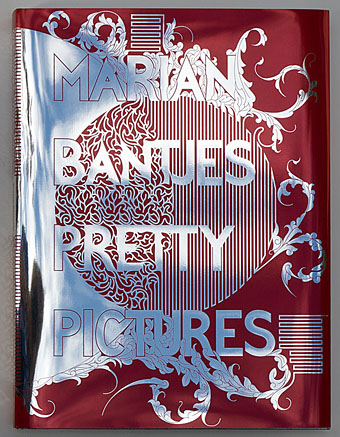
Pretty Pictures, a new book by designer Marian Bantjes, is out on October 1st.

• A writer admired by Angela Carter, Michael Moorcock, Harlan Ellison, Anthony Burgess, Jonathan Meades and Iain Sinclair; a “writer’s writer…[whose] best stories bear comparison with the Ficciones of Jorge Luis Borges”; a writer with an “unsettling quality to his writing, a whiff of brimstone that links him to fin-de-siècle occult figures such as HP Lovecraft—and even, at a further remove, Aleister Crowley”. David Collard explains why you may want to read something by Gerald Kersh (1911–1968), four of whose books are being republished.

• The Eccentronic Research Council and Maxine Peake pay homage to Delia Derbyshire’s The Dreams project with a new single out at the end of the month (Pye Corner Audio and Carol Morley appear on the flip). Ms Peake’s barm-cake reverie may be heard here.

• “Applying for grants, writing artist statements, showing up to openings—artists have to do far more than just make art if they want to find an audience for it.” Jen Graves on lies and deception in the art world.

The material does not make the work. The life does not make the art. Exactly the opposite. The work creates the material. The art creates the life. Did Trinidad exist before Naipaul? Did cargo ships exist before Joseph Conrad? Did Newark and the New Jersey suburbs exist before Philip Roth? Did women in playgrounds in New York City exist before Grace Paley? See how the writer invents the material? These places did not exist as literary subjects. They were invisible to literature. The magic of a great book is that it makes its own subject seem inevitable. The danger is, it makes the subject seem like the source of power in the work.

Phyllis Rose on life and literature.

• Mix of the week: Secret Thirteen Mix 087, 40 minutes of original electronic music by Geistform (Rafael Martinez Espinosa).

• “You’ve Got This“, an It Gets Better-style video support campaign for people recently diagnosed with HIV.

• At Dangerous Minds: Babalon Working: Brian Butler’s trippy occult odyssey with Paz de la Huerta.

Manfred Mohr‘s computer-created artwork, from the 1960s to the present.

Robert Macfarlane on the strange world of urban exploration.

Rick Poynor on Bohumil Stepan’s Family Album of Oddities.

• Oli Warwick talks to Martin Jenkins, aka Pye Corner Audio.

• The 384-page BUTT calendar for 2014 is now on sale.

• Pye Corner Audio: We Have Visitors (2010) | Toward Light (2011) | The Mirror Ball Cracked (2012)

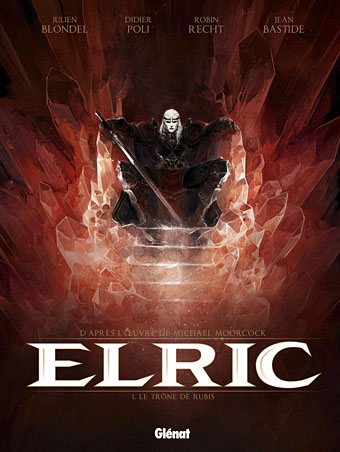
Elric 1: Le trône de rubis

elric1.jpg

The closest I ever got to illustrating Michael Moorcock’s Elric character was the sleeve for The Chronicle of the Black Sword in 1985, a Hawkwind concept album based on the first couple of Elric books. That design favoured a decorative approach over anything illustrative, however. At the time I felt too intimidated by the renderings of Elric’s first illustrator, James Cawthorn, and subsequent depictions by book cover artists such as Michael Whelan, to attempt my own version of the character. These days I pay little attention to heroic fantasy of any kind but I do look out for new depictions of Moorcock’s anti-hero. Earlier this year the French bande dessinée publisher, Glénat, released the first album in a planned series of five comic-strip adaptations of the Elric books. Many creditable Elric comics have appeared since the 1970s, not least the Cawthorn version of Stormbringer, one of the earliest and best, and Philippe Druillet’s own somewhat eccentric production. Mike Moorcock very generously sent me a copy of the Glénat volume this week, and I’d say this is now the one to beat.

elric2.jpg

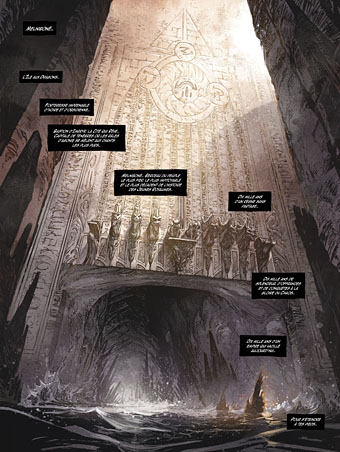
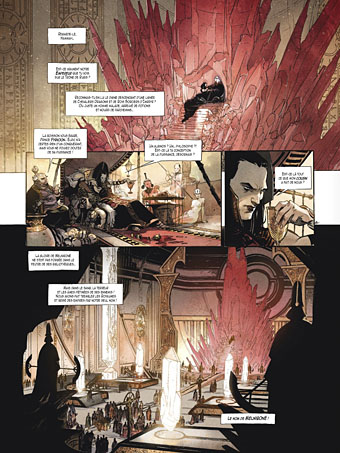
Writer Julien Blondel has adapted the books with the art duties being taken by Didier Poli and Robin Recht. Jean Bastide is the colourist. I’ve always preferred the French and Belgian approach to comic art over the American style so I’m naturally biased towards a book such as this. That said, the art is marvellous, and so many of the details feel just right. Moorcock portrays the Melnibonéans as decadent and cruel, something that Poli and Recht portray with scenes of naked slaves being bled, butchered, and even used as human torches for the blithe amusement of their masters. The general atmosphere in the opening pages is like something from Flaubert’s Salammbô with its combination of antique depravity and the massing of great armies prior to battle. They don’t slouch with the monstrosities, either, there’s a spot of Lovecraftian weirdness when Elric is rescued by Straasha, the Sea King. I look forward to seeing how they deal with Arioch (who puts in an appearance at the end) and the other Chaos Lords. The dialogue is all in French, of course, but if you know the books it’s easy to follow even with French as limited as mine.

elric3.jpg

The Glénat site has a few more page samples. Moorcock has been watching these books being adapated and re-adapted for decades, and he says this is among the very best. For anyone with more than a passing interest in the brooding albino prince it’s well worth seeking out.

Previously on { feuilleton }
Salammbô illustrated
Jim Cawthorn, 1929–2008

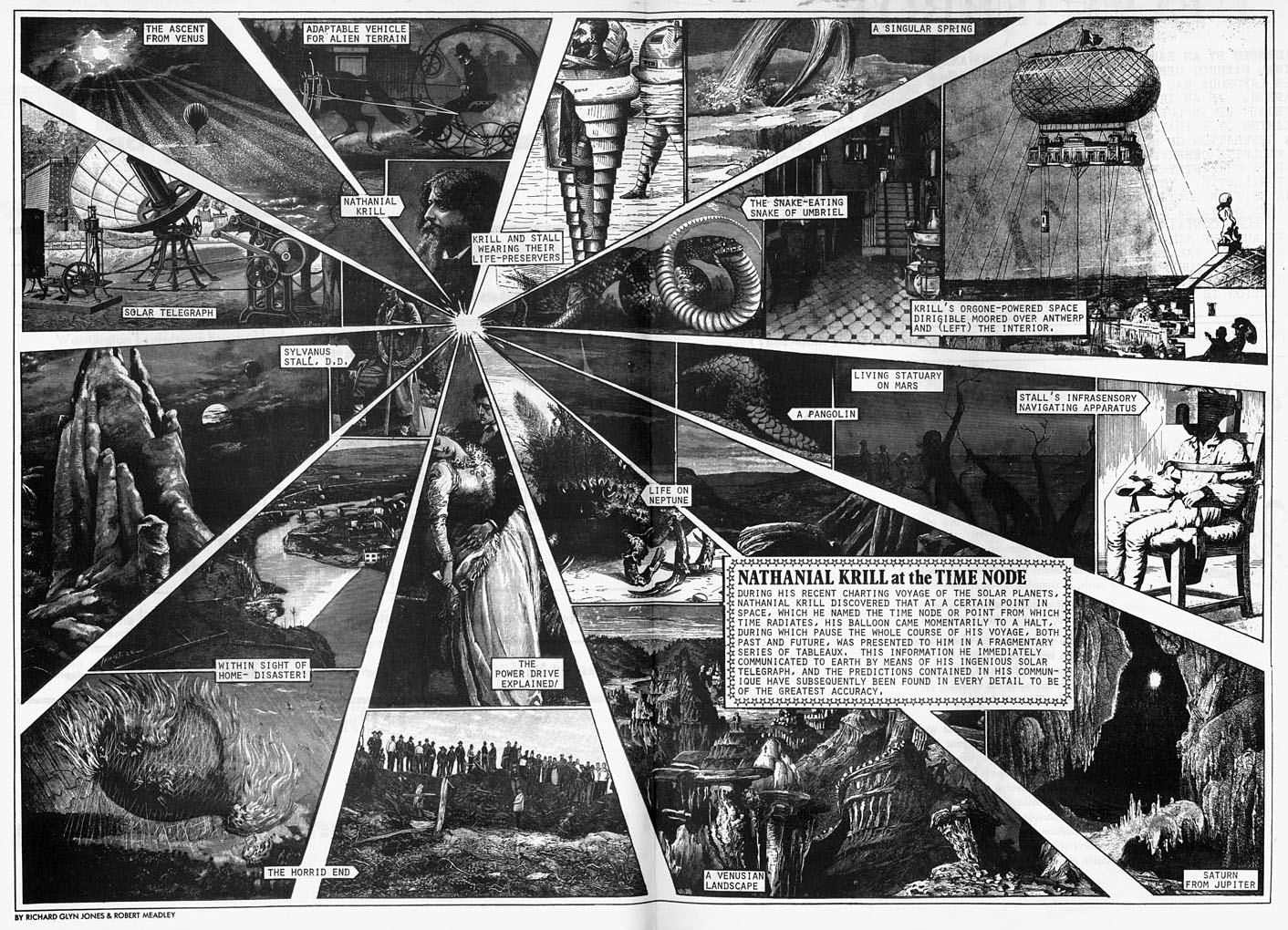
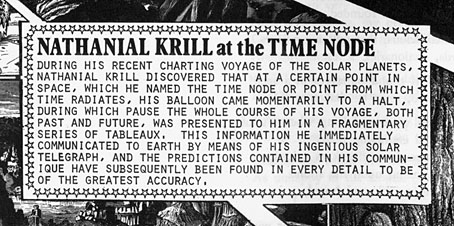
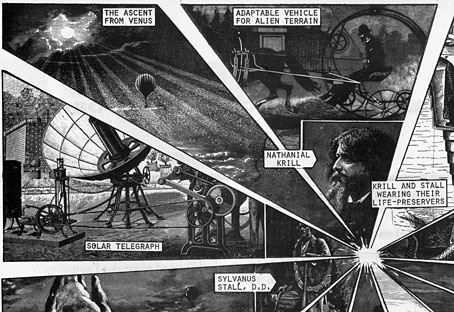
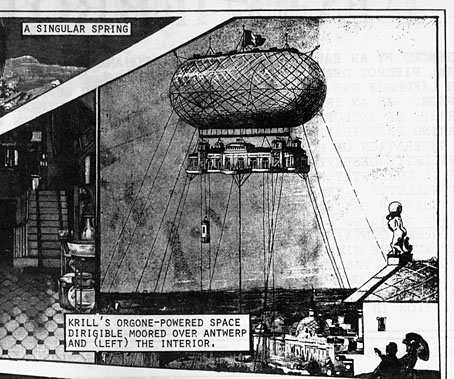
Nathanial Krill at the Time Node

krill.jpg

Nathanial Krill at the Time Node (1978) by Richard Glyn Jones and Robert Meadley.

Michael Moorcock’s New Worlds magazine resumed publication in 1978 after a hiatus of two years following the end of its New Worlds Quarterly paperback format. The issues for the years 1978 and 79 are the oddest in the entire run of the magazine. Issue 214 had the magazine title in Russian, a cover illustration of Union Jack anti-hero Zenith the Albino, and promised to deliver “Politics—Sport—Science”; issue 213 had an Empire-era cover, and contents which mostly dispensed with written fiction in favour of visual features such as newspaper pages from parallel time streams, or satirical collage.

krill2.jpg

Among the satire there was this two-page piece by Richard Glyn Jones and Robert Meadley which is probably the closest the magazine came to what people now call steampunk. I say probably because many of Moorcock’s alternate histories were doing in the late 60s and early 70s what steampunk does today, although not all of these appeared in NW. Nathanial Krill at the Time Node has the additional interest for me in being another example of the use of period engravings for fantastic or satirical ends, and one that few people will have seen. Richard Glyn Jones was a regular illustration contributor to New Worlds; Robert Meadley had four short stories in New Worlds Quarterly. Ten years ago I designed Meadley’s essay collection, A Tea Dance At Savoy. He’s a great writer, I keep hoping we’ll see more of his work one day.

krill3.jpg

krill4.jpg

Weekend links 151

yongliang.jpg

Untitled art by Yang Yongliang. There’s more at But Does It Float.

• “Newly unearthed ITV play could be first ever gay television drama“. Writer Gerald Savory, incidentally, also adapted Dracula for the BBC in 1977, still the version that’s closest to the novel.

Craig Redman and Karl Maier‘s poster designs for the Bavarian State Opera.

Lustmord: ambient’s dark star, and The Strange World of Scanner.

The cats are tapping the old man for psychic sap, milking him, stalking through rubbled dreams of the coming Land of the Dead. On subsequent US visits – to Bastrop in Texas and Phoenix, Arizona – I learned about the fellowship of those internal exiles, the hardcore writers: Michael Moorcock, Jim Sallis. Like Burroughs, they kept cats and guns (Mike’s was a replica). Cats infiltrate mystery fiction: men with coffee habits, ex-drinkers, post-traumatic spooks solving crimes the hard way. Moorcock uses cats like a scarf, like Peter Sellers in The Wrong Box; their claws scratch runes into his easy chair.

Iain Sinclair remembers visiting William Burroughs. I remember meeting those Moorcock moggies; not as interesting to reminisce about, however.

The Ghosts of Antarctica: Abandoned Stations and Huts.

• A Masterpiece of the Ridiculous by Jocelyn Brooke.

• “Chance is a good librarian,” says Alberto Manguel.

• Mix of the week: dub from Bristol duo Zhou.

The Aleph: Infinite Wonder / Infinite Pity.

Sarah Lee‘s underwater photography.

Arthur #34 is out!

Underwater (1979) by Harry Thumann | Underwater Church (1992) by Conrad Schnitzler | Underwater Flowers (2003) by John Foxx & Harold Budd

Weekend links 150

feanne.jpg

One of A Pair of Peacocks (2012) by Feanne.

Jonathan Barnbrook reveals his package design for the new David Bowie CD. The Barnbrook studio has also designed the catalogue for the forthcoming V&A Bowie exhibition. And there’s more (don’t worry, it’ll be over soon): Jon Savage on When Bowie met Burroughs.

• “Witches have a fashion moment,” says the NYT. Nice clothes but the writing trots out too many of the usual lazy clichés. Related: A Tale of Witches, Woodland and Half-remembered Melodies…, a new mix by Melmoth the Wanderer.

Calidostópia! is a free album (FLAC & mp3) from Marcus Popp aka Oval: “an enticing 16-track collaboration…with seven wonderful singers/musicians from all over South America”.

Before meeting Moorcock in person, [Hari] Kunzru went on to say, ‘I didn’t realise the role he’d played in connecting so many different scenes and undergrounds together – the psychedelic music scene, the science fiction scene, the hip experimental literature scene around people like William Burroughs, pop art’.

Brave New Worlds: A Michael Moorcock Retrospective by Carol Huston. Moorcock’s Elric novels will be published by Glénat in new bande dessinée adaptations later this year.

• More art by Michael W. Kaluta at The Golden Age. And more fantastic comics/illustration by Philippe Caza at 50 Watts. There’s more Caza here.

• Mine and David Britton’s new book, Lord Horror: Reverbstorm, was reviewed at The Spectator.

Google Street Scene: “Moments of cinema captured by Google Street View cameras”.

Cosmic Sentinels and Spiral Jetties: JG Ballard, Robert Smithson & Tacita Dean

• Strange Flowers showcases the heads of Pavel Tchelitchew, 1949–1952.

Setting in the East: Diamanda Galás on Women and Real Horror

Little Joe: “A magazine about queers and cinema, mostly.”

Nanoparticles loaded with bee venom kill HIV.

Treatises on Dust: Antic Found Texts

The Wizard Blew His Horn (1975) by Hawkwind (with Michael Moorcock) | Brothel In Rosenstrasse (1982) by Michael Moorcock’s Deep Fix | Running Through The Back Brain (1983) by Hawkwind (with Michael Moorcock)