Weekend links 344

axiomdub.jpg

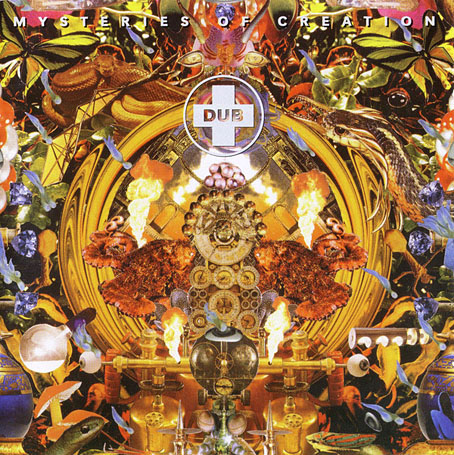
Axiom Dub – Mysteries Of Creation (1996), a Bill Laswell production. Art by James Koehnline.

• As noted earlier, the great Bill Laswell has made some of his sprawling back catalogue available at Bandcamp, news of which has prompted Vinyl Factory to put together a recommended listening guide. Judging by the comments I’m not the only Laswell-head deploring the absence of the masterpiece from Material, Hallucination Engine. Linked here before, and happily still being updated, the comprehensive Bill Laswell discography at Silent-Watcher. Related: An ESP-Disk Primer by Marc Masters.

Listen to the Voice of Fire, a symposium concerning alchemy in sound art, takes place at the National Library of Wales at the beginning of March. Phil Legard offers some thoughts on alchemy, music and John Dee.

• The guilty cinematic pleasures of John Carpenter. Related: Director and actor Alice Lowe chooses seven favourite horror films.

The Broomway, Essex, a tidal path known as “The Doomway” for its reputation as the most dangerous walk in Britain.

• Mixes of the week: K-Punk presents Return to the Fourth World, and FACT Mix 584 by Lawrence English.

• “There was more to the late John Berger than that TV series and art book”, says Richard Turney.

• “Music’s cassette-tape revival is paying off,” says John Paul Titlow.

Diamanda Galás announces two new albums.

Bob Dylan paints a Blackpool pier.

• Pixel art by Uno Moralez

One Letter Words

Reduction (1980) by Material | Ghost Light/Dread Recall (1996) by Material | No Guts No Galaxy (1999) by Material (feat. Ramm Ell Zee & phonosycographDISK)

Weekend links 340

zagorski.jpg

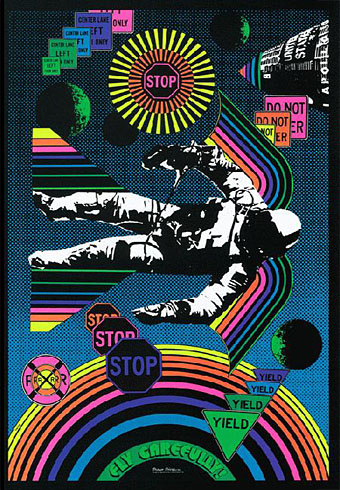
Fly Carefully (1969) by Stanisław Zagorski.

• Video of Tuxedomoon live in San Francisco, Rotterdam and Paris, 1983 (or try this copy), and a late-night German TV broadcast from 1985. The first Tuxedomoon album, Half-Mute, has been reissued by Crammed Discs with an accompanying album, Give Me New Noise: Half-Mute Reflected, featuring cover versions of the songs by various artists.

• More end-of-year reviews: Dennis Cooper’s recommendations are always eclectic (and thanks again for the blog shout!); not necessarily the best ambient and space music of 2016 by Dave Maier; a review of the year by graphic designer Jonathan Barnbrook; the 15 finalists of the 2016 Art of Building architectural photography competition.

The Complete Stories of Leonora Carrington will be published in April 2017 by Dorothy. Related: Letters, Dreams, and Other Texts by Remedios Varo will be published next year by Wakefield Press. Also of interest on that page is a new edition of Haschisch by Oscar AH Schmitz illustrated by Alfred Kubin.

• The week in Things (see this post): John Carpenter’s The Thing: The Story of an SF Horror Game-Changer. Ennio Morricone’s score will be infecting the vinyl world next year. Meanwhile, Matthew Thrift recommends “10 great films set in the Arctic and Antarctica”.

• Mixes of the week: FACT mix 581 by Pan Daijing, XLR8R podcast 468 by Jan Jelinek, and Secret Thirteen Mix 203 by Blood Sport.

A Year In The Country on Monumental Follies (1972), a book about architectural eccentricity by Stuart Barton.

• William Burroughs reads 23 random paragraphs from Naked Lunch each time you load this page.

• “The world is terrifying and destructive and dehumanising and tragic,” says Charlie Kaufman.

• Scents and sensuality: William Dalrymple on the perfumes of India, past and present.

• Brenda S G Walter on Hill House: The haunted soul of Shirley Jackson.

• A trailer for Dome Karukoski’s Tom of Finland. There’s more here.

Illustrating the Sixties: Paintings by Italian artists in London.

Michael Rother and Cavern Of Anti-Matter live in Berlin.

Cinemetal

Network 23 (1981) by Tangerine Dream | Exit 23 (1989) by Psychick Warriors Ov Gaia | Studio 23 (2012) by The Time And Space Machine

Things

thing01.jpg

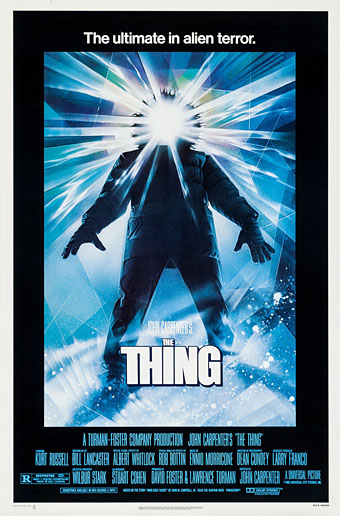
Art by Drew Struzan.

One of my current commissions is a piece of art for a book based on John Carpenter’s The Thing, due to be published next year. This was a request I agreed to immediately, having been astonished by the film when it appeared in 1982 (I saw it three times), and having rated it ever since as Carpenter’s best, as well as one of my all-time favourite horror films. I haven’t started on the planned piece just yet but the commission encouraged me to upgrade my DVD copy of the film to the Blu-ray version, and to also read for the first time John W. Campbell’s “Who Goes There?”, the short story that was the origin of both Carpenter’s film and The Thing From Another World (1951) directed by Christian Nyby. Reading the story set me hunting around for other interpretations of Campbell’s alien.
thing02.jpg

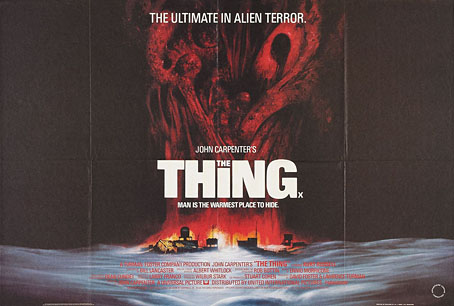
UK poster. Art by Les Edwards.

The story was instructive in several ways, the first being how closely Bill Lancaster’s script for the Carpenter film follows the story’s outline. The paperback collection I was reading has an introduction by James Blish which complains about the Howard Hawks/Christian Nyby production turning the polymorphous alien into another clone of Frankenstein’s monster. That’s true but the Nyby film still scared me to death when I first saw it aged 11 or so, and it has its merits. Lancaster not only stayed closer to the original shape-shifting premise but also kept many of the character names, plus details such as the blood test and the Thing’s attempt at the end to build a machine to escape from the encampment. The unforgettable opening, however, with the lone helicopter pursuing the dog, is all Lancaster’s.
thing03.jpg

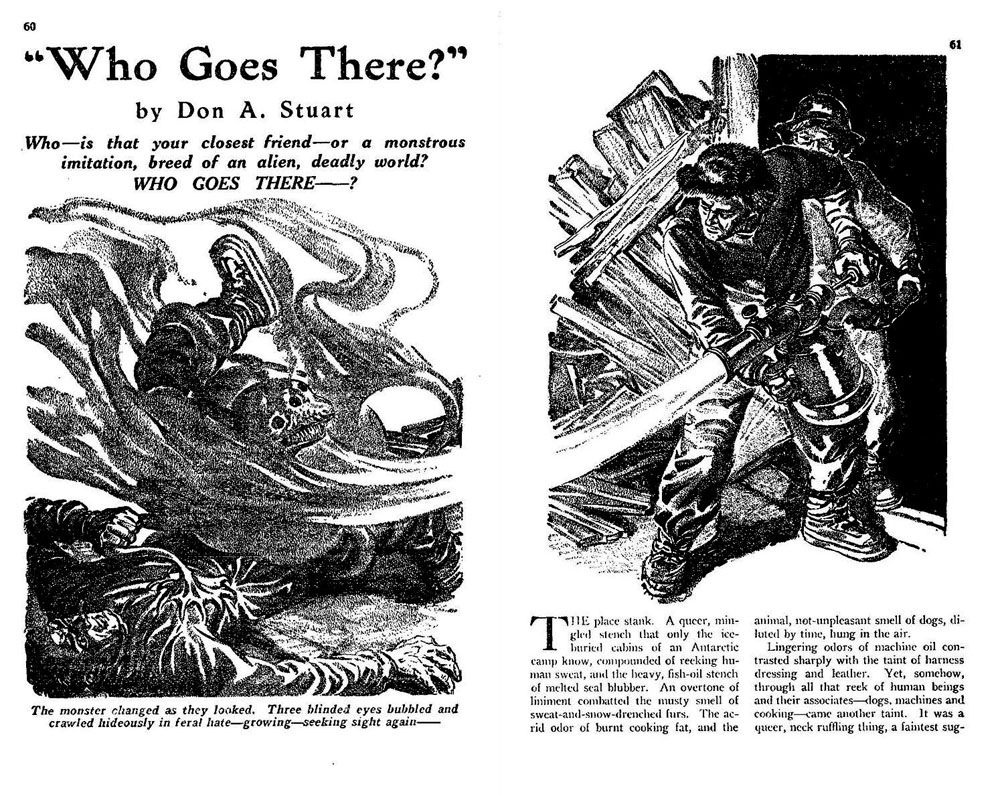
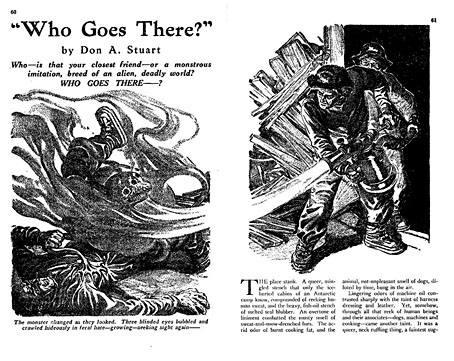
Astounding Science-Fiction, August 1938; artist unknown. “Don A. Stuart” was a pseudonym for John W. Campbell, at that time the newly appointed editor of Astounding. Campbell’s editorship changed the name of the magazine from Astounding Stories to Astounding Science-Fiction.

It was face up there on the plain, greasy planks of the table. The broken haft of the bronze ice-axe was still buried in the queer skull. Three mad, hate-filled eyes blazed up with a living fire, bright as fresh-spilled blood, from a face ringed with a writhing, loathsome nest of worms, blue, mobile worms that crawled where hair should grow—

Campbell’s description of the ice-bound alien is better than some of his writing elsewhere. I’m used to tempering my judgement when visiting stories written for the pulps but Campbell’s writing is really awful, and a reminder of why I never got very far with the early SF writers. Weird Tales magazine had its share of ham-fisted journeymen (and women), but Campbell’s contemporaries such as Clark Ashton Smith and HP Lovecraft read like the most finessed and mandarin prose stylists in comparison. Well, The Thing isn’t the first great film to be based on a poor-quality story so we can at least thank Campbell for his scenario, although how much of it was his own has never been clear. The idea of ancient aliens in Antarctica (some of which are amorphous shape-shifters) had already been explored by HP Lovecraft in At the Mountains of Madness; Lovecraft’s story was published in 1936 by Astounding Stories, the same magazine that published “Who Goes There?” two years later. This lineage, and the possible influence, makes The Thing one of the foremost Lovecraftian films even without all of its tentacled abominations.
thing04.jpg

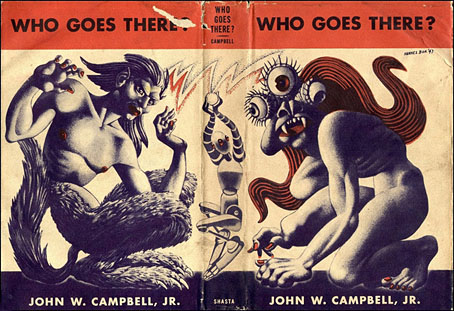
Art by Hannes Bok.

The story provided the title of Campbell’s debut collection of short fiction in 1948. I’ve known the Hannes Bok cover art for many years but hadn’t realised until recently that the three-eyed monster on the front was a Bokian rendering of Campbell’s alien. The figure on the back is presumably a human/husky hybrid, while I’d guess the robot relates to one of the author’s other stories.

Continue reading “Things”

Weekend links 334

rist.jpg

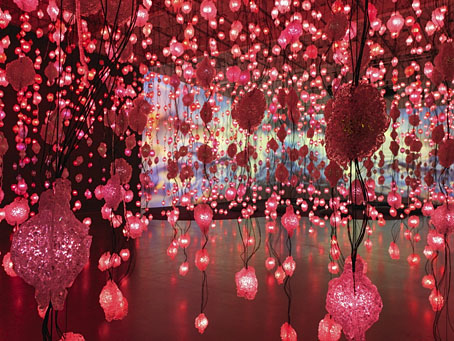
Pixel Forest (2016) by Pipilotti Rist.

• “Think about it: gays, lesbians, bisexuals, and transgender people were almost completely invisible in the movies or on television, or even in newspapers and magazines. It wasn’t until LGBT people started producing their own media that we started to see consistent, positive images. But it would take until very recently for TV and cinema to catch up with what happened in books and magazines decades ago. In other words, nearly all LGBT culture only existed in print or at the bar. So when the queer bookstore disappears, where else can you find 40+ years of LGBT culture? (Hint: it’s not on Netflix.)” Ken White on starting Query Books and republishing classic LGBT literature.

• Related to the above: David Shariatmadari reviews a new edition of Coming Out, Jeffrey Weeks’ history of gay emancipation in the UK; Modern Harmonic is reissuing Love Is A Drag, a collection of “love songs by men, for men”, first released in 1962; Your Daily Male 2017: 52 international artists, 365 pages of full-colour male art; erotic portraits of Yukio Mishima by Eikoh Hosoe.

A Year In The Country revisits The Touchables (1968), a film about four Swinging Sixties girls who live in a huge plastic bubble in the countryside (must be a nightmare in winter); the quartet kidnap a rock star as “a temporary solution to the leisure problem”. Script by Ian La Frenais from a story by David & Donald Cammell. No DVD but it’s on YouTube.

• Mixes of the week are still in the Halloween zone: FACT mix 575 by Fenriz, and Resting Lich Face by SeraphicManta.

• War, love and weirdness: Brian Dillon on Powell & Pressburger’s A Matter of Life and Death, 70 years on.

• Bringing back the magic: a conversation with Hope Sandoval & The Warm Inventions.

David Toop listens, finally, to the legendary John Latham recordings of Pink Floyd.

The Synth Sounds of John Carpenter: Halloween, The Fog, Assault on Precinct 13.

• “Creep or craftsman? Hitchcock was both,” says Tom Shone.

The Dazzling Designs for a New York That Never Existed

Photography by Harry Gruyaert

The Untouchables (1959) by Nelson Riddle | The Touchables (All Of Us) (1968) by Nirvana (UK) | The Touchables (1980) by The Human League

Weekend links 333

timeout.jpg

Time Out (London), no. 2403. No illustrator or designer credited.

• October isn’t all about the dark, there’s also psychedelia: Ned Raggett reviews a new collection of British psych, Let’s Go Down And Blow Our Minds: The British Psychedelic Sounds of 1967, while Floodgate Companion, a forthcoming collection of art by Robert Beatty, is previewed here.

• Mixes of the week (aside from my own, of course): Samhain Seance 5: Invasion of the Robot Witch by The Ephemeral Man, Thee Finders Kreepers Halloween Spezial, and Secret Thirteen Mix 199 by Blue Hour.

• “No diggin’ ‘ere!” Adam Scovell revisits the ghostly locations of the BBC’s A Warning to the Curious, and presents a short film based on the same.

• Stanley Kubrick’s film of The Shining has lost its shine through endless quotation and over-familiarity, says Anne Billson. Hard to disagree.

Between Ballard’s Ears: in which two short stories by JG Ballard—Track 12 and Venus Smiles—are dramatised in binaural sound.

John Carpenter talks to Adam Woodward about remakes, his love of early synthesisers and why nostalgia works in mysterious ways.

• Next month at the British Library: Brion Gysin: A Centennial Invocation with Alan Moore, Iain Sinclair, Barry Miles and others.

Peter Bebergal on the Fraternity of the Rosy Cross, “a shadowy medieval brotherhood that probably didn’t exist”.

Until The Hunter, a new album by Hope Sandoval and The Warm Inventions, is streaming here.

• San Fran-disco: Geeta Dayal on how Patrick Cowley and Sylvester changed dance music forever.

• A small portion of Bill Laswell‘s vast back catalogue is now on Bandcamp.

• At MetaFilter: The strange history of books bound in human skin.

• Italian composer Fabio Frizzi remembers 50 years of cult horror.

Matthew Cheney on the strange horrors of Robert Aickman.

Jóhann Jóhannsson’s favourite records

Dark Start (1995) by ELpH vs Coil | Darkstalker (2000) by Bohren & Der Club Of Gore | Dark (2012) by Moritz Von Oswald Trio