Weekend links 309

witch.jpg

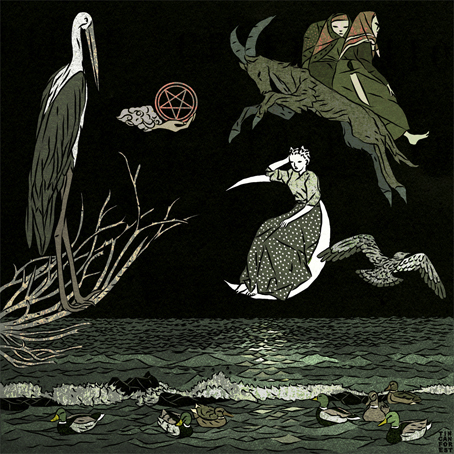
From What is a Witch, “an illuminated manifesto on witchcraft” by Pam Grossman and Tin Can Forest.

• “The other strand of influence for me from dance music was a production house called Savoy in Manchester, England. They were a super underground publishing house that printed cartoons and comic books, and they also released a series of underground dance records. And they were always being shut down by the police and all their stuff was being confiscated, because it was considered ‘anti-society’ in England.” Anohni giving a shout to my colleagues at Savoy Books in a new interview.

Belladonna of Sadness (1973), a feature-length animated film by Eiichi Yamamoto, has been restored, and is being given a premier release in the US. There’s a review here and a trailer here. No news as yet of a UK release but Finders Keepers has the soundtrack album.

Alejandro Jodorowsky talks to Daniel Kalder about his new novel, Albina and the Dog-Men, while Jodorowsky’s comic-book collaborator, Ladrönn, talks to Smoky Man about their new graphic novel, The Sons of El Topo.

Pretty little watercolours these are not. Made by bulldozers and dynamite instead of a paintbrush and easel, the works—often sited on baking sandscapes—fuse minimalism and modern industrial aesthetics to evoke the otherworldly structures of ancient civilisations, from Stonehenge to Mayan temples and the Egyptian pyramids.

Alex Needham on America’s land artists. A few years ago I tracked down some of the structures he describes using Google Maps.

• In every dream home a heartache: High Rise director Ben Wheatley on adapting Ballard, practical special effects and ’70s parenting.

Tom Phillips: From Prequel To Sequel, an exhibition of pages from A Humument at Shandy Hall Gallery.

• From fresh food to magic mushrooms: Michael Pollan probes the medicinal uses of psychedelic drugs.

• “Let’s not forget graphic design is an artistic discipline,” says Jonathan Barnbrook.

Supervert discusses censorship and related matters at SomethingDark.

• “I’ve sung gospel music when in great despair,” says Diamanda Galás.

• Mix of the week: FACT Mix 550 by James K.

Boy Club is a new gay magazine.

Gospel Trane (1968) by Alice Coltrane | The Gospel Comes To New Guinea (1981) by 23 Skidoo | Gospel Train (1990) by African Head Charge
Weekend links 304

stamp.jpg

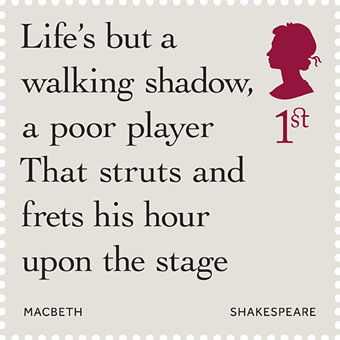
One of ten new stamps designed by The Chase for the Royal Mail’s Shakespeare celebrations.

• “I basically had this problem with bombast and intensity. And I started to feel like it was a nuclear arms race.” Tim Hecker talking to Rick Moody about loud sounds, Icelandic elves and Minimalism. Hecker’s new album, Love Streams, features contributions from Ben Frost and Jóhann Jóhannsson.

• “He joked in a letter to Edmund Wilson that he had ‘managed to get into Harvard with a butterfly as my sole backer.'” Laura Marsh on Nabokov the lepidopterist.

• The brutal musical legacy of JG Ballard by Tim Noakes. Ballard’s own musical taste, as revealed in his choice for Desert Island Discs, was mostly nostalgic.

One outcome of this sense that homosexual people existed in large numbers while still remaining more or less invisible to the naked eye was the suspicion that when they got together they were likely to engage in something more, something even worse than the indulging of a perversion. Notoriously, the networks of homosexuality seemed to transcend many more formal social and political boundaries, reifying crossovers not only between national and ethnic cultures, but between high society and the demi-mondes of bohemian artists, and so forth. The Homintern certainly helped cross-fertilise the arts.

Gregory Woods on the gay artists and writers who changed the world

• Mixes of the week: FACT Mix 544 by Tim Gane, Abs’s Cornerhouse Classics by Abigail Ward, and Secret Thirteen Mix 181 by Broken Bone.

I Can’t Give Everything Away: Jonathan Barnbrook’s text-and graphics video for the song by David Bowie.

• “Chernobyl is spooky, in the manner of all disowned places.” Simon Parkin enters the Zone.

Osman Ahmed on why Doreen Valiente is “the mother of modern witchcraft”.

• The camera obscura art of Abelardo Morell.

An oral history of Taxi Driver.

Swiss graphic design in CSS

• RIP Tony Conrad

Lady Macbeth (1972) by Third Ear Band | In The Back Of A Taxi (1984) by Penguin Cafe Orchestra | Butterfly Mornings (2001) by Hope Sandoval & The Warm Vibrations

Weekend links 301

ruscha.jpg

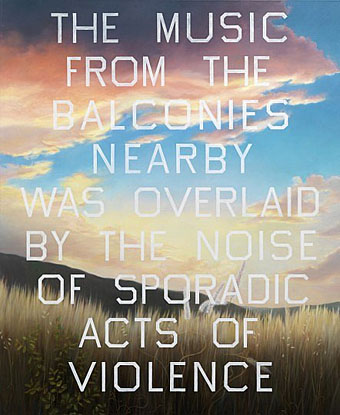
The Music from the Balconies (1984) by Edward Ruscha.

• At The Quietus: High-Rise director Ben Wheatley runs through his favourite films. Kudos for mentioning Elem Klimov’s Come and See (1985) among the more familiar fare, a nightmarish masterwork that everyone should watch at least once. On the same site, author Joe R. Lansdale also lists some favourite films while discussing the new TV series of his Hap and Leonard books.

Electric Hintermass (Sound Apart) by Hintermass, a track from The Apple Tree, their debut album on the Ghost Box label.

Michael Mann’s Heat: “A complex, stylistically supreme candidate for one of the most impressive films of the Nineties”.

• Despair Fatigue: David Graeber on how [political] hopelessness grew boring, and what happens next.

• Mix of the week: FACT Mix 541 by Tortoise, and Blowing Up The Workshop 56 by Eric Lanham.

• At Dennis Cooper’s: “Some books (1961–1975) that either faked ingesting LSD or did”.

• David Litvinoff again: “Was he only an opportunistic hustler?” asks David Collard.

John Carpenter’s The Thing rescored with one of the director’s Lost Themes.

Overlooked: a book by Marina Willer about the manhole covers of London.

• Pam Grossman (words) and Tin Can Forest (art) ask What is a Witch?

• A long way down: Oliver Wainwright on JG Ballard and High-Rise.

• A conversation with designer and typographer Erik Spiekermann.

• The BFI compiles a list of “The 30 Best LGBT Films of All Time“.

• Decoding the spiritual symbolism of artist Hilma af Klint.

Sabat Magazine

Heat (1983) by Soft Cell | The Heat (1985) by Peter Gabriel | Heat Miser (1994) by Massive Attack

Weekend links 300

goudal.jpg

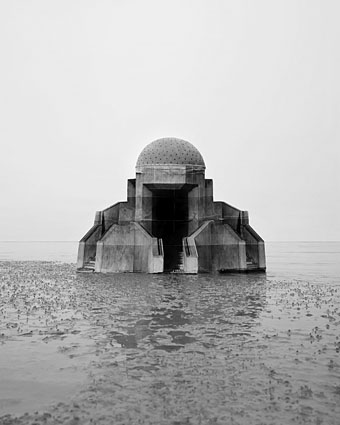
Observatoire IX from the Observatoires series by Noemie Goudal.

• “Before Lady Raglan’s intervention, this figure had been anonymous. She gave him a name: the Green Man.” Josephine Livingstone on the persistence of a supposed figure from pagan folklore.

Ben Wheatley: “Financing a film as crazy as [High-Rise] takes good casting”. Related (in a Ballardian sense): the abandoned hotels of the Sinai Desert.

• “We were in danger of becoming full-time, paid up musicians…” Drew Daniel and Martin “MC” Schmidt of Matmos look back over their career.

Fahey didn’t make many new friends with his scything dismissal of the folk revival. He distrusted the way that folkies regarded music as a carrier for the correct political messages of the moment. As Lowenthal puts it: “To him, the student idealists had naïve worldviews and dreamed of unrealistic political utopias,” whereas Fahey “attempted to channel darkness and dread through his music.” For Woody Guthrie and Pete Seeger devotees, the ideological message came first, with musical tone or trickery a distant second. As Fahey saw it, the dizzyingly strange source music they borrowed from and then built their careers on emerged as little more than a scrubbed-up ventriloquist’s doll, all the coarse grain and troubling metaphysic of its original voices jettisoned. He also detected high condescension and low reverse racism in how the folk-revival people preferred their old blues guys barefoot and wearing dungarees—even if they now usually dressed in sharp suits and often preferred to play amplified, electric urban blues.

Ian Penman on John Fahey

• “It’s amazing how quickly a sound can lose its moorings and float off into this kind of unchartered territory,” says Robin The Fog.

• Mixes of the week: FACT Mix 540 by Via App, and Secret Thirteen Mix 178 by BlackBlackGold.

Oliver Wainwright on Edward Johnston, designer of the typeface for the London Underground.

• At Dennis Cooper’s: DC’s: Spotlight on…The Free-Lance Pallbearers (1967) by Ishmael Reed.

Each drop of Hennessy X.O is an Odyssey: Nicolas Winding Refn makes an alcohol ad.

Wayne Shorter & Herbie Hancock pen an open letter to the next generation of artists.

Japan’s scariest manga artist (Junji Ito) loves Japan’s creepiest cosplayer (Ikura).

• “He was a sexual outlaw.” Jack Fritscher‘s love affair with Robert Mapplethorpe.

Peter De Rome: the RAF pilot who became “the grandfather of gay porn”.

The Strange Case of Mr William T. Horton

• RIP Big George Martin and Ken Adam.

Shortwave Radio World

Viriconium FAQ

Nine Feet Underground (1971) by Caravan | Green Bubble Raincoated Man (1972) by Amon Düül II | Betyárnóta (Outlaw Song, 1989) by Muzsikás

Weekend links 299

blanco.jpg

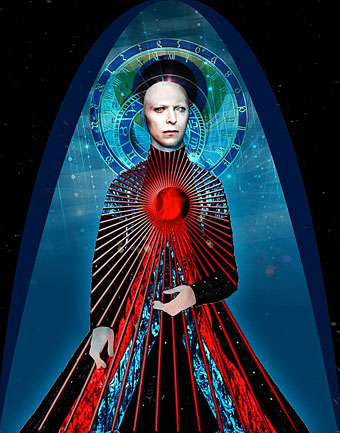
Starman (2016) by Nyahzul Blanco. From the Saint Bowie exhibition at Stephen Romano Gallery, NY.

• “…[Dashiel] Hammett’s first-hand experience of political sleaze, industrial violence and the everyday routine of an agent allowed for a realism that brought hard-boiled fiction to new heights.” Oliver Harris reviews a new life of Hammett, a history of the American detective, and a study of film noir.

• Mixes of the week: Secret Thirteen Mix 177 by Vladislav Dobrovolski, The After-School Club by Melmoth The Wanderer, and Perfect Monolake by Rich Ears.

Inside High-Rise: product designs by Michael Eaton and Felicity Hickson for Ben Wheatley’s feature film.

Yeats is not the only respected writer to make use of the tarot: Italo Calvino, Salvador Dalí, and even Charles Williams, a novelist and theologian who belonged to the Inklings literary circle, also drew on the cards. Still, the cards remain firmly associated with the occult—and, while [Jessa] Crispin is sympathetic to that tradition, she aims to bring tarot to those who may be skeptical of that way of thinking. Her references are more literary than arcane.

Peter Bebergal talks to Jessa Crispin about making the Tarot literary again

Legowelt’s best free paranormal synth samples, occult instruments and lo-fi effects.

• At Dangerous Minds: a smorgasbord of sorcerous bad taste via Vintage Occult.

• Free download: Cavern of Anti-Matter live at Acad, Berlin, 2015.

• Conversing with your Subconscious: The Art of Adrian Cherry.

Diagonal Science is the debut album from Black Helicopters.

111 Photographs of 111 Westminster Street in Providence, RI.

• More magick: occult documentaries of the 1970s.

• A Bosch-themed fashion feature by Tim Walker.

Cycloid Drawing Machine

Dark Star (1984) by Harold Budd | Dark Start (1994) by ELpH vs Coil | Dark Star Blues (2004) by Acid Mothers Temple & The Melting Paraiso U.F.O.