Weekend links 366

kashiki.jpg

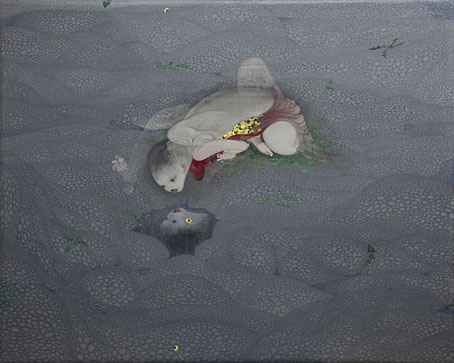
Dandelion (2009) by Tomoko Kashiki.

• “Standard Ebooks takes ebooks from sources like Project Gutenberg, formats and typesets them using a carefully designed and professional-grade style guide, lightly modernizes them, fully proofreads and corrects them, and then builds them to take advantage of state-of-the-art ereader and browser technology.”

• Obscenity and the Arts, a previously unpublished essay by Anthony Burgess, will appear in book form later this year via Pariah Press.

• Mixes of the week: VF Mix 97: Talk Talk by The Last Dinosaur, and Secret Thirteen Mix 225 by Janek Schaefer.

Rub any two writers together and similarities will show. No two writers, however different, are completely different. Here’s a crucial instance: Lovecraft and Ballard both put architecture at the heart of their fiction, even though neither had the slightest formal training in the subject. And it is via this interest that the two intersect in an unexpected way. They are connected, through time and space, by that most humble of architectural events: the corner, the junction between two walls. What Lovecraft and Ballard did was to make the corner into a place of nightmares — and in doing so, they reveal its secret history.

Will Wiles in a long and rewarding essay, The Corner of Lovecraft and Ballard

• Dungeons Deep, Forests Dark – A beginner’s guide to Dungeon Synth by Daniel Pietersen.

• Alex Ross on Joséphin Péladan, the Symbolists and the occult roots of Modernism.

• Cooling the Tube: engineering heat out of the [London] Underground by IanVisits.

• Caroline on the mysteries of Pye Corner: Flames, poltergeists and bodysnatchers.

• The Saint of Sin City – Tony Kail Visits Las Vegas’ Santuario de la Santa Muerte.

• Photographs of Art Nouveau architecture by Keiichi Tahara.

• A stream of the new Porter Ricks album, Anguilla Electrica.

• Jasper Sharp on 100 years of Japanese animation.

• At Dennis Cooper’s: 197 clocks.

• On The Corner [Take 4] (1972) by Miles Davis | Corner Crew Dub (1976) by Augustus Pablo | Empty Avenues And Dark Corners (Pye Corner Audio Mix) (2013) by John Foxx and the Belbury Circle
Weekend links 361

f1x-2.jpg

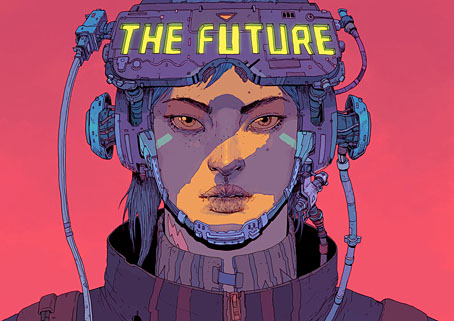
The Future Vol.2 (2016) by f1x-2.

• One of the notable things about the reaction to the original series of Twin Peaks was the way in which Americans were astonished that something so outré could be allowed on television. Here in the UK the response was a little more subdued; we had, after all been spoiled for years by The Prisoner, Sapphire and Steel, and numerous odd and challenging dramas by Dennis Potter and others. Pre-dating all of these was The Strange World of Gurney Slade (1960), a six-part series starring Anthony Newley that was unprecedented in its Surrealism. Andy Murray looks back at the series, and at the rest of Newley’s career.

• Andrew Dickson on Peter Ackroyd whose latest book, Queer City: Gay London from the Romans to the Present Day, is published later this month.

• Alyona Sokolnikova on a Soviet vision of the future: the legacy and influence of Tekhikia – Molodezhi (Technology for the Youth) magazine.

You know who weren’t cops? All the radicals and queers and artists and dreamers that were there while I grew up, my mom and dad’s old friends from New York and the wider bohemian world, the actors and the drag queens and the dilettantes and the ex junkies and the current junkies, the kind of queer people who wouldn’t get caught dead getting married, the people who actually made the “old New York” of the myth into what it was. They were smart and they were funny and they were tougher than I can imagine and they were possessed of an existential commitment to the idea that life is complicated and so we shouldn’t be quick to judge. They were tolerant, in the true sense, even while they were tireless advocates for actual justice. […] Now we’re Rudy Giuliani, trying to get offensive art pulled off the walls. Now we’re the book burners. Now we’re the censors. Now we attack the ACLU for defending free speech. Now we screech about community morals. Now we’re the prison camp screws. That’s us. Me, I could never be one of the good ones. Never. I can never live up to that ideal. I know I’m not good enough. I know when the judgment day comes, I go down. And so I decline. You can decline, too.

Planet of Cops by Freddie deBoer, or how inflexible morality makes everyone a cop

• Mixes of the week: FACT Mix 601 by Dark Entries, Secret Thirteen Mix 221 by Eli Keszler, and XLR8R Podcast 490 by Ben Lukas Boysen.

• At Dangerous Minds: Punk, Patti Smith, William Burroughs & capitalism: A “conceptual conversation” with RE/Search’s Vale.

• Emily Wells on the strange, irreverent worlds of Down Below and The Complete Stories of Leonora Carrington.

• Rick Poynor on Mike Halliwell’s montages based on JG Ballard’s The Atrocity Exhibition.

• “Why are the British so scared of cannabis?” asks Professor David Nutt.

• Witchcraft and the Gay Counterculture (1978) by Arthur Evans.

• At Dennis Cooper’s: Jacques Rivette Day.

• Designing Penguin Modern Classics

• Future Dub (1994) by Mouse On Mars | Future Proof (2003) by Massive Attack | Future (2004) by Alva Noto

Weekend links 354

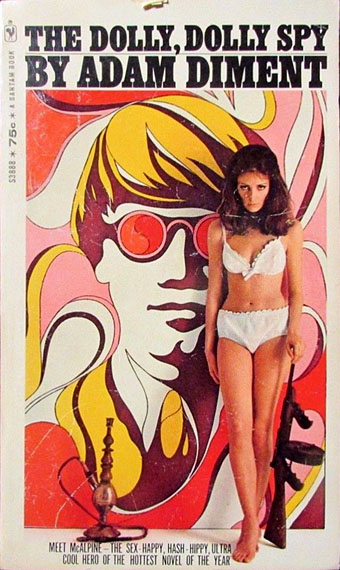
diment.jpg

The Dolly, Dolly Spy (1968).

• As mentioned previously, Concrete Desert is a musical collaboration between The Bug (Kevin Martin) and Earth’s Dylan Carlson inspired, they say, by Los Angeles and the fiction of JG Ballard. Martin & Carlson talked to Patrick Clarke at The Quietus about the album’s creation. Elsewhere, Kevin Martin compiled a list for Bleep of ten musical influences on the album, and Dylan Carlson had a Fireside Chat with Red Bull Music.

• Phil Legard of Xenis Emputae Travelling Band and Hawthonn has released a new EP, Hesperian Garden, featuring compositions derived from the Monas Hieroglyphica of John Dee.

• More Ballard: Mike Holliday maps the evolution of Crash, a novel which is published in a new “Collector’s Edition” by Fourth Estate next week.

• Teleplasmiste “bridge the oscillation gap from deep listening ambient music and the heaviest of doomy drones,” says Richard Fontenoy.

• David Barnett on Adam Diment, “the superstar spy novelist who vanished for four decades”.

• The queer art underground of 1980s London as photographed by David Gwinnutt.

• A sculpture of a Buddhist deity made from 20,000 beetles.

• Mix of the week: XLR8R Podcast 483 by Jane Fitz.

• RIP Gilbert Baker, designer of the rainbow flag.

• Rubber Dolly Rag (1930) by Uncle Bud Landress with Georgia Yellow Hammers | Voodoo Dolly (1981) by Siouxsie and the Banshees | Cosmic Funky Dolly (2003) by Acid Mothers Temple & The Melting Paraiso U.F.O.

Weekend links 349

burgess.jpg

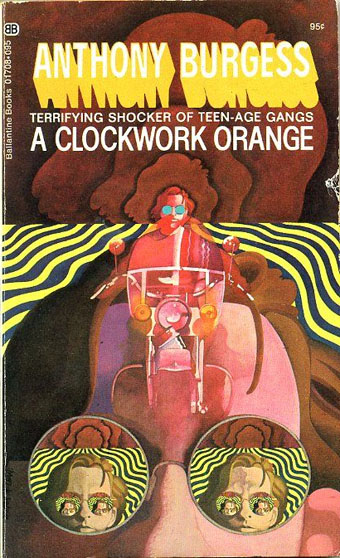
• Before Stanley Kubrick fixed an image of Alex and his droogs in the popular imagination, artists could get away with playing on the threat of biker gangs as Wilson McLean does in this vaguely psychedelic cover from 1969. (McLean’s interpretation may possibly derive from a 1965 edition.) LibraryThing has a collection of Clockwork Orange covers from around the world which run the gamut of cogs, orange hues and variations on David Pelham’s famous Penguin design from 1972. Meanwhile, AL Kennedy celebrates 100 years of Anthony Burgess by examining the writer’s career as a whole, although the web feature still manages to get a photo of Malcolm McDowell in there.

• “Even bad books can change lives,” says Phil Baker reviewing The Outsider by Colin Wilson and Beyond the Robot, a Wilson biography by Gary Lachman. I wouldn’t call The Outsider a bad book but Wilson’s more wayward opinions (and later works) are best treated with scepticism.

• “Murtaugh refers to his subject’s ‘pervasive sense of doom’ and Welch himself speaks of ‘the extraordinary sadness of everything.'” David Pratt reviewing Good Night, Beloved Comrade: The Letters of Denton Welch to Eric Oliver, edited by Daniel J. Murtaugh.

• At The Quietus this week: Tinariwen bassist Eyadou Ag Leche is interviewed by Richie Troughton, Jane Weaver unveils a new song from her forthcoming album, Modern Kosmology, and Danny Riley explores the strange world of Ben Chasny.

• “A micro-history of cultural gatekeeping: once told by the censors what we may read, then by critics what we should, we are now told merely what we can read.” Ben Roth writing against the use of “readability” as a literary value.

• Yayoi Kusama’s amazing infinity rooms are at the Hirshhorn Museum and Sculpture Garden, Washington DC, until May. For the rest of us, Peter Murphy’s panoramic photo is still online.

• More music: my friends Watch Repair have become visible enough to be interviewed by an Argentinian website. The group’s Bandcamp page recently made three new releases available.

• Yet more music: They Walk Among Us, a new song and video by Barry Adamson, and Anymore, a new song and video by Goldfrapp.

• Earth and The Bug announce Concrete Desert, a collaborative album inspired by Los Angeles and the fiction of JG Ballard.

• Bad Books for Bad People: Episode 7: The Incal – Epic French Space-Opera Comics.

• Mixes of the week: FACT Mix 589 by Aisha Devi, and Secret Thirteen Mix 212 by Qual.

• Eduardo Paolozzi‘s forays into fashion and furnishings.

• Cooking with Vincent [Price]

• Moroccan Tape Stash

• Tin Toy Clockwork Train (1986) by The Dukes Of Stratosphear | Clock (1995) by Node | Clockwork Horoscope (2009) by Belbury Poly

Science Fiction Monthly

sfm01.jpg

Art by Chris Foss.

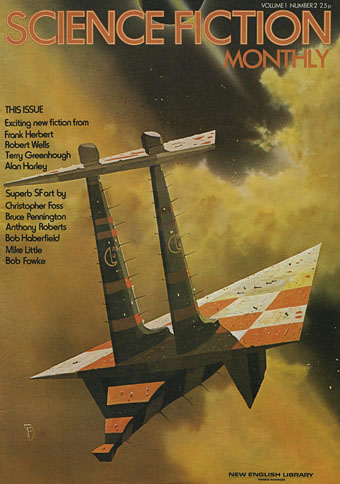
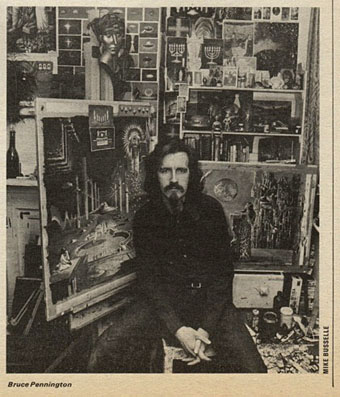
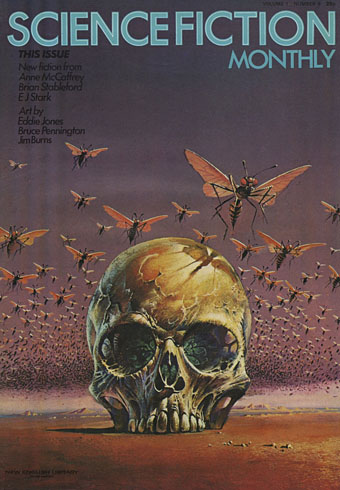
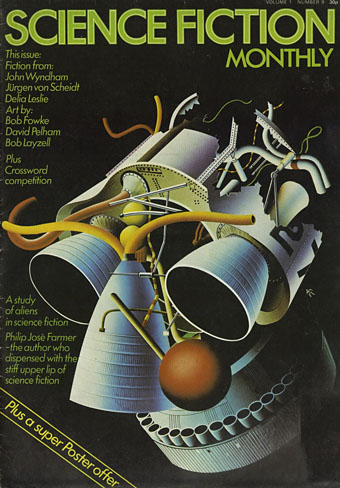
Recent uploads at the Internet Archive include an incomplete run of British magazine Science Fiction Monthly, a large-format collection of SF art and original fiction that ran for 28 issues from 1974 to 1976. Science Fiction Monthly was significant for my generation since it was the only regular British SF magazine available in the mid-70s. (Michael Moorcock and co. were still producing issues of New Worlds but the only ones I saw were the quarterly paperbacks). Science Fiction Monthly was published by New English Library which made it seem at first glance like a promotional tool for the publisher, even more so when most of the cover art and almost all the ads were for NEL titles. The early issues lean heavily on NEL content but later issues had a broader reach and contained all the features you’d expect from an SF magazine of the period: news columns, film reviews, interviews, a bad comic strip, and so on. The thing I liked most at the time was the reproduction of book cover art at a large size, with full-colour paintings filling the broadsheet pages or spreads, all printed with the intention of being removed and fixed to bedroom walls. The early issues were also unique in giving regular attention to the artists, running interviews and even showing photographs of the people responsible for all of that familiar paperback art. I didn’t see all of the early issues but the interviews were later collected in book form by NEL in Visions of the Future (Janet Sacks ed., 1976), a volume that made a considerable impression since it showed me that SF and fantasy illustration was a viable career rather than the product of remote and mysterious talents.

sfm02.jpg

Artist Bruce Pennington (see this post).

A few page samples follow. It’s a shame the collection at the Internet Archive is incomplete since the magazine’s contents were interesting to the end. The only copy I own today is the one for October 1975 (not currently available online) which is almost a JG Ballard special, with a feature on the writer, an interview about his new novel, High-Rise, and an original piece of fiction.

sfm03.jpg

Art by Bruce Pennington.

sfm04.jpg

Art by David Pelham.

Continue reading “Science Fiction Monthly”