Weekend links 530

yoshino.jpg

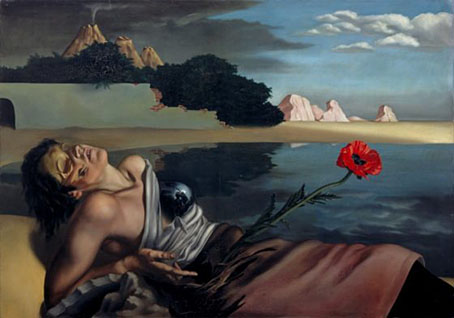
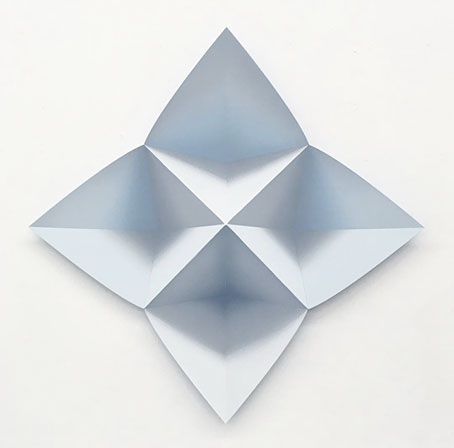
Kami #58 -bloom- (2019) by Momo Yoshino.

• “Set amid the countryside and the beaches of coastal Sussex, They depicts a world in which plundering bands of philistines prowl England destroying art, books, sculpture, musical instruments and scores, punishing those artistically and intellectually inclined outliers who refuse to abide by this new mob rule.” Lucy Scholes on They: A Sequence of Unease (1977) by Kay Dick, which she calls “a lost dystopian masterpiece”. This is revelatory in a minor way since for years I’ve remembered seeing a slim volume with the title They in a bookshop, and which I later thought might have been a Rudyard Kipling book (there’s a Kipling story with the same title). The timing is right, the sighting would have been in 1977 or 78. The combination of that short, one-word title with a stark cover image and a sinister description on the rear was hard to forget but I didn’t take note of the author’s name. (I also didn’t buy the book, opting instead for some inferior work.) A shame that it seems to be resolutely out of print.

• “The threat to civil liberties goes way beyond ‘cancel culture’,” says Leigh Phillips. It makes a change seeing this coming from Jacobin when so much of the left today can find nothing wrong with censorship so long as it’s in a good cause. (Every censor that ever lived believed they were acting in a good cause, were on “the right side of history”, etc, etc.) The piece includes a dismissal of the increasingly common riposte that “only the state can censor”: this would be news to my colleagues at Savoy Books who endured years of police harassment including the seizure and destruction of printed material; the same with the long history of police action against UK rap artists. Related: “Work that’s cancelled for being ‘of its time’ was probably objected to, at the time.” Dorian Lynskey on chronocentrism and “the narcissism of the present”.

• “Cruising baths, bars, and subway toilets, snorting poppers and ‘fist fucking with 40 guys for 14 hours’ (as he recalled in You Got to Burn to Shine, his 1993 collection of prose and poems), he found meaning in a religion of radical eros whose sacrament was anonymous sex.” Mark Dery reviewing Great Demon Kings: A Memoir of Poetry, Sex, Art, Death, and Enlightenment by John Giorno.

Aubrey Powell says his best photograph is the burning man from the cover of Wish You Were Here by Pink Floyd.

• Mixes of the week: Fact mix 770 by Lyra Pramuk, and mr.K’s Kooky Kuts Vol.4 by radioShirley & mr.K.

• The Alchemical Brothers: Brian Eno & Roger Eno interviewed by Wyndham Wallace.

• Origami-inspired optical illusion oil paintings by Momo Yoshino.

Alexander Larman on the demise of the second-hand bookshop.

• New music: Follow The Road by Yumah, and Röschen by Pole.

• At Dennis Cooper’s: Lighting.

• RIP Linda Manz.

My Boyfriend’s Back (1963) by The Angels | Carnival of the Animals, R. 125: VII. The Aquarium (Camille Saint-Saëns) (1975) by the Württemberg Chamber Orchestra, Heilbronn with Marylene Dosse & Anne Petit, conducted by Jörg Faerber | Kill All Hippies (2000) by Primal Scream
Weekend links 527

equus.jpg

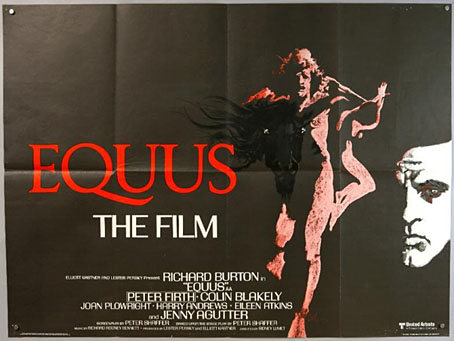
Poster art by Bob Peak.

• Sidney Lumet’s 1977 film of Peter Shaffer’s Equus receives a limited blu-ray release by the BFI in August. Richard Burton’s performance has always received a mixed response (I’ve never been in the anti-Burton camp) but the film is serious and well-made. And, as with The Offence (1973), there’s the thrill of seeing Lumet turn his attention away from his beloved New York City to examine British lives.

• “Astronomer claims to have pinpointed date of Vermeer’s View of Delft.” Yes, but how long did it take Vermeer paint the view? Speaking as someone who used to paint a lot, I’d say two or three days at least. Then there’s that awkward thing known as “artistic licence”…

• “I was taken aback by the antic side of Borges. He was irreverent, funny, insistent on his ways, and brilliantly talkative.” Jay Parini on Jorge Luis Borges, and his experience as the writer’s chauffeur in the Scottish Highlands.

• Strange Islands: Benjamin Welton on a favourite cinematic micro-genre I explored here a few years ago: the mysterious tropical island that’s a home to fearsome beasts and outsized (often deranged) personalities.

Greydogtales on The Sapphire Goddess of Nictzin Dyalhis, the Weird Tales writer with a name like a character from one of his stories.

• “I came for the giant phalluses and stayed for the joy of being a gay person.” Eight artists on the influence of Tom of Finland.

Tamsin Cleary on Nobuhiko Obayashi’s House (1977) which she calls “the world’s most demented haunted house film”. It really is.

The Gone Away, a short film by Sean Reynard for the forthcoming album from Belbury Poly.

Moorcography: the beginnings of an online Michael Moorcock bibliography.

• “Our sound engineer got a death threat”: Andrew Male on Olivia, a lesbian record label.

Bajo el Signo de Libra explores the art of Aubrey Beardsley.

• At Dennis Cooper’s: Hans-Jürgen Syberberg Day.

The secret drawings of Great Britain’s UFO Desk.

Wyrd Daze Lvl.4 is here.

The Four Horsemen (1971) by Aphrodite’s Child | All The Pretty Little Horses (2004) by Coil | When The Horses Were Shorn Of Their Hooves (2018) by Dylan Carlson

Hardy art

hardy1.jpg

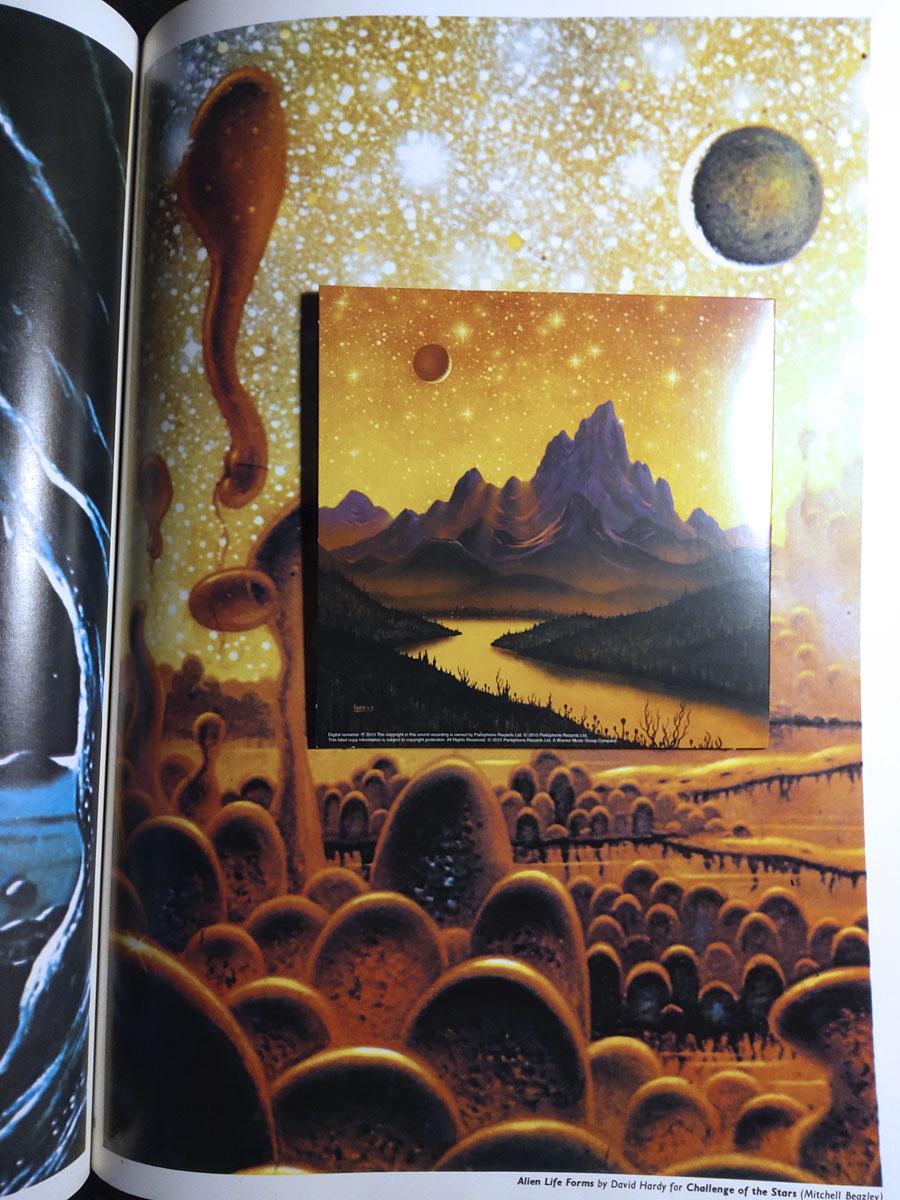
Hawkwind continue to be the overwhelming topic of the moment while I’m reading Joe Banks’ marvellously detailed account of the group’s first decade. One of the many attractions of Hawkwind for this listener was their intersection with other areas of interest: Moorcock and New Worlds, obviously (two of Robert Calvert’s poems appeared in New Worlds Quarterly), but also SF and fantasy in general. The alien planet on the back cover of the Hall of the Mountain Grill album was immediately recognisable as the work of British space artist David A. Hardy thanks to a feature in Visions of the Future (1976) a collection of artwork reprints from the art and fiction magazine Science Fiction Monthly. Hardy had a long association with astronomer Patrick Moore, illustrating the covers of Moore’s novels and later collaborating on a speculative science book, Challenge of the Stars (1972). A few of the latter paintings were reprinted in Visions of the Future, including one with the title Alien Life Forms that depicted amoeboid creatures on a remote planet. The painting would have become the back cover of the Hawkwind album if Hardy hadn’t insisted on creating a new work in a more suitable ratio.

Hardy’s association with Hawkwind extended to their stage shows, with a series of circular paintings used by “Liquid Len” (Jonathan Smeeton) on a rotating projector that covered the band in moving panoramas of ancient monuments, dinosaurs, alien landscapes and exploding worlds. Two of the paintings appear as the endpapers in Joe’s book; the dinosaurs and the monuments may be seen here.

hardy2.jpg

Cover design by Bryan Cholfin.

My own Hawkwind covers make very poor comparisons to Hardy’s meticulous renderings but we do have a further connection via The Very Best of Fantasy and Science Fiction, a collection of stories from the long-running magazine edited by Gordon Van Gelder. I designed the book’s interiors and Hardy contributed the cover art. Hardy painted many covers for F&SF throughout the 1970s and 80s, this shining rocket being a reworking of a cover he produced for the magazine’s 60th anniversary issue. The archetypal spacecraft of classic science fiction, and almost a definitive example. You might even call it a silver machine…

Previously on { feuilleton }
Silver machines
Notes from the Underground
Hawkwind: Days of the Underground
The artists of Future Life
Science Fiction Monthly
The Chronicle of the Cursed Sleeve
Rock shirts
The Cosmic Grill
Void City
Hawk things
The Sonic Assassins
New things for July
Barney Bubbles: artist and designer

Chance encounters on the dissecting table

maldoror2.jpg

In times of great uncertainty about our mission, we often looked at the fixed points of Lautréamont and De Chirico, which sufficed to determine our straight line.

André Breton, Surrealism and Painting, 1928

1: The metaphor, 1869

maldoror.jpg

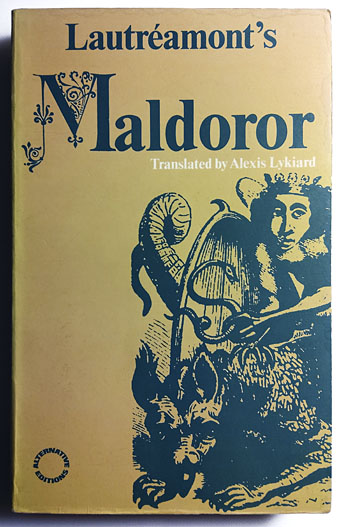
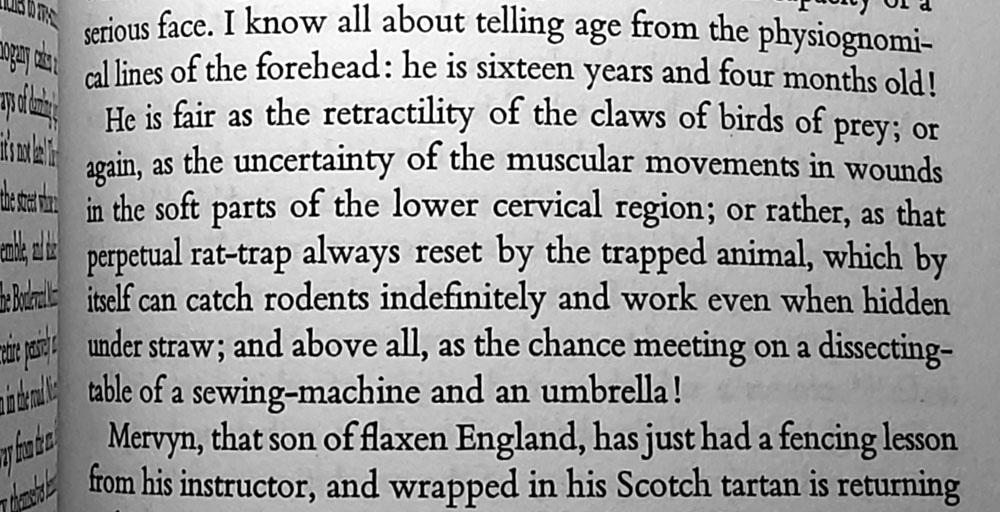
You can’t read the history of Surrealism for very long before encountering some variation of the most famous line from Les Chants de Maldoror by the Comte de Lautréamont/Isidore Ducasse: “beautiful as a chance encounter on a dissecting table of a sewing-machine and an umbrella”. Translations vary, as do misquotations; the page above is from the Alexis Lykiard translation where you can also read the surrounding text. The context of the description is seldom mentioned when the quote is used, and reveals that the words are describing the attractiveness of an English schoolboy living with his parents in Paris. The insipid Mervyn is stalked, seduced and finally murdered by the villainous Maldoror. Lautréamont’s metaphor, like so much else in the book, carries a sting in its tail.


2: The Enigma of Isidore Ducasse, 1920

ray.jpg

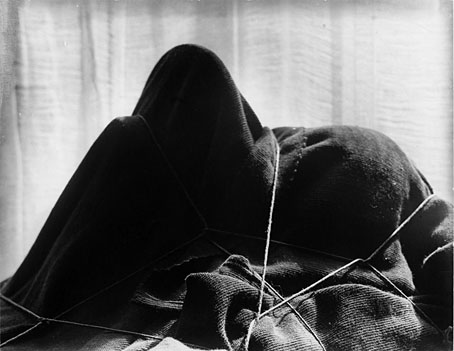
Man Ray, like Mervyn, was a foreigner living in Paris when he created this artwork. The “enigma” may be taken as referring both to the wrapped object (a sewing machine sans umbrella) as well as to the mysterious author of Les Chants de Maldoror, who died at the age of 24 after writing his explosive prose poem, and about whose life little is known. I first encountered Ducasse’s name in art books showing pictures of this piece which is one of the earliest works of Surrealist art. For a young art enthusiast the enigma was more in the name itself: who was this Ducasse, and why was he enigmatic? The original of Man Ray’s piece was subsequently lost, like many of his pre-war sculptures, but may be seen inside the first issue of La Révolution Surrealiste. Editions of the work that exist today are recreations made in the 1970s.


3: An illustration for Les Chants de Maldoror, 1934

dali3.jpg

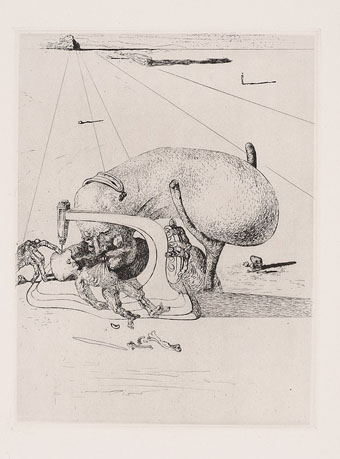
Salvador Dalí created 30 full-page etchings and 12 vignettes for an illustrated edition of Lautréamont’s work published by Skira in Paris in 1934. Dalí must have seemed an ideal match for a book whose prose descriptions offer copious atrocities and mutations but, as with many of Dalí’s illustrations, the pictures owe more to his obsessions than to Lautréamont’s text, and could easily be used to illustrate something else entirely. Plate 19 does, however, feature a sewing machine.


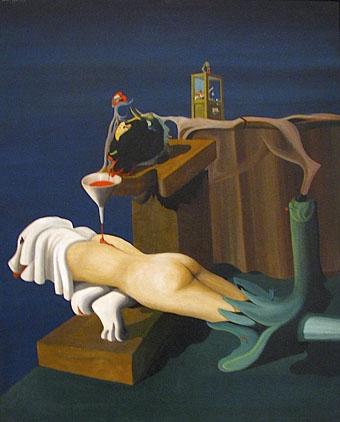
4: Electrosexual Sewing Machine, 1935

dominguez.jpg

A Surrealist painting by Oscar Dominguez which emphasises the sexual nature of Lautréamont’s metaphor, or at least the Freudian interpretation of the same. Breton and company took the sewing machine for a female symbol, while the umbrella was male; the dissecting table where their encounter takes place is, of course, a bed.

[In Electrosexual Sewing Machine] the dissection appears to be under way. There is a strange abusive surgery being undertaken, the thread of the sewing machine replaced with blood which is being funnelled onto the woman’s back. The plant itself may even echo de Lautréamont’s umbrella. Domínguez has taken one of the central mantras of Breton’s Surreal universe and has pushed it, through a combination of painterly skill and semi-automatism, in order to create an absorbing and haunting vision that cuts to the quick of the movement’s spirit. (via)


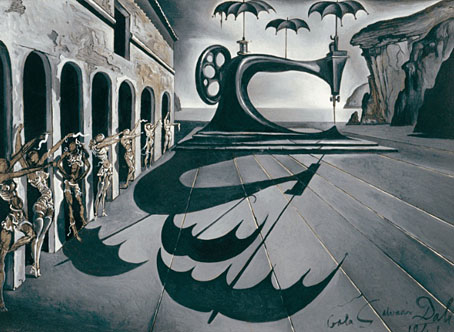
5: Sewing Machine with Umbrellas in a Surrealist Landscape, 1941

dali4.jpg

More from Dalí who was hired by Fritz Lang to create images for a sequence of drunken delirium in the film Moontide. The commission arrived four years before Dalí’s work for Hitchcock on Spellbound, and if successful might have even dissuaded Hitchcock from hiring Dalí, but Lang left the film once shooting had begun, and his replacement, Archie Mayo, disliked the artist’s contributions. This surviving concept painting seems lazy compared to the Spellbound sequences (which were also trimmed by the ever-interfering David O. Selznick): the colonnade is a bald swipe from De Chirico, while the umbrella-bedecked sewing machine makes clumsy and literal use of the Lautréamont metaphor which is better left as a provocative collision of verbal imagery.


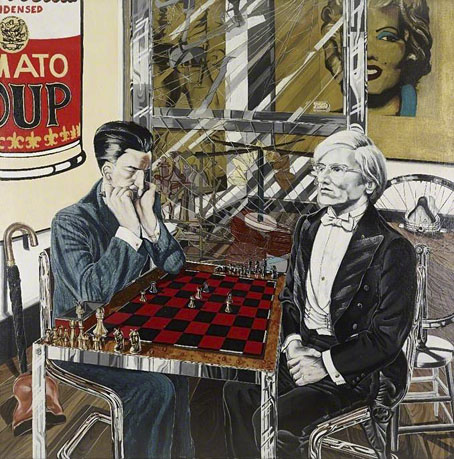
6: “As beautiful as the chance meeting on a dissection table of a sewing-machine and an umbrella…”: Andy Warhol and Marcel Duchamp, 1976

core.jpg

A painting by Philip Core, part of a series in which well-known cultural figures (eg: Harold Pinter and Joe Orton) encounter each other in rooms that reflect their works. Core wrote a biography of Andy Warhol, so maybe he knew something that I don’t, but I’d be very surprised if the Pop artist ever played a game of chess in his life, never mind being proficient enough to win so many pieces from the chess-obsessed Duchamp. As for Marcel, he’d raise an eyebrow at that wrongly positioned chess board…


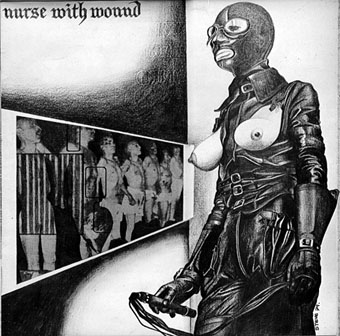
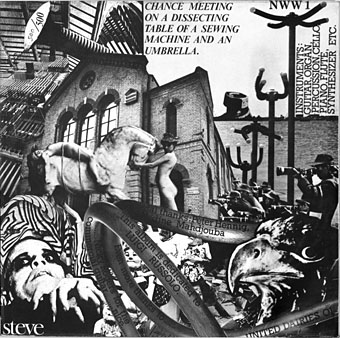
7: Nurse With Wound, 1979

nww1.jpg

Lautréamont infects another medium. Steven Stapleton’s music group/art project has been infused from the outset by a pranksterish Dada/Surrealist spirit, so the purloining of the metaphor for the title of the first Nurse With Wound album is entirely fitting.

nww2.jpg


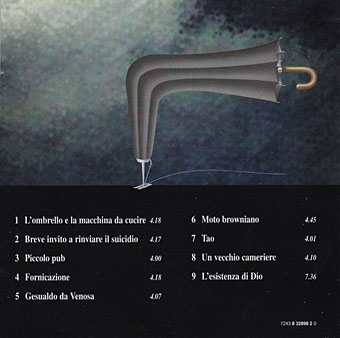
8: L’Ombrello E La Macchina Da Cucire, 1995

battiato1.jpg

Unlike this album by the very prolific Franco Battiato which Discogs describes as “experimental”. The first piece on the album uses the same title as the album, and is anything but experimental, especially compared to the improvised racket created by Nurse With Wound.

battiato2.jpg


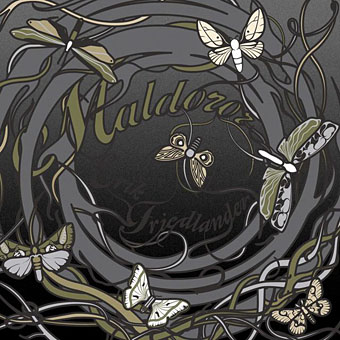
9: Maldoror, 2003

friedlander.jpg

A jazz album by Erik Friedlander which I haven’t heard but which takes its track titles from phrases by Lautréamont.

Do other examples exist? No doubt they do, but the more recent uses of Lautréamont’s words only demonstrate how over-familiarity dulls an effect that was once shocking and original.

Previously on { feuilleton }
Santiago Caruso’s Maldoror
Jacques Houplain’s Maldoror
Hans Bellmer’s Maldoror
Les Chants de Maldoror by Shuji Terayama
Polypodes
Ulysses versus Maldoror
Maldoror
Books of blood
Magritte’s Maldoror
Frans De Geetere’s illustrated Maldoror
Maldoror illustrated

Weekend links 522

moesman.jpg

Self-Portrait (1935) by Johannes Hendrikus Moesman.

• At Bibliothèque Gay, René Bolliger (1911—1971), an artist whose homoerotica is being celebrated in an exhibition, Les Beaux Mâles, at Galerie Au Bonheur du Jour, Paris, next month. There are more beaux mâles in a new book of photographs, Hi, Hello!, by Roman Duquesne.

• The summer solstice is here which means it’s time for Dennis Cooper‘s favourite fiction, poetry, non-fiction, film, art and internet of the year so far. As before, I’m flattered to be listed in the internet selection. Thanks! Also at DC’s, Michael Snow Day.

• “I hope Roger Corman is doing okay,” I was thinking last week while rewatching one of Corman’s Poe films. He’s been overseeing the production of three new features during the lockdown so, yes, he’s doing okay. I loved the Cries and Whispers anecdote.

• “Unsettling and insinuating, fabulously alert to the spaces between things, Harrison is without peer as a chronicler of the fraught, unsteady state we’re in.” Olivia Laing reviewing The Sunken Land Begins to Rise Again by M. John Harrison.

The original Brain label release of Aqua (1974), the first solo album by Tangerine Dream’s Edgar Froese, had a different track list and different mixes from the Virgin releases. The album has never been reissued in this form.

• New music at Bandcamp: Without Thought, music for an installation by Paul Schütze; and Hatching Under The Stars, songs by Clara Engel.

Deborah Nicholls-Lee on Johannes Hendrikus Moesman (1909–1988), “the erotic Dutch surrealist you should have heard of”.

Kate Solomon on where to start with the Pet Shop Boys. I’d also recommend Introspective.

• Dalí in Holographic Space: Selwyn Lissack on Salvador Dalí’s contributions to art holograms.

• At Spoon & Tamago: An obsession with retro Japanese round-cornered windows.

John Boardley on the “writing mistresses” of the calligraphic golden age.

Mark Duguid recommends Michael Reeves’ Witchfinder General (1968).

• The favourite music of Crammed Discs boss, Marc Hollander.

• Occult/erotic prints by Eleni Avraam.

Aqua: Every Raindrop Longs For The Sea (Jeder Tropfen Träumt Vom Meer) H2O (1973) by Achim Reichel | Aqua (1979) by Dvwb | Aqua (1981) by Phew