Weekend links 840

hugo.jpg

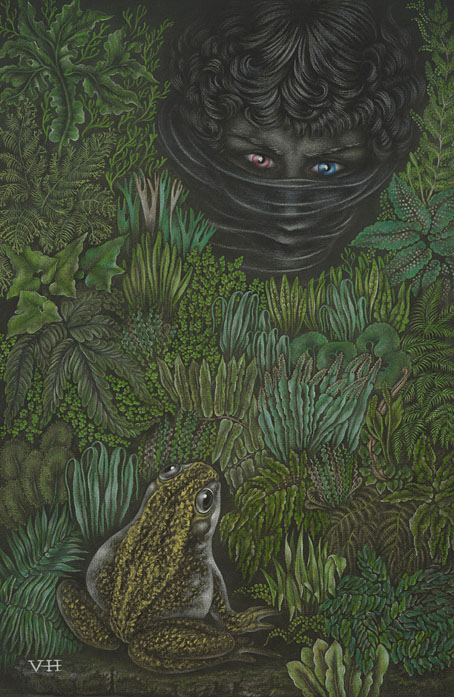
The Toad of Maldoror (1932) by Valentine Hugo.

• Old music: Thank You America (John Robie Dub Mix) by Cabaret Voltaire. Code, the group’s 1987 debut for the Parlophone label, receives an overdue reissue later this year with a substantial collection of remixes.

• At Lesser-Known Writers: Douglas A. Anderson examines the career of Hal Garrott, a writer whose novels for children feature fine illustrations by Dugald Stewart Walker and Mary-Ponton Gardner.

• The August catalogue of lots for the After Dark: Gay Art and Culture online auction. Homoerotic art, photos, historic porn, etc.

• Mixes of the week: The Invisible Collage Vol. 1, and Robert Aiki Aubrey Lowe’s Invisible Jukebox Mix at The Wire.

• New music: Modulisme Session 144. Lightning Field 01. Constraint by Philippe Petit, and Signal Loss by Paul Beaudoin.

• At Colossal: Los Angeles Public Library unveils the world’s largest pop-Up book.

• At the BFI: Craig Ian Mann selects 10 great East German films.

• At Dennis Cooper’s it’s Ed Emshwiller’s Day.

Signaux Codes Non Identifiés (1978) by Michel Magne | Code Rays (Codex Dub) (1995) by Main | Codes (Encryption And Decryption) (2025) by Andrew Heath

Ragnar von Holten’s Maldoror

vonholten1.jpg

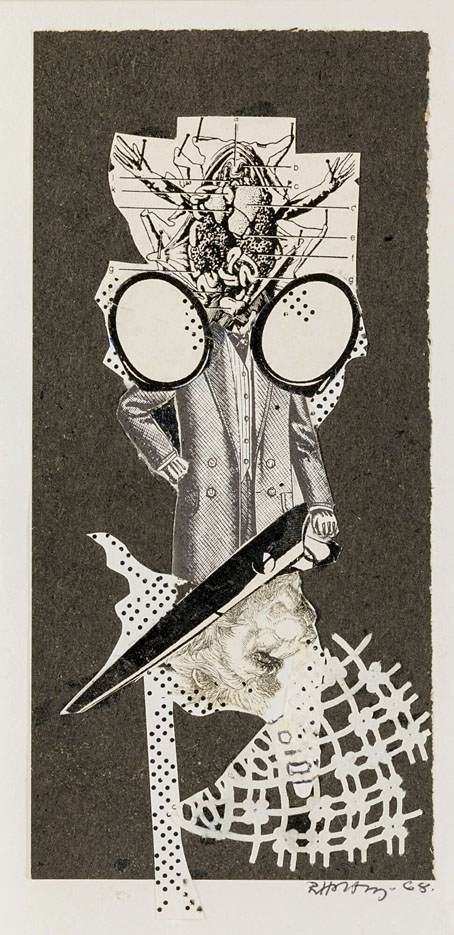
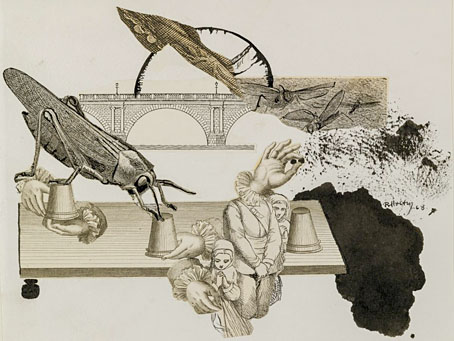
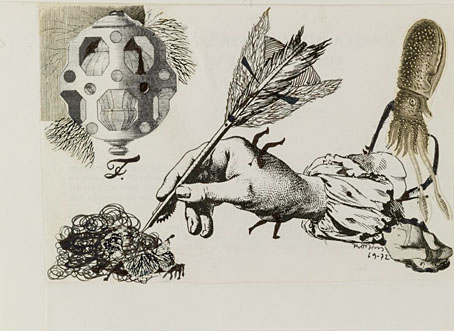
More Maldoror, and more collage, this time from Swedish artist and art historian Ragnar von Holten (1934–2009). The Historical Dictionary of Surrealism describes von Holten as a Gustave Moreau enthusiast who first contacted the Paris Surrealists in 1960 when he was organising a retrospective of Moreau’s work at the Louvre. André Breton had long been a champion of Moreau, especially in the decades when the artist was out of fashion, and wrote a preface for von Holten’s L’Art Fantastique Gustave Moreau. One of the many things I like about the Surrealists is the continuity they provide with the history of fantastic and visionary art.

vonholten2.jpg

Von Holten’s Maldoror collages were begun in the late 1960s and completed in 1972 when they were published in a Swedish edition of the novel. I don’t know how many illustrations there were in all but you can see more at the Moderna Museet website. Not all the collages are labelled as being derived from Maldoror but many of the titles refer to the text all the same. Also there are two drawings intended as vignettes, one of which depicts in a rather literal fashion Lautréamont’s most popular metaphor.

vonholten3.jpg

vonholten4.jpg

Elsewhere on { feuilleton }
The Surrealism archive

Previously on { feuilleton }
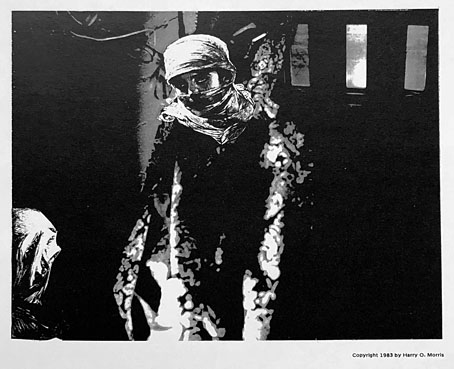
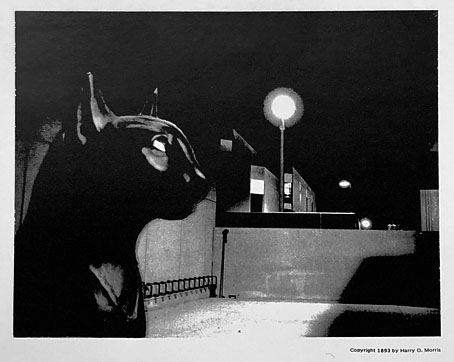
Harry O. Morris’s Maldoror
Covering Maldoror
Kenneth Anger’s Maldoror
Chance encounters on the dissecting table
Santiago Caruso’s Maldoror
Jacques Houplain’s Maldoror
Hans Bellmer’s Maldoror
Les Chants de Maldoror by Shuji Terayama
Polypodes
Ulysses versus Maldoror
Maldoror
Books of blood
Magritte’s Maldoror
Frans De Geetere’s illustrated Maldoror
Maldoror illustrated

Harry O. Morris’s Maldoror

morris01.jpg

Lautréamont’s delirious prose poem/novel/proto-Surrealist dream-text is sufficiently wild and free-ranging to inspire many visual interpretations. One of the peculiarities of the book is that all these interpretations are valid to some degree, although some still suit the general tone better than others. Quite a few of the well-known Surrealist artists had a crack at illustrating Les Chants de Maldoror but artists who don’t illustrate on a regular basis have a tendency to gesture vaguely at the given text while offering yet more of their own concerns.

morris02.jpg

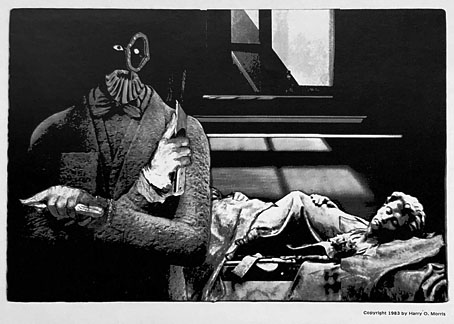
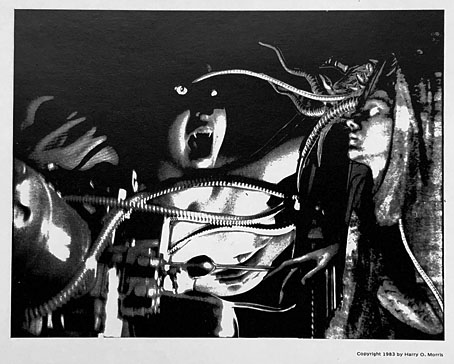
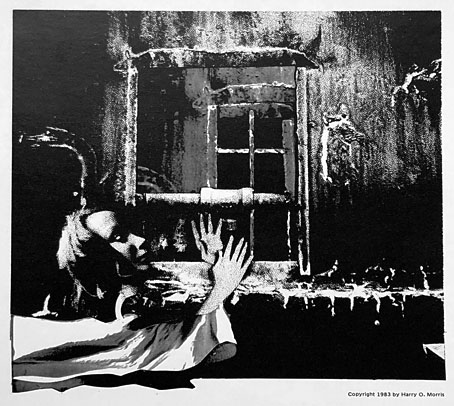
Expert collage artist Harry O. Morris does a better job than Dalí, Magritte and co. in his depictions of Lautréamont’s mutable scenarios. Maldoror is very much a collaged text, a product of its author’s enthusiastic plagiarism, which suggests that if the book has to be illustrated at all then collage is the technique to use. Morris’s interpretation was published in 1983 as Scenes from Lautréamont’s Maldoror, a portfolio of 10 plates. A note from the artist on this page acknowledges the influence of photo-montagist JK Potter, Morris being better known for his collages of engraved illustrations and other pictorial matter.

morris03.jpg

morris04.jpg

morris05.jpg

Continue reading “Harry O. Morris’s Maldoror”

Covering Maldoror

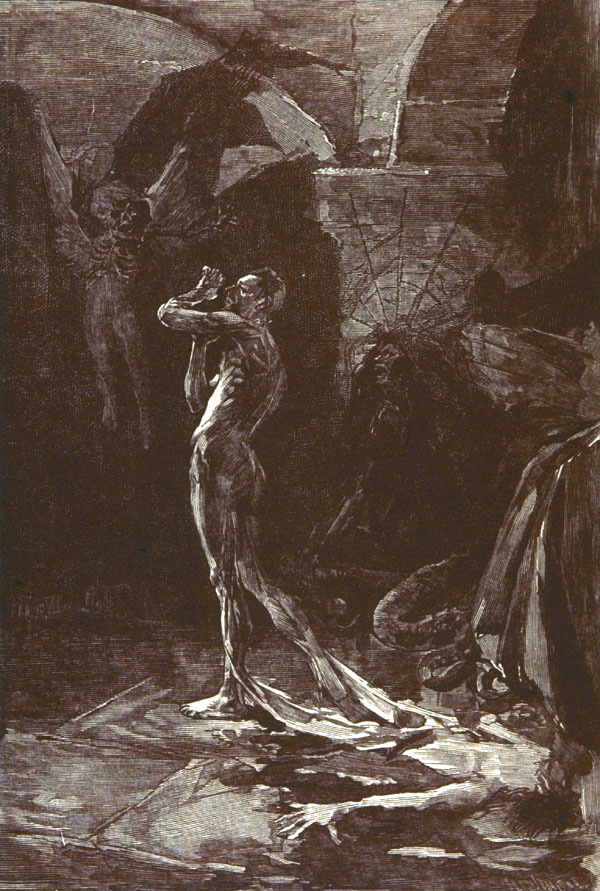
roy.jpg

This illustration by José Roy is a frontispiece created for a rare edition of Les Chants de Maldoror published by Genonceaux in 1890. Roy (1860–1924) was a French artist whose work receives little attention today but his Maldoror illustration happens to be the first of its kind, and a picture that serves the text better than some of those being produced a few years later. The detail of a flayed man stepping out of his skin prefigures Clive Barker by almost a century, a further example of the ways in which Lautréamont’s baleful masterpiece was ahead of his time.

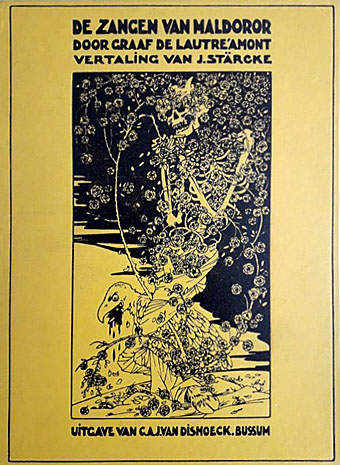
maldoror01.jpg

Netherlands, 1917. Cover art by WF Gouwe.

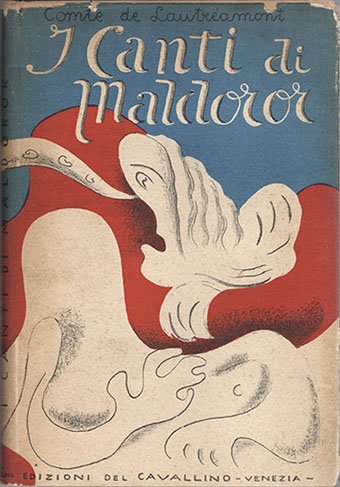
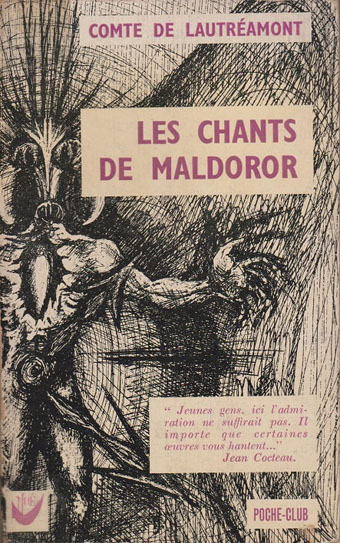
Previous posts here have concerned illustrated editions of Maldoror but this one is all about the covers. Literary classics aren’t always very rewarding in this respect but Maldoror’s textual and imaginative wildness has prompted an assortment of illustrative choices that range from the appropriate to the bewilderingly arbitrary. The following covers are a selection of the more notable examples, avoiding those without pictures or ones that use photographs of the book’s enigmatic author, Isidore Ducasse.

maldoror02.jpg

Italy, 1944. Cover art by Mario De Luigi.

maldoror26.jpg

France, 1947. Cover and interior illustrations by Jacques Houplain.

Salvador Dalí was the first well-known artist to illustrate Maldoror but his 1934 edition was published with plain black boards. Houplain’s illustrations follow the text more closely than do those by Dalí, Magritte or Bellmer, all of whom remain preoccupied with their own obsessions.

maldoror03.jpg

Belgium, 1948. Cover and interior illustrations by René Magritte.

maldoror04.jpg

France, 1963. Cover art by Paul Jamotte.

Continue reading “Covering Maldoror”

Kenneth Anger’s Maldoror

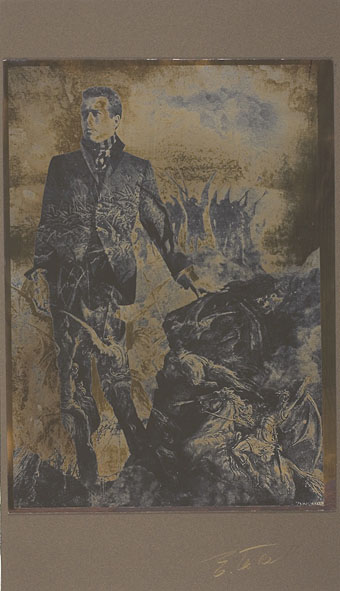
teske.jpg

Kenneth Anger, Topanga Canyon, Composite with Gustave Doré Engraving (1954) by Edmund Teske.

Les Chants de Maldoror, 1951–1952.
16mm; black and white; filmed in Paris and Deauville.

With a hand-held 16mm camera I shot my first series of short haiku. This was my apprenticeship in the marvels that surround us, waiting to be discovered, awake to knowledge and life and whose magical essence is revealed by selection. At 17, I composed my first long poem, a 15 minute suite of images, my black tanka: Fireworks.

I had seen this drama entirely on the screen of my dreams. This vision was uniquely amenable to the instrument that awaited it. With three lights, a black cloth as décor, the greatest economy of means and enormous inner concentration, Fireworks was made in three days.

An example of the direct transfer of a spontaneous inspiration, this film reveals the possibilities of automatic writing on the screen, of a new language that reveals thought; it allows the triumph of the dream.

The wholly intellectual belief of the “icy masters” of cinema in the supremacy of technique recalls, on the literary level, the analytical essays of a Poe or the methods of a Valéry, who said: “I only write to order. Poetry is an assignment.”

At the opposite pole to these creative systems there is the divine inspiration of a Rimbaud or a Lautréamont, prophets of thought. The cinema has explored the northern regions of impersonal stylization; it should now discover the southern regions of personal lyricism; it should have its prophets.

These prophets will restore faith in a “pure cinema” of sensual revelation. They will re-establish the primacy of the image. They will teach us the principles of their faith: that we participate before evaluating. We will give back to the dream its first state of veneration. We will recall primitive mysteries. The future of film is in the hands of the poet and his camera. Hidden away are the followers of a faith in “pure cinema.” even in this unlikely age. They make their modest “fireworks” in secret, showing them from time to time, they pass unnoticed in the glare of the “silver rain” of the commercial cinema. Maybe one of these sparks will liberate the cinema….

Angels exist. Nature provides “the inexhaustible flow of visions of beauty.” It is for the poet, with his personal vision, to “capture” them.

Kenneth Anger—Modesty and the Art of Film, Cahiers du Cinéma no. 5, September 1951

* * *

Little is known about Anger’s activities during the mid-1950s. By 1958 he still had not been able to complete any films in Paris. He held on to his hope of completing Maldoror. His stack of preproduction notes and sketches had grown larger and he had plans to photograph nudes in a graveyard. Several Parisian Surrealists threatened to hand Anger’s head to him if he shot Maldoror. The book’s fluid, dreamlike imagery had been one of the trailblazers of Surrealism, and his detractors felt that a gauche American with a reputation for pop iconography and bold homosexual statement would debase a sacred text.

Bill Landis—Anger: The Unauthorized Biography of Kenneth Anger, 1995

* * *

I discovered the book when I was quite young. I loved it, put a lot of passion into it. I found people to play the parts. I found settings, gaslit corners, places still had the romantic look of a Second Empire. It was a terrific ambition to make this epic film-poem. I found ways to translate the text’s extraordinary images. I planned to film a mid-nineteenth century story taking place in twentieth century Paris. I filmed “the hymn to the ocean” on the beach at Deauville, with Hightower and members of the Marquis de Cuevas Ballet. They danced in the sea; tables were placed beneath the water line so the dancers could stand on their points. It looked as though they were standing on waves. The people who called themselves “Surrealists” were furious—this group of punks threatened me—they didn’t want a Yank messing round with their sacred text. I just told them to go to hell! I also managed to film the war of the flies and pins. I put bags of pins and dozens of flies into a glass container; revolved the container and filmed in close-up. As the pins dropped the flies zigzagged to escape. In slow motion an impressive image.

Kenneth Anger—Into the Pleasure Dome: The Films of Kenneth Anger, edited by Jayne Pilling & Michael O’Pray, 1989

* * *

The sections of the film that were completed [are] stored in the Cinémathèque Française, but [their] exact whereabouts in the archive is unknown, with no images from the film being currently available for reproduction.

Alice L. Hutchinson—Kenneth Anger, 2004

Previously on { feuilleton }
Donald Cammell and Kenneth Anger, 1972
My Surfing Lucifer by Kenneth Anger
Inauguration of the Pleasure Dome: The Eldorado Edition
Brush of Baphomet by Kenneth Anger
Anger Sees Red
Kenneth Anger’s Hollywood Babylon
Lucifer Rising posters
Missoni by Kenneth Anger
Anger in London
Arabesque for Kenneth Anger by Marie Menken
Edmund Teske
Kenneth Anger on DVD again
Mouse Heaven by Kenneth Anger
The Man We Want to Hang by Kenneth Anger
Relighting the Magick Lantern
Kenneth Anger on DVD…finally