Weekend links: the queer edition

queer.jpg

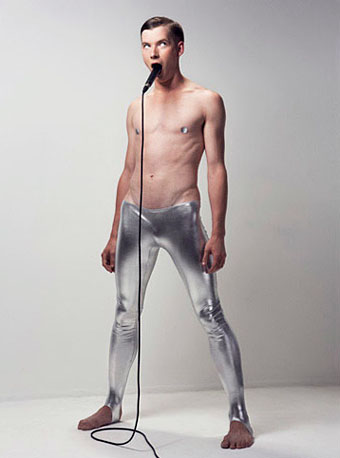
A T-shirt design by artist Daryl Vocat.

Tove Jansson: Out of the Closet. The unorthodox life and work of the woman who gave us the Moomins.

Submissions are now open for PANK’s October special online issue featuring Queer prose, poetry & art.

• More new magazines: Zeus and Made in Brazil Magazine, the latter being a spin-off from the justly-praised weblog of Brazilian hotness.

• An old magazine, called, er…Magazine: “Everything about Magazine was new, from the stark photoless cover design with its bold typeface to the way the men were photographed. The pictures weren’t overtly sexual, but proudly confronted the viewer in a different way: “To us, showing a face was the most important thing because back in 1980, gay people still had to hide their faces,” Lestrade says.” A few pictures from Magazine.

Revealed: The Tradition of Male Homoerotic Art, an exhibition at the Leslie-Lohman Gallery, NYC, from May 12th.

• The programme for the International Dublin Gay Theatre Festival which is running to May 16th.

scissors.jpg

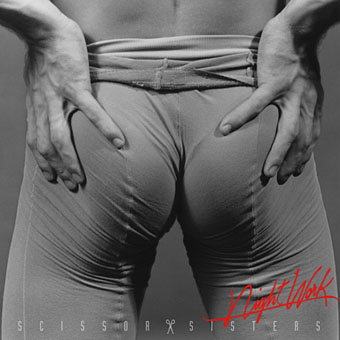
Scissor Sisters have a new album, Night Work, out next month. The cover picture is a photo of dancer Peter Reed by Robert Mapplethorpe. Antony and the Johnsons have announced a new album (and accompanying book) for October.

• Headline of the week: “Christian right leader George Rekers takes vacation with ‘rent boy’ ”. Rekers took issue with the story; his Rentboy.com escort took issue with Rekers’ issue-taking. Then things became unpleasant. And now another escort has come forward.

Henry & Glenn Forever, “a love story to end all love stories”. “Who knew Rollins was such a caring spouse? Who knew Hall and Oates were so infernally evil—yet so considerate?”

• This week’s Tumblr silliness: Lesbians Who Look Like Justin Bieber.

• I’m not on Facebook, nor will I ever be. If you are, however, here’s ten reasons why you should quit. The EFF has six things you need to know about Facebook Connections. Wired thinks that Facebook has gone rogue and an alternative is needed. What does Facebook publish about you and your friends? Finally, Gawker has ten reasons why you’ll be on Facebook forever.

The Prague Pneumatic Post.

How to serve absinthe.

Cthulhu is not cute.

• Song of the week: Gay Messiah by Rufus Wainwright.

Mark Twain

twaintesla.jpg

Nikola Tesla and Mark Twain, 1894.

Mark Twain died 100 years ago today, April 21st, 1910, and the anniversary is being marked in America by a variety of events throughout the year, some of which are listed on this dedicated site. I’ve always been grateful to Twain for cheering a portion of my dismal school days with The Adventures of Huckleberry Finn, one of two books we were forced to read that I actually enjoyed. (The other was Lord of the Flies; both stories, perhaps significantly, concern Wild Boys.) I’ve wanted to re-read Huckleberry Finn for years, perhaps now would be a good time to actually do so.

Unlike many writers of his generation, Twain’s work still seems vital today, and not only his fiction. His broadsides and polemics return continually to basic issues of tolerance and humanity and are often as relevant now as they were a century ago. Twain had little patience for the hypocrisies of his fellows when it came to matters of religion, warfare or the treatment of other human beings; like his contemporary, Oscar Wilde, he’s always been endlessly quotable. Consider these two extracts:

Citizenship? We have none! In place of it we teach patriotism which Samuel Johnson said a hundred and forty or a hundred and fifty years ago was the last refuge of the scoundrel—and I believe that he was right. I remember when I was a boy and I heard repeated time and time again the phrase, ‘My country, right or wrong, my country!’ How absolutely absurd is such an idea. How absolutely absurd to teach this idea to the youth of the country. True Citizenship at the Children’s Theater, 1907

But the truth is, that when a Library expels a book of mine and leaves an unexpurgated Bible lying around where unprotected youth and age can get hold of it, the deep unconscious irony of it delights me and doesn’t anger me. Letter to Mrs FG Whitmore, February 7, 1907

(more)

…then wonder what Twain would have to say about America’s current crop of blustering yahoos with their flags and crosses and misspelled signs.

A copy of the first edition of The Adventures of Huckleberry Finn, illustrated throughout by EW Kemble, can be downloaded at the Internet Archive. For Twain’s dim view of the Bible and its adherents, see his Letters from the Earth. The Tesla Memorial Society has another photograph of Twain in the great inventor’s laboratory.

Weekend links 10

harlequin.jpg

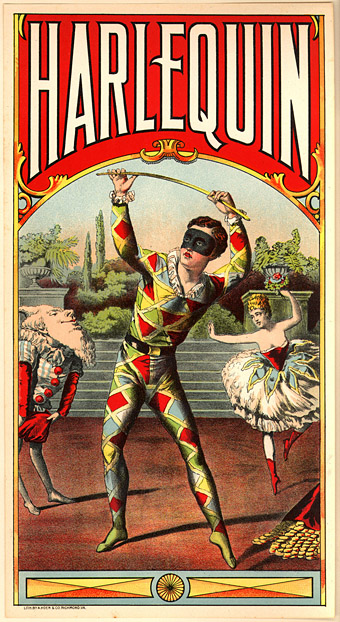
One of a number of vintage ads and ephemeral items at this Flickr set.

• From 1971: The Anthony Balch/William Burroughs/Jan Herman video experiment.

• The NYT reports on World on a Wire, a neglected science fiction drama by Rainer Werner Fassbinder.

• “While some of the technology industry’s brightest minds were inventing the first PCs and developing groundbreaking software, they were also feeding their heads with LSD.”

• The archive of author and illustrator Mervyn Peake has been acquired by the British Library for £410,000.

• Thames & Hudson are publishing I Wonder, a book by the wonderful Marian Bantjes, later in the year. Her site has a preview. I want.

• The gays: It’s election season in the UK so My Gay Vote looks at how the three main parties have supported LGB issues. (No data for the graphs, however.) Is theatre finally glad to be gay? Yet more Tumblrs: I heart skinny boys & Cute boys with cats.

• Trend-spotter, “svengali”, Situationist and the man who named the Sex Pistols: RIP Malcolm McLaren. The Guardian ran a number of memorial pages. Related: Anarchy in Gardenstown.

• Dublin’s One City, One Book choice for April 2010 is The Picture of Dorian Gray.

The Catastrophist: Christopher Hitchens on JG Ballard.

Steampunk Taxidermy by Lisa Black.

• LIFE looks back at Aleister Crowley.

• Groovy songs of the week: Julie Driscoll (with Brian Auger & The Trinity), a pair of songs by Bob Dylan—This Wheel’s On Fire—and Donovan—Season Of The Witch—and sets which look like a collaboration between Verner Panton and Marcel Duchamp. Amazing.

Weekend links 8

adur.jpg

Another label design of mine for the Adur Brewery. Much as I like Otto Weisert’s Arnold Böcklin typeface it’s something I’ve been reluctant to use in the past due to its lazy deployment by UK shop sign makers. The ribbon motifs and the hops are adapted from one of my Art Nouveau reference books, however, so it seemed appropriate in this case.

Dead Fingers Talk: The Tape Experiments of William S. Burroughs, a forthcoming exhibition at IMT, London, “presenting two unreleased tape experiments by William Burroughs from the mid 1960s alongside responses by 23 artists, musicians, writers, composers and curators.” Related: get a Naked Lunch t-shirt (or another cover design) at Out of Print clothing.

Ronald Clyne: American folk modernist. Rediscovering the album and book cover designer.

Better Things: The Life and Choices of Jeffrey Jones. A documentary about the work of artist Jeffrey Jones. Related: Mike Kaluta appears in the trailer and Golden Age Comic Book Stories has pages from Kaluta’s illustrated Metropolis (1988), a novel by Thea von Harbou.

• “I imagined myself as a giant penis launching off from earth like a spaceship.” WFMU’s Beware of the Blog explores Cary Grant’s use of LSD. Related: Orange Sunshine – The Brotherhood of Eternal Love and Its Quest to Spread Peace, Love, and Acid to the World, a book by Nicholas Schou.

• Britain’s armed forces have a lesson for the US: “Only 10 years ago, the Army was expelling soldiers for homosexuality. Now gay weddings get the regimental blessing.” A very modern military partnership.

Cassette tapes and their growing curiosity/fetish value. Related: Michael Stipe and Maison Martin Margiela’s sterling silver microcassette charm.

• Another week, another theremin link: Detergent bottles become theremins.

• “Edinburgh is a city built on the production of books”.

The National Archives UK’s photostream at Flickr.

Typographic playing cards.

• A song for Cary Grant: The Trip by Park Avenue Playground, an obscurity from 1967. And These New Puritans have a new video for Attack Music.

Penda’s Fen by David Rudkin

penda4.jpg

This is a post I’d been intent on writing for the past four years but kept putting off: why go to great lengths to describe another television drama which people can’t see? And how do you easily appraise something which haunted you for twenty years and which remains a significant obsession? My hand has been forced at last by a forthcoming event (detailed below) so this at least has some fleeting relevance, but before getting to that let’s have some facts.

penda3.jpg

Penda’s Fen was a TV play first screened in March 1974 in the BBC’s Play For Today strand. It was shot entirely on film (many dramas in the 1970s recorded their interiors on video) and runs for about 90 minutes. The writer was David Rudkin and it was directed by Alan Clarke, a director regarded by many (myself included) as one of the great talents to emerge from British television during the 1960s and 70s. The film was commissioned by David Rose, a producer at the BBC’s Pebble Mill studios in Birmingham, as one of a number of regional dramas. Rudkin was, and still is, an acclaimed playwright and screenwriter whose work is marked by recurrent themes which would include the tensions between pagan spirituality and organized religion, and the emergence of unorthodox sexuality. Both these themes are present in Penda’s Fen, and although the sexuality aspect of his work is important—pioneering, even—he’s far from being a one-note proselytiser. Alan Clarke is renowned today for his later television work which included filmed plays such as Scum (banned by the BBC and re-filmed as a feature), Made in Britain (Tim Roth’s debut piece), The Firm (with Gary Oldman), and Elephant whose title and Steadicam technique were swiped by Gus Van Sant. Penda’s Fen was an early piece for Clarke after which his work became (in Rudkin’s words) “fierce and stark”.

The most ambitious of Alan Clarke’s early projects, Penda’s Fen at first seems a strange choice for him. Most scripts that attracted Clarke, no matter how non-naturalistic, had a gritty, urban feel with springy vernacular dialogue (and sometimes almost no dialogue). David Rudkin’s screenplay is different: rooted in a mystical rural English landscape, it is studded with long, self-consciously poetic speeches and dense with sexual/mythical visions and dreams, theological debate and radical polemic—as well as an analysis of Elgar’s The Dream of Gerontius. But though Penda’s Fen is stylistically the odd film out in Clarke’s work, it trumpets many of his favourite themes, in particular what it means to be English in the last quarter of the twentieth century.

Howard Schuman, Sight & Sound, September 1998

Spencer Banks is the principal actor in Penda’s Fen, playing Stephen Franklin, an 18-year-old in his final days at school. The BBC’s Radio Times magazine described the film briefly:

Young Stephen, in the last summer of his boyhood, has somehow awakened a buried force in the landscape around him. It is trying to communicate some warning, a peril he is in; some secret knowledge; some choice he must make, some mission for which he is marked down.

penda2.jpg

The magazine also interviewed Rudkin about the film:

“I think of Penda’s Fen as more a film for television than a TV play—not just because it was shot in real buildings on actual film but because of its visual force…

“It was conceived as a film and written visually. Some people think visual questions are none of the writer’s business—that he should provide the action and leave it to the director to picture it all out. For me, writing for the screen is a business of deciding not only what is to be shown but how it is to be seen…

Penda’s Fen is a very simple story; it tells of a boy, Stephen, who in the last summer of his boyhood has a series of encounters in the landscape near his home which alter his view of the world…
Continue reading “Penda’s Fen by David Rudkin”