Weekend links 306

midian.jpg

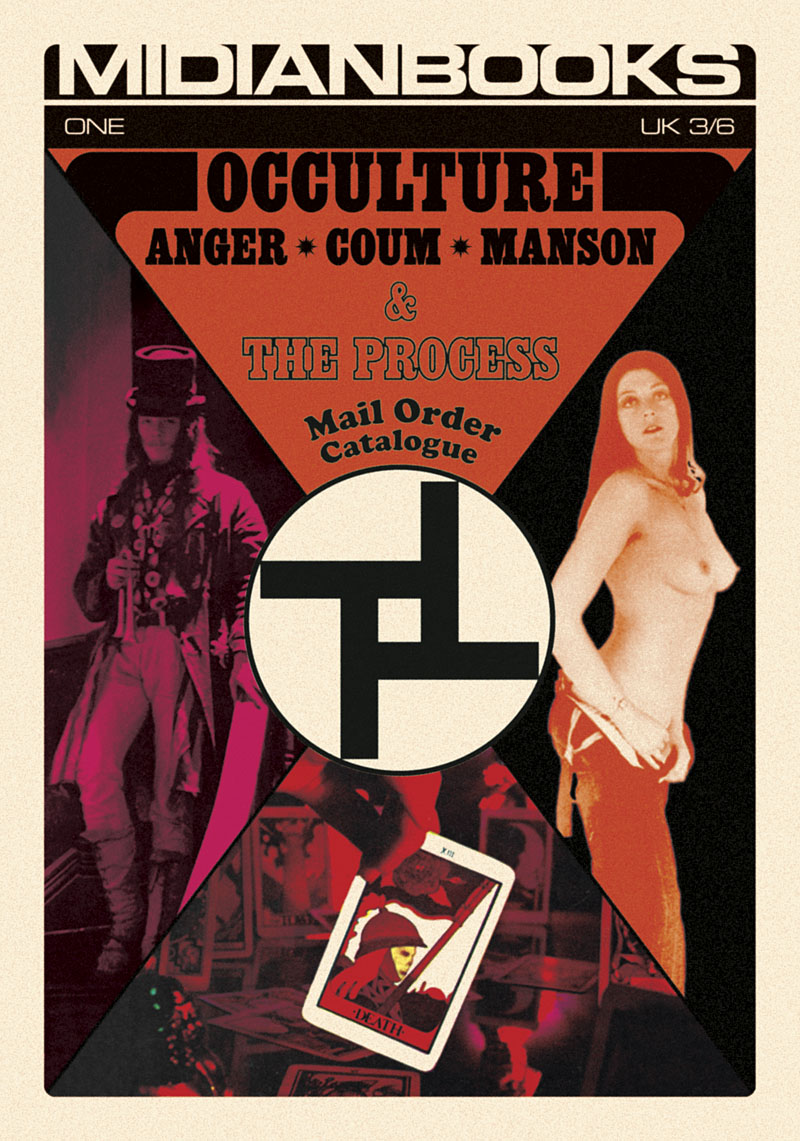
• The Midian Books Occulture catalogue launched this week sporting a cover that I pieced together for Midian’s Jonathan Davies. The design pastiches the look of the Process Church magazines of the early 1970s; inside there’s a haul of Process material on sale together with COUM/Throbbing Gristle ephemera (that’s Cosi Fanni Tutti on the right, as seen on her modelling business card), Kenneth Anger ephemera (that’s Bobby Beausoleil on the left) and much more.

• More occulture: Lost Envoy: The Tarot Deck of Austin Osman Spare launches on 11 May at Camden Arts Centre, Arkwright Road, London NW3 6DG, from 7–9pm. All are welcome.

• Out this week: Close To The Noise Floor – Formative UK Electronica 1975–1984: Excursions in Proto-Synth Pop, DIY Techno and Ambient Exploration.

• Mixes of the week: Spin Doctor’s All Vinyl Prince Tribute Mix, and the Rum Music Mix by Russell Cuzner.

David Gentleman’s illustrations for New Penguin Shakespeare books, 1967–1977.

• More electronica: Walberswick by Jon Brooks is now available in a digital edition.

• Blown up: Steve Rose on how cinema captured the dark heart of the swinging 60s.

• Six Quietus writers choose favourite Prince songs. Related: The A–Z of Prince

A Timeline of Slang Terms for Male Homosexuality by Jonathan Green.

Berenice Abbott’s views of New York streets then and now.

• Jan Švankmajer is crowd-funding his next film, Insects.

Laurie Anderson on the creation of O Superman.

• Blood Ceremony: The Great God Pan (2011) | Oliver Haddo (2011) | Ballad Of The Weird Sisters (2013) | Let It Come Down (2014)

Night’s black agents

dulac.jpg

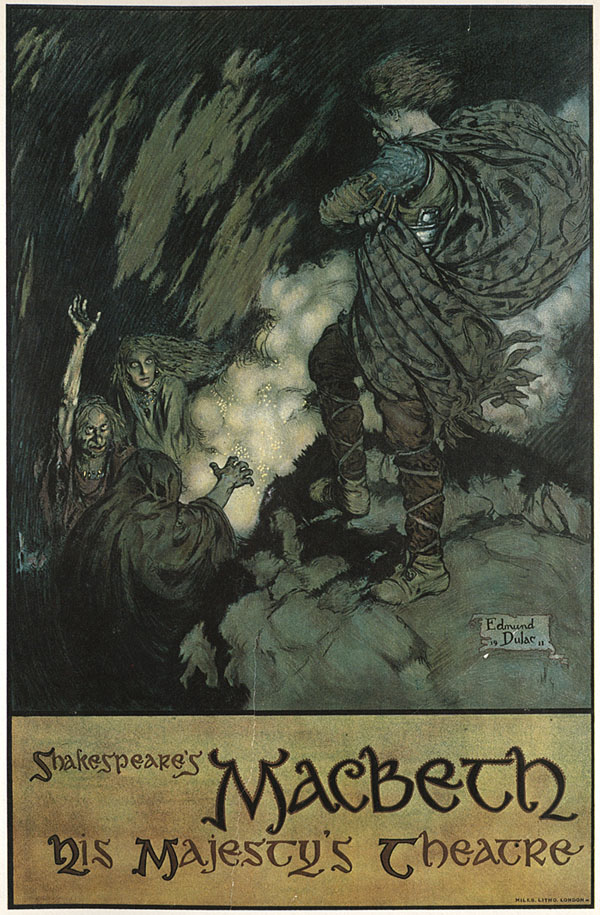
Poster by Edmund Dulac (1911).

This month sees a profusion of events marking the 400th anniversary of Shakespeare’s death so here’s my contribution, a rundown of Macbeths-I-have-seen on screen and stage. I’ve mentioned before that Macbeth and The Tempest are my favourite Shakespeare plays, two dramas concerned with magic of very different kinds. Macbeth is the more popular play, not least for being the more easily adaptable: the supernatural dimension may not suit every circumstance but the themes of treachery, fear, paranoia and a murderous struggle for power are universal. This list contains a wide range of adaptations but there are many film versions I’ve yet to see, including the most recent directed by Justin Kurzel.

welles.jpg

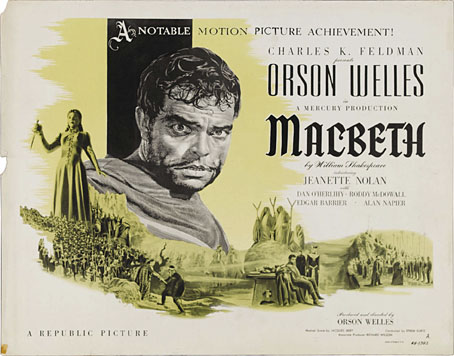
Macbeth (1948), directed by Orson Welles
Orson Welles as Macbeth
Jeanette Nolan as Lady Macbeth

I think the Welles adaptation was the first Macbeth of any kind that I saw so it’s fitting that it begins this chronological list. Famously shot over three hectic weeks on the sound stages of Republic Studios, and with sets made from props previously used in cheap westerns, the result is often eccentric. I’ve a lot of time for Welles as a director but this is one film of his that I’ve never enjoyed very much. His theatre performances (and productions) of Shakespeare began at school, and he was seldom precious with the texts: Chimes at Midnight is a fusion of several different plays while this version of Macbeth uses the same doctored script that he directed for the Voodoo Macbeth in Harlem in 1936. I don’t mind some editing—short scenes such as the witches’ meeting with Hecate are often excised—but some of Welles’ changes are made to support his belief that the witches are directly responsible for Macbeth’s actions, a theory I don’t agree with, and which I’ve never seen given credence elsewhere. This explains oddities such as the appearance of the witches at the very end of the film delivering words from the beginning of the play: “Peace! The charm’s wound up.”

Worse than this is the decision to have most of the cast speaking with vague Scottish accents (a “burr” Welles called it), something that would work with a Scottish cast but which courts disaster with a group of Americans working in haste. The accents may be warranted by the setting but the words of the play are English ones, free of common Scottish colloquialisms such as “ken”, “bairn” and the like. On the plus side, it’s good to see Harry Lime-era Welles performing Shakespeare, and the mist-shrouded production has a barbaric quality that Jean Cocteau appreciated. The forked staff that each witch carries is a detail that I’ve borrowed for drawings on a number of occasions.

joemacbeth.jpg

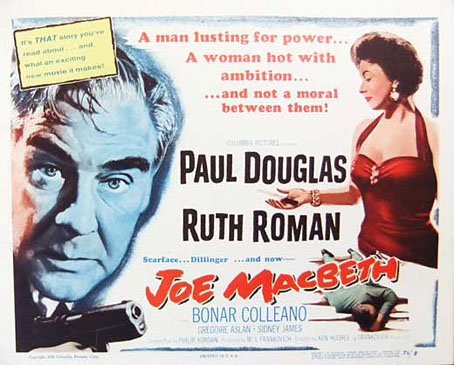
Joe MacBeth (1955), directed by Ken Hughes
Paul Douglas as Joe MacBeth
Ruth Roman as Lily MacBeth

The play reworked as a cheap gangster picture set in the Chicago of the 1930s but made in Britain with a partly American cast. I’ve only seen this once (and many years ago) but I recall it being pretty ludicrous, not least for another accent problem with the English actors doing bad impersonations of Chicago hoodlums. Anyone who grew up watching the Carry On comedy films has a hard time taking Sid James seriously in heavy roles, and here he plays the Banquo character, “Banky”. Joe MacBeth is chiefly notable today for being the first entry in the Macbeth-as-gangster sub-genre; after this there was Men of Respect (1990), Maqbool (2003, an Indian film set in Mumbai), and Macbeth (2006, an Australian film set in Melbourne), none of which I’ve yet seen.

Continue reading “Night’s black agents”

Weekend links 304

stamp.jpg

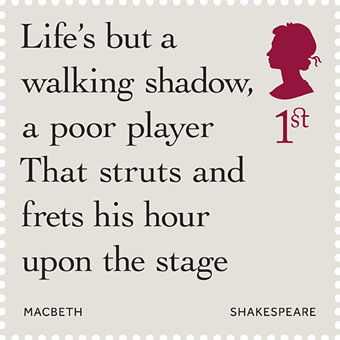
One of ten new stamps designed by The Chase for the Royal Mail’s Shakespeare celebrations.

• “I basically had this problem with bombast and intensity. And I started to feel like it was a nuclear arms race.” Tim Hecker talking to Rick Moody about loud sounds, Icelandic elves and Minimalism. Hecker’s new album, Love Streams, features contributions from Ben Frost and Jóhann Jóhannsson.

• “He joked in a letter to Edmund Wilson that he had ‘managed to get into Harvard with a butterfly as my sole backer.'” Laura Marsh on Nabokov the lepidopterist.

• The brutal musical legacy of JG Ballard by Tim Noakes. Ballard’s own musical taste, as revealed in his choice for Desert Island Discs, was mostly nostalgic.

One outcome of this sense that homosexual people existed in large numbers while still remaining more or less invisible to the naked eye was the suspicion that when they got together they were likely to engage in something more, something even worse than the indulging of a perversion. Notoriously, the networks of homosexuality seemed to transcend many more formal social and political boundaries, reifying crossovers not only between national and ethnic cultures, but between high society and the demi-mondes of bohemian artists, and so forth. The Homintern certainly helped cross-fertilise the arts.

Gregory Woods on the gay artists and writers who changed the world

• Mixes of the week: FACT Mix 544 by Tim Gane, Abs’s Cornerhouse Classics by Abigail Ward, and Secret Thirteen Mix 181 by Broken Bone.

I Can’t Give Everything Away: Jonathan Barnbrook’s text-and graphics video for the song by David Bowie.

• “Chernobyl is spooky, in the manner of all disowned places.” Simon Parkin enters the Zone.

Osman Ahmed on why Doreen Valiente is “the mother of modern witchcraft”.

• The camera obscura art of Abelardo Morell.

An oral history of Taxi Driver.

Swiss graphic design in CSS

• RIP Tony Conrad

Lady Macbeth (1972) by Third Ear Band | In The Back Of A Taxi (1984) by Penguin Cafe Orchestra | Butterfly Mornings (2001) by Hope Sandoval & The Warm Vibrations

Weekend links 303

belbury.jpg

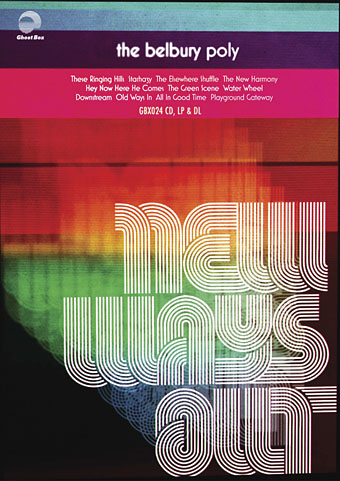
Design by Julian House.

• The last major release by Ghost Box recording artists Belbury Poly was The Belbury Tales in 2012, so news of a new album is most welcome. New Ways Out by The Belbury Poly (that definite article is a fresh addition) will be released next month. The Belbury Parish Magazine has links to larger copies of Julian House’s artwork for this and the recent release from Hintermass, The Apple Tree.

But before New Ways Out appears there’s a compilation album from A Year In The Country released at the end of April. The Quietened Village is “a study of and reflection on the lost, disappeared and once were homes and hamlets that have wandered off the maps or that have become shells of their former lives and times. Audiological contents created by Howlround, Time Attendant, The Straw Bear Band, Polypores, The Soulless Party, The Rowan Amber Mill, Cosmic Neighbourhood, A Year In The Country, Sproatly Smith, David Colohan and Richard Moult.” I’ve been fortunate to hear an advance copy, and it’s an excellent collection.

• “London’s architecture has become laughably boorish, confidently uncouth and flashily arid,” says Jonathan Meades in a review of Slow Burn City: London in the Twenty-First Century by Rowan Moore.

I feel very ill, physically and mentally ill when I hear Christmas carols. I feel so angry, so much like getting out a sniper’s rifle when I hear that kind of music. And Broadway shows with their sentimental songs, those kinds of things are terrifying for me because they call up memories from far back and I don’t necessarily know what they are but they just break me, they break my heart, they break my soul. Iannis Xenakis, the great Greek composer, he said the same thing. He couldn’t listen to the music his mother had played to him when he was young, because it was akin to thinking of someone who was disemboweled. And so for me, if I do a song that’s what you’d say is pretty, my interpretation takes it to another place because it shows the death of the virgin, the animal that goes out in the spring and then gets shot by a hunter. It is prettiness that is very alarming to me, so I tend to do a juxtaposition of something that might be pretty with something that is harsh, just because I feel that they occur in life together.

Diamanda Galás talking to Louise Brown about her work

The Fantastical Otherworlds of Adam Burke: S. Elizabeth talks to the artist behind Nightjar Illustration.

• “I try to frighten myself”: Master musician and curator David Toop on his extraordinary cassette tape archives.

• Silver Machine: Hawkwind’s Space Rock Journey throughout Science Fiction and Fantasy by Jason Heller.

• Mixes of the week: Secret Thirteen Mix 179 by Mesmeon, and a new Italian Occult Psychedelia Festival Mix.

• Offset Identities: Kenneth FitzGerald on graphic designer Barney Bubbles.

The Cine-Tourist lists some of the many cats in the films of Chris Marker.

John Patterson on Ran (1985), Akira Kurosawa’s last great masterpiece.

• Britain’s scarecrows photographed by Colin Garratt.

Strange Flowers explores the city of Turin.

The Museum of Talking Boards

Giallo-themed playing cards

Origami bookmarks

Silver Machine (1972) by Hawkwind | Silver Machine (1973) by James Last | Silver Machine (1988) by Alien Sex Fiend
Weekend links 302

bacchus.jpg

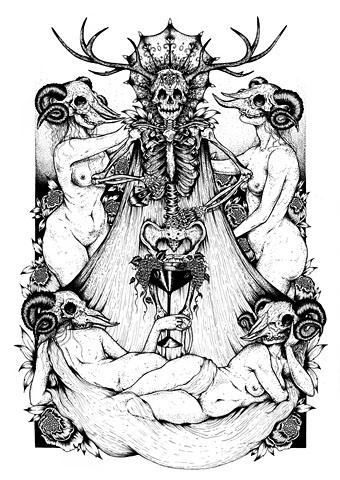
Nymphs of Bacchus by Lozzy Bones.

• “[Jonathan Meades] has a horror of explanation and an even greater one of manifestos, the artless moron’s medium of choice.” The writer turns artist with an “exhibition of Treyfs and Artknacks” at Londonewscastle.

Robert Aickman: Author of Strange Tales is a 50-minute introduction to the writer and his works by RB Russell and Rosalie Parker.

A second volume of  Cosmic Machine: A Voyage Through French Cosmic & Electronic Avantgarde will be landing in May.

Amelia Mangan talks to Kattomic Energy about her horror fiction, and mentions these pages in passing. (Thanks!)

• The Interpretation of Screams: AS Hamrah on David Lynch: The Man from Another Place by Dennis Lim.

• “People thought we were on drugs – and we were!” Minimalist musician Tony Conrad interviewed.

• Two 1975 Buchla concerts by Suzanne Ciani are released for the first time by Finders Keepers.

• Inspiration from above and below: The strange world of… Sunn O))).

• At Dangerous Minds: HR Giger’s ads for the Pioneer Corporation.

• At Dennis Cooper’s: New Queer Cinema (1985–1998).

Graphic Stamps, a history by Iain Follett and Blair Thomson.

Ramsey Campbell’s “Thirteen Novels on the Edge of Horror”.

• The occult artwork of David Chaim Smith.

Easter Woman (1980) by The Residents | Easter Parade (1984) by The Blue Nile | Easterfaust (2014) by The Cosmic Dead