The art of Pinckney Marcius-Simons, 1867–1909

marcius-simons13.jpg

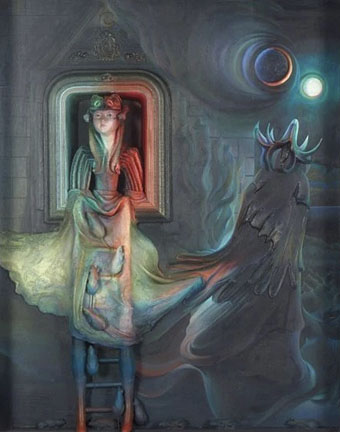
Vision of the Demon.

The Symbolist movement in painting never really took hold in America the way it did in Europe so it’s a surprise to find a new name to add to the very small list of American Symbolists. Pinckney Marcius-Simons painted his share of 19th-century genre pictures but these give way in his later career to canvases that show a distinct Gustave Moreau influence, or perhaps Turner in those nebulous volumes of illuminated vapour. Marcius-Simons was born in New York but lived in Europe for most of his life; he studied in Paris so he would have been able to see Moreau’s work first-hand. A few of his later pictures are rather vague fantasies but his real obsession was with Wagner’s operas, and he spent the last few years of his life working as a set designer at Bayreuth while also creating a series of paintings intended to illustrate the entire run of Wagner’s Ring Cycle. His most remarkable creation isn’t a canvas, however, but a French edition of A Midsummer Night’s Dream which he painted over entirely, even decorating the binding. I’m surprised again that such a unique work isn’t more widely known. Happily the entire book is available online at the Folger Shakespeare Library.

All the usual caveats apply here with regard to the accuracy of titles and dates. There’s even some dispute about the artist’s birth year which is occasionally given as 1865. Most of these pictures have been found on auction sites where larger reproductions may be seen.

marcius-simons03.jpg

Port City.

marcius-simons04.jpg

marcius-simons05.jpg

Sunrise.

marcius-simons12.jpg

The City of Dreams.

Continue reading “The art of Pinckney Marcius-Simons, 1867–1909”

Weekend links 603

weird.jpg

Weird Tales (Canada), May 1942. Cover art by Edmond Good.

• “…in 1968, seven years after the MOMA retrospective, Orson Welles appreciatively got in touch and suggested that Bogdanovich do a book-length set of interviews with him like the one that Bogdanovich had just done with Ford. The resulting book, This Is Orson Welles (which took a winding path to publication, in 1992, seven years after Welles’s death), is a classic of the literature of movies.” Richard Brody on the late Peter Bogdanovich. The book of Welles interviews is one of my favourite film books, as good in its way as Hitchcock/Truffaut, and like Truffaut’s book you wish it was twice as long.

• At Public Domain Review: Paloma Ruiz and Hunter Dukes on Johann Caspar Lavater’s frog-to-human physiognomies. If you reverse the sequence, as I did for one of the illustrations in Lovecraft’s Monsters, you approach The Shadow Over Innsmouth.

• The week in virtual exploration (via MetaFilter): Mini Tokyo 3D and Explore the Soane Museum, London.

• Submissions are open for the 16th issue of Dada journal Maintenant which will have the theme “Nyet Zero”.

• At Spoon & Tamago: Artists and artisans collaborate on exhibition of 144 maekake aprons.

• DJ Food unearths flyers and posters for the Million Volt Light & Sound Rave, 1967.

• Mix of the week: Isolatedmix 116 by Chris SSG.

• At Dennis Cooper’s: Stephen Dwoskin Day.

The Little Blue Frog (1970) by Miles Davis | Jail-House Frog (1972) by Amon Düül II | Tree Frog (1995) by Facil

Weekend links 602

hightimes.jpg

High Times, May 1980. Cover art by Frank Frazetta.

• Desperately Seeking Mothman: “The Scythian Lamb, after all, was equal parts Venus flytrap and baby lamb, a mysterious woolly gourd,” says Tara Isabella Burton, on the trail of cryptids old and new.

• “In my youth of course I indulged in such stunts as bringing forth a Boramez, or a so-called vegetable lamb.” It’s that lamb again, in a translation of pages from The Voynich Manuscript.

• “2022: Be willing to be dazzled,” says S. Elizabeth. Also, follow her blog because she’s always turning up strange and wonderful things.

• “Why do we count down to the New Year?” Alexis McCrossen explores the history of countdowns, from Fritz Lang to the present day.

• “Snow coats reality in a fresh layer of strangeness,” says Charlie Fox.

• Spending the War Without You: Laurie Anderson’s Norton Lectures.

• New music: Our Hands Against The Dusk by Rachika Nayar.

• Mix of the week: Fact Mix 840 by Time Is Away.

• Galerie Dennis Cooper presents…Piet Zwart.

Does It Matter Irene? (1979) by The Mothmen | Tardis (Sweep Is Dead, Long Live Sweep) (1981) by The Mothmen | Mothman (1981) by The Mothmen

Weekend links 601

innocents.jpg

The Innocents (1961), one of the great cinematic ghost stories.

• “Out of the many adaptations, Jack Clayton’s [The Innocents] is considered the benchmark. The film celebrated its 60th anniversary this year, having premiered in London on the 24th of November, 1961. Considering the sheer number of competitors to Clayton’s version, it is telling of the film’s qualities that it still stands far and above its many peers. In fact, it is difficult to see James’s story without those stark black-and-white images of the film coming to mind, as well as its stunning central performance by Deborah Kerr. Suffice to say, 60 years on, James’s screen ghosts still haunt.” Adam Scovell on the many adaptations of The Turn of the Screw by Henry James.

• “I wanted to turn sex into art because art makes sense of life.” Jack Fritscher talks to photographer Rick Castro about gay S&M fetishes, Drummer magazine, Robert Mapplethorpe, and his BDSM porn studio, Palm Drive Video.

• “Fela was a very good human resources manager.” Lemi Ghariokwu, creator of over 2,000 album covers, talks to Nathan Evans about his time working for Fela Kuti.

I’ve been approached several times to ‘make an NFT’. So far nothing has convinced me that there is anything worth making in that arena. ‘Worth making’ for me implies bringing something into existence that adds value to the world, not just to a bank account. If I had primarily wanted to make money I would have had a different career as a different kind of person. I probably wouldn’t have chosen to be an artist. NFTs seem to me just a way for artists to get a little piece of the action from global capitalism, our own cute little version of financialisation. How sweet—now artists can become little capitalist assholes as well.

Brian Eno on the fool’s-goldrush du jour

• At Vimeo: The Snail on the Slope, a film of generative processes by Vladimir Todorovic based on the strange science-fiction novel by Arkady and Boris Strugatsky.

• At Dangerous Minds: an exploration of Eight Songs for a Mad King by Peter Maxwell Davies, “one of the most insane pieces of music ever written”.

• “This is how one ought to see, how things really are.” Ido Hartogsohn on Aldous Huxley’s mescaline experiments.

• Always an essential guide: The Wire magazine’s releases of year.

• The end of December brings us Alan Bennett’s diary at the LRB.

• At Dennis Cooper’s: Ryoji Ikeda Day.

Innocenti (1992) by Brian Eno | Innocent Square [excerpt] (2011) by Christian Skjødt Hasselstrøm | First In An Innocent World (2016) by The Pattern Forms

Short films by Gérald Frydman

frydman01.jpg

Scarabus.

After writing about Gérald Frydman’s animated short Scarabus (1971) last year it’s taken me all this time to get round to watching the other films on his Vimeo channel, most of which are also animations. Scarabus was of interest for its deftly-crafted Surrealism, and there’s more of the same in some of these later films, especially Agulana. As with another Belgian director, Raoul Servais, Frydman directs all his films but doesn’t always animate them himself, hence the variety of art styles.

frydman02.jpg

Agulana (1976) is a kind of sequel to Scarabus with human figures being menaced and oppressed in a transforming environment. The Magritte quotient in films such as this raises the question of whether Magritte-ness (for want of a better term) is a quality unique to René Magritte or a component of the general Belgian character. Jonathan Meades insists on the latter in an excellent film of his own about Belgium.

frydman03.jpg

Alepha (1980) is more Surrealism, which in this case brings to mind the animated films of Piotr Kamler. Naked figures drift over landscapes filled with ambulatory spheres, vast spikes and other structures. Where Kamler favoured electronic soundtracks by Luc Ferrari and Bernard Parmegiani, Frydman has regular collaborator Alain Pierre provide a score of electronic drones.

frydman04.jpg

La Photographie (1983) is the first of two short films set in the 19th century. This one is little more than an anecdote, with a bored family forced to remain motionless while their photograph is taken, a process that lasts for the entire duration of the film. Outside the studio we see a Jules Verne wonderland of new inventions—dirigibles, rapid transport, electric light, typewriters and so on—where the frenetic activity contrasts with the inertia of the photographic process.

frydman05.jpg

Le Cheval de Fer (1984) is another photographic anecdote, this time concerning the wager prompted by an argument about whether a horse’s legs left the ground when it was galloping (and if so, at what point). The argument was famously settled by Eadweard Muybridge who invented a system to photographically record animal locomotion, thus paving the way for cinema, and for film animation.

frydman06.jpg

Les Effaceurs (1991) is Surrealism of a dark and disturbing kind with people urgently trying to scrub away their facial features.

Also on Frydman’s channel is La Sequence Silverstein (2000), a short science-fiction scenario which he wrote but didn’t direct. This one is live action and with dialogue in unsubtitled French. It not bad but I prefer the animations.

Previously on { feuilleton }
Raoul Servais: Courts-Métrages
Scarabus, a film by Gérald Frydman
L’Araignéléphant
Le labyrinthe and Coeur de secours
Chronopolis by Piotr Kamler