Weekend links 844

ayers.jpg

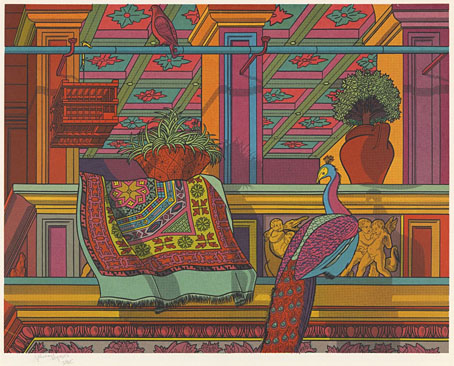
Crivelli’s Room I (1967) by Gillian Ayers.

• “This is the first film ever made about HP Lovecraft—and almost no one has seen it. Shot in 1989–90, it features unique interviews with Lovecraft’s friends and colleagues. It has sat unfinished for more than thirty-five years. We need your help to complete it and release it for the first time.” Lovecraft: When the Stars are Right, a documentary directed by Seán Martin, is asking for funding assistance to help digitise the extant footage. Watch the crowdfunding trailer.

• New music: Oblique by Ghost Dubs; Serpentine by Christer Bothén / Oren Ambarchi / Johan Berthling / Andreas Werliin; The Cardboard Falcon by Mico Nonet.

• Among the new titles at Standard Ebooks, the home of free, high-quality, public-domain texts: The Lost Stradivarius, by John Meade Falkner.

• At Nautilus: Kristen French talks to Devon Stoliker about the latest researches into psilocybin experiences using an fMRI scanner.

• At Colossal: “On vintage boards, Lou Benesch conjures the fantastic world of The Magician”.

Amazonie (2020): music by Jonathan Fitoussi; animation by Jules Guérin.

• The Strange World of…Adam Curtis.

• RIP Frank Beard.

Rolling Stone

The Pink Room (1988) by Seigen Ono | The Darkened Room (1995) by David Toop | The Room Of Accidental Geometry (2000) by Harold Budd

Mystical prints by Olga Fröbe-Kapteyn

kapteyn07.jpg

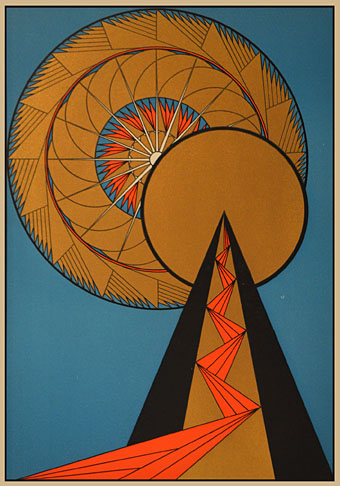
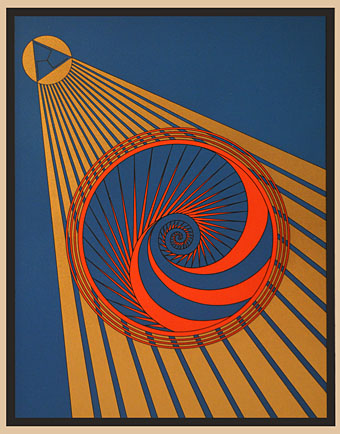
The Central Spiritual Sun.

This picture appears on the cover of an album of electronic music, The Golden Apples Of The Sun by Suzanne Ciani and Jonathan Fitoussi, which was released last Friday. Being already partial to the music of both Ms Ciani and Monsieur Fitoussi I’ve been enjoying this one (although there’s no CD…bah), and was curious about the cover art which I took at first for a contemporary creation. The artist, Olga Fröbe-Kapteyn (1881–1962) was born in the Netherlands but spent most of her life in Zurich where she was friends with Carl Jung, Richard Wilhelm and other mystically-inclined intellectuals, and where she formed Eranos (later the Eranos Foundation), a conference/institute for the exchange of ideas between West and East.

kapteyn01.jpg

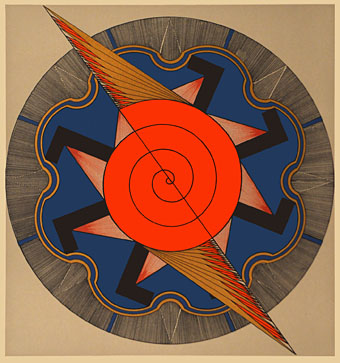
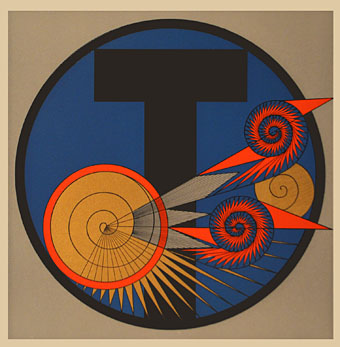
Eternal Energy.

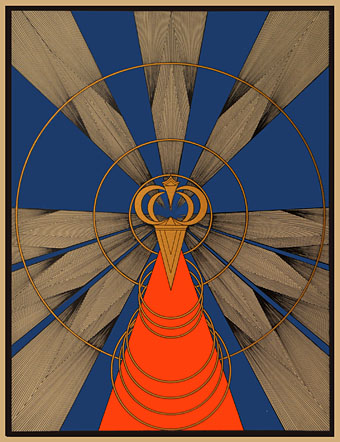
Fröbe-Kapteyn wasn’t a full-time artist, the screenprints she made in the 1930s appear to be an offshoot of her researches into archetypal symbolism, but she had an evident flair for this kind of image making. The Central Spiritual Sun is one of a series of 14 prints which are described as “Theosophist” although I can’t vouch for the accuracy of this. At least one of them (Kether, The Crown) refers to the Kabbalah, while several others have obvious Christian qualities. For those who like the Ciani/Fitoussi cover art, there’s an edition of the vinyl release of The Golden Apples Of The Sun that comes with a poster reproduction.

kapteyn02.jpg

Kether, The Crown.

kapteyn03.jpg

Reincarnation.

kapteyn04.jpg

The Divine Breath.

Continue reading “Mystical prints by Olga Fröbe-Kapteyn”

Weekend links 678

hablik.jpg

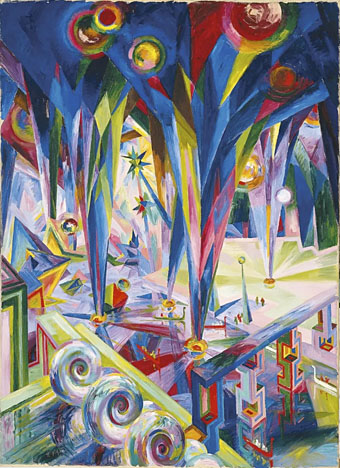
Interior of a Cathedral (1921) by Wenzel Hablik.

• The inevitable Cormac McCarthy features: “Cormac McCarthy took us beneath the surface,” says Kevin Berger at Nautilus magazine, publishers of McCarthy’s essay about the origins of language. At The Paris Review, three writers reminisce about reading McCarthy’s fiction.

• At Bajo el Signo de Libra: Bhupen Khakhar (1934–2003). “Su obra examina las implicaciones políticas y socioculturales de la homosexualidad en la India.”

Dennis Cooper’s favourite fiction, poetry, non-fiction, film, art, and internet of 2023 so far. Thanks again for the link here!

• New music: Telepathic Heights by Hawksmoor, and Golden Apples of the Sun by Suzanne Ciani & Jonathan Fitoussi.

• Mixes of the week: DreamScenes – June 2023, and isolatedmix 121: Oslated & Huinali Showcase mixed by S-Pill.

• At Unquiet Things: Crystal Castles and Harmonious Heavens: Wenzel Hablik’s Glittering Utopias.

• At Public Domain Review: Wonder and Pleasure in the Oude Doolhof of Amsterdam.

• At Spoon & Tamago: Exploring Tokyo’s Hidden Shrines.

• At Aquarium Drunkard: Bush Tetras interviewed.

Ben Chasny’s favourite albums.

• RIP Glenda Jackson.

Utopiat No. 1 (1973) by Utopia | Utopia (2000) by Goldfrapp | Utopia (2013) by Brown Reininger Bodson

Weekend links 649

chihuly.jpg

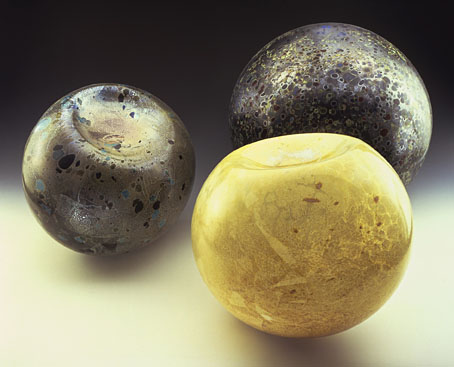
Niijima Floats: Mottled Blue Black Float with Silver Leaf (1991) by Dale Chihuly.

• “Blue whale songs fall below the range of human hearing. If you want to listen to one, to actually hear its ethereal patterns of wobbly pulses and haunting moans, you have to speed it up by at least two-fold. But according to Hildebrand and McDonald’s instruments, the tonal frequencies of the songs had been sinking to even greater depths for three straight years. ‘This is weird,’ Hildebrand thought. To figure out if it was just an anomaly or something more, Hildebrand and McDonald embarked on a quest to find some really old songs. Eventually they got their hands on some of the earliest known recordings, created by the Navy in the 1960s and stored on analog cassettes. They were floored. The frequencies had declined by 30 percent over 40 years.” Kristen French on a mysterious development in blue whale songs.

• “She didn’t see it as a game, or for divination, but as a model of the universe.” Joanna Moorhead on the Tarot designs of Leonora Carrington.

• “A collection of blogs about every topic”: ooh.directory. (Ta to whoever added this place to the list.)

• New music: Pop Ambient 2023 by Various Artists, and Aeolian Mixtape by Quinta.

• At Public Domain Review: The Tanzmasken of Lavinia Schulz and Walter Holdt.

• At Wormwoodiana: Mark Valentine on mazes and labyrinths. (Previously)

• At Spoon & Tamago: Paper-cut cityscapes by kirie artist Hiroki Saito.

• At Smithsonian Magazine: The Unrivaled Legacy of Dale Chihuly.

• Mix of the week: Neo-Medieval Mix by Moon Wiring Club.

• Old music: Back To The Woodlands by Ernest Hood.

• At Dennis Cooper’s: Jacques Rivette Day.

Weyes Blood’s favourite music.

(Gorgeous Curves Lovely Fragments Labyrinthed On Occasions Entwined Charms, A Few Stories At Any Longer Sworn To Gathered From A Guileless Angel And The Hilt Edges Of Old Hearts, If They Do In The Guilt Of Deep Despondency.) (2004) by Akira Rabelais | The Private Labyrinth (2008) by The Wounded Kings | Labyrinths (2018) by Jonathan Fitoussi & Clemens Hourrière

Weekend links 641

coin.jpg

For mysterious and eldritch reasons the Republic of Palau has minted a Cthulhu-themed 20 dollar coin. Via.

• “Pre-gap tracks are a CD-specific phenomenon, paralleled only by DVD Easter Eggs, or hidden levels in a computer game. On the one hand, they’re only possible digitally, on the other, they seem to be an attempt to add some mystique to a circle of plastic.” Daryl Worthington on the 40th anniversary of the Digital Audio Compact Disc. Regular readers will know that CD has been, and remains, my favourite musical format for reasons I won’t bother arguing here. Related: Wikipedia’s list of albums with tracks hidden in the pregap. Also: “There’s endless choice, but you’re not listening”: fans quitting Spotify to save their love of music.

• “Meek’s use of sound effects and swathes of ghostly reverb, woven into seemingly innocuous pop songs and rock and roll instrumentals—as if the BBC Radiophonic Workshop was directed by Phil Spector—created a sense of the sublime and hinted at strange realities beyond our own.” Mark Pilkington explores the strange world of Joe Meek.

• “Structured as a ‘dream within a dream’, the narrative weaves together mythological, biblical, and occult references to construct a universe filled with ruinous landscapes and orgiastic celebrations.” Demetra Vogiatzaki on the enigmas, architectural and otherwise, presented by Hypnerotomachia Poliphili (1499).

The man who made this absurd noir was answerable neither to studio nor Shakespeare, but only his own monumental whims. Thus, Mr. Arkadin sends Citizen Kane (1941) through the looking glass—the action transposed to post–World War II Spain and given a spin somewhere between metaphysics and megalomania…

If Jean Cocteau’s Orpheus recast myth as pulp, Mr. Arkadin elevates pulp to myth. It is the most Borgesian of Welles’s movies. Writing in Cahiers du cinéma, the young Eric Rohmer compared Mr. Arkadin to Jules Verne and Fantômas: It creates something that is ­nearly impossible today: a romantic fiction that involves neither the future nor any removal from one’s usual surroundings…

J. Hoberman writing in 2006 about Orson Welles’ Mr. Arkadin (1955). I was rewatching the film earlier this week in its guise as Confidential Report, the version re-edited by its producer to try and create something with greater commercial appeal. I’ve yet to see the recent restoration but even in its butchered form it’s a fascinating piece of work

Early Cormac McCarthy interviews rediscovered: “Between 1968 and 1980, he gave at least 10 interviews to small local papers in Lexington, Kentucky and east Tennessee, a region where he lived and had friends.”

• New music: Perceptions by Model Alpha (Jonathan Fitoussi & Julie Freyri), and Epektasis by Nicklas Barker.

Dreams of Space: Books and Ephemera; “Non-fiction children’s space flight stuff 1945–1975”.

• At Dennis Cooper’s: Roget Malot presents…Spirit Photography Day.

• Mix of the week: A mix for The Wire by FOQL.

Spirit (1978) by Frédéric Mercier | Spirit (1990) by Jah Wobble’s Invaders Of The Heart | Spirit Level (Lost In Space) (1992) by Horizon 222