
Weekend links 844

ayers.jpg

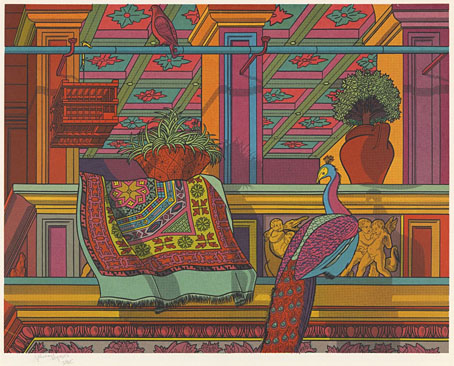
Crivelli’s Room I (1967) by Gillian Ayers.

• “This is the first film ever made about HP Lovecraft—and almost no one has seen it. Shot in 1989–90, it features unique interviews with Lovecraft’s friends and colleagues. It has sat unfinished for more than thirty-five years. We need your help to complete it and release it for the first time.” Lovecraft: When the Stars are Right, a documentary directed by Seán Martin, is asking for funding assistance to help digitise the extant footage. Watch the crowdfunding trailer.

• New music: Oblique by Ghost Dubs; Serpentine by Christer Bothén / Oren Ambarchi / Johan Berthling / Andreas Werliin; The Cardboard Falcon by Mico Nonet.

• Among the new titles at Standard Ebooks, the home of free, high-quality, public-domain texts: The Lost Stradivarius, by John Meade Falkner.

• At Nautilus: Kristen French talks to Devon Stoliker about the latest researches into psilocybin experiences using an fMRI scanner.

• At Colossal: “On vintage boards, Lou Benesch conjures the fantastic world of The Magician”.

Amazonie (2020): music by Jonathan Fitoussi; animation by Jules Guérin.

• The Strange World of…Adam Curtis.

• RIP Frank Beard.

Rolling Stone

The Pink Room (1988) by Seigen Ono | The Darkened Room (1995) by David Toop | The Room Of Accidental Geometry (2000) by Harold Budd
Weekend links 716

poynter.jpg

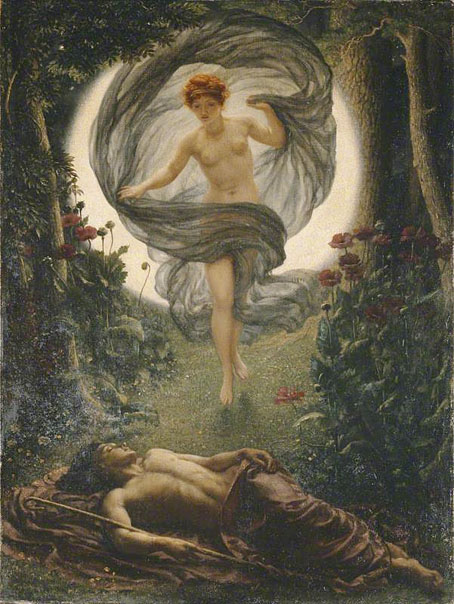
The Vision of Endymion (1902) by Edward John Poynter.

The Art and History of Lettering Comics by Todd Klein. Eight of the pages in the forthcoming Moon & Serpent book have been lettered by Todd.

• At Igloomag: Chang Terhune looks for music to help you sleep. No mention of an obvious (and superior) candidate, Sleep by Max Richter.

• New music: Ghosted II by Oren Ambarchi, Johan Berthling and Andreas Werliin; and The Ship by David Shea.

But unlike macroscopic drugs like cannabis, LSD is so small and so powerful that its consumption almost always requires an inert housing—the water, tablets, sugar cubes, bits of string, or pieces of paper that transport the drug from manufacturer to tripper. In the law, this vehicle is described as the “carrier medium,” an object impregnated with drugs, one that can be sold, seized, presented as evidence, and dissolved into the hearts, minds, and guts of consumers.

When you print images onto a paper carrier medium, you are adding another layer of mediation to an already loopy transmission. Hence, a meta medium, a liminal genre of print culture that dissolves the boundaries between a postage stamp, a ticket, a bubble gum card, and the communion host. This makes blotter a central if barely recognized artifact of psychedelic print culture, alongside rock posters and underground newspapers and comix, but with the extra ouroboric weirdness that it is designed to be ingested, to disappear. Blotter is the most ephemeral of all psychedelic ephemera. It is produced to be eaten, to blur the divide between object and subject, dissolving material signs and molecules into a phenomenological upsurge of sensory, poetic, and cognitive immediacy.

Erik Davis, in an extract from Blotter: The Untold Story of an Acid Medium

• At Wormwoodiana: John Howard on The London Adventure, or, The Art of Wandering by Arthur Machen.

• At Unquiet Things: Hidden Marvels on Your Bookshelf: The Artistic Legacy of Laurence Schwinger.

• “Some intelligent civilizations will be trapped on their worlds”. Evan Gough explains.

• At Vinyl Factory: The Latin-American women of 20th-century electronic music.

• At Dennis Cooper’s: Steve Erickson presents A Black Psychedelia Primer Day.

• At Public Domain Review: Animated Putty by Walter R. Booth.

Vinita Joshi’s favourite music.

Sleepy Theory (1982) by Weekend | Sleep 3 (1995) by Paul Schütze | Sleep Games (2012) by Pye Corner Audio