Weekend links 141

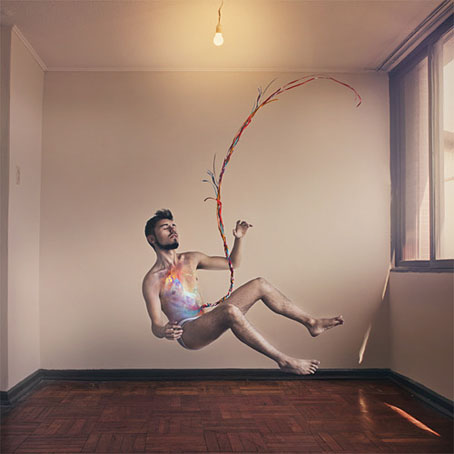
nguyen.jpg

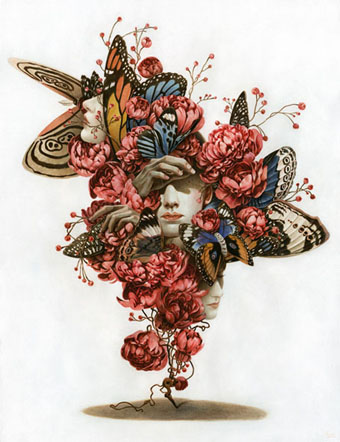
From the Beautiful Faces series (2012) by Tran Nguyen.

• “What possessed a generation of young European artists, and a few Americans, to suddenly suppress recognizable imagery in pictures and sculptures? Unthinkable at one moment, the strategy became practically compulsory in the next.” Peter Schjeldahl on the birth of abstraction.

• “A profanely mystical work of hyperpurple theory-porn, ObliviOnanisM is an auto-erotic intellectual fiction envisioning the phantastical unending odyssey of a young woman, Gemma, whom you will never know.”

Psychedelia—An Ancient Culture, A Modern Way of Life, a 520-page history of psychedelic culture by Patrick Lundborg. Related: Ken Kesey talks about the meaning of the Acid Tests.

[Hodges] made a convincing case that Turing’s teenage crush on a fellow schoolboy, Christopher Morcom, was an important catalyst for his lifelong preoccupation with the relationship between brain and mind. Morcom’s unexpected death at the age of eighteen was a shattering blow to Turing, who began to reflect on whether his friend’s consciousness might survive after death or whether it was simply a result of complex material processes and expired when life did. Hodges also linked the famous “Turing Test”, in which a computer attempts to pass as an intelligent human being, to Turing’s own dilemma as a gay man in a homophobic world. (Turing called his test the “imitation game”, and Hodges observed, “like any homosexual man, he was living an imitation game, not in the sense of conscious play acting, but by being accepted as a person that he was not”.)

Michael Saler reviews three books about computing pioneer Alan Turing

• Paul Gallagher at Dangerous Minds looks at Flowers, Lindsay Kemp’s theatrical staging of Genet’s Our Lady of the Flowers.

David Pearson designed a new edition of George Orwell’s Nineteen Eighty-Four for Penguin.

• Quadtone – Lumisonic Rotera: Mariska de Groot plays a light-to-sound instrument.

“Cash Mobs” Go Global—Battle Spreads Against Chain Store Dominance.

Cities and the Soul: a feast of Italo Calvino links at MetaFilter.

25 dessins d’un dormeur, Jean Cocteau, 1929.

Haunted Decor: a Flickr group.

Computer In Love (1966) by Perrey & Kingsley | Computer Love (1981) by Kraftwerk | Computer Love (1992) by The Balanescu Quartet

The weekend artists, 2012

barnes.jpg

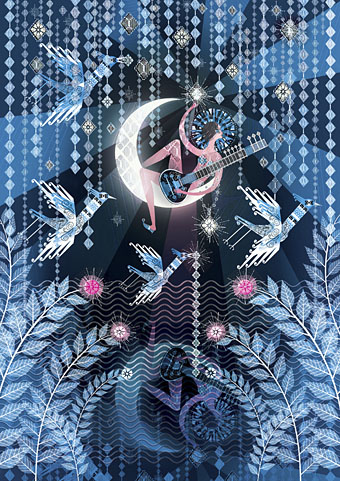
Lucy in the Sky with Diamonds (2012) by Lesley Barnes. She also has peacock wrapping paper.

The most popular post of the year was one I made last December featuring all the artists whose work had appeared throughout 2011 in the weekend links posts. (The surge of views occurred early in January when it was linked on Stumbleupon.) Since I’ve been away this week there aren’t any links so here’s a retrospective of things that caught my eye in 2012.

durette.jpg

Heartsick (2011) by Kelly Durette.

jacobsen.jpg

Self-portrait by Jon Jacobsen from his Home series.

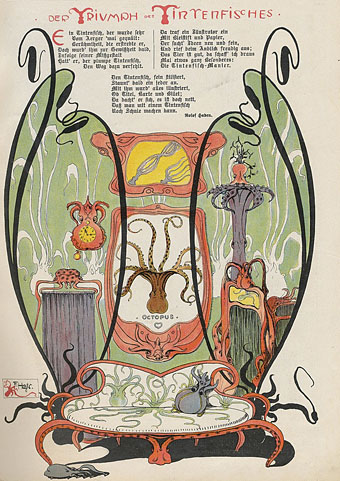
tintenfisches.jpg

Der Triumph des Tintenfisches from Meggendorfer-Blätter (c. 1900). Via Beautiful Century.

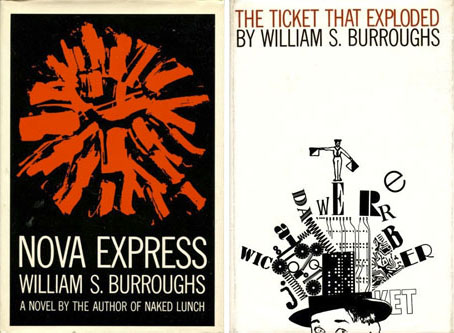
kuhlman.jpg

Two Grove Press covers by Roy Kuhlman. From Arden Kuhlman Riordan’s Pinterest page collecting her father’s cover designs.

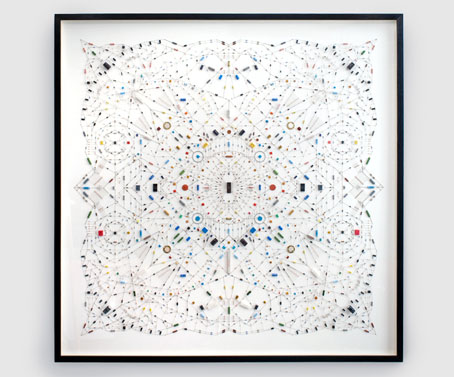
ulian.jpg

Technological mandala 02 (The beginning) (2012) by Leonardo Ulian.

Continue reading “The weekend artists, 2012”

Weekend links 140

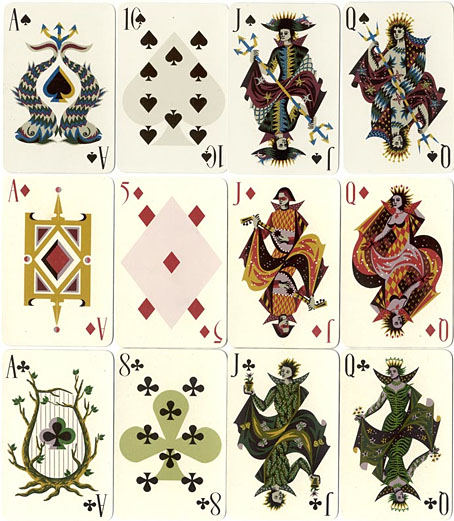
cards.jpg

Thanks to Callum for pointing the way to a beautiful set of playing cards designed by Picart le Doux.

Of cigars and pedants by Houman Barekat, in which Vladimir Nabokov has a problem with Henry James. Tangentially related: Post-Punk’s Nabokov: Howard Devoto and Magazine, live from Berlin, 1980. (Given A Song From Under The Floorboards, and lines like “I could have been Raskolnikov / But mother nature ripped me off”, I’d say it’s more accurate to describe Devoto as Post-Punk’s Dostoyevsky.)

• “I was introduced to Kneale’s work like most kids: by a fifty-foot hologram of a psychic locust and a British colonel deliquesced by five million years of bad Martian energy.” In Keep Me in the Loop, You Dead Mechanism Dave Tompkins looks back at Nigel Kneale’s TV play The Stone Tape. I reported my own impressions at the end of October.

• At The Quietus this week, Carol Huston on Lord Horror: A History Of Savoy Publishing. Michael Butterworth is interviewed, and the piece includes some quotes from earlier interviews by yours truly.

As the Massachusetts minister Increase Mather explained in 1687, Christmas was observed on Dec. 25 not because “Christ was born in that Month, but because the Heathens Saturnalia was at that time kept in Rome, and they were willing to have those Pagan Holidays metamorphosed into Christian” ones. So naturally, official suppression of Christmas was foundational to the godly colonies in New England.

Rachel N. Schnepper on the Puritan War on Christmas.

• Maxine Peake and the Eccentronic Research Council have a seasonal song for you. Take the title, Black ChristMass, as a warning. The group recently played live on The Culture Show.

• Clive Hicks-Jenkins’ Artlog is currently hosting Alphabet Soup, an online exhibition by different artists each depicting the letters of the alphabet. Start here and click forward.

Ornate Typography from the 19th Century featuring samples from the King George Tumblr. Related: Sheaff ephemera.

saturn.jpg

Saturn at Saturnalia. A Cassini image of the planet’s nightside.

Kenneth Anger interviewed by P. Adams Sitney. A 53-minute tape recording from 1972.

• At The Outer Church: James Ginzburg of Emptyset posts a winter music mix.

When Candy Darling met Salvador Dalí.

The psychedelic secrets of Santa Claus.

• At Pinterest: Camp as…

Saturn (1956) by Sun Ra | Permafrost (live, 1980) by Magazine | Uptown Apocalypse (1981) by B.E.F.

Weekend links 139

barnes.jpg

Lucy in the Sky with Diamonds (2012) by Lesley Barnes. She also has peacock wrapping paper.

Big thanks to Dennis Cooper for including this blog in his favourite music, fiction, poetry, film, art & internet lists for 2012. Lots of good company there. One benefit of end-of-year lists is the way they suggest things to look for in January.

• “…the best pictures of dicks that I’ve ever seen…” Rudy Rucker reviews Malcolm McNeill’s The Lost Art of Ah Pook Is Here and Observed While Falling, out at last from Fantagraphics. Rucker notes that William Burroughs’ text is still only available in out-of-print editions in which case you’ll need a book dealer. Elsewhere, Burroughs: The Movie has cleared 50% of its restoration Kickstarter goal but still needs supporters.

• Julia Holter has been a recurrent presence in these posts since the release in March of her acclaimed second album, Ekstasis. FACT has an alternate version of the album’s opening song, Marienbad, one of the extra tracks on the recent UK reissue.

Suttree’s saga carried me down, down, down to the bottom of a heightened surrogate reality, a nadir where the rarest jewels of clarity are found. The fourth time through the novel I arrived at a state of barometric equipoise, a balancing between my mental state and Suttree’s. Then, as he descended again, I began to rise. There was a hypnotic poetry to his fall — his life disintegrated, then the fragments disintegrated, then those fragments followed suit ad infinitum.

Jim White on the life-preserving qualities of Suttree by Cormac McCarthy.

• “An 18-year-old boy who discovers he has a fetish for the aged gets a job in a nursing home and develops an intimate relationship with one particular old man.” Gerontophilia, a proposed film by Bruce LaBruce, is looking for funding.

• Can’t wait for this: Groenland Records announces Who’s That Man?, a four-CD set of music produced and performed by Conny Plank. FACT has a track list.

• At BUTT magazine: Pink Courtesy Phone Mix by Richard Chartier, a great selection of electronica old and new.

• Another end-of-year list: Volumes 1 & 2 of The Graphic Canon are in NPR’s Indie Bookseller best of 2012 selection.

The Nightmare Paintings: art by Aleister Crowley currently touring Australia.

• Christmas with Monte: Colin Fleming on the ghost stories of MR James.

• “The war on drugs is a war on human nature” says Lewis Lapham.

Alan Moore: why I turned my back on Hollywood.

• More electronica: Chris Carter discusses synths.

Saul Bass poster sketches for The Shining.

• At Pinterest: The Pan Within.

Ah Pook Is The Mayan God Of Death (1975) by William Burroughs | Panic (1985) by Coil | Light Shining Darkly (1992) by Coil.

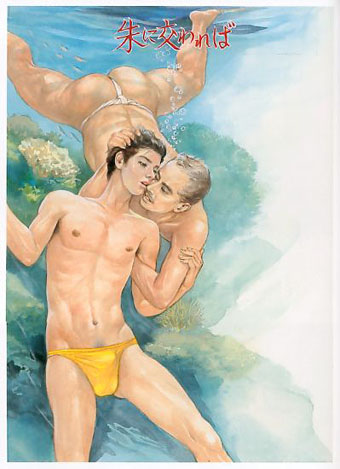
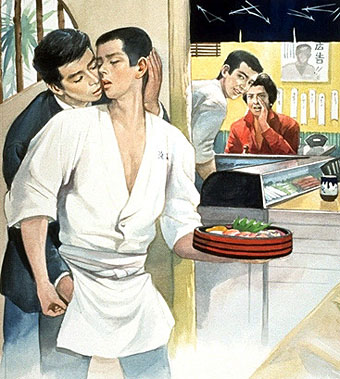
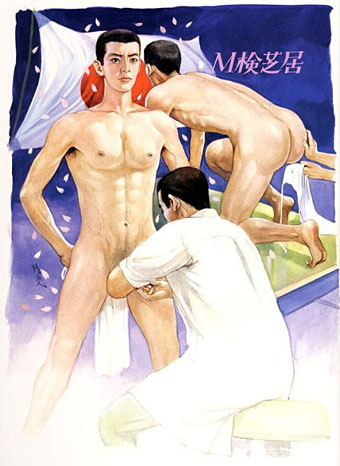
Gekko Hayashi revisited

hayashi02.jpg

It remains a fact that the most popular posts here are the sex-related ones. The post about Clayton Cubitt’s Hysterical Literature project continues to rack up views despite having been written about at greater length on far more popular sites; this weekend Facebook users were flocking to see the phallic plaster casts (why now?).

One of the perennial favourites from the gay artists archive is the post I made two years ago about the homoerotic art of Gekko Hayashi, the pseudonymous alter ego of Goji Ishihara (1923–1997). This has managed to become an almost universal point of reference despite all my knowledge about the artist being gleaned from other websites. The popularity would appear to be due to a generally high level of visibility in Google rankings combined with a tendency to write about recherché subjects which don’t receive high-profile attention elsewhere. Talking to Anne Billson yesterday about Ishihara’s monster art had me searching around for more of the Hayashi material. There’s still little to be seen outside some Japanese reprints. Given the language barrier when searching the Japanese book world it’s difficult to say whether any of these are still in print.

hayashi05.jpg

After turning up a few more examples of Hayashi’s work I’m increasingly struck by the strangeness of some of his art as well as the rare disjunction of seeing a commercial illustration style serving semi-pornographic ends. The latter effect is like seeing the libido of an artist such as Look and Learn painter Ron Embleton suddenly laid bare. A similar disjunction can be found in Oliver Frey’s work where a polished illustration and comic strip technique is applied to raw sexual scenarios. (I should note that Ron Embleton’s libido was on display in his comic strips for Penthouse magazine while—going in the opposite direction—Oliver Frey worked for a while at Look and Learn.)

hayashi07.jpg

You can find a polished style elsewhere but few artists get quite as weird with their erotic fantasies as the picture below showing a pair of penis-headed males embracing, and the one of a boy in what may be a bath full of blood being menaced (?) by an ambulatory midget phallus. Weirdness is familiar in the fetish world—everyone’s fetish is inherently weird to those who don’t share it—but always within strict limits, and besides, these aren’t fetishes. What’s odd about the pictures (especially the first) is the way they overburden the eros with a peculiarity you’d think would defeat the purpose of the painting. Hayashi/Ishihara worked as a comic artist as well as an illustrator so perhaps they’re part of a larger narrative; they may also be illustrating a text piece like some of the other pictures. For the moment they appear caught between the gay work and the monster illustration from the 1970s. This isn’t a complaint, it makes the art all the more intriguing and worth searching for.

hayashi09.jpg

Continue reading “Gekko Hayashi revisited”