Karel Zeman film posters

zeman17.jpg

A festival poster from 2022. Zeman’s films are popular in Japan.

Last week’s post about Czech film-maker Karel Zeman prompted me to see whether any more of his feature films have become available on disc. The international success of Zeman’s semi-animated adventures led to the production of more films along similar lines, although not all of these are as fantastic (or as popular) as Invention for Destruction or Baron Munchausen. A Jester’s Tale, for example, is a historical drama, albeit one which still makes use of Zeman’s skill with animation and special effects. The Karel Zeman Museum in Prague has been slowly restoring and reissuing the director’s features on DVD and blu-ray discs, the most recent title being The Stolen Airship, another film based on Jules Verne’s novels which I’m looking forward to seeing. The museum has also been increasing its production of spin-off products, including poster prints which include a couple of designs I hadn’t seen before. Browsing the poster sites revealed a few more attractive designs for international releases.


The Treasure of Bird Island (1953)

zeman01.jpg

Czech, 1953. Art by Jindřich Cech.

I still haven’t seen Zeman’s first two features. The Treasure of Bird Island is wholly animated story based on a Persian fairy tale.


Journey to Prehistory (1955)

zeman02.jpg

Poland, 1955. Art by Jan Młodożeniec.

Zeman’s second feature is his first film to mix live action and animation, with a story about a group of boys whose journey down a river leads to an encounter with prehistoric creatures. I like the way this poster reduces the narrative to its basic elements while also looking like a design for a Godzilla-themed postage stamp.


Invention for Destruction (1958)

zeman03.jpg

Czech, 1958. Art by Karel Knechtl.

A film I’ve enthused about before, and an ideal place to start with Zeman’s fantasies.

zeman04.jpg

Poland, 1958. Art by Jan Lenica.

“That looks like a Jan Lenica design,” I thought, and so it is. The human-headed fish vehicle has little to do with Zeman’s film but a character like this wouldn’t be out of place in one of Lenica’s own animations, especially Labirynt.

Continue reading “Karel Zeman film posters”

The art of Justin Todd

todd15.jpg

I was pleased to find a copy of this book recently, a slim volume published in 1978 which isn’t especially rare but which usually sells for much more than the £2 I paid for it. Justin Todd is a British illustrator whose work was a familiar sight on book covers in the 1970s, especially when his commissions weren’t restricted to a single genre. Cover artists who work on fantasy novels are often asked to do horror covers (and vice versa), or edged towards science fiction when the material suits their style; Todd worked on fantasy, horror and the occasional SF title while also providing covers for mainstream novels, offbeat non-fiction, historical fiction and children’s stories. Fully-illustrated children’s books evidently became his main line of work in the 1980s—Alice’s Adventures in Wonderland, The Wind in the Willows, a collaboration with Angela Carter—which would have left him no time for cover commissions. I was amused to find him illustrating crank titles (previously) in the early 70s when he did the paperback cover for one of the great anti-crank books, John Sladek’s The New Apocrypha, a few years later.

todd06.jpg

The Centre of the Cyclone: An Autobiography of Inner Space (1972) by John C. Lilly.

Todd’s style is easy to recognise once you’ve seen a few examples: meticulous gouache renderings that tend to be slightly naive even when they’re depicting a wholly realistic story like Treasure Island. Gouache is a water-based paint that’s useful when you want a flat, even finish, but it doesn’t give you the depth of colour or contrast provided by oils or acrylics. Todd’s paintings embrace the limitations of the medium, with gradients and shadings that are so soft and diffused they might be taken at first for pencil drawings.

todd13.jpg

The Journey to the East (1972) by Herman Hesse.

The Magical Paintings of Justin Todd isn’t a comprehensive study of Todd’s illustration work, more a snapshot of a career in progress. In addition to 64 full-page reproductions there’s a two-page interview by editor and art director Mike Dempsey which provides valuable biographical details. I was pleased to find that many of the cover paintings were ones I hadn’t seen before, including a few Arcimboldo-like faces. Todd had a flair for this kind of visual invention, constructing faces or even whole figures out of disparate objects. I’ve had a copy of The Journey to the East for many years but until this week I don’t think I’d ever looked closely at all the tiny figures making up the central figure that strides across the landscape.

Mike Dempsey maintains a blog which includes a reminiscence of working with Justin Todd.

todd09.jpg

Stories of Five Decades (1972) by Herman Hesse.

todd02.jpg

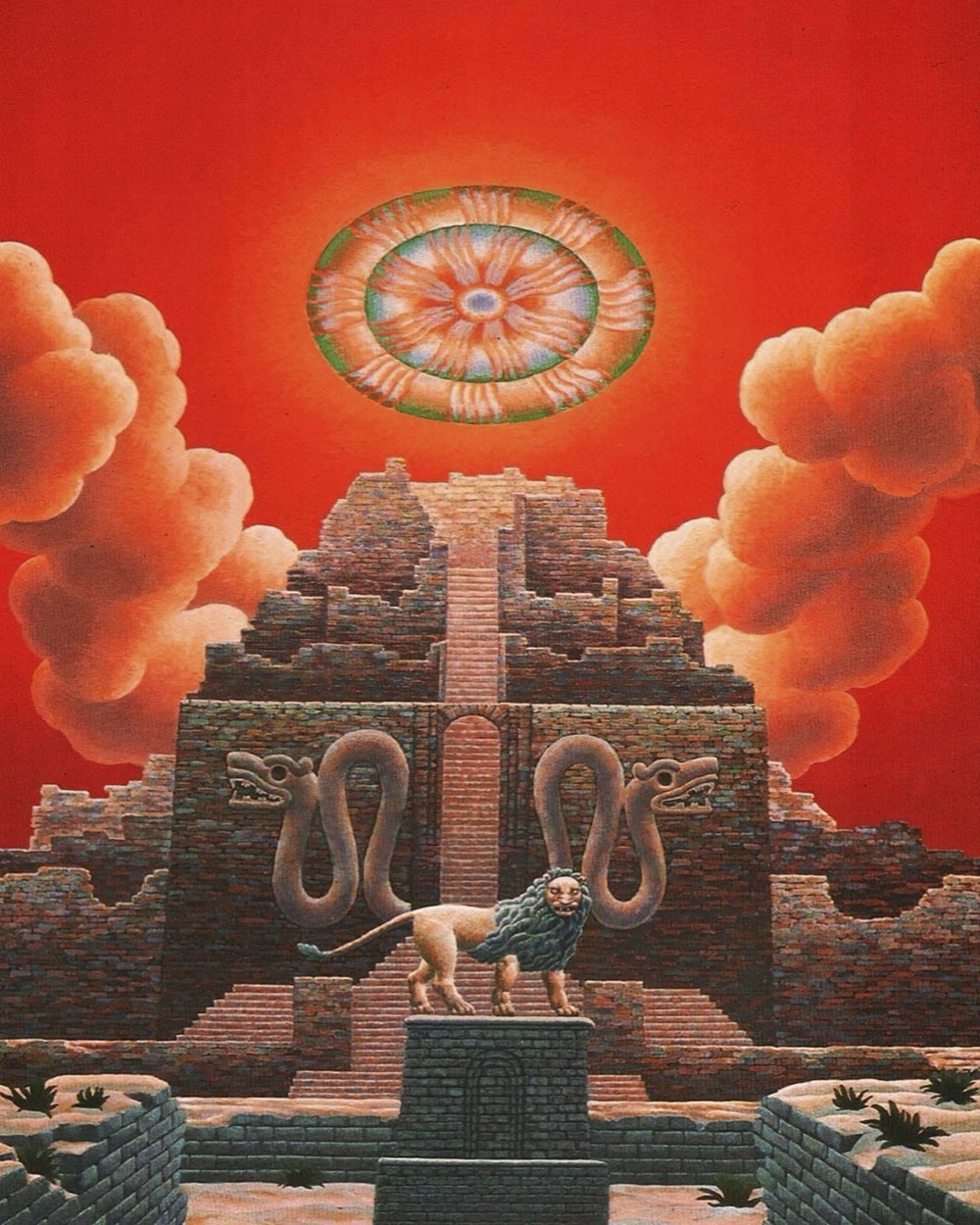
Secret Places of the Lion (1973) by George Hunt Williamson.

Continue reading “The art of Justin Todd”

Now It’s Dark

dark1.jpg

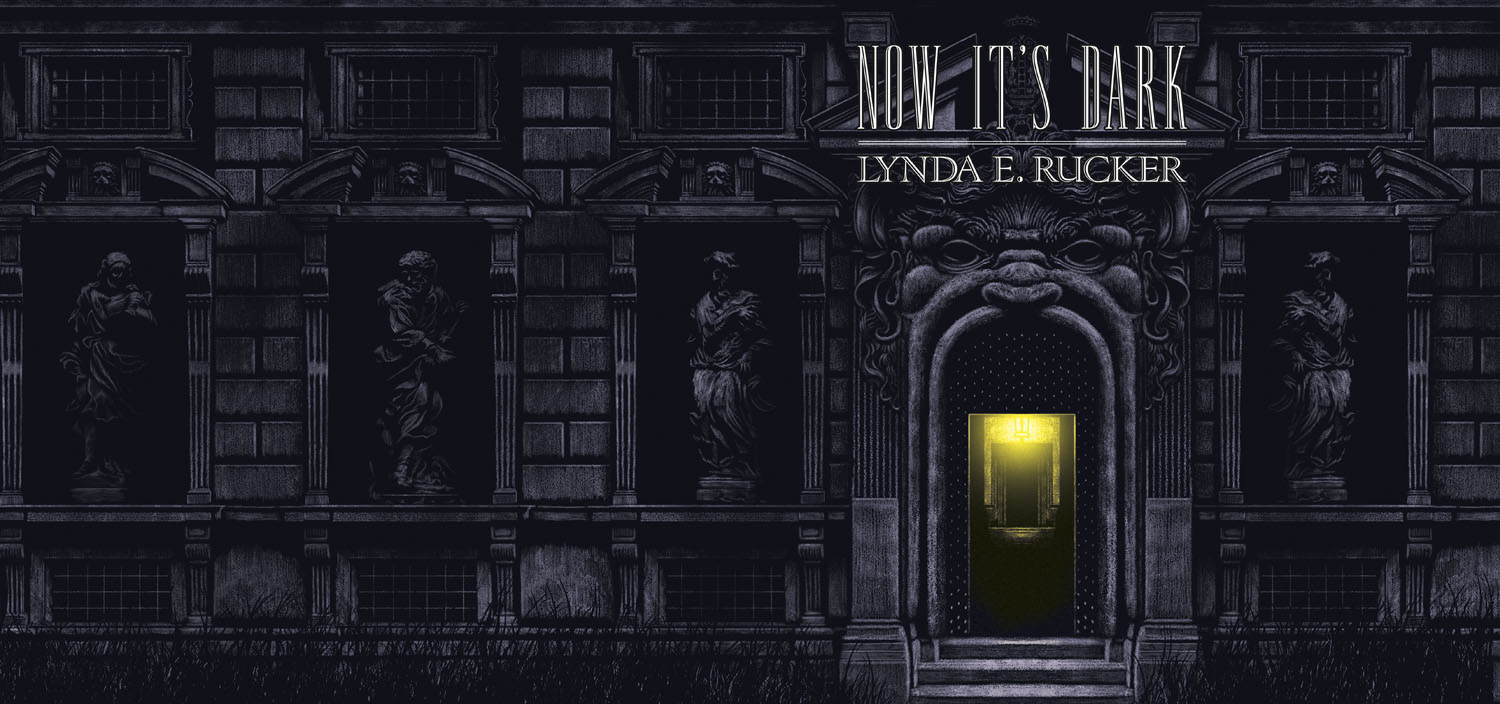
Now It’s Dark by Lynda E. Rucker; cover art by John Coulthart; jacket design by Meggan Kehrli; introduction by Rob Shearman; edited by Brian J. Showers and Timothy J. Jarvis; copyedited by Jim Rockhill; typeset by Steve J. Shaw; published by Swan River Press.

Hardback: Published on 27 January 2023; limited to 400 copies of which 100 were embossed and hand numbered; signed by Lynda E. Rucker, Rob Shearman, and John Coulthart; xii + 225 pages; lithographically printed on 90 gsm paper; dust jacketed; illustrated Wibalin boards; sewn binding; head- and tail-bands; ISBN: 978-1-78380-043-8.

dark2.jpg

Dust jacket.

dark3.jpg

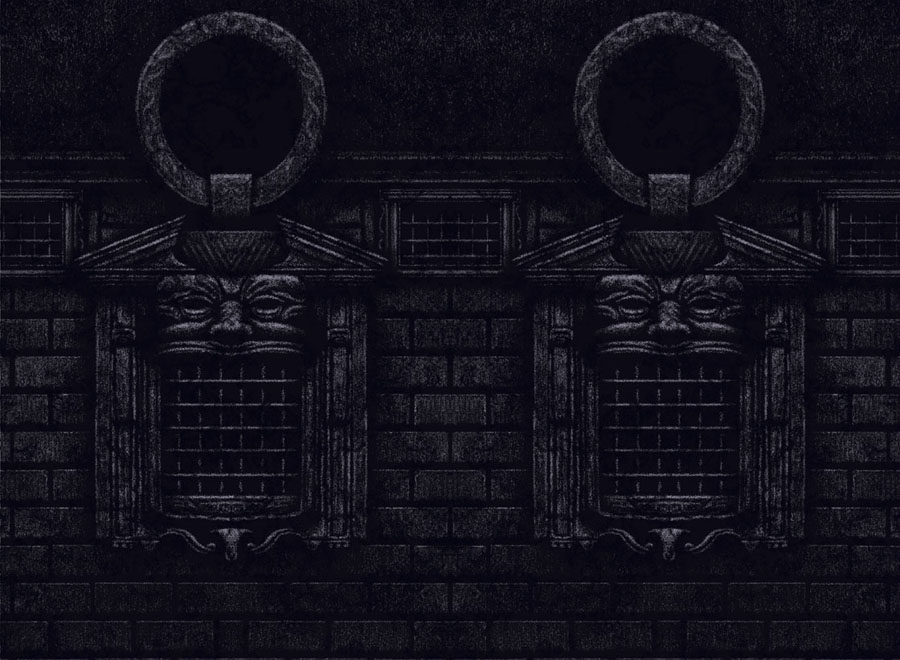
Printed boards.

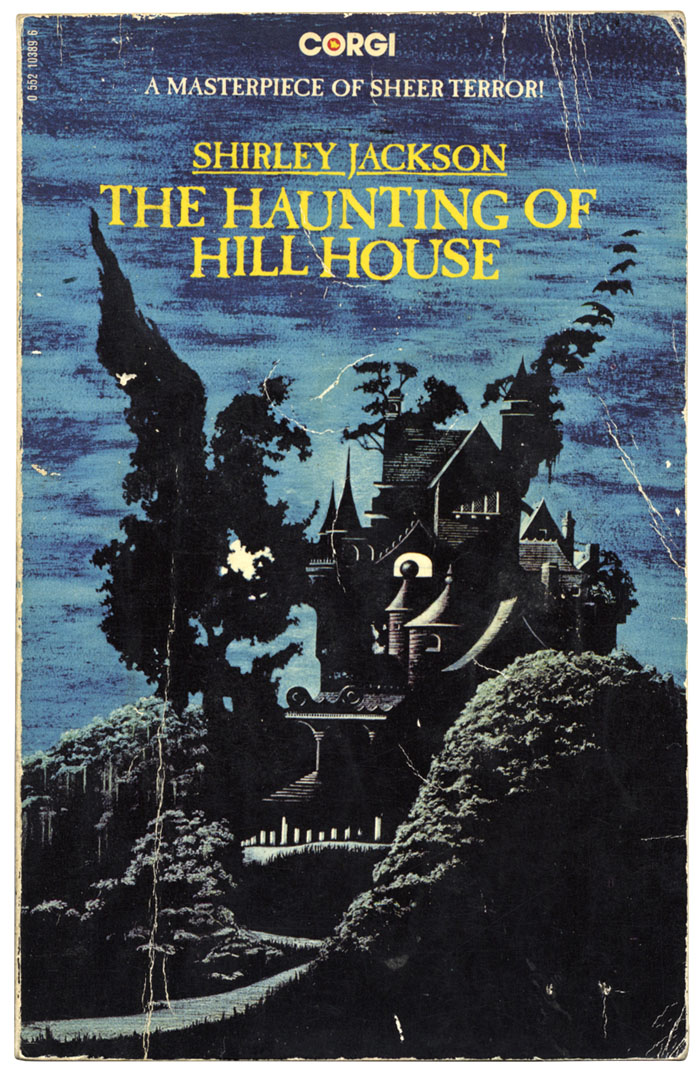
This is the last of the books I was working on last year, and being another design for Swan River Press means that once again the artwork is a wraparound cover with printed boards under the wrap. Now It’s Dark is a collection of horror stories (or possibly “strange stories” à la Robert Aickman), and a very fine collection it is. I was given carte blanche with this one so the cover is a mood piece rather than anything directly illustrational. One of the stories concerns the god Pan, which tempted me at first to do something with a satyr-like face, possibly as an architectural feature like a mascaron. But focusing on a single story in this way usually makes me worry about giving that story too much attention if it hasn’t also provided the title of the collection. Thinking about mascarons and their positioning above arched doorways led to the design you see here, a gesture towards a minor trend in horror illustration that makes use of the Arcimboldo effect, as with my battered Shirley Jackson paperback.

haunting.jpg

Corgi Books, 1977. No artist credited.

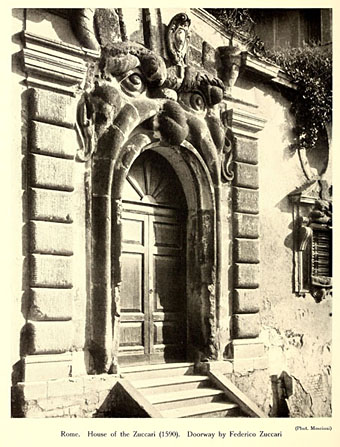
zuccari1.jpg

A Boy and His Dog on a Staircase in Rome (1886) by Niels Frederik Schiøttz-Jensen.

My cover is a variation on a real place, the “House of Monsters” entrance of the Palazzo Zuccari in Rome which today houses the Bibliotheca Hertziana. I placed the portal into an extended Baroque facade while moving the monstrous windows to the boards of the book. Given the way the grotteschi concept was a common feature of the Baroque you’d expect there to be more doorways like this but the palazzo street entrance seems to be unique. Equivalents such as the Ogre’s Head at Bomarzo are more like theme-park attractions than architectural features. I’ve never seen Umberto Eco mention the Palazzo Zuccari but I imagine he would have enjoyed seeing an infernal mouth as an entrance to a library.

zuccari2.jpg

Previously on { feuilleton }
Infernal entrances

Yuggoth details

yuggoth01.jpg

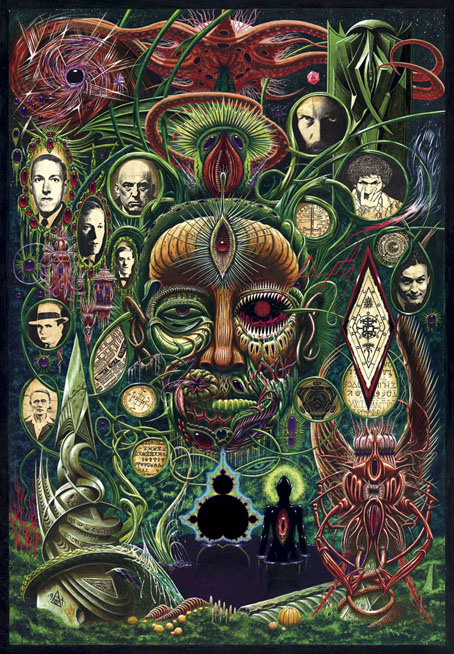
Yuggoth Cultures (1994) by John Coulthart.

Earlier this week I spent a day scanning this painting—which I’m now surprised to find is 21 years old—so I might at last have a good quality digital copy. There’s been a copy on the website for years but that was a print made at a high-street copy shop that did nothing for the detail and range of colour. It’s quite a large piece—49.54 x 71.39 cm (19.5 x 28.1 inches)—done with acrylics on board. Since 2003 the painting has been used (in another poor reproduction) on the cover of The Starry Wisdom, the controversial collection of Lovecraftian fiction from Creation Books. The painting wasn’t originally intended for that collection, however, and doesn’t quite fit since a number of the portraits don’t feature in the book at all.

Yuggoth Cultures would have been an earlier collection of Lovecraftian fiction and non-fiction that Alan Moore had begun writing for Creation in 1993. Alan’s idea was to take Lovecraft’s Fungi from Yuggoth sonnet sequence as the basis for a collection that would explore Lovecraft’s fictional world and also draw together a variety of figures from the same era: fellow writers, occultists like Aleister Crowley and Austin Spare, and Harry Houdini for whom Lovecraft ghost-wrote Imprisoned with the Pharaohs in 1924. Unfortunately the stars were not right on this occasion; Alan took the sole copy of the half-written manuscript to London in order to read selections at an event in Soho but left the papers in a cab. Some pieces survived, having been copied and stored elsewhere—The Courtyard in The Starry Wisdom is one of these—and there was talk for a while of the lost pieces being rewritten but enthusiasm for the project flagged.

yuggoth08.jpg

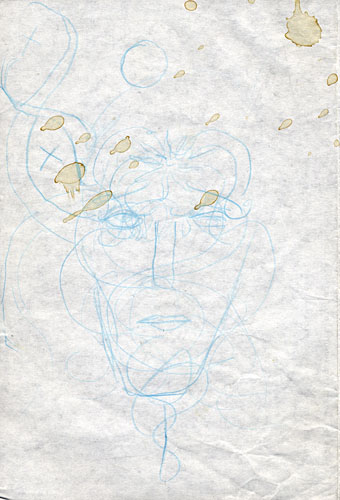
This is Alan’s sketch for the cover, the idea being to have a Lovecraft head made of fungal growths rather like an Arcimboldo painting. The head would be sprouting tendrils whose loops would contain pictures of some of the people featured in the book. Alan’s quick sketch is actually a better approximation of Lovecraft’s strange features than my painted version which isn’t narrow enough. For the record (and because people always ask), the other people on the cover are Alan himself, Austin Osman Spare, Aleister Crowley, Harry Houdini, Robert E Howard (not Al Capone as people often think) and Clark Ashton Smith.

yuggoth09.jpg

yuggoth10.jpg

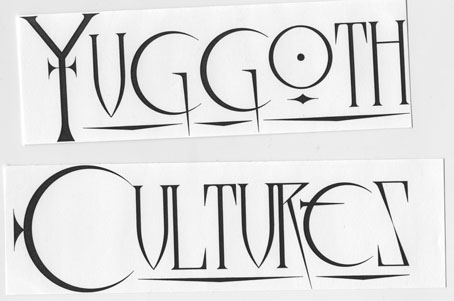
While searching through the archives I discovered these lettering designs although they’re probably not bold enough to read very well on such a busy painting. Before I started using a computer, designs like this had to be drawn at large size then scaled down using a photocopier.

Continue reading “Yuggoth details”

Vertumnus

arcimboldo1.jpg

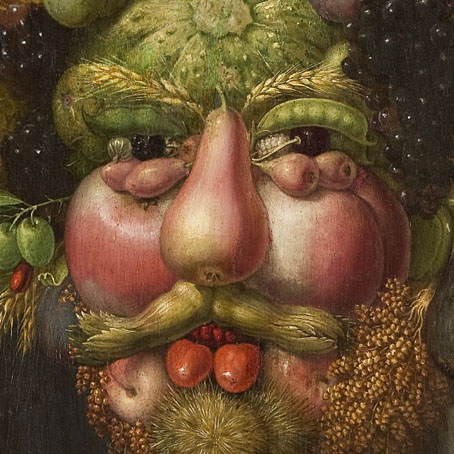
Rudolf II of Habsburg as Vertumnus (detail).

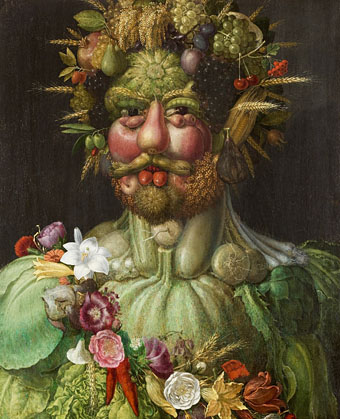
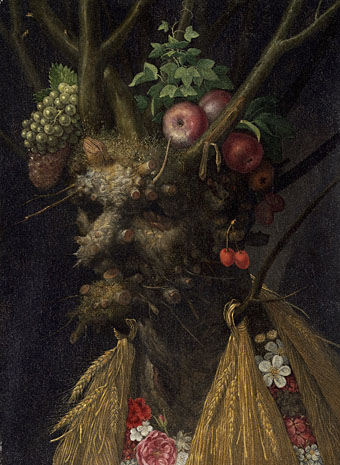
With the spring here starting to show its reluctant face it’s an apt moment to find a handful of Giuseppe Arcimboldo’s paintings at the Google Art Project. Vertumnus is the perennial favourite, Arcimboldo’s portrait of his patron, Rudolf II of Hapsburg, as the Roman god of the seasons. I’ve always thought this portrait flattered Rudolf more than those which faithfully depict his homely features. We’re told the Emperor was very pleased with his fruity likeness.

arcimboldo2.jpg

Rudolf II of Habsburg as Vertumnus (1590).

arcimboldo3.jpg

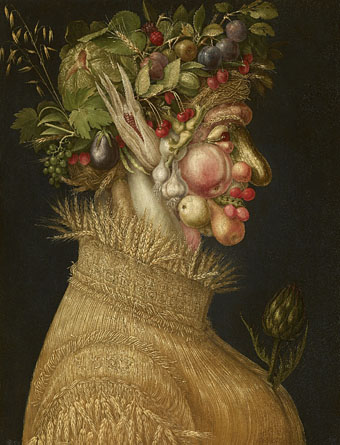
Summer (1563).

arcimboldo4.jpg

Four Seasons in One Head (c. 1590).

Previously on { feuilleton }
Arcimboldo’s Four Elements