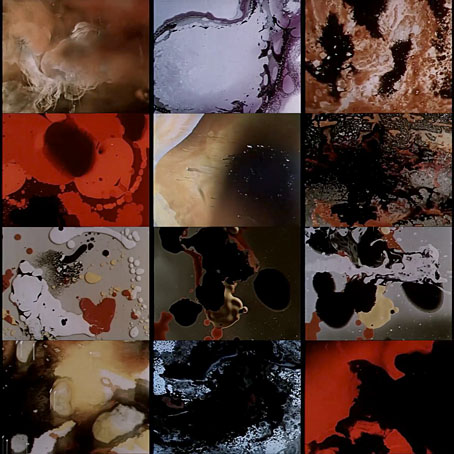
Somnambulists, a film by Mieczyslaw Waskowski

waskowski.jpg

This 9-minute film by Polish actor and director Mieczyslaw Waskowski was made in 1958. At that time Waskowski’s swirling blobs of paint in oil or water would have seemed merely abstract; a decade on and they would have unavoidable psychedelic or even cosmic connotations. Stanley Kubrick used similar effects for some of the shots in the Star Gate sequence of 2001: A Space Odyssey only at much higher resolution and camera speed.

Elsewhere on { feuilleton }
The abstract cinema archive

Weekend links 249

ulrich.jpg

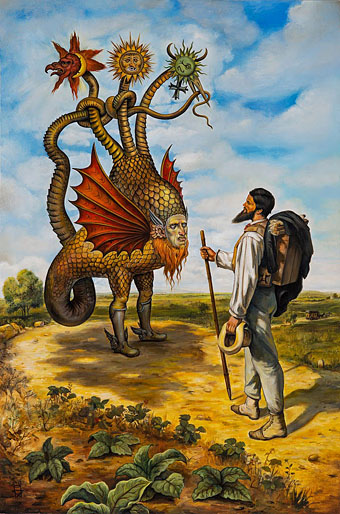
The Philosophers (Homage to Courbet) by Christopher Ulrich. Another great tip from Full Fathom Five.

• “Mushrooms are the only psychedelic drugs that I take, and I don’t take them very often. But I would trust them. Once you’ve done them a few times it’s very easy to feel a sense of entity. You can feel that there is a characteristic in this level of consciousness which almost seems…playful? Or aware, or sometimes a bit spooky.” Alan Moore discussing art and psychedelics in Mustard magazine. Related: “Psychedelics not linked to mental health problems or suicidal behavior: A population study.”

• “Leonora Carrington transcended her stolid background to become an avant-garde star,” says Boyd Tonkin. At the BBC Chris Long looks at Leonora Carrington’s journey from Lancashire to Mexico. The Carrington exhibition at Tate Liverpool opened on Friday.

A Savoyard’s First Brush with Censorship, Clara Casian’s proposed documentary film about Savoy Books, is looking for Kickstarter funding.

Warner suggests that there are four characteristics that define a veritable fairy tale: first, it should be short; second, it should be (or seem) familiar; third, it should suggest ‘the necessary presence of the past’ through well-known plots and characters; fourth, since fairy tales are told in what Warner aptly calls ‘a symbolic Esperanto’, it should allow horrid deeds and truculent events to be read as matter-of-fact. If, as Warner says, ‘the scope of a fairy tale is made by language’, it is through language that our unconscious world, with its dreams and half-grasped intuitions, comes into being and its phantoms are transformed into comprehensible figures like cannibal giants, wicked parents or friendly beasts.

Alberto Manguel reviewing Once Upon a Time: A Short History of Fairy Tale by Marina Warner

De Natura Sonorum (1976) by Bernard Parmegiani: a free download at AGP of the original vinyl recording, something I overlooked several years ago.

• At Dangerous Minds: Real Horrorshow!: Malcolm McDowell and Anthony Burgess discuss Kubrick and A Clockwork Orange.

Meeting Bernard Szajner, a short film about the French electronic musician by Tom Colvile, Nathan Gibson & Abdullah Al-wali.

• Dismembrance of the Thing’s Past: Dave Tompkins on John Carpenter’s The Thing.

That Battle Is Over, a new song by Jenny Hval.

Mushroom (1971) by Can | The Mushroom Family (2010) by The Time And Space Machine | Growing Mushrooms Of Potency (2012) by Expo ’70

Weekend links 198

boty.jpg

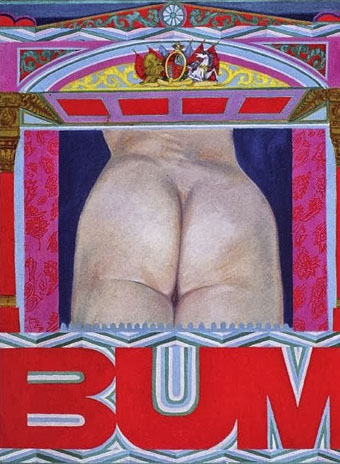
Bum (1966) by Pauline Boty.

Eleanor Birne on Pauline Boty, “the only prominent female Pop artist among a generation of famous men”. Ken Russell’s Pop Art documentary, Pop Goes the Easel (1962), which features Boty, may be seen here. Two years later Boty was back with Ken Russell playing the part of the prostitute from The Miraculous Mandarin in a film about Béla Bartók. That’s something I’d love to see. There’s more about her painting, and the work of other female Pop artists, here.

• Why Are We Sleeping? Mark Pilkington on the music world’s recurrent interest in the philosophy of GI Gurdjieff. Pilkington’s most recent Raagnagrok release with Zali Krishna, Man Woman Birth Death Infinity, was reviewed by Peter Bebergal.

• Cinematic details: Frames-within-frames in The Ipcress File (1966), and the typography of 2001: A Space Odyssey (1968).

highrise.jpg

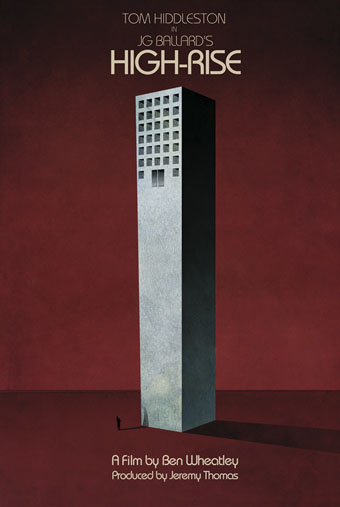
A Jay Shaw poster for Ben Wheatley’s forthcoming film of High-Rise.

• “…a large cavity must be dug in the bird’s shoulder and filled with ball bearings.” Christine Baumgarthuber on the dubious delights of The Futurist Cookbook.

• Why Tatlin Can Never Go Home Again: Rick Poynor on the difficulties of finding a definitive representation of an artwork online.

Jay Parini reviews Inside a Pearl: My Years in Paris by Edmund White. At AnOther Donatien Grau talks to White about fashion.

• At Bajo el Signo de Libra (in Spanish): the homoerotic and occasionally Surrealist art of Pavel Tchelitchew.

• At 50 Watts: Kling Klang Gloria: Vintage Children’s Books from Austria.

• The motorbike girl gangs of Morocco photographed by Hassan Hajjaj.

Geoff Manaugh on how LED streetlights will change cinema.

Stylus “is an experiment in sound, music and listening”.

• Mix of the week: Secret Thirteen mix 106 by Senking.

• At Pinterest: JG Ballard

This Is Pop? (1978) by XTC | Pop Muzik (1979) by M | Pop Quiz (1995) by Stereolab

Weekend links 139

barnes.jpg

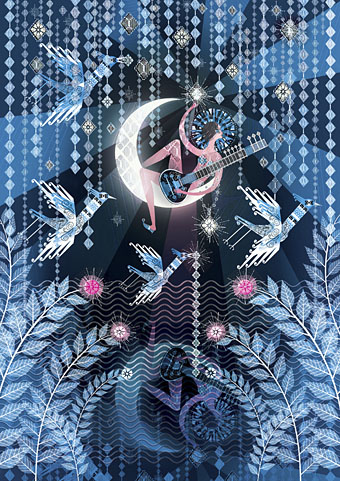
Lucy in the Sky with Diamonds (2012) by Lesley Barnes. She also has peacock wrapping paper.

Big thanks to Dennis Cooper for including this blog in his favourite music, fiction, poetry, film, art & internet lists for 2012. Lots of good company there. One benefit of end-of-year lists is the way they suggest things to look for in January.

• “…the best pictures of dicks that I’ve ever seen…” Rudy Rucker reviews Malcolm McNeill’s The Lost Art of Ah Pook Is Here and Observed While Falling, out at last from Fantagraphics. Rucker notes that William Burroughs’ text is still only available in out-of-print editions in which case you’ll need a book dealer. Elsewhere, Burroughs: The Movie has cleared 50% of its restoration Kickstarter goal but still needs supporters.

• Julia Holter has been a recurrent presence in these posts since the release in March of her acclaimed second album, Ekstasis. FACT has an alternate version of the album’s opening song, Marienbad, one of the extra tracks on the recent UK reissue.

Suttree’s saga carried me down, down, down to the bottom of a heightened surrogate reality, a nadir where the rarest jewels of clarity are found. The fourth time through the novel I arrived at a state of barometric equipoise, a balancing between my mental state and Suttree’s. Then, as he descended again, I began to rise. There was a hypnotic poetry to his fall — his life disintegrated, then the fragments disintegrated, then those fragments followed suit ad infinitum.

Jim White on the life-preserving qualities of Suttree by Cormac McCarthy.

• “An 18-year-old boy who discovers he has a fetish for the aged gets a job in a nursing home and develops an intimate relationship with one particular old man.” Gerontophilia, a proposed film by Bruce LaBruce, is looking for funding.

• Can’t wait for this: Groenland Records announces Who’s That Man?, a four-CD set of music produced and performed by Conny Plank. FACT has a track list.

• At BUTT magazine: Pink Courtesy Phone Mix by Richard Chartier, a great selection of electronica old and new.

• Another end-of-year list: Volumes 1 & 2 of The Graphic Canon are in NPR’s Indie Bookseller best of 2012 selection.

The Nightmare Paintings: art by Aleister Crowley currently touring Australia.

• Christmas with Monte: Colin Fleming on the ghost stories of MR James.

• “The war on drugs is a war on human nature” says Lewis Lapham.

Alan Moore: why I turned my back on Hollywood.

• More electronica: Chris Carter discusses synths.

Saul Bass poster sketches for The Shining.

• At Pinterest: The Pan Within.

Ah Pook Is The Mayan God Of Death (1975) by William Burroughs | Panic (1985) by Coil | Light Shining Darkly (1992) by Coil.

Weekend links 131

thingposter.jpg

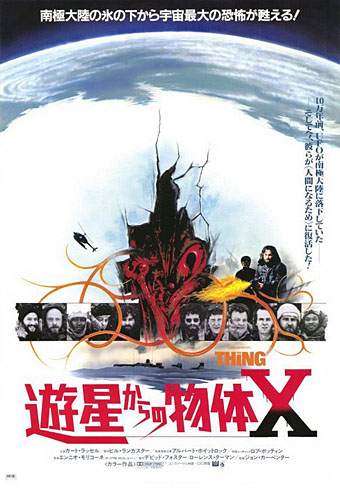
Japanese poster (1982).

At The Quietus Steve Earles looks back at John Carpenter’s visceral and uncompromising The Thing which exploded messily onto cinema screens thirty years ago. It’s always worth being reminded that this film (and Blade Runner in the same year) was considered a flop at the time following bad reviews and a poor showing at the summer box office. One reason was The Thing‘s being overshadowed by the year’s other film of human/alien encounters, something called E.T. the Extra-Terrestrial. To The Thing‘s status as the anti-E.T. you can add its reversal of the can-do heroics of Howard Hawks’ The Thing from Another World (1951), an attitude out-of-step with Reaganite America. Carpenter’s film is not only truer to the original story but from the perspective of 2012 looks like one of the last films of the long 1970s, with Hawks’ anti-Communist subtext replaced by bickering, mistrust, paranoia and an unresolved and completely pessimistic ending that most directors would have a problem getting past a studio today.

I was fortunate to see The Thing in October of 1982 knowing little about it beyond its being a John Carpenter film (whose work I’d greatly enjoyed up to that point) and a remake of the Hawks film (which I also enjoyed a great deal). One benefit of the film’s poor box office was a lack of the kind of preview overkill which made E.T. impossible to avoid, and which a couple of years earlier did much to dilute the surprise of Ridley Scott’s Alien. I went into The Thing mildly interested and came out overwhelmed and aghast. For years afterwards I was insisting that this was the closest you’d get on-screen to Lovecraft’s At the Mountains of Madness. The correspondence is more than merely Antarctica + monsters when you consider this:

Lovecraft’s story was rejected by his regular publisher Weird Tales but was accepted by Astounding Stories in 1936 >> The editor of Astounding, John W. Campbell, published his own Antarctica + monsters story (under the pen-name Don A. Stuart), “Who Goes There?”, in the same magazine two years later >> Charles Lederer wrote a loose screen adaptation of Campbell’s story which Howard Hawks and Christian Nyby filmed as The Thing from Another World.

This isn’t to say that Campbell copied Lovecraft—both stories are very different—but I’d be surprised if Lovecraft’s using Antarctica as the setting for a piece of horror-themed science fiction didn’t give Campbell the idea.

More things elsewhere: Anne Billson, author of the BFI Modern Classics study of The Thing, on the framing of Carpenter’s shots, and her piece from 2009 about the film | Mike Ploog’s storyboards | Ennio Morricone’s soundtrack music, of which only a small percentage was used in the film.

• The week in music: 22 minutes of unreleased soundtrack by Coil for Sara Dale’s Sensual Massage | Analog Ultra-Violence: Wendy Carlos and the soundtrack for A Clockwork Orange | A Halloween mixtape by The Outer Church | Herbie Hancock & The Headhunters, live in Bremen, 1974: a 66-minute set, great sound, video and performances | Giorgio Moroder’s new SoundCloud page which features rare mixes and alternate versions | A video for Collapse by Emptyset.

One of the main themes of the book, and what I found in The Arabian Nights, was this emphasis on the power of commodities. Many of the enchanted things in the book are lamps, carpets, sofas, gems, brass rings. It is a rather different landscape than the fairy tale landscape of the West. Though we have interiors and palaces, we don’t have bustling cities, and there isn’t the emphasis on the artisan making things. The ambiance from which they were written was an entirely different one. The Arabian Nights comes out of a huge world of markets and trade. Cairo, Basra, Damascus: trades and skills.

Nina Moog talks to Marina Warner

John Palatinus, “one of the last living male physique photographers of the 1950s”, is interviewed. Related: the website of Ronald Wright, British illustrator for the physique magazines.

• “A classic is a work which persists as a background noise even when a present that is totally incompatible with it holds sway.” Italo Calvino’s 14 Definitions of What Makes a Classic.

Huge Franz Kafka archive to be made public. Related: Judith Butler asks “Who owns Kafka?”

• Geoff Manaugh’s Allen Ginsberg Photos & Ephemera, 1994–Dec 1996.

Magic mushrooms and cancer: My magical mystery cure?

Clark Ashton Smith Portfolio (1976) by Curt Pardee.

Jan Toorop’s 1924 calendar.

artQueer: a Tumblr.

• All The Things You Are (1957) by Duke Ellington | Things That Go Boom In The Night (1981) by Bush Tetras | Things Happen (1991) by Coil | Dead People’s Things (2004) by Deathprod.