Fuseli’s Nightmare

nightmare1.jpg

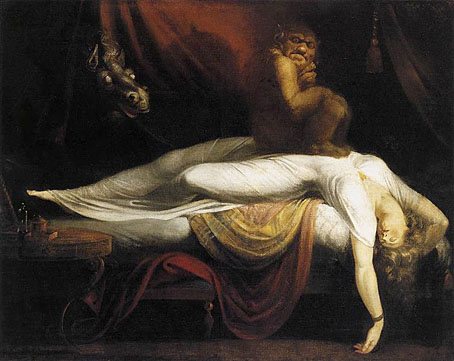
The Nightmare (1781).

Christopher Frayling’s Nightmare: The Birth of Horror (1996) opens with a prologue examining Henry Fuseli’s most celebrated painting:

Henry Fuseli, who later wrote that “one of the most unexplored regions of art are dreams”, and who was said to have supped on raw pork chops specifically to induce his nightmare, made his name with this painting. And engraved versions, produced in 1782, 1783 and 1784, distributed the image across Europe, until Fuseli’s masterpiece became the way of visualising bad dreams.

Although The Nightmare was painted just before the Romantic craze in Western Europe—which revelled in peeling back the veneer of rational civilisation to reveal the “natural” being or the raw sensations beneath, sometimes through the gateway of dreams—it was well-known to the writers and painters of the early nineteenth century. One of them wrote that “it was Fuseli who made real and visible to us the vague and insubstantial phantoms which haunt like dim dreams the oppressed imagination”.

The Nightmare was fascinating—and scary—because it operated at so many different levels at once. It was set in the present (the stool and bedside table are “contemporary” in style), and it was concerned not so much with an individual’s nightmare—the usual subject-matter of dream paintings, often involving famous individuals and their prophecies—as with nightmares in general. It was not A Nightmare, but The Nightmare; not a vision but a sensation. This gave it a direct impact, unmediated by history, which put a lot of critics off.
nightmare2.jpg

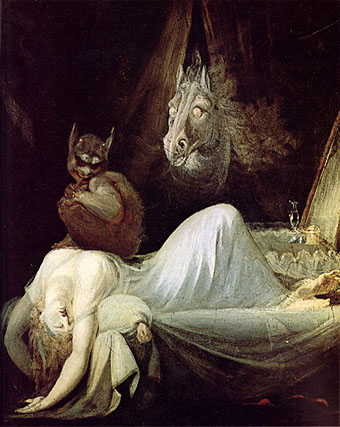
The Nightmare (1791).

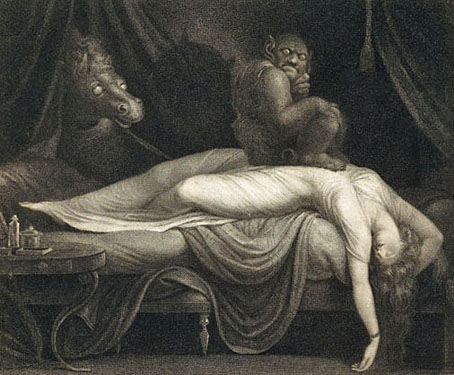
Later generations of critics have had no such problems, of course, nor have the legions of artists and cartoonists who’ve plagiarised and parodied this memorable scene. I had a vague notion of collecting some of the derivations but a quick image search reveals an endless profusion of squatting figures and thrusting horse heads. Wikipedia did provide two of the engraved versions, however. Of the two paintings above I’ve always preferred the later one: the incubus, or “mara” as Frayling calls it, looks more sinister, and the horse head has become an almost unavoidable sexual symbol. No wonder that Siegmund Freud had a copy of The Nightmare on the wall of his waiting room.
nightmare3.jpg

Engraving by Thomas Burke (1783).
Continue reading “Fuseli’s Nightmare”

Weekend links 229

drongelen.jpg

Untitled (2007) by Remko van Drongelen.

• Another week, another Kickstarter project: Frank Woodward’s 2008 documentary, Lovecraft: Fear of the Unknown, was an excellent study of HP Lovecraft’s life and work featuring interviews with John Carpenter, Neil Gaiman, Caitlín R. Kiernan, Peter Straub, Guillermo Del Toro and leading Lovecraft scholar ST Joshi; the film also included a few examples of my Cthulhoid artwork. Disc copies of the film have been out-of-print for a while so Frank’s fund is hoping to raise money for a new Blu-ray edition featuring extended interviews and other extras.

• David Cronenberg’s debut novel, Consumed, “reads somewhat like a mashup of William Gibson, the king of near-future SF cool, and 1970s horror maestro James Herbert,” says Steven Poole. I’d have thought a more obvious analogy would be with JG Ballard; descriptions of Cronenberg’s narrative make it sound like Ballard’s concerns repurposed for our current era of electronically-mediated everything. Related: Crash by Sanyú, “adaptación de un fragmento de la novela de J. Ballard”.

• “To commune with the music of Cyclobe is to enter not just a strange world, but strange constellations – interdimensional, atemporal zones of carefully cultivated auras bordering wild, unstable forces.” Russell Cuzner talks to Ossian Brown and Stephen Thrower about Derek Jarman, hurdy-gurdies and the deceptive nature of time.

…there are no rules in fiction even if creative writing programs everywhere have tried to make people believe there are. When I read fiction that has passed through the filter of too many workshops, I often get the feeling that I’m reading the same novel over and over again: the same way of being humorous, the same way of being candid, the same way of creating empathy.

Valeria Luiselli talking to Jennifer Kabat about fiction, cities and maps.

• The rationale behind Silent Partners: Artist & Mannequin from Function to Fetish is “to explore the way that the artificial human figure has routinely provided artists with the most direct and reliable route to visual realism. And then to work out why that makes us so upset.” Kathryn Hughes on a new exhibition.

• “It immediately throws up some interesting thoughts: Bowie as the young dandy and the obvious comparisons with Oscar Wilde and The Picture Of Dorian Gray, with the portrait that ages.” Designer Jonathan Barnbrook on the cover photos for David Bowie’s forthcoming album Nothing Has Changed.

• October brings all the music mixes. This week there’s a choice of FACT mix 463 by Dntel, Autumn’s Whirr by Café Kaput (aka Jon Brooks), and Suspected Rural Telephone Box Poltergeist by The Geography Trip.

• “…when you first go into the room it’s like entering a furnace… a furnace of sound.” Scott Walker talks to John Doran about recording with Sunn O))). The new album, Soused, is out on 20th October.

We are the Martians: the Legacy of Nigel Kneale, a new collection of Kneale-related essays and appreciations, edited by Neil Snowdon.

• Kim Newman is one of the contributors to the Kneale collection. Here he is on the main types of ghost story, and how to recognize them.

Issue 7 of Glitterwolf magazine is out on the 15th, and it’s a Halloween special.

Etai Rahmil makes mask-pipes from glass for weed smokers.

Accidental Cool Art

Hurdy Gurdy Man (1968) by Donovan | Hurdy Gurdy Man (1970) by Eartha Kitt | Hurdy Gurdy Man (2009) by Patrick Cowley & Jorge Socarras

Weekend links 224

zona.jpg

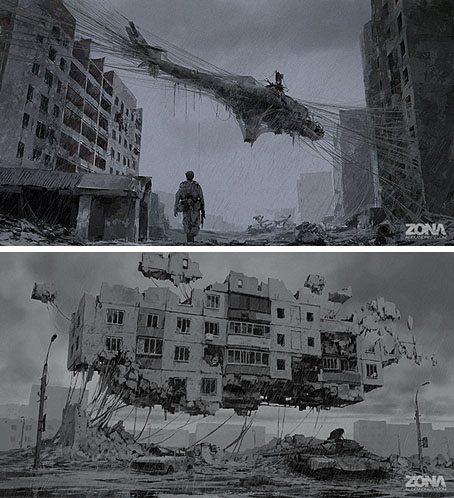
Zona: concept art by Alex Andreyev for a planned TV series based on Roadside Picnic by Arkady & Boris Strugatsky.

The Black Sessions are a long-running series of concerts by international artists recorded for radio station France Inter. UK group Broadcast were recorded by the station in May, 2000. While copies of the shows can be often be hard to find, files of the Broadcast concert may be downloaded here. A fantastic performance, especially the white-hot psychedelic freakout at the end.

• Further investigations from the radio age: Invention for Radio No. 1: The Dreams (43 mins, 1964): “an attempt to re-create in five movements some sensations of dreaming—running away, falling, landscape, underwater and colour”. Voices recorded by Barry Bermange with Radiophonic manipulation by Delia Derbyshire.

• “…in his first description of Cthulhu he gives you a list of four things that Cthulhu isn’t quite like.” Nick Talbot talks to Alan Moore about HP Lovecraft. Related: one of my depictions of Azathoth appears in this list of “gods who have forsaken you”.

• Tracking the locations of JG Ballard’s Super-Cannes: an investigation by Rick Poynor. Related: houseboats, architecture and eco-disaster; Justin Sullivan photographs California’s extreme drought.

• “As her writing career existed outside the realm of respectable ‘high-lit’ fiction, she cast herself as an outsider icon.” Chris Kraus on I’m Very Into You, a collection of Kathy Acker’s emails.

• Cover design inspiring fiction: Susan Coll on how a photo of a Bauhaus chair on the cover of her new novel, The Stager, made her alter her text at the last minute.

• “People were either taken by it or felt it was the Antichrist.” MetaFilter on Clair Noto’s unmade science-fiction film, The Tourist.

The Norwood Variations is a new album by Drew Mulholland (Mount Vernon Arts Lab et al).

• Thought Maybe has a collection of the television essays made by Adam Curtis.

• From 1974: How To Make Magic, a children’s handbook of the occult.

• Mix of the week: Secret Thirteen Mix 126 by Mira Calix.

One Minute Blasts Rising To Three And Then Diminishing (2000) by Mount Vernon Arts Lab | Dashwood’s Reverie (2001) by Mount Vernon Arts Lab | Warner’s Reverie (2002) by Mount Vernon Astral Temple

Weekend links 221

cornell.jpg

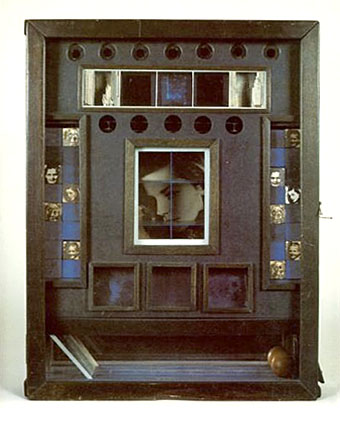
Untitled (Penny Arcade Portrait of Lauren Bacall) (1946) by Joseph Cornell.

• Having been a Bernard Szajner enthusiast for many years it’s good to see his music receiving some belated reappraisal. David McKenna talked to Szajner about his Visions Of Dune album (which is being reissued by InFiné next month), laser harps, The (Hypothetical) Prophets, and working with Howard Devoto.

• Priscilla Frank posts some big views of Marjorie Cameron’s occult paintings as a preview of the forthcoming exhibition at MOCA Pacific Design Center, Los Angeles.

• Fascinating reading in light of the recent kerfuffle over True Detective, Christopher Loring Knowles on the possible sources of HP Lovecraft’s Cthulhu Mythos.

Those who set up oppositions between the electronic technology and that of the printing press perpetuate Frollo’s fallacy. They want us to believe that the book—an instrument as perfect as the wheel or the knife, capable of holding memory and experience, an instrument that is truly interactive, allowing us to begin and end a text wherever we choose, to annotate in the margins, to give its reading a rhythm at will—should be discarded in favor of a newer tool. Such intransigent choices result in technocratic extremism. In an intelligent world, electronic devices and printed books share the space of our work desks and offer each of us different qualities and reading possibilities. Context, whether intellectual or material, matters, as most readers know.

Alberto Manguel, lucid as always, on the act and import of reading.

• “It’s time to give prog rock’s artist-in-residence Roger Dean his due,” says Amber Frost. No argument there, I did my bit in 2010.

• “Why do the covers of so many self-published books look like shit?” asks B. David Zarley.

• Mixes of the week: FACT mix 455 by Airhead, and Secret Thirteen mix 225 by Clock DVA.

• At Core77: Rain Noe chooses favourite skyscraper photos by Russian urban explorers.

• “O, Excellent Air Bag”: Mike Jay on the nitrous oxide fad of the early 19th century.

Nick Carr goes in search of Manhattan’s last remaining skybridges.

Lauren Bacall at Pinterest.

• Shaï Hulud (1979) by Zed (Bernard Szajner) | Welcome (To Death Row) (1980) by Bernard Szajner | Person To Person (1982) by The (Hypothetical) Prophets

Intertextuality

cthulhu17.jpg

The Call of Cthulhu (1988): in the upper half there’s the big sun from Bob Peak’s poster for Apocalypse Now, in the lower half a radical reworking of Arnold Böcklin’s The Isle of the Dead.

In 1990, shortly after the first season of Twin Peaks had finished showing in the US, Video Watchdog magazine ran a feature by Tim Lucas which attempted to trace all the various cultural allusions in the character names and dialogue, references to old TV shows, song lyrics and the like. This was done in a spirit of celebration, with Lucas and other contributors welcoming the opportunity to dig deeper into something they’d already enjoyed. This week we’ve had a similar unravelling of textual borrowings in a TV series, only now we have the internet which, with its boundless appetite for accusing and shaming, can often seem like something from the grand old days of the Cultural Revolution.

cthulhu01.jpg

The Call of Cthulhu (1988): a more subtle allusion to Apocalypse Now.

The latest culprit ushered to the front of the assembly for the Great Internet Struggle Session is Nic Pizzolatto whose script for True Detective has indeed been celebrated for its nods to Robert Chambers and The King in Yellow. It’s also in the process of being condemned for having borrowed phrases or aphorisms from Thomas Ligotti’s The Conspiracy Against the Human Race (2011). See this post for chapter and verse.

cthulhu02.jpg

The Call of Cthulhu (1988): It’s not very clear but that’s a boat from The Creature from the Black Lagoon.

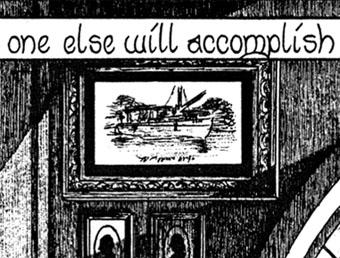
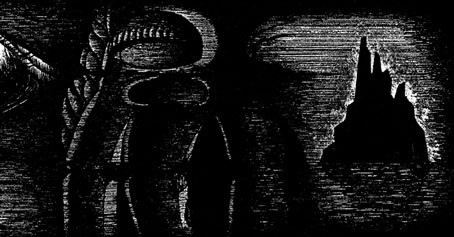
If I find it difficult to get worked up over all this pearl-clutching it’s because a) it shows a misunderstanding of art and the way many artists work; b) True Detective was an outstanding series, and I’d love to see more from Pizzolatto and co; and c) I’ve done more than enough borrowing of my own in a variety of media, as these samples from my adaptation of The Call of Cthulhu demonstrate, a 33-page comic strip where there’s a reference to a painting, artist or film on almost all the pages, sometimes several on the same page.

cthulhu03.jpg

The Call of Cthulhu (1988): Ophelia by Millais.

Cthulhu is a good choice here since Pizzolatto’s story edged towards Lovecraft via the repeated “Carcosa” references. You’d think a Lovecraft zine of all things would know better than to haul someone over the coals for borrowing from another writer when Lovecraft himself borrowed from Robert Chambers (and Arthur Machen and others), while “Carcosa” isn’t even original to Chambers’ The King in Yellow but a borrowing from an Ambrose Bierce story, An Inhabitant of Carcosa (1886). Furthermore, Lovecraft famously complained about his own tendencies to pastiche other writers in a 1929 letter to Elizabeth Toldridge: “There are my ‘Poe’ pieces and my ‘Dunsany pieces’—but alas—where are any Lovecraft pieces?”

Continue reading “Intertextuality”