The art of Virgil Finlay, 1914–1971

finlay1.jpg

Mrs Amworth.

Another great artist of the macabre and supernatural, Virgil Finlay was the one of the most talented and imaginative illustrators of his generation. Unlike older contemporaries such as Joseph Leyendecker, who became wealthy producing elegant yet often bland advertising art, much of Finlay’s best work was for pulp magazines like Weird Tales and Amazing Stories which paid a pittance and printed his finely-hatched scratchboard drawings on the cheapest paper. The advantages to this work, such as they were, came in the access to a huge and appreciative audience, and the chance to provide the first illustrations for what would turn out to be classic genre stories. Finlay illustrated a number of HP Lovecraft’s tales and received the highest praise from the author in doing so. His illustration for Lovecraft’s The Thing on the Doorstep (below) contains a slight nod to Harry Clarke’s Valdemar picture (see previous post) with its distant, highlighted doorway, a detail that Clarke himself borrowed from the celebrated Las Meninas by Velázquez.

Therionweb has five galleries of Finlay’s pictures and Bud Plant again has a brief biography.

finlay2.jpg

Abercrombie Station.

finlay3.jpg

The Thing on the Doorstep.

finlay4.jpg

Six and Ten.

Elsewhere on { feuilleton }
• The illustrators archive

Ghost Box

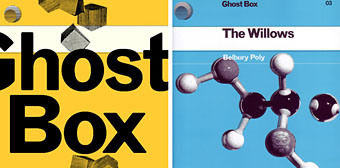
ghost_box.jpg

Q: What do you get when you cross analogue synthesizers, samples from obscure public information films, the graphic design of Pelican Books, Arthur Machen, HP Lovecraft, Algernon Blackwood, CS Lewis, Hammer horror, the Wicker Man and the music from Oliver Postgate’s animated films for children?

A: the CD releases by artists on the Ghost Box label. Ghost Box describe themselves as “an independent music label for artists that find inspiration in library music albums, folklore, vintage electronics, and the school music room” which, if you’re familiar with the reference points, is exactly what you get. A rather wonderful blend it is too, some of the tracks on Belbury Poly’s The Willows (named after Algernon Blackwood’s stunning horror tale) are how I expected Stereolab to sound until I heard them and was rather disappointed.

Favourite of the Ghost Box releases I’ve heard to date is (perhaps inevitably) Ourobourindra by Eric Zann (the “artist” here is named after Lovecraft’s haunted musician from The Music of Erich Zann). The website description—”Eric Zann’s radios, oscillators and recordings conjure eldritch, echoing spaces and invoke the voices of the dead that whisper within them”—again is a pretty accurate summation of this atmospheric and sinister audio collage. “Sinister” is a term that can be applied to much of this music and the Ghost Box founders, Julian House and Jim Jupp, declare in a Wire feature this month that matters spectral are of particular concern, hence the label name. Ourobourindra works especially well in this regard, sounding like the product of someone working through a trauma caused by viewing the seance scene from Dracula AD 1972 at too young an age. This is one I’ll be playing on Halloween.

Ghost Box music can be purchased online here.

Elsewhere on { feuilleton }
• The album covers archive

Previously on { feuilleton }
• Penguin book covers
• The music of Igor Wakhévitch
• The music of the Wicker Man
• The Absolute Elsewhere

The Haunter of the Dark

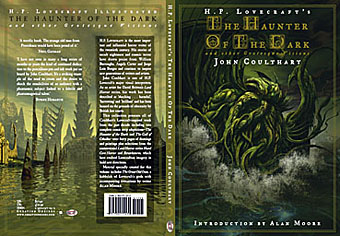
haunter2006_spread.jpg

Today sees the publication of my collection of Lovecraft adaptations and illustrations, The Haunter of the Dark and other Grotesque Visions (Creation Oneiros) in the US, although I’ve no idea what’s out there right now. Confusion reigns on the online front with Amazon.com saying the book isn’t out yet while Barnes & Noble says it’s a new title that’s out of stock. Presumably things will settle down in the next week or two, in the meantime you can order copies, of course. UK release has been put back a few more weeks but the book should be available in October: Amazon.co.uk.

Sample pages and previous book news can be seen here.

“At its far edge, horror shades into beauty, and it is far beyond
that edge that Coulthart takes us, into terrible magnificence.”
Alan Moore, in the book’s introduction

“A terrific book, haunting and beautiful.
That writer from Providence would have been proud…”
Neil Gaiman

Down with human life

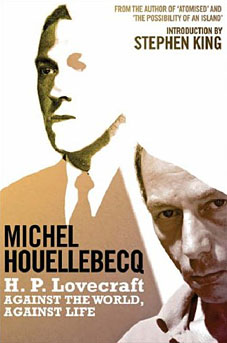
houellebecq.jpgSam Leith is engrossed by a formidable essay on the father of ‘weird fiction’.

HP Lovecraft: Against the World, Against Life
by Michel Houellebecq
tr by Dorna Kazheni
intro by Stephen King
256pp, Weidenfeld & Nicolson
£10 (pbk)
Saturday, August 12, 2006
The Daily Telegraph

“I AM SO BEASTLY TIRED of mankind and the world that nothing can interest me unless it contains a couple of murders on each page or deals with the horrors unnameable and unaccountable that leer down from the external universes.” So wrote Howard Phillips Lovecraft (1890–1937). His extraordinary body of work can be seen as a sustained effort to fill that prescription.

The founding father of what has become known as “weird fiction”, Lovecraft was not a congenial figure. Tall, ugly, misanthropic, snobbish, reclusive, he hated people in general, and people of other races in particular. More or less nothing happened in his life. He was 32 before he kissed a woman and his brief, unsuccessful and wholly unexpected marriage put paid to love for good. He died of intestinal cancer at 47.

His literary concerns were as follows: unkillable tentacled beings from beyond space worshipped by cannibal death cults; hideous prodigies of miscegenation; gibberings from the abyss; indecipherable languages of madness; insane architectural geometries; colours outside any nameable spectrum. Lovecraft has nothing in common with Anita Brookner.

On the surface, he has very little in common with Michel Houellebecq, either. What they seem to share, though, is an aggressive misanthropy. In this consistently engaging essay, an infatuated Houellebecq argues that Lovecraft’s work pioneered a sort of anti-literature: a great shout of “NO!” to human life.

Lovecraft was not just unrealistic, Houellebecq argues, but anti-realistic: the devotee of a sort of malevolent sublime. Religious writers see our animal lives as validated by the notion that beyond our perception lies something infinitely larger, more ancient and more benevolent. Lovecraft played with the opposite idea. If there’s something else, why should we imagine it would be benevolent? How much more likely that we have, here, a pretty disgusting animal existence; but that if we caught a whiff of what lies outside it, we’d go instantly mad—if we were lucky.

Very little of what Lovecraft wrote conforms to the conventional canons of what literature should be doing. His characters are more or less interchangeable: drab men with drab jobs, no pasts and no futures. They are there to bear witness, to have the living daylights frightened out of them and, if they are unlucky, to be “devoured by invisible monsters in broad daylight at the Damascus market square”. There’s no interest in human life, or money, or sex. The stories don’t start in the real world and amble into horror: they start midway through the screaming hab-dabs and turn up the volume from there producing what Houellebecq calls “an open slice of howling fear”. The involuted and clumsily baroque sentences disapproved of by Lovecraft’s detractors are serving, then, a singular purpose: to pile more on—to generate an intoxicating fever pitch of rhetoric.

Houellebecq’s essay is often perverse, sometimes jejune, more than occasionally downright silly. He attributes more consistency of philosophical purpose to Lovecraft than, I think, a sensible reading of the “great texts”—”The Call of Cthulhu” (1926), ‘The Colour Out of Space” (1927), ‘The Dunwich Horror” (1928), “The Whisperer in Darkness” (1930), “At the Mountains of Madness” (1931), “The Dreams in the Witch House” (1932), ‘The Shadow over Innsmouth” (1932) and “The Shadow Out of Time” (1934)—will bear.

And he on more than one occasion dismisses Lovecraft’s critics, with Houellebecquian arrogance, as “idiots” and such like. But his essay is both a formidable literary performance in itself, a work of real imaginative sympathy, and a consistently engrossing intellectual workout. It bursts with new ideas, and new ways of thinking about this oddest of writers. Bolstered by an introduction by Stephen King, and a pair of first-rate Lovecraft stories, it’s worth anyone’s tenner.

Lovecraft, as Houellebecq observes, “writes for an audience of fanatics—readers he was finally to find only years after his death”. That his work at last found those readers is beyond question. The “Cthulhu Mythos”, like Tolkien’s Middle-Earth, has become a place in which devotees live.

Ever since Lovecraft’s friend August Derleth completed some of his unfinished stories after his death, fantasy writers have done more than imitate Lovecraft’s approach: they have set their stories in his universe. The internet now throws up thousands of references to the mythos, allusions to the dread Necronomicon, and artists’ imaginings of Lovecraft’s monsters.

When I was a child, there was a Call of Cthuthu role-playing game. There’s even an internet cartoon series, “Hello Cthulhu“, that pits the Elder Gods against the overpowering cuteness of “Hello Kitty”. “Hi there! Would you like a cookie?!?” asks a fwuffy kitty with a ribbon in her hair. “No, actually. I would hate to have a cookie, you vapid waste of inedible flesh!” retorts Cthulhu. Lovecraft wouldn’t have liked it, I don’t think. But somewhere, sepulchrally, he might have been flattered.

Previously on { feuilleton }
• Le horreur cosmique

New things for August

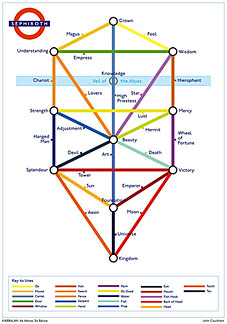
kabbalah.jpg

A couple of updates to the site this month. Firstly there’s another interview with Eroom Nala focussing on life, art and (inevitably) my forthcoming Haunter of the Dark book.

And I’ve finally got round to expanding the line of CafePress products (T-shirts and a larger poster print) for my Kabbalah poster which seems to be my most popular work judging by sales there. This surprises me seeing as it was done on a whim in 2000 after a visit to London. Alan Moore later used it in an issue of Promethea but I don’t know whether the people interested in it are Promethea fans or some of the new breed of Kabbalists.

I’ll be adding more products for other lines, and some new things, as time permits over the next few weeks.

Update: CafePress have decided that my artwork may need “copyright clearance”. So don’t bother trying to buy anything just yet.

Update 2: CafePress tell me that “Transport for London provided us with a notice stating that the use of the London Underground Roundel infringes upon their intellectual property rights”. I presume this means now I’ll have to amend the artwork to remove the offending article. Copyright hell: it’s the wave of the future. Get used to it. See this Boing Boing post for a good example of London Transport’s dead hand.

Update 3: Products reworked with slightly amended artwork although for some reason the page is still showing the old items.