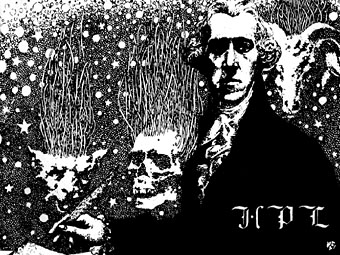
HP Lovecraft by Virgil Finlay, 1937.
A journal by artist and designer John Coulthart.

HP Lovecraft
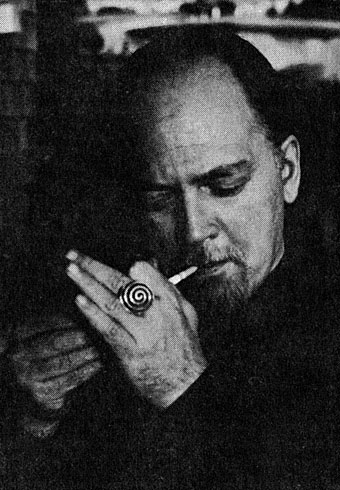
There are few people who really change your life but Robert Anton Wilson—who died earlier today—certainly changed mine. Wilson’s Illuminatus! trilogy (written with Robert Shea) was my cult book when I was at school in the 1970s, a rambling, science fiction-inflected conspiracy thriller that opened the doors in my teenaged brain to (among other things) psychedelic drugs, HP Lovecraft, James Joyce, William Burroughs and Aleister Crowley as well as being a crash-course in enlightened anarchism. I’ve had people criticise the books to me since for their ransacking of popular culture but this was partly the point, they were collage works, and they worked as a perfect introduction for a young audience to worlds outside the usual circumscribed genres.
The philosophical side of Wilson’s work was probably the most important at the time (and remains so now), his “transcendental agnosticism” made me start to question the adults around me who were trying to force my life to go in a direction I wasn’t interested in at all. I’m sure I would have resisted that kind of pressure anyway but the value of RAW’s writings in Illuminatus! and the later Cosmic Trigger came with being given an intelligent rationale for those decisions; I couldn’t necessarily articulate why I was “throwing my life away” by wanting to drop out of the whole education system but Wilson’s work had convinced me it was the right thing to do. I still mark the true beginning of my life as May 1979, the month I left school for good.
He wouldn’t want us to be maudlin, I’m sure. It’s typical for a writer who spent so much of his life writing about drugs and coincidences that he managed to die on Albert Hofmann’s birthday. So I’ll just say thank you Robert, for changing my life. And Hail Eris!
Previously on { feuilleton }
• The Absolute Elsewhere
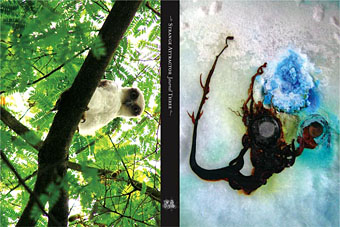
Yes, it’s that magazine again, the perfect thing to feed your head for the new year.
Mark P and SAJ are profiled in the latest Wire.
Ken Hollings rides the world’s subcultural currents mapped by London’s Strange Attractor.
The Wire #275, January 2007
Strange Attractor is well named. There’s really no escaping it. Starting out as a series of live events, it has slowly transmuted into an annual publication, set up an online clearing house for the weird and the wonderful and recently made its first move towards establishing itself as a publishing house. “Strange Attractor celebrates unpopular culture,” runs its mission statement. “We declare war on mediocrity and a pox on the foot soldiers of stupidity. Join us.” Who could possibly resist such a challenge? Sooner or later you have to get involved. (In the interests of full transparency: the writer of this article has taken part in a number of Strange Attractor evenings and is a regular contributor to Strange Attractor Journal.)
With orders for the Strange Attractor publications coming in from all over the world, and mainstream media like The Independent On Sunday praising it for producing “one of the most weirdly beautiful, beautifully weird magazines of the past hundred-odd years” a bigger problem presents itself. How do you celebrate unpopular culture without losing its unpopularity?
“There’s certainly no business plan,” admits Strange Attractor Journal‘s publisher and chief editor, Mark Pilkington. “We’re really making it all up as we go along. I hope that Strange Attractor‘s approach to culture is simultaneously that of the archaeologist, the ethnographer, the anthropologist, the occultist, the showman and the curator.”
It’s a heady mix. The first two issues, both book-sized anthologies running to more than 200 and 400 pages apiece, have presented material ranged across such elusive topics as mind control experiments, mould art, hair sculpture, cargo cults, neglected gods and forgotten waxworks. Such a list limits more than it clarifies, however. Strange Attractor Journal is concerned less with the unexplained than with the unexpected. You never know what it will cover next.
“I think Strange Attractor is refreshing to people in that it manages to straddle several cultural channels while still following its own agenda,” Pilkington admits, “and it’s one not driven by the same obvious memes. But at the same time it’s important that it doesn’t become obscurantist for its own sake—some things are lost for a reason, others will only resurface when the time is right.”
Strange Attractor‘s wayward eclecticism dates back to a series of monthly events begun in the summer of 2001 by Pilkington in collaboration with artist John Lundberg and continuing over the next two years. Staged at London’s Horse Hospital venue, they gave an early indication of the loose network of experimental enterprises that was starting to come into existence, linking outsider artists with cultural anthropologists, textual hackers and practising occultists.
“We’d mix talks, films, music, presentations, each night being themed around a different topic,” Pilkington recalls. “I rather pretentiously called them ‘information happenings’. Subjects ranged from conspiracy theory to theremins, Esperanto to magick, hoaxes, illusions and psychic deceptions: basically anything that interested us and could draw people that we liked or wanted to meet into one place.” Highlights included a live and bloody demonstration of psychic surgery, sci-fi movie themes played on vintage electronic instruments and a live Lovecraft-influenced Chaos Magick ritual with a soundtrack performed “by a band who couldn’t see what was going on.”
After Lundberg enrolled at the National Film and Television School, Pilkington went solo but eventually grew tired of doing regular live events, deciding instead to do something that would last longer: hence the Journal.
The notion of outliving the moment, of being around for more than just a quick cultural fix, is very much a part of SAJ‘s overall look and feel. The first thing you notice is that the front and back cover of each issue is devoid of text or title, which only appears on the book’s spine. If you want to know who the contributors are, you’ll have to look inside.
“For me, it was about giving as much space as possible to striking images and therefore making them stand out on the bookshelf,” Pilkington explains. “I imagined people being aware that something was wrong with the cover but perhaps not being able to put their finger on it.”
The absence of cover copy also binds together the Journal‘s various contributors in the anonymity of a collective endeavour. “We’re lucky enough to live in an age where we can clearly trace the influences of the past on our present,” Pilkington continues, “and it’s not always today’s most celebrated ideas, musicians and writers who will be remembered. This notion of timelessness is very important to what SAJ is and does. I’d like the books to be as irrelevant to a reader 100 years in the future as it would be to someone 100 years in the past. It’s a re-manipulation of the notion of built-in obsolescence.”
The Journal‘s pages teem with old woodcuts, antiquated typefaces and intricate layouts, giving the impression of having been produced in some parallel past: one that runs counter to established tenets of historical development. Having previously worked as a journalist for periodicals as varied as Fortean Times, Bizarre and The Guardian, Mark Pilkington remains keenly aware of what’s going on around him.
“There’s a particularly vibrant, very loose cultural network in London at the moment,” he remarks, “one that incorporates music and sound, ideas and information, visual arts and almost anything else you’d care to imagine. It’s inevitable that these people, places and events all bounce off and influence each other in a kind of subcultural Brownian motion.”
As well as working closely with designer Alison Hutchinson, readying volume three for publication, Pilkington has also been getting Strange Attractor Press up and running. Its first book to date, The Field Guide: The Art, History And Philosophy Of Crop Circle Making by Rob Irving and John Lundberg, is a particularly cerebral blend of art theory, paranormal phenomena, hoaxes and speculations, ruggedly bound and designed to fit snugly inside your knapsack while out exploring the British countryside. Conventional wisdom says it shouldn’t work, but Strange Attractor‘s own particular blend of parlour magic proves that it does.
“I sometimes see myself as a medium,” Mark reveals, “a channel for all the material that has formed Strange Attractor. I’ve been incredibly lucky with the amazing contributions the Journal has attracted so far.”
There’s no escaping it. Strange Attractor really is well named.
Strange Attractor Journal Three, and The Field Guide: The Art, History And Philosophy Of Crop Circle Making by Rob Irving & John Lundberg, are available now.
Previously on { feuilleton }
• Strange Attractor Journal Three
• How to make crop circles
BBC Radio 3 gets hip to the squamous nightmares of HPL.
Available to listen to online until next Sunday.
Geoff Ward examines the strange life and terrifying world of the man hailed as America’s greatest horror writer since Poe.
During his life Lovecraft’s work was confined to lurid pulp magazines and he died in penury in 1937. Today, however, his writings are considered modern classics and published in prestigious editions.
Among the writers considering his legacy are Neil Gaiman, ST Joshi, Kelly Link, Peter Straub and China Mieville.
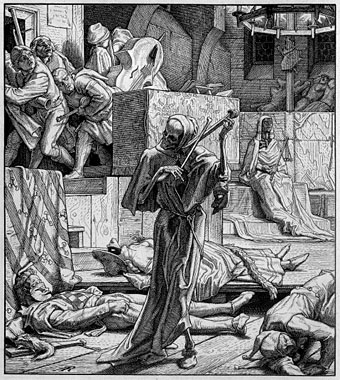
Der Tod als Erwürger (1851) by Alfred Rethel.
It’s a fact (sad or otherwise) that a substantial percentage of my music collection would make good Halloween listening but in that percentage a number of works are prominent as spooky favourites. So here’s another list to add to those already clogging the world’s servers, in no particular order:
Theme from Halloween (1978) by John Carpenter & Alan Howarth.
What a surprise… All John Carpenter‘s early films have electronic scores and great themes, Halloween being the most memorable, and one that’s gradually infected the wider musical culture as various hip hop borrowings and Heat Miser by Massive Attack demonstrate.
Monster Mash (1962) by Bobby “Boris” Pickett.
The ultimate Halloween novelty record. A host of imitators followed the success of this single while poor Bobby struggled to be more than a one-hit wonder. It wasn’t to be, this was his finest hour. Available on These Ghoulish Things: Horror Hits for Halloween with some radio spots by Bobby and a selection of other horror-themed rock’n’roll songs.
The Divine Punishment (1986) & Saint of the Pit (1988) by Diamanda Galás.
Parts 1 & 2 of Galás’s Masque of the Red Death, a “plague mass” trilogy based on the AIDS epidemic. These remain my favourite records by Ms Galás; on the first she reads/sings passages from the Old Testament accompanied by sinister keyboards, making the Bible sound as steeped in evil and metaphysical dread as the Necronomicon. On Saint of the Pit she turns her attention to French poets of the 19th century (Baudelaire, Gérard de Nerval & Tristan Corbière) while unleashing the full power of her operatic vocalizations. Einstürzende Neubauten’s FM Einheit adds some thundering drums. “Correct playback possible at maximum volume only.” Amen to that.
The Visitation (1969) by White Noise.
An electronic collage piece about a ghostly lover returning to his grieving girlfriend. White Noise were David Vorhaus working alongside BBC Radiophonic Workshop pioneers Delia Derbyshire and Brian Hodgson to create an early work of British electronica and dark psychedelia. The Visitation makes full use of Derbyshire and Hodgson’s inventive tape effects and probably accounts for them being asked to score The Legend of Hell House a few years later. Immediately following this is the drums and screams piece, Electric Storm In Hell; play this loud and watch the blood drain from the faces of your Halloween guests.
Zeit (1972) by Tangerine Dream.
Subtitled “A largo in four movements”, Zeit is Tangerine Dream’s most subtle and restrained album, four long tracks of droning atmospherics.
The Masque of the Red Death (1997) read by Gabriel Byrne.
From Closed On Account Of Rabies, a Poe-themed anthology arranged by Hal Willner. The readings are of variable quality; Christopher Walken’s The Raven is effective (although I prefer Willem Defoe’s amended version on Lou Reed’s The Raven) while Dr John reads Berenice like one of Poe’s somnambulists. Gabriel Byrne shows how these things should be done.
De Natura Sonoris no. 2 (1971) by Krzysztof Penderecki.
More familiar to people as “music from The Shining“, this piece, along with much of the Polish composer‘s early work, really does sound like music in search of a horror film. His cheerily-titled Threnody For The Victims Of Hiroshima is one piece that won’t be used to sell cars any time soon. Kubrick also used Penderecki’s equally chilling The Dream of Jacob for The Shining score, together with pieces by Ligeti and Bartók.
Treetop Drive (1994) by Deathprod.
Helge Sten is a Norwegian electronic experimentalist whose solo work is released under the Deathprod name. “Electronic” these days often means using laptops and the latest keyboard and sampling equipment. Deathprod music is created on old equipment which renders its provenance opaque leaving the listener to concentrate on the sounds rather than be troubled by how they might have been created. The noises on the deceptively-titled Treetop Drive are a disturbing series of slow loops with squalling chords, anguished shrieks and some massive foghorn rumble that seems to emanate from the depths of Davy Jones’ Locker. Play it in the dark and feel the world ending.
Ouroborindra (2005) by Eric Zann.
Another collection of sinister electronica from the Ghost Box label (see this earlier post), referencing HP Lovecraft and Arthur Machen’s masterpiece, The White People. Spectral presences haunting the margins of the radio spectrum.
Theme from The Addams Family (1964) by Vic Mizzy.
Never the Munsters, always the Addams Family! If you don’t know the difference, you must be dead.
Happy Halloween!
Previously on { feuilleton }
• The music of the Wicker Man