Ghosts of the Chit-Chat

chitchat1.jpg

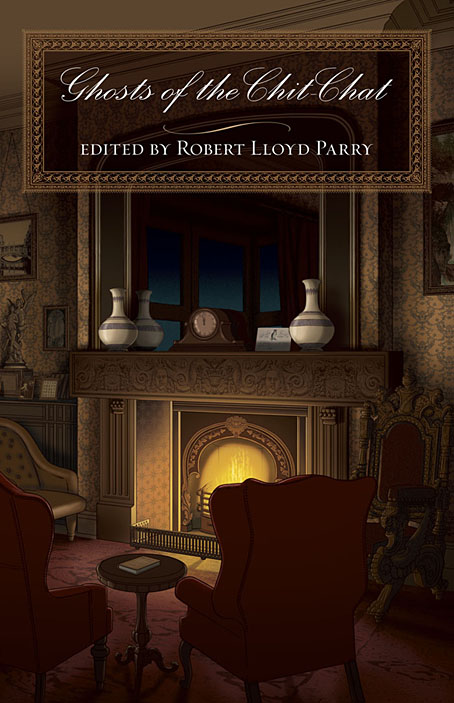
My latest cover for Swan River Press is very suitable for the season, It’s also a good example of the “window” type of cover design, where you show a view into a scene rather than a flat design. Window covers are common in fantasy and science fiction, less so in the horror genre where you often want to avoid giving too much away. The “Chit-Chat” of the title was The Chit-Chat Club, a group of students and tutors at King’s College, Cambridge:

On the evening of Saturday, 28 October 1893, Cambridge University’s Chit-Chat Club convened its 601st meeting. Ten members and one guest gathered in the rooms of Montague Rhodes James, the Junior Dean of King’s College, and listened — with increasing absorption one suspects — as their host read “Two Ghost Stories”.

Ghosts of the Chit-Chat celebrates this momentous event in the history of supernatural literature, the earliest dated record we have of M. R. James reading his ghost stories out loud. And it revives the contributions that other members made to the genre; men of imagination who invoked the ghostly in their work, and who are now themselves shades. In a series of essays, stories, and poems Robert Lloyd Parry looks at the history and culture of the Club.

In addition to tales and poems never before reprinted, Ghosts of the Chit-Chat features earlier, slightly different versions of two of M. R. James’s best-known ghost stories; Robert Lloyd Parry’s profiles and commentaries on each featured Chit-Chat member sheds new light on this supernatural tradition, making Ghosts of the Chit-Chat a valuable resource for casual readers and long-time Jamesians alike. (more)

chitchat2.jpg

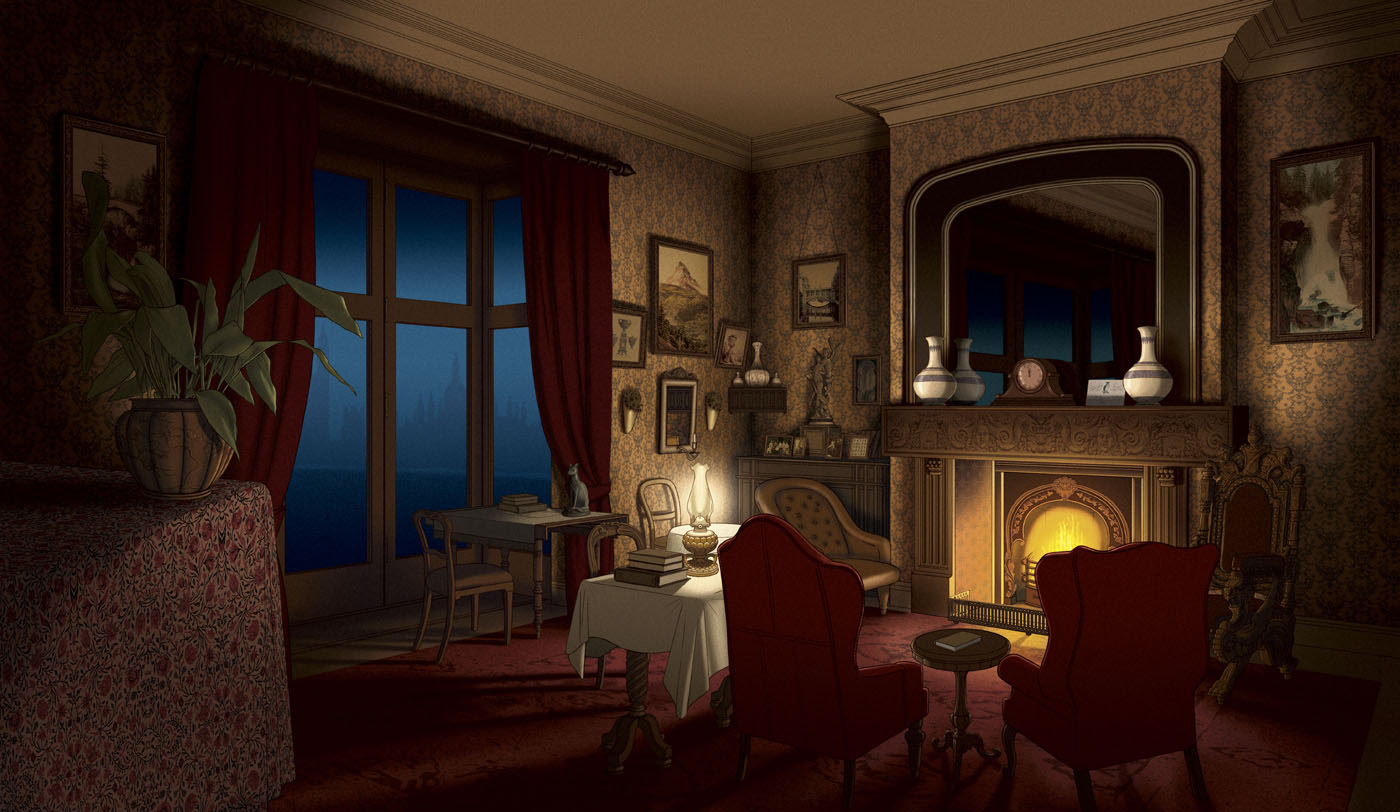
The full picture which will be a little cropped on the print version. Here you get to see more aspidistra.

The brief for the cover was to show a view of an empty room in a manner similar to the covers drawn by “Ionicus” (Joshua Charles Armitage) in the 1970s and 80s for a series of supernatural story collections. After looking at a number of these covers I took Tune in for Fear as a template; I liked the angle of the picture which offered a view of a welcoming fireplace to contrast with the night sky seen on the back of the book, and the two-point perspective makes a change from my tendency to create symmetrical pictures. The inhabitants of the Ionicus room seem to have either fled or been abducted whereas mine have either just left or are soon to arrive. The clock on the mantelpiece is almost at midnight, and there’s a Chit-Chat invitation next to it so I’d suggest the latter. The picture contains a number of references to the stories and poems in the book, although not as many as I’d originally intended when several of the pieces proved resistant to having their contents reduced to a single detail. I won’t list everything here since I’d prefer readers to try and match the details themselves.

Ghosts of the Chit-Chat will be published in December, and is available for pre-order here.

Previously on { feuilleton }
The Far Tower: Stories for WB Yeats
The Scarlet Soul: Stories for Dorian Gray

The Cthulhu Mythos in the pulps

mythos01.jpg

The Nameless City: First published in The Wolverine, November 1921. Reprinted in Weird Tales, November 1928. Illustration by Joseph Doolin.

This would have been “The Cthulhu Mythos in Weird Tales” if some of HP Lovecraft’s more substantial stories hadn’t been published elsewhere. To prevent sprawl I’ve limited the list to Lovecraft’s own stories even though the Mythos takes in the work of contemporaries such as Clark Ashton Smith, Robert E. Howard, Frank Belknap Long, Zealia Bishop, August Derleth and others. I like seeing the first appearance in print of familiar tales, and I like seeing their accompanying illustrations even if the drawings are inferior pieces, which they often were for the first decade of Weird Tales. These are the short-story equivalent of first editions, and in the case of The Call of Cthulhu you get to see the first printing anywhere of that mysterious name.

mythos02.jpg

The Hound: Weird Tales, February 1924. Illustration by William Fred Heitman.

This issue is also notable for a story by Burton Peter Thom which shares a title with a Mythos-derived song by Metallica, The Thing That Should Not Be.

mythos03.jpg

The Festival: Weird Tales, January 1925. Illustration by Andrew Brosnatch.

mythos22.jpg

The Colour Out of Space: Amazing Stories, September 1927. Illustration by JM de Aragon.

Lovecraft didn’t think that Weird Tales would appreciate this one even though it’s more horror than science fiction so he sent it to Amazing Stories instead.

mythos04.jpg

mythos26.jpg

The Call of Cthulhu: Weird Tales, February 1928. Illustration by Hugh Rankin.

It’s doubtful that Rankin, Senf and co. would have been up to the task of depicting Great Cthulhu or the non-Euclidean nightmare of R’lyeh, but this hardly excuses editor Farnsworth Wright’s decision to give the cover to Elliott O’Donnell’s ridiculous ghost table.

Continue reading “The Cthulhu Mythos in the pulps”

Écorché

ecorche01.jpg

Engraving by Philip Galle.

Écorché, from the French verb to flay, was the traditional term applied to depictions of the skinless man found in anatomical studies, and the musculature models made for the use of artists and sculptors. This is almost always a male figure. Women tend to feature in the anatomical works of previous centuries in order to illustrate the conditions of pregnancy, the male body being considered the default for the usual sexist reasons.

I’ve been revisiting the history of these figures while working on a new book design so what follows are a few choice examples, some of which carry a pleasantly Surrealist charge. In the years that followed the pioneering studies by Vesalius and co. there was a period of playfulness in anatomical illustration during which time the figures are shown peeling away their flesh to reveal the muscles or even the organs beneath, a striptease where the substance of the body itself is removed. As William Burroughs was fond of quoting: “‘T ain’t no sin to take off your skin, and dance around in your bones.”

ecorche07.jpg

Valverde de Hamusco (1556).

ecorche06.jpg

Engraving by G. Bonasone (15–).

ecorche02.jpg

Engraving by Philip Galle.

Continue reading “Écorché”

Manuel Orazi’s Fleurs du Mal

orazi01.jpg

This collection of Baudelaire’s poems with illustrations by French artist Manuel Orazi (1860–1934) didn’t turn up when I was searching for illustrated editions a few years ago. With over 50 full-page drawings or vignettes it’s more profusely illustrated than most. It’s also more determinedly erotic than most, concentrating on depictions of female flesh at the expense of the poet’s other themes; Orazi’s fleurs on the title pages are a succession of priapic or vaginal orchids and fungi. The book was published in 1934, which means it was probably the last thing that Orazi worked on, but it resembles something from the fin de siècle, especially the work of Félicien Rops. Browse it or download it here.

orazi02.jpg

orazi03.jpg

orazi04.jpg

orazi05.jpg

Continue reading “Manuel Orazi’s Fleurs du Mal”

Alphonse Mucha et Son Oeuvre

mucha01.jpg

Alphonse Mucha was so wildly prolific, and his work maintained such a consistently high standard, that book collections tend to focus on the popular Art Nouveau prints and posters to the exclusion of everything else. This short study of Mucha’s career was published in 1897 when the Nouveau style was becoming a dominant trend in Continental Europe, thanks in part to the promotion of art journals like La Plume, as well as to Mucha himself. The reproductions are all monochrome halftones but they include many sketches, illustrations and smaller works that are either never seen elsewhere or are marginalised by his advertising graphics and the designs for Sarah Bernhardt. Browse the book here or download it here.

mucha02.jpg

mucha03.jpg

mucha04.jpg

mucha05.jpg

Continue reading “Alphonse Mucha et Son Oeuvre”