Weekend links 830

hilscher.jpg

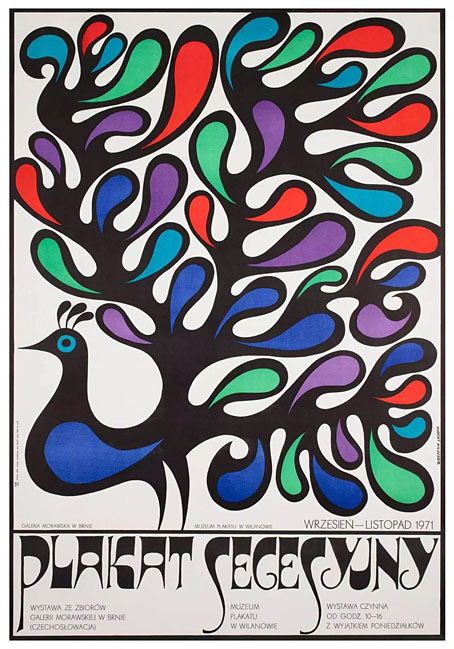
Plakat Secesyjny (1971), a poster by Hubert Hilscher for an exhibition of Art Nouveau graphics.

• At Public Domain Review: Longitude by Way of Wounded Hounds: Kenelm Digby’s Sympathetick Powder (1669 edition). Two subjects familiar to readers of Thomas Pynchon’s Mason & Dixon.

Miles Davis and group (Dave Liebman, Pete Cosey, Reggie Lucas, Michael Henderson, Al Foster, James Mtume) live in Stockholm in 1973. TV footage, 56 minutes.

• At the BFI: Rory Doherty selects ten great films about forgers and fakes, while Kazuo Ishiguro compiles a list of his top ten train films.

• At Colossal: “Markus Brunetti’s monumental photos venerate European ecclesiastical landmarks”.

• Font Faces: Nick Shinn answers questions about being a type designer.

• Mix of the week: DreamScenes – May 2026 at Ambientblog.

Milky Way photographer of the year 2026.

• New music: Chambers by Ruben.

Train To Ranchipur (1959) by The Markko Polo Adventurers | One Train Load Of Dub (1974) by Tommy McCook & The Observers | Sunstroke / Mind Train (1992) by Sun Dial

Weekend links 693

sime.jpg

Imaginary (no date) by Sidney Sime.

• Victor Rees was in touch this week to alert me to a one-off screening of The Gourmet (previously), a cult TV drama from 1986 written by Kazuo Ishiguro and directed by Michael Whyte. The screening, which will take place at Swedenborg House, London, on 16th October, is one of a series of retrospective events based around an exhibition from 1974, Albion Island Vortex, by Brian Catling and Iain Sinclair. The film, which is connected to Sinclair’s oeuvre by its use of one of the Hawksmoor churches, will be followed by a Q&A session with Sinclair and Michael Whyte. The screening is free but places are limited so prior booking is required.

• “Alongside his thieves and vagabonds, Hotten includes religious slang, public schoolboy slang, pirate slang, equine stable slang, phrases coined by Dr. Johnson, the slang of softened oaths, workmen’s slang, stagehand slang, shopkeeper’s slang, and dozens of other argots.” Hunter Dukes on A Dictionary of Modern Slang, Cant, and Vulgar Words (1860) by John Camden Hotten.

The Night Land, William Hope Hodgson’s “Dying Earth” doorstop, is republished in an abridged version as part of MIT Press’s Radium Age series, “proto–science fiction stories from the underappreciated era between 1900 and 1935”. All the reprints come with new introductions, the one for Hodgson being by Erik Davis.

• “My partner wanted me to stop buying lava lamps. It was an expensive hobby, and we were running out of room in our apartment.” Nora Claire Miller on the lure of the lava lamp. I only own a single one but I appreciate the obsessive attraction.

• Rambalac takes his roaming camera for a walk through teamLab Planets, Tokyo, a labyrinthine exhibition featuring plenty of water (and wet feet), and a moss garden filled with large silver eggs.

• At Strange Flowers: An examination of the connections between the self-mythologising Marie Corelli and her fictional counterparts in the Mapp and Lucia novels of EF Benson.

• Coming soon from Strange Attractor: Cabarets of Death, a book about the otherworldly cabarets of Montmartre by Mel Gordon, edited by Joanna Ebenstein.

• Among the new titles at Standard Ebooks, the home of free, high-quality, public-domain texts: The Secret Glory by Arthur Machen.

10 essential Japanese reggae releases selected by Kay Suzuki.

• Mix of the week: A Fact Mix by Venus Ex Machina.

Modern Art in Mid-Century Comics.

• RIP Michael Gambon.

Planet Caravan (1970) by Black Sabbath | Planet Queen (1971) by T. Rex | Oszillator Planet Concert (1971) by Tangerine Dream

Covering Ishiguro

ishiguro1.jpg

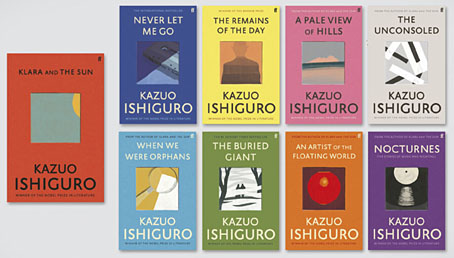
I like seeing an author’s works designed as a set, and so do the bigger publishers for whom redesigns are a useful way to freshen their back catalogue. This month the Faber edition of Klara and the Sun by Kazuo Ishiguro provides the template for a redesign of the author’s previous works, with new editions of the seven other novels plus a story collection, Nocturnes. I’ve not read any of these books so I’ll leave it to Ishiguro’s readers to gauge the suitability of the minimal illustrations, although the one for Nocturnes is the kind of visual pun that designers today often search for. The image is explained by the book’s subtitle, “Five Stories of Music and Nightfall”. I’d have been tempted to go the George Hardie route with the illustrations, flattening the colours, adding outlines, and placing that cassette and shadow at forty-five-degree angles. But Hardie’s bold isometrics might seem a little too cartoony for Ishiguro. Faber designer Pete Adlington recounts the thinking behind his covers here.

ishiguro2.jpg

ishiguro3.jpg

ishiguro4.jpg

ishiguro5.jpg

Continue reading “Covering Ishiguro”

Weekend links 564

kolbe.jpg

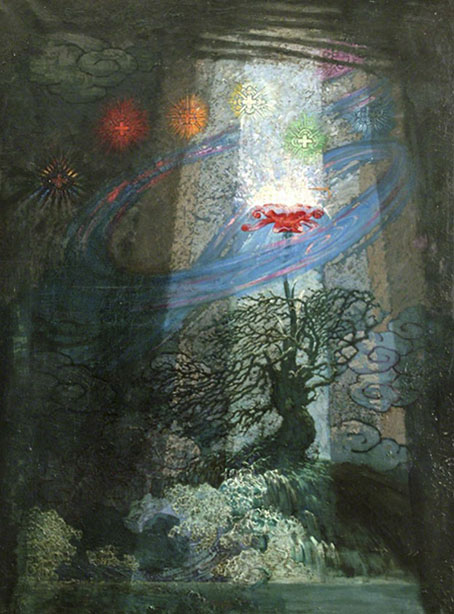
Fantastical Tree (c. 1830) by Carl Wilhelm Kolbe.

• “It’s just a square and a semi-circle at the end of the day.” Pete Adlington navigates the rapids of high-profile cover design for the UK edition of Kazuo Ishiguro’s Klara and The Sun. I’m not always keen on the minimal approach but the Faber edition is a better design than the equally minimal US cover whose circle in a hand makes it look like a reprint of Logan’s Run. Faber also produced a limited edition with the sun circle wrapped onto sprayed page edges.

• “‘With a mysterious smile on her lips,’ writes the Chilean film director Alejandro Jodorowsky, ‘the painter whispered to me, “What you just dictated to me is the secret. As each Arcana is a mirror and not a truth in itself, become what you see in it. That tarot is a chameleon.”‘” The painter referred to is the now-ubiquitous Leonora Carrington whose own Tarot deck is investigated by Rhian Sasseen.

• “‘Horror is an emotion,’ Douglas E. Winter tells us. I would respectfully like to amend that assertion. Horror is a range of emotions. And each of these moods, if they are to be successful, must be cultivated differently.” Brian J. Showers offers his thoughts on horror fiction.

• “You move from awareness of—and preoccupation with—how sounds affect our bodies, into how that might create a web of connection with the external world—with the natural world.” Annea Lockwood talking to Jennifer Lucy Allan about her career as a composer and sound artist.

• Gay cruising and its geography in cinema and documentary, a list of films by Mike Kennedy. Related: Shiv Kotecha on O Fantasma (2000), a film by João Pedro Rodrigues.

• Coming from Strange Attractor in June: Coil: Camera Light Oblivion, a photographic record by Ruth Beyer of the first live performances by Coil from 2000–2002.

• At Wormwoodiana: Mark Valentine on The Star Called Wormwood (1941), a strange novel by Morchard Bishop.

• At Unquiet Things: Ephemeral and Irresistible: The Spectacular Still-life Botanical Drama of Gatya Kelly.

• “Fevers of Curiosity”: Charles Baudelaire and the convalescent flâneur by Matthew Beaumont.

• 1066 and all that: Explore the Bayeux Tapestry online.

• Mix of the week: Secret Thirteen Mix 311 by Arigto.

• New music: Terrain by Portico Quartet.

Fever (1956) by Little Willie John | Fever (1972) by Junior Byles | Fever (1980) The Cramps

Weekend links 559

fukuda.jpg

Cover art by Toshiyuki Fukuda for the Japanese edition of the new novel by Kazuo Ishiguro.

• “The story here is how between 1978 and 1982, this impulse shed its novelty genesis and its spoils were divvied up between gay producers making high-energy soundtracks for carnal abandon, and quiet Hawkwind fans smoking spliffs in Midlands bedrooms.…this excellent compilation offers fresh understandings of a period in sonic history where the future was up for grabs.” Fergal Kinney reviews Do You Have the Force? Jon Savage’s Alternate History of Electronic Music, 1978–82.

DJ Food continues his history of mini CDs with Oranges And Lemons, the 1989 album by XTC which was released in the usual formats together with a limited edition of three small discs in a flip-top box. The cover art by Dave Dragon is a good example of the resurrected groovy look.

• “If Austin Osman Spare, William Burroughs, Mary Butts and Kathy Acker got together for a séance, the transcript could well look like this.”

• How Leonora Carrington used Tarot to reach self-enlightenment: Gabriel Weisz Carrington on his mother’s quest for mythic revelations.

• Mixes of the week: Sounds Unsaid at Dublab with Tarotplane, and To Die & Live In San Veneficio by SeraphicManta.

• At Dennis Cooper’s: 5strings presents…Solve et Coagula: An introduction to Israel Regardie.

• The Joy of Silhouettes: Vyki Hendy chooses favourite shadow-throwing cover designs.

Emily Mortimer on how Lolita escaped obscenity laws and cancel culture.

Freddie deBoer has moved his writing to Substack.

• New music: Wirkung by Arovane.

• Children Of The Sun (1969) by The Misunderstood | Children Of The Sun (1971) by Hawkwind | Children Of The Sun (2010) by The Time And Space Machine