Weekend links 366

kashiki.jpg

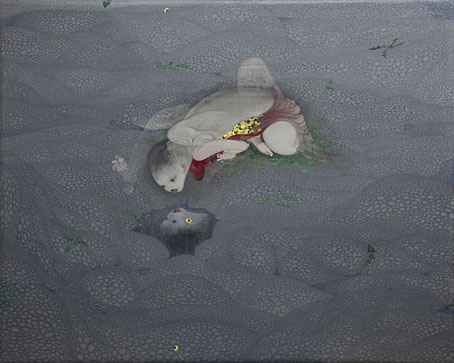
Dandelion (2009) by Tomoko Kashiki.

• “Standard Ebooks takes ebooks from sources like Project Gutenberg, formats and typesets them using a carefully designed and professional-grade style guide, lightly modernizes them, fully proofreads and corrects them, and then builds them to take advantage of state-of-the-art ereader and browser technology.”

Obscenity and the Arts, a previously unpublished essay by Anthony Burgess, will appear in book form later this year via Pariah Press.

• Mixes of the week: VF Mix 97: Talk Talk by The Last Dinosaur, and Secret Thirteen Mix 225 by Janek Schaefer.

Rub any two writers together and similarities will show. No two writers, however different, are completely different. Here’s a crucial instance: Lovecraft and Ballard both put architecture at the heart of their fiction, even though neither had the slightest formal training in the subject. And it is via this interest that the two intersect in an unexpected way. They are connected, through time and space, by that most humble of architectural events: the corner, the junction between two walls. What Lovecraft and Ballard did was to make the corner into a place of nightmares — and in doing so, they reveal its secret history.

Will Wiles in a long and rewarding essay, The Corner of Lovecraft and Ballard

• Dungeons Deep, Forests Dark – A beginner’s guide to Dungeon Synth by Daniel Pietersen.

Alex Ross on Joséphin Péladan, the Symbolists and the occult roots of Modernism.

• Cooling the Tube: engineering heat out of the [London] Underground by IanVisits.

Caroline on the mysteries of Pye Corner: Flames, poltergeists and bodysnatchers.

• The Saint of Sin City – Tony Kail Visits Las Vegas’ Santuario de la Santa Muerte.

• Photographs of Art Nouveau architecture by Keiichi Tahara.

• A stream of the new Porter Ricks album, Anguilla Electrica.

Jasper Sharp on 100 years of Japanese animation.

• At Dennis Cooper’s: 197 clocks.

On The Corner [Take 4] (1972) by Miles Davis | Corner Crew Dub (1976) by Augustus Pablo | Empty Avenues And Dark Corners (Pye Corner Audio Mix) (2013) by John Foxx and the Belbury Circle
Weekend links 359

azuma.jpg

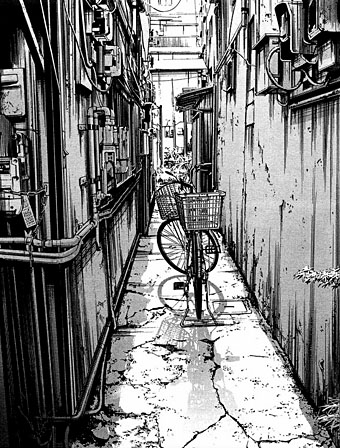
An urban scene from Yotsuba&! by manga artist Kiyohiko Azuma.

• The resurgence of interest in Alice Coltrane’s music is very welcome even if she joins for the moment the list of those artists (usually women: see Leonora Carrington) tagged by editors as “lost”, “forgotten”, “unrecognised”, etc. Alice Coltrane was only ever lost if you weren’t paying attention, and was notable enough fifteen years ago to be given the cover of The Wire magazine. Articles appearing this week have been prompted by a compilation of the devotional music that Coltrane recorded for a series of self-released cassettes in the 1980s. Geeta Dayal writes about the creation of the ashram recordings, while Stewart Smith suggests starting points for new listeners.

• Mentioned here before, but there’s now a page for the book: a new edition of Hashish (1902) by Oscar Schmitz will be published by Wakefield Press in November. “A collection of decadent, interweaving tales of Satanism, eroticism, sadism, cannibalism, necrophilia, and death”, illustrated by Alfred Kubin.

• Mixes of the week: A Dark Entries mix for the 400th issue of The Wire, Procedure, LA, April 25, 2017 by Pinkcourtesyphone, and Secret Thirteen Mix 220, a 4-hour epic by Ricardo Gomez Y De Buck.

• More off-the-beaten-path film lists: Sarah Lyons for Dirge Magazine on three occult documentaries, and Terry Ratchett for Dennis Cooper on 18 needlessly obscured avant-garde films.

• An Island of Peace: James Conway on Amanda DeMarco’s new translation of Walking in Berlin: A Flâneur in the Capital by Franz Hessel.

Ryuichi Sakamoto talks to Aaron Coultate about overcoming cancer, The Revenant and his new album, async.

Ingrid D. Rowland on Caravaggio: The Virtuoso of Compassion.

• “I think I am weirdly politically correct,” says John Waters.

Mnemonic Generator

• Berliner Nächte Part 1 (1990) by Seigen Ono | Berlinerstrasse (1995) by Coco, Steel & Lovebomb | Berlin (1998) by Pole

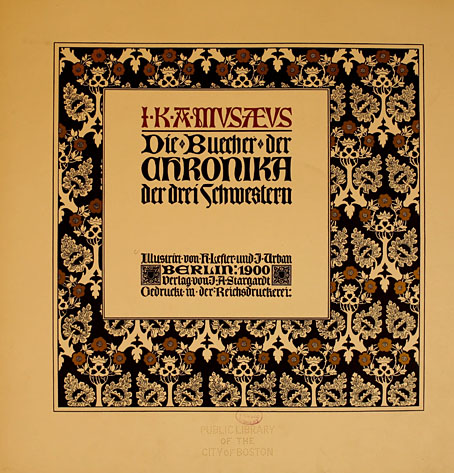
Die Buecher der Chronika der drei Schwestern

chronika01.jpg

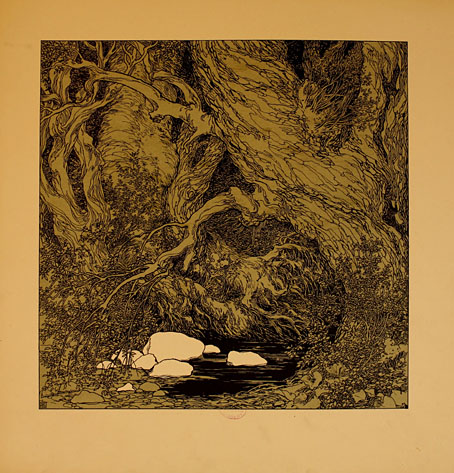
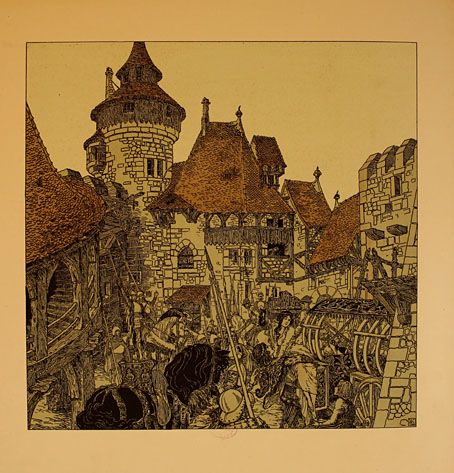
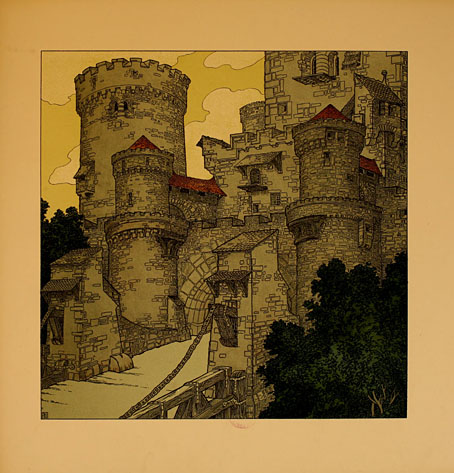
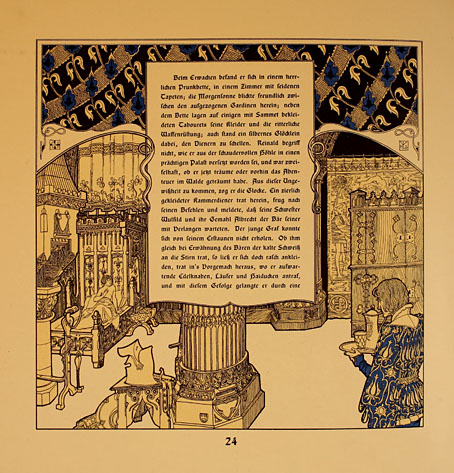
Die Buecher der Chronika der drei Schwestern (The Books of the Chronicles of the Three Sisters) is a German fairy tale set down by Johann Karl August Musäus, and presented here in a 1900 edition illustrated by Heinrich Lefler and Joseph Urban. Lefler and Urban were brothers-in-law who worked as set designers as well as illustrators; Urban was also an architect who later moved to the United States. One of his extant buildings is the Mar-a-Lago in Florida but he can’t be held responsible for its current use or its present owner.

chronika02.jpg

Looking at the excellent illustrations the pair produced for this volume I’d guess that Urban concentrated on the building design which is much more elaborate and inventive than you generally see in children’s books. The selections here are mostly full-page pieces but the book is illustrated throughout, with the text flowing into and around the drawings.

chronika03.jpg

chronika04.jpg

chronika05.jpg

Continue reading “Die Buecher der Chronika der drei Schwestern”

Weekend links 353

tuke.jpg

The Critics (1927) by Henry Scott Tuke.

• Geeta Dayal talks to ambient musician Midori Takada about Through The Looking-Glass (1983), an album being reissued this month by Palto Flats/We Release Whatever The Fuck We Want Records.

Jacob Brogan reviews The Abominable Mr. Seabrook by Joe Ollmann, a graphic biography of writer, occultist, explorer and determined cannibal, William Seabrook.

• More from the usual suspects (on these pages at least): Jonathan Meades on his new cookbook and a recent bout of heart surgery; and Iain Sinclair on The Last London.

The law only applied to men, but that didn’t mean same-sex relationships between women were immune to opprobrium. Dorothy Todd was hired as the editor of British Vogue in 1922. Under her visionary stewardship, the magazine became a bastion of high modernist style, swapping petticoats and corsets for Picasso, Cocteau, Man Ray and Woolf. Todd lived with her lover, the fashion editor Madge Garland. Sacked in 1926 because of declining circulation, she planned to sue the magazine, but was silenced when the publisher Condé Nast threatened to publicly expose her “morals”.

In such an inimical climate, it’s not surprising that art became a zone of enchantment as well as resistance. The plenitude of camp aesthetics, the lush excess, the cross-pollination of high and low forms might be conceived as a direct response to the paucity and hostility of the culture at large. From the mannered decadence of Aubrey Beardsley’s naughty woodcuts, to Cecil Beaton’s portraits of Stephen Tennant as a radiant boy prince, to the cabaret high jinks of Danny La Rue, to the wickedly doctored library book covers made by the playwright Joe Orton (a crime for which he received a jail sentence), camp offered a way of remaking the world, cutting it down to size and reassembling it in richly strange and strangely rich new forms.

Olivia Lang on the British artists working in defiance of iniquitous laws prior to the (partial) decriminalisation of homosexual acts in 1967.

• Due for publication later this year, You Should Come With Me Now, a new collection of short fiction by M. John Harrison.

Daniel Marner reviews Scarred For Life Volume One: The 70s, a book about the dark side of British pop culture.

Jay Babcock talks to Erik Davis about the end of Arthur magazine and his new life in the Californian desert.

• The nature photography of Nobuyuki Kobayashi and the ruin photography of Gina Soden.

Jon Forss of design team Non-Format on his time designing The Wire magazine.

Mac McClelland on how doctors treat mental illness with psychedelic drugs.

• Mix of the week: Secret Thirteen Mix 216 by WSR.

Hisham Matar on Jorge Luis Borges.

London Boys (1976) by T. Rex | Last Train To London (1979) by Electric Light Orchestra | London (2004) by Patrick Wolf

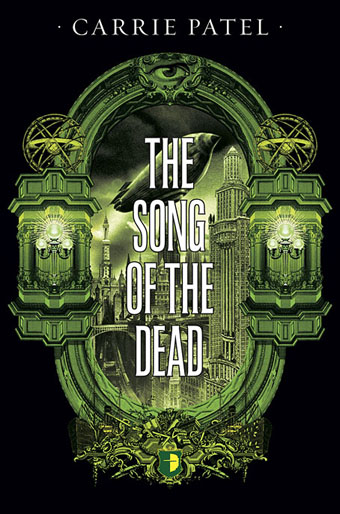
The Song of the Dead by Carrie Patel

patel1.jpg

Presenting my latest cover for Angry Robot books, and the third cover I’ve done for Carrie Patel. The Song of the Dead is a sequel to Carrie’s two previous novels in the Recoletta series, The Buried Life and Cities and Thrones. For the new volume I maintained continuity by keeping the architectural frame while changing some of the details; the use of green after doing the previous covers in blue and red means that this is now the second series I’ve done for Angry Robot (KW Jeter’s being the first) using a red/green/blue colour scheme. This wasn’t intentional but was the result of choosing colours that differ from each other as much as possible. (Or almost as much: red, blue and yellow are primary colours, green is a secondary colour.) The requirement for the pictorial content was to show a city of disparate architecture but with less of an antique style than that seen on The Buried Life. Almost all the buildings in my palimpsest creation are taken from renderings of unbuilt skyscrapers or views from the early 20th century showing New York “as it will be in the future”. The airship is my own invention, based on the French model of dirigible which favoured pointed ends. The Song of the Dead will be published at the beginning of May.

patel2.jpg

And while I’m writing about recent work, it’s worth mentioning that The Thing: Artbook is now available for pre-order from Printed In Blood. This is a 400-page tribute to John Carpenter’s horror masterwork laden with responses and interpretations of Thingery from a wide range of international artists, myself included. The book will be out in July, and copies pre-ordered from the publisher will come with two bonus prints. More about this later.

Previously on { feuilleton }
Things
Two covers