Lyrical Substance Deliberated

beatles.jpg

Lucy In The Sky With Diamonds from Yellow Submarine (1968).

The advent of spring invariably gets me listening to favourite psychedelic songs, and this year has been no exception. Earlier this week I was idly wondering how many songs there are that follow the Beatles’ lead in telegraphing their drug metaphors by using the initials L-S-D in their titles. Wikipedia’s page for Lucy In The Sky With Diamonds (1967) relates John Lennon’s oft-repeated claim that the initialism in the title was a coincidence, and the song itself is really a bit of Lewis Carroll-like whimsy. This might be credible if works of art only ever carried one meaning but they don’t, of course, and the song is both a piece of Lewis Carroll-like whimsy as well as being a pretty obvious paean to the drug experience: “Climb in the back with your head in the clouds / And you’re gone”. Jefferson Airplane’s White Rabbit (1967) was similarly ambivalent with mushrooms/pills replacing acid.

Among the many things birthed by the enormous success of the Sgt Pepper album, a small flurry of songs or instrumentals have imitated Lennon’s initialism for their titles. The ones that came immediately to mind are detailed below, and they make a curious group. If anyone knows of any others—there must be others…—then please leave a comment.

hendrix.jpg

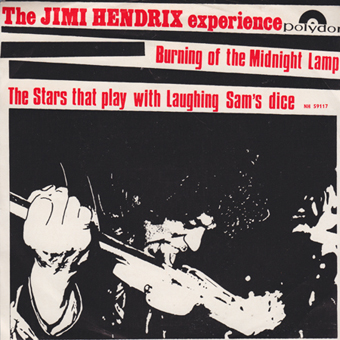
Burning Of The Midnight Lamp/The Stars That Play With Laughing Sam’s Dice (Aug, 1967).

The Jimi Hendrix Experience’s B-side not only alludes to LSD but also to STP. The song itself doesn’t go very far before collapsing into freakout mode.

trip.jpg

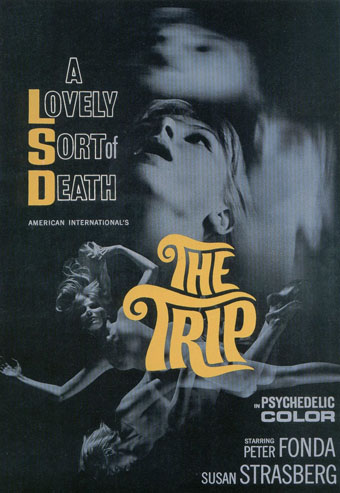
The Trip (1967).

Not a song but included here for that “Lovely Sort of Death” tag. Written by Jack Nicholson! With Dennis Hopper as the acid dealer! See the trailer here, then watch the whole film here.

power.jpg

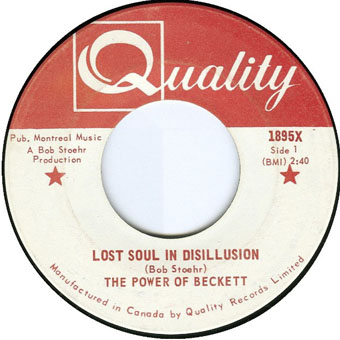
Lost Soul In Disillusion (November, 1967).

Hard to imagine anyone in London would have heard this in 1967. The Power of Beckett were a Montreal garage group who only released two singles. Lost Soul In Disillusion turned up years later on compilation albums.

Continue reading “Lyrical Substance Deliberated”

The Art of Tripping, a documentary by Storm Thorgerson

aot1.jpg

How does this sound? 100 minutes of solidly informative documentary about the use of drugs by artists from the early 19th century on; a production that calls upon a remarkable cast of contributors (see below), with music by David Gilmour, and the whole thing “devised and directed” by Storm Thorgerson, better known as one third of the great Hipgnosis design team.

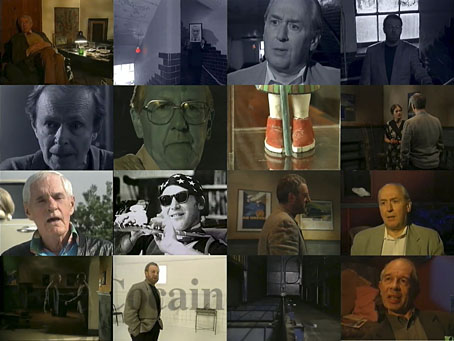
The Art of Tripping was broadcast in two parts in 1993 during the Without Walls arts strand on Channel 4 (UK). David Gale was the writer, with actor Bernard Hill playing the part of the narrator and guide. The programme managed to deal with a contentious subject without indulging in hysteria or insulting the intelligence of the audience, a rare thing today. Twenty years ago it was still possible to make a documentary about a popular subject without having any low-grade celebrity-du-jour offering their wretched opinion. The contributors here who aren’t medical people are almost all writers of one kind or another; Thorgerson and Gale punctuate the proceedings with a few actors who impersonate various historical figures.
aot2.jpg

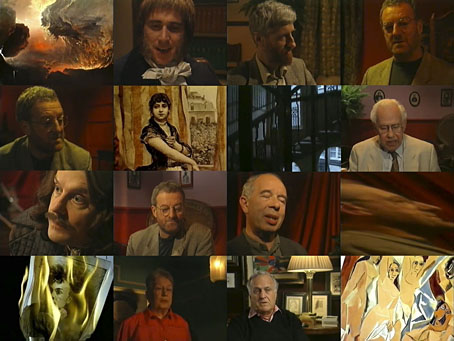
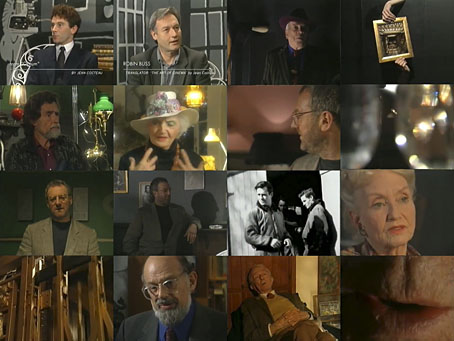
Without Walls was a very good series on the whole but this for me was a real highlight (no pun intended). In addition to it being a rare example of Storm Thorgerson working in television, the direction showed how it was possible to match the theme without recourse to cliché or flashy visuals. There isn’t a single moment of archive footage either. Thorgerson’s history of “socially unacceptable” drugs is structured as a journey through the levels of a multi-storey building, from ground floor to roof; being familiar with the director’s free-associative working methods I can imagine this being a result of thinking about getting high. Bernard Hill encounters the various commentators in successive rooms, each of which is furnished and lit to suggestively imply the drug in question. The use of lighting as a key motif is a smart one, and another metaphor, of course, for literal and symbolic (or spiritual) illumination. Editing effects are also deployed to thematically correspond to the different substances.
aot3.jpg

This would be very successful even without a wide range of contributors but Thorgerson and company assembled a stunning array of different writers, many of whom I’d never seen on TV before, and many of whom didn’t turn up again. Some of them fill dual roles, so JG Ballard is on hand to enthuse about Naked Lunch, and appears later talking about his bad LSD trip. Similarly, Brian Aldiss talks about Anna Kavan, and also about Philip K Dick. Below there’s a rough list of the drugs covered and the people involved. In the two decades since this was made many of the people involved have since died, the director included, so the film now has the feel of a historical artefact. The Art of Tripping can be see in full at YouTube. This is how good British television used to be.

Opium
Dr Virginia Berridge (author), Grevel Lindop (author), Marek Kohn (author), Dr EMR Critchley (author), Phil Daniels (as Thomas De Quincey), Dr Tony Dickenson (neuropharmacologist), Dr Ian Walker (author), Thom Booker (as Edgar Allan Poe), Dr Peggy Reynolds (author)
Hashish
Prof John Hemmings (author), Ronald Hayman (author), Patrick Barlow (as Theophile Gautier), John McEnery (as Charles Baudelaire), Jon Finch (as Gérard de Nerval), Bernard Howells (lecturer, King’s College, London), June Rose (author), John Richardson (author), Margaret Crosland (author), Danny Webb (as Jean Cocteau), Robin Buss (translator), David Gascoyne (poet), George Melly (collector, Surrealist art)
Mescaline
Prof Eric Mottram (University of London), Francis Huxley (nephew of Aldous Huxley), Jay Stevens (author), Laura Huxley (widow of Aldous Huxley),
Psilocybin
Brian Cory (as Robert Graves), Paul O’Prey (author)
Marijuana / Nitrous Oxide
Harry Shapiro (author), Carolyn Cassady (author), Prof Ann Charters (author), Allen Ginsberg (poet)
Kief
Paul Bowles (author)
Heroin
JG Ballard (author), Prof Avital Ronell (author), Hubert Selby Jr (author), Brian Aldiss (author)
LSD
Dr Oscar Janiger (experimental psychiatrist), Diana Quick (as Anaïs Nin), Prof Malcolm Lader (psychopharmacologist), Dr Timothy Leary (author), Todd Boyco (as Andy Warhol)
Amphetamine
Lawrence Sutin (author)
Cocaine
Robert Stone (author), Prof. Annette Dolphin (neuropharmacologist)
MDMA

Previously on { feuilleton }
• Storm Thorgerson, 1944–2013
• Hipgnosis turkeys
• Enter the Void
• Opium fiends
• La Morphine by Victorien du Saussay
• In the Land of Retinal Delights
• Haschisch Hallucinations by HE Gowers
• Storm Thorgerson: Right But Wrong
• Demon rum leads to heroin
• The art of LSD
• Hep cats
• German opium smokers, 1900
Weekend links 186

mutu.jpg

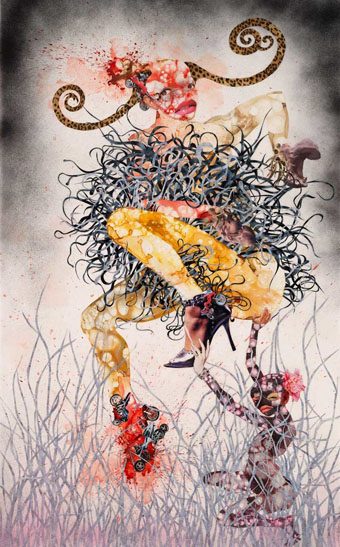
One Hundred Lavish Months of Bushwhack (2004) by Wangechi Mutu.

I wouldn’t be so bold as to call Benjamin Noys’ contribution to the recent The Weird conference at the University of London a highlight, but it was a surprise to find Lord Horror in general and the Reverbstorm book in particular being discussed alongside so many noteworthy offerings. Noys’ piece, Full Spectrum Offence: Savoy’s Neo-Weird, is now available to read online, a very perceptive examination of the tensions between the Old Weird and the New.

• Le Transperceneige is a multi-volume bande dessinée of post-apocalypse science fiction by Jacques Lob & Jean-Marc Rochette. Snowpiercer is a film adaptation by Korean director Bong Joon-ho featuring John Hurt, Jamie Bell, Chris Evans and Tilda Swinton. Anne Billson calls the director’s cut an “eccentric masterpiece” so it’s dismaying to learn that the film is in danger of being hacked about by the usual rabble of unsympathetic Hollywood distributors.

• This month marks the 100th anniversary of the publication of Proust’s À la recherche du temps perdu. Public Domain Review posted some of the paintings mentioned in Swann’s Way (or The Way by Swann’s as the latest translation so inelegantly has it).

• How the Paris World’s Fair brought Art Nouveau to the Masses in 1900: a huge picture post about my favourite exposition.

• Mix of the week: “Sport of Kings” Mix by Ricardo Donoso. Related: Paul Purgas on five favourite records.

• Ernst Reichl: the man who designed Ulysses. Related: Hear all of Finnegans Wake read aloud over 35 hours.

• “Why does Alain de Botton want us to kill our young?” A splendid rant by Sam Kriss.

• Love’s Secret Ascension: Peter Bebergal on Coil, Coltrane & the 70th birthday of LSD.

• Malicious Damage: Ilsa Colsell on the secret art of Joe Orton & Kenneth Halliwell.

• Just Say No to the Bad Sex Award, or the BS Award as Tom Pollock calls it.

• Lauren O’Neal’s ongoing PJ Harvey Tuesdays: One, Two, Three and Four.

• Neville Brody on the changing face of graphic design.

• A Brief History of the London Necropolis Railway.

• Des Hommes et des Chatons: a Tumblr.

• At Pinterest: Androgyny

• Virgin Prunes: Pagan Lovesong (vibeakimbo) (1982) | Caucasian Walk (1982) | Walls Of Jericho (live at The Haçienda, Manchester, 1983; I’m in that audience somewhere)

Weekend links 176

dlouhy.jpg

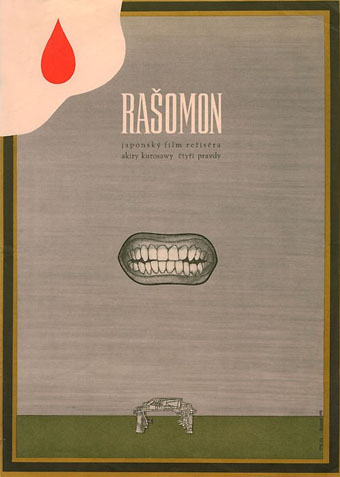
This week PingMag was looking at Czech film posters. This one by Bedrich Dlouhy is for the belated 1970 release of Kurosawa’s Rashomon.

• In October Alison Goldfrapp curates an exhibition for The Lowry, Salford, featuring her favourite art. Examples will include work by Leonora Carrington, Lotte Reiniger and Henry Darger so I’ll definitely be seeing this one. The new Goldfrapp album, Tales of Us, is released this week. Alison Goldfrapp & Lisa Gunning’s film for Annabel is here.

• Michael Glover profiles artist Tom Phillips who has a new show of his paintings at the Flowers Gallery, London. The indefatigable Phillips also talked to Tracy McVeigh about his design for the new 50 pence coin which celebrates the centenary of Benjamin Britten.

• Get Carter director Mike Hodges remembers re-teaming with Michael Caine for the island-set crime thriller Pulp, and shares a letter that JG Ballard wrote to him in admiration of the film.

Dismantling the surveillance state won’t be easy. Has any country that engaged in mass surveillance of its own citizens voluntarily given up that capability? Has any mass surveillance country avoided becoming totalitarian? Whatever happens, we’re going to be breaking new ground.

Bruce Schneier on how to deal with the total surveillance state.

• Babel/Salvage presents The Midnight Channel, the newest montage of poetry by Evan J. Peterson, inspired by cinema of the horrific, fantastic and bizarre.

• Mixes of the week are from composer Amanda Feery at The Outer Church, and Pinkcourtesyphone (Richard Chartier) at Secret Thirteen.

• At Dangerous Minds: Kimberly J. Bright on the psychedelic poster art of Hapshash and the Coloured Coat. Related: LSD may not be bad for you, says study.

• Queer Zines: a 400-page study edited by AA Bronson & Philip Aarons.

• Justin Abraham Linds on The Walt Whitman of gay porn.

• Designs for theatre and print by Oskar Schlemmer.

• Beautiful Mars: a Tumblr.

• Catleidoscope!

• Goldfrapp: Lovely Head (2000) | Strict Machine (2003) | Caravan Girl (2008)

Weekend links 169

anderson.jpg

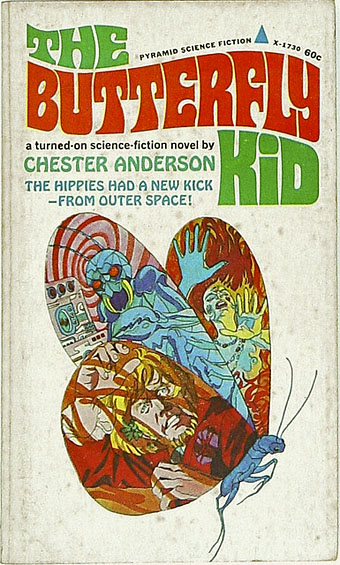
Cover illustration by Gray Morrow, 1967. One of the less exploitative examples from a collection of hippy book covers.

• Ten Photographs by Alain Resnais: Mise en scène of Memory, Aesthetics of Silence by Ehsan Khoshbakht. In the comments to that post someone shows an old Penguin book with cover photos by Chris Marker. This confirms that the “C. Marker” whose name I found on the back of another Penguin book was indeed Monsieur Chat.

• There’s more (there’s always more…): Cornelius Castoriadis interviewed by Chris Marker in 1989, the complete footage of an interview edited down for Marker’s TV series L’héritage de la chouette (The Owl’s Legacy). Watch the series itself at YouTube.

• “A generation of innovators want to change the way we have sex and consume porn, but Google, Apple, and Amazon won’t let them,” says Andrea Garcia-Vargas. Related: Sam Biddle on how Tumblr is pushing porn into an internet sex ghetto.

• Mix of the week: the Chop Quietus Mix, “a jagged journey all the way from Broadcast to the uneasy thrum of Suicide, kosmische flavours from Popol Vuh and Cluster, Alexander Robotnik and many more.”

• Strange Flowers looked back at The Student of Prague: “the first art film, the first horror film and the first auteur film”, and now a century old.

• Clive Hicks-Jenkins talked to animator Barry Purves about the pleasures and difficulties of creating animated films for adults.

• Mazzy Star released a song, California, from their new album which arrives in September. Can’t wait.

• Suzanne Ciani, “American Delia Derbyshire of the Atari Generation” explains synthesizers, 1980.

• Christer Strömholm‘s photos of Parisian transgender communities in the 1950s.

• What are These Giant Concrete Arrows Across the American Landscape?

• How Kiyoshi Izumi built the psych ward of the future by dropping acid.

• Alan Moore: The revolution will be crowd-funded.

• Fuck Yeah Mazzy Star

• Suzanne Ciani: Lixiviation | The First Wave—Birth Of Venus (1982) | The Eighth Wave (1986)