

Weekend links 360

sasaki.jpg

Threshold (2008) by Roku Sasaki.

• A previously unseen interview with Angela Carter from 1979 in which she talks to David Pringle about her evolution as a writer, literary influences and genre fiction.

• Among the highlights in the latest edition of Wormwood there’s Doug Anderson on Panacea by Robert Aickman, a “vast unpublished philosophical work”.

• The London Review Bookshop podcast: Marina Warner and Chloe Aridjis discuss Leonora Carrington.

The prose works, conversely, read like surrealist poetry. They were written according to a compositional method Roussel called le procédé (the procedure), in which a complicated system of puns rather than traditional narrative logic determines the progression of the story. In Locus Solus, the mad scientist Martial Canterel takes his colleagues on a tour of his country estate—“the lonely place” of the title—to show them the bizarre inventions generated by Roussel’s procédé. These include a device that constructs a mosaic made out of human teeth; a water-filled diamond in which a dancer, a hairless cat, and the head of Danton are suspended; and a series of corpses Cantarel has brought back to life with the fluid “ressurectine,” which compels them to act out the most important event of their former lives, to the scientists’ astonishment.

Ryan Ruby on Raymond Roussel, The Accidental Avant-Gardist

• The latest manifestation of paranormal electronica by The Electric Pentacle is entitled Black Ectoplasm.

Sergey Bessmertny‘s account of working as a camera technician on Andrei Tarkovsky’s Stalker.

• City Of Fallen Angels: The Bug vs. Earth. In conversation with Kevin Martin and Dylan Carlson.

• Sex and art by the Grand Canal: Judith Mackrell on Peggy Guggenheim in Venice.

• A Guide Through the Darkened Passages of Dungeon Synth.

• Mix of the week: XLR8R Podcast 489 by Samuel Rohrer.

• The late Mika Vainio/Panasonic live in 1996.

Xan Brooks on Cary Grant’s 100 acid trips.

Resurrection (1968) by Steppenwolf | Resurrection (1975) by Master Wilburn Burchette | Resurrection (1987) by Demons Of Negativity

Weekend links 354

diment.jpg

The Dolly, Dolly Spy (1968).

• As mentioned previously, Concrete Desert is a musical collaboration between The Bug (Kevin Martin) and Earth’s Dylan Carlson inspired, they say, by Los Angeles and the fiction of JG Ballard. Martin & Carlson talked to Patrick Clarke at The Quietus about the album’s creation. Elsewhere, Kevin Martin compiled a list for Bleep of ten musical influences on the album, and Dylan Carlson had a Fireside Chat with Red Bull Music.

• Phil Legard of Xenis Emputae Travelling Band and Hawthonn has released a new EP, Hesperian Garden, featuring compositions derived from the Monas Hieroglyphica of John Dee.

• More Ballard: Mike Holliday maps the evolution of Crash, a novel which is published in a new “Collector’s Edition” by Fourth Estate next week.

Teleplasmiste “bridge the oscillation gap from deep listening ambient music and the heaviest of doomy drones,” says Richard Fontenoy.

David Barnett on Adam Diment, “the superstar spy novelist who vanished for four decades”.

• The queer art underground of 1980s London as photographed by David Gwinnutt.

A sculpture of a Buddhist deity made from 20,000 beetles.

• Mix of the week: XLR8R Podcast 483 by Jane Fitz.

• RIP Gilbert Baker, designer of the rainbow flag.

• Rubber Dolly Rag (1930) by Uncle Bud Landress with Georgia Yellow Hammers | Voodoo Dolly (1981) by Siouxsie and the Banshees | Cosmic Funky Dolly (2003) by Acid Mothers Temple & The Melting Paraiso U.F.O.

Weekend links 349

burgess.jpg

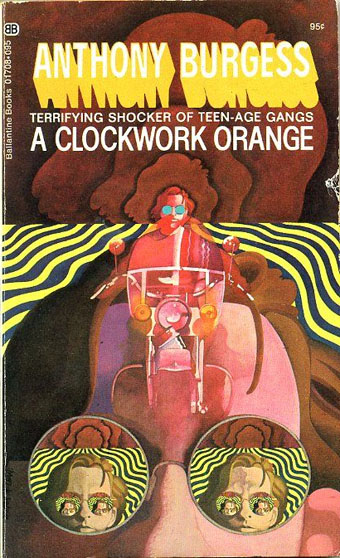
• Before Stanley Kubrick fixed an image of Alex and his droogs in the popular imagination, artists could get away with playing on the threat of biker gangs as Wilson McLean does in this vaguely psychedelic cover from 1969. (McLean’s interpretation may possibly derive from a 1965 edition.) LibraryThing has a collection of Clockwork Orange covers from around the world which run the gamut of cogs, orange hues and variations on David Pelham’s famous Penguin design from 1972. Meanwhile, AL Kennedy celebrates 100 years of Anthony Burgess by examining the writer’s career as a whole, although the web feature still manages to get a photo of Malcolm McDowell in there.

• “Even bad books can change lives,” says Phil Baker reviewing The Outsider by Colin Wilson and Beyond the Robot, a Wilson biography by Gary Lachman. I wouldn’t call The Outsider a bad book but Wilson’s more wayward opinions (and later works) are best treated with scepticism.

• “Murtaugh refers to his subject’s ‘pervasive sense of doom’ and Welch himself speaks of ‘the extraordinary sadness of everything.'” David Pratt reviewing Good Night, Beloved Comrade: The Letters of Denton Welch to Eric Oliver, edited by Daniel J. Murtaugh.

• At The Quietus this week: Tinariwen bassist Eyadou Ag Leche is interviewed by Richie Troughton, Jane Weaver unveils a new song from her forthcoming album, Modern Kosmology, and Danny Riley explores the strange world of Ben Chasny.

• “A micro-history of cultural gatekeeping: once told by the censors what we may read, then by critics what we should, we are now told merely what we can read.” Ben Roth writing against the use of “readability” as a literary value.

• Yayoi Kusama’s amazing infinity rooms are at the Hirshhorn Museum and Sculpture Garden, Washington DC, until May. For the rest of us, Peter Murphy’s panoramic photo is still online.

• More music: my friends Watch Repair have become visible enough to be interviewed by an Argentinian website. The group’s Bandcamp page recently made three new releases available.

• Yet more music: They Walk Among Us, a new song and video by Barry Adamson, and Anymore, a new song and video by Goldfrapp.

• Earth and The Bug announce Concrete Desert, a collaborative album inspired by Los Angeles and the fiction of JG Ballard.

• Bad Books for Bad People: Episode 7: The Incal – Epic French Space-Opera Comics.

• Mixes of the week: FACT Mix 589 by Aisha Devi, and Secret Thirteen Mix 212 by Qual.

Eduardo Paolozzi‘s forays into fashion and furnishings.

Cooking with Vincent [Price]

Moroccan Tape Stash

• Tin Toy Clockwork Train (1986) by The Dukes Of Stratosphear | Clock (1995) by Node | Clockwork Horoscope (2009) by Belbury Poly

Weekend links 330

battle.jpg

Summer Passing (2013) by Laura Battle.

• The Marquis de Sade’s enduringly contentious The 120 Days of Sodom has been republished by Penguin Books in a new translation by Will McMorran and Thomas Wynn. “[De Sade] described his novel as ‘the most impure tale ever written since the world began’ and, for all the hyperbole, his description still holds true even now,” says Will McMorran, exploring the history and reputation of the book.

• From the Cutting Room Floor: Rick Klaw talks to Bruce Sterling about the current state of US (and world) politics. Sterling’s Futurist novel Pirate Utopia (which I’ve designed and illustrated) will be published by Tachyon next month.

• New from Strange Attractor: In Fairyland: The World of Tessa Farmer, edited by Catriona McAra, and Of Shadows: One Hundred Objects from The Museum of Witchcraft and Magic by Sarah Hannant and Simon Costin.

• Mix of the week: Programme No. 16 in the long-running Radio Belbury series is a guest presentation by The Pattern Forms (Jon Brooks, Edward Macfarlane and Edward Gibson).

The Book of Three Gates by Simon Berman, “An Esoterica of HP Lovecraft’s Cthulhu Mythos”, is seeking funding.

• Occultist Phil Hine discusses Richard Payne Knight and phalluses at the Conway Hall, London, later this month.

• “My goal is to make music that is transcendent and isn’t specific of a certain time,” says Earth’s Dylan Carlson.

• Kiss the sky: psychedelic posters of the 60s and 70s from the collection of the late Felix Dennis.

Radionics Radio: An Album Of Musical Radionic Thought-Frequencies.

Madeleine LeDespencer on the occult bookshops of London.

Unknown Pleasures waveform gif generator

Sade Masoch (1968) by Bobby Callender | Confessional (Give Me Sodomy Or Give Me Death) (1991) by Diamanda Galás | The Sodom And Gomorrah Show (2006) by Pet Shop Boys

Weekend links 321

miyabi.jpg

The Addams Family In Kimonos by Matsuyama Miyabi. Via S. Elizabeth.

• “They’re not the men you’ll walk down the street and lock eyes with, or that you’ll spot at a bar casually. They’re a fantasy.” Michael Valinsky reviewing Tom House: Tom Of Finland In Los Angeles edited by Michael Reynolds. Related (and almost a polar opposite): Nick Campbell on The Life to Come and Other Stories by EM Forster.

Randall Dunn, musician (Master Musicians of Bukkake), producer (Sunn O))), Earth, etc), engineer, discusses making and recording music.

John Waters brings back Multiple Maniacs: “Of course I went a little too far.” he says. Waters also talked about the film at Gawker.

Q: Most cherished book on your shelves? Why?

A: Depends on the day. Today it’s Blood Meridian by Cormac McCarthy. Blood Meridian is an indictment of Manifest Destiny, the Westward Expansion, of Hollywood and its portrayal of the west; it’s confrontational and bellicose. The sheer brutality of it affected me like I’d swallowed poison or taken a shot to the liver that I didn’t remember. Blood Meridian is a reminder that literature isn’t always tame. It can bite you.

Laird Barron talking to Smash Dragons about favourite writers and his own fiction

• In East Tower Dreaming Howlround, aka Robin the Fog, processes the sounds of a former BBC office building.

• At The Headless Hashasheen: Magic Mirrors and Specters: Paschal Beverly Randolph, Hashish, & Scrying.

• At Dangerous Minds: The astonishingly beautiful three-colour photography of Bernard Eilers.

Samm Deighan on Gothic Film in the ’40s: Doomed Romance and Murderous Melodrama.

• On a scale from 1–100, Milton Glaser rates every single Olympic logo design in history.

• The overwhelming A/V experience of Paul Jebanasam and Tarik Barri.

Patrick Feaster describes how to “play back” a picture of a sound wave.

• Mix of the week: Secret Thirteen Mix 192 by Shadows.

COLLAGE—The London Picture Archive

Madrigal Meridian (1978) by Tangerine Dream | Meridian Moorland (1979) by Peter Baumann | Meridian (2009) by Espers