Brecht and Bowie

baal2.jpg

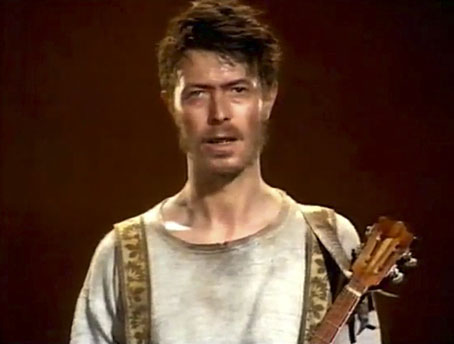
While David Bowie is still making the news it’s worth revisiting Baal, an hour-long BBC TV adaptation of the Bertolt Brecht play broadcast in 1981. Bowie stars as the title character, a thoroughly disagreeable poet and café singer who ruins the lives of those around him. This caused a stir at the time more for Bowie’s presence than for the content although Brecht wasn’t exactly a popular choice for evening entertainment. Prior to this most of Bowie’s acting had been in films, with his television appearances being limited to song performances or chat show discussions. The Man Who Fell to Earth aside, I’ve been somewhat dismissive of Bowie’s acting at times, his accent and the sheer weight of his musical persona overwhelm whatever role he’s given, but he’s good in this. He throws himself into the role, and is more convincing than I remember him being a couple of years later in Merry Christmas Mr Lawrence.
baal.jpg

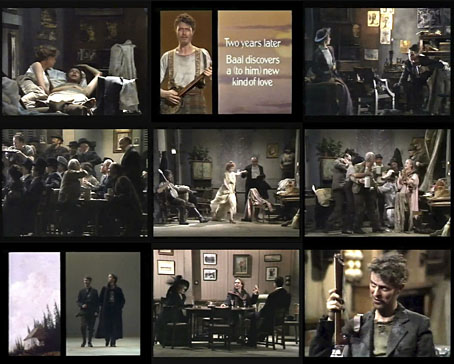
For many people Bowie will be the sole attraction in Baal but for me there’s also the presence of the great Alan Clarke as director and co-adaptor (with John Willett). Clarke directed the cult TV play Penda’s Fen in 1974, and was later responsible for a handful of other notable TV films including Scum, Made in Britain, Road, Elephant (1989), and The Firm, all of which are distinguished by a singular intensity and dramatic power the likes of which is usually only found in the best feature films. Compared to those plays Baal is a minor piece, filmed entirely in the studio, and made deliberately stagey to honour Brecht’s Verfremdungseffekt. The cameras keep their distance from the performers, and Brechtian distance is also achieved by the use of split-screen, title cards, and Bowie’s direct addresses to the viewer. If this seems like challenging material for a general audience (never mind the singer’s fans) consider that Baal was broadcast in primetime on BBC 1 when there were only three television channels in the UK. This would not happen today.

Previously on { feuilleton }
Penda’s Fen by David Rudkin

“Who is this who is coming?”

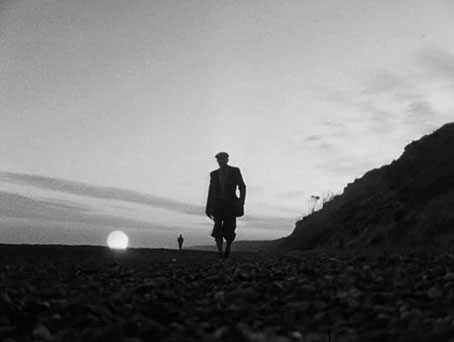
whistle4.jpg

Whistle and I’ll Come to You (1968).

He blew tentatively and stopped suddenly, startled and yet pleased at the note he had elicited. It had a quality of infinite distance in it, and, soft as it was, he somehow felt it must be audible for miles round. It was a sound, too, that seemed to have the power (which many scents possess) of forming pictures in the brain. He saw quite clearly for a moment a vision of a wide, dark expanse at night, with a fresh wind blowing, and in the midst a lonely figure—how employed, he could not tell. Perhaps he would have seen more had not the picture been broken by the sudden surge of a gust of wind against his casement, so sudden that it made him look up, just in time to see the white glint of a sea-bird’s wing somewhere outside the dark panes.

MR James, Oh, Whistle, and I’ll Come to You, My Lad.

One of the alleged highlights of this year’s Christmas television from the BBC was a new adaptation of an MR James ghost story, Oh, Whistle, and I’ll Come to You, My Lad. The film starred John Hurt and came with the same truncated title, Whistle and I’ll Come to You, as was used for Jonathan Miller’s 1968 version, also a BBC production. The story title comes originally from a poem by Robert Burns. The new work was adapted by Neil Cross and directed by Andy de Emmony, and I describe it as an alleged highlight since I wasn’t impressed at all by the drama, the most recent attempt by the BBC to continue a generally creditable tradition of screening ghost stories at Christmas. Before I deal with my disgruntlement I’ll take the opportunity to point the way to some earlier derivations. (And if you don’t want the story spoiled, away and read it first.)

Continue reading ““Who is this who is coming?””

Weekend links 25

borgespesos

A commemorative Borges coin.

He says, “Two aesthetics exist: the passive aesthetic of mirrors and the active aesthetic of prisms. Guided by the former, art turns into a copy of the environment’s objectivity or the individual’s psychic history.” There, of course, he sums up all of realism, no? “Guided by the latter, art is redeemed, makes the world into its instrument and forges, beyond spatial and temporal prisons, a personal vision.” That’s Borges.

The Borges Behind the Fiction: Colin Marshall talks to translator Suzanne Jill Levine. Related: The Garden of Forking Paths.

• From The Quietus: Blondie in Conversation with William S. Burroughs by Victor Bockris, 1979; An Interview with Laurie Anderson by Robert Barry, 2010.

In 962 Abd-er Rahman III was succeeded by his son Al-Hakim. Owing to the peace which the Christians of Cordova then enjoyed […] the citizens of Cordova, Arabs, Christians, and Jews, enjoyed so high a degree of literary culture that the city was known as the New Athens. From all quarters came students eager to drink at its founts of knowledge. Among the men afterwards famous who studied at Cordova were the scholarly monk Gerbert, destined to sit on the Chair of Peter as Sylvester II (999–1003), the Jewish rabbis Moses and Maimonides, and the famous Spanish-Arabian commentator on Aristotle, Averroes.

Entry for The Diocese of Cordova from The Catholic Encyclopedia (1917).

Professor Newt’s Distorted History Lesson. A riposte to the ignorance of the wretched Gingrich. Related: the Mezquita de Córdoba.

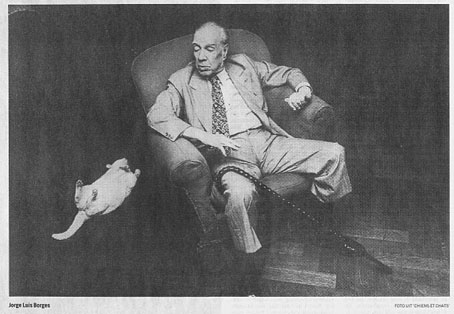
borgeskat

Jorge Luis Borges and a cat. Via.

Joseph and His Friend—A Story of Pennsylvania (1870) by Bayard Taylor, America’s first (?) gay novel. Related: 20 classic works of gay literature.

Elegies For Angels, Punks and Raging Queens at the Shaw Theatre, London, from 10–28 August 2010.

• Tristan Perich’s 1-Bit Symphony is released later this month. Café Kaput’s first release, Electronic Music in the Classroom by DD Denham, appears in September.

• “Just relax and enjoy it.” k-punk on the ambition and vision of David Rudkin’s Artemis 81.

• Chris Watson explores Alan Lamb’s The Wires: three audio recordings to download.

• Jonathan Barnbrook: Tuxedomoon fan, 1988, and Tuxedomoon designer, 2007.

• Rob Young’s Electric Eden reviewed by Michel Faber.

Brian Eno gets the Warp factor.

No Tears (1978) by Tuxedomoon; Atomic (1979) by Blondie; Everything You Want (1980) by Tuxedomoon; Next One Is Real (1984) by Minimal Compact; Hologram (2010) by These New Puritans.

Weekend links: Ghosts, Spooks and Spectres edition

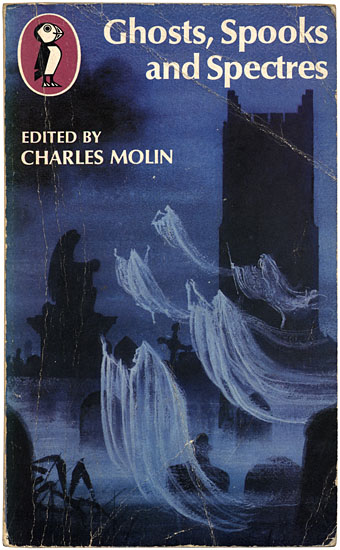
spectres.jpg

Cover design by Philip Gough.

Ghosts, Spooks and Spectres (1972 reprint). Editor Charles Molin collected nineteen ghost stories by writers including Oscar Wilde (The Canterville Ghost), Charles Dickens (The Signal-Man), J. Sheridan Le Fanu (Madame Crowl’s Ghost) and HG Wells (The Inexperienced Ghost). This was one of my favourite books when I was ten-years old. There’s nuffin like a Puffin. Puffin Books’ parent company, Penguin, is 75 this year.

• The good people at the Outer Alliance have posted an interview with me here in which I talk about the subversive sexualities of sf in the 1970s and also admit to writing fiction.

• There’s just time to mention It Came From Pebble Mill, an event which includes another screening of David Rudkin’s Penda’s Fen.

• “In our society, there has tended to be a very strong compartmentalization of different experiences, different cultural forms, different genres. We can talk in a very broad sense and say art is separate from science, for example, or body is separate from mind, or we can talk in a specific sense and say one certain form of dance music is separate from one form of, say, heavy metal. I don’t really buy those compartmentalizations. I understand why they exist, how they’ve come into being and why they’re convenient, but it’s not the way I think, it’s not the way I experience the world, it’s not the way I believe things should be.” From an interview by Colin Marshall with David Toop at 3QD. Toop’s latest book is Sinister Resonance: The Mediumship of the Listener.

The Kingdom of the Pearl by Léonard Rosenthal, illustrated by Edmund Dulac.

Ghost Stations by Dollboy, a CD package. And then there’s the Ghostly Bento.

7 Inch Cinema are Birmingham-based cultural historians.

• Mark Pilkington’s Mirage Men now has its own site.

Borges on Pleasure Island: JLB and his love of RLS.

• RIP Arne Nordheim, Norwegian composer.

• Charlie Visnic’s Modular Ghost Synth.

On the trail of Tutankhamen’s penis.

Photos by Thom Ayres.

Ghosts by Japan | Spooky Rhodes by Laika | Purple Dusk by Spectre.

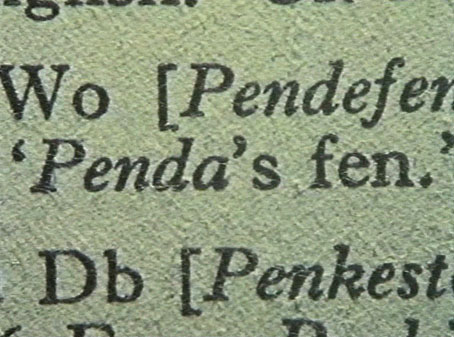
Penda’s Fen by David Rudkin

penda4.jpg

This is a post I’d been intent on writing for the past four years but kept putting off: why go to great lengths to describe another television drama which people can’t see? And how do you easily appraise something which haunted you for twenty years and which remains a significant obsession? My hand has been forced at last by a forthcoming event (detailed below) so this at least has some fleeting relevance, but before getting to that let’s have some facts.

penda3.jpg

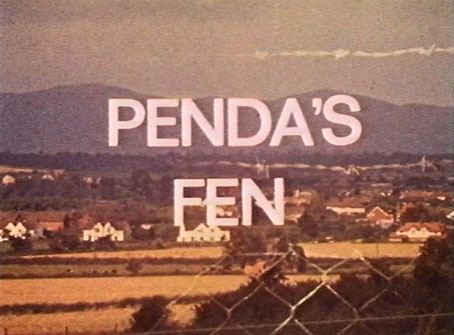
Penda’s Fen was a TV play first screened in March 1974 in the BBC’s Play For Today strand. It was shot entirely on film (many dramas in the 1970s recorded their interiors on video) and runs for about 90 minutes. The writer was David Rudkin and it was directed by Alan Clarke, a director regarded by many (myself included) as one of the great talents to emerge from British television during the 1960s and 70s. The film was commissioned by David Rose, a producer at the BBC’s Pebble Mill studios in Birmingham, as one of a number of regional dramas. Rudkin was, and still is, an acclaimed playwright and screenwriter whose work is marked by recurrent themes which would include the tensions between pagan spirituality and organized religion, and the emergence of unorthodox sexuality. Both these themes are present in Penda’s Fen, and although the sexuality aspect of his work is important—pioneering, even—he’s far from being a one-note proselytiser. Alan Clarke is renowned today for his later television work which included filmed plays such as Scum (banned by the BBC and re-filmed as a feature), Made in Britain (Tim Roth’s debut piece), The Firm (with Gary Oldman), and Elephant whose title and Steadicam technique were swiped by Gus Van Sant. Penda’s Fen was an early piece for Clarke after which his work became (in Rudkin’s words) “fierce and stark”.

The most ambitious of Alan Clarke’s early projects, Penda’s Fen at first seems a strange choice for him. Most scripts that attracted Clarke, no matter how non-naturalistic, had a gritty, urban feel with springy vernacular dialogue (and sometimes almost no dialogue). David Rudkin’s screenplay is different: rooted in a mystical rural English landscape, it is studded with long, self-consciously poetic speeches and dense with sexual/mythical visions and dreams, theological debate and radical polemic—as well as an analysis of Elgar’s The Dream of Gerontius. But though Penda’s Fen is stylistically the odd film out in Clarke’s work, it trumpets many of his favourite themes, in particular what it means to be English in the last quarter of the twentieth century.

Howard Schuman, Sight & Sound, September 1998

Spencer Banks is the principal actor in Penda’s Fen, playing Stephen Franklin, an 18-year-old in his final days at school. The BBC’s Radio Times magazine described the film briefly:

Young Stephen, in the last summer of his boyhood, has somehow awakened a buried force in the landscape around him. It is trying to communicate some warning, a peril he is in; some secret knowledge; some choice he must make, some mission for which he is marked down.

penda2.jpg

The magazine also interviewed Rudkin about the film:

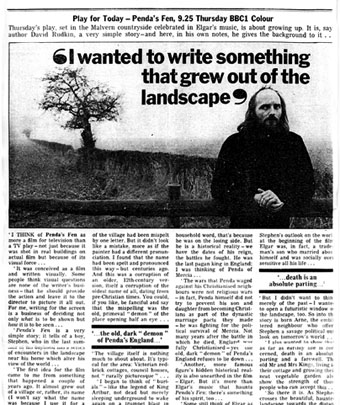
“I think of Penda’s Fen as more a film for television than a TV play—not just because it was shot in real buildings on actual film but because of its visual force…

“It was conceived as a film and written visually. Some people think visual questions are none of the writer’s business—that he should provide the action and leave it to the director to picture it all out. For me, writing for the screen is a business of deciding not only what is to be shown but how it is to be seen…

Penda’s Fen is a very simple story; it tells of a boy, Stephen, who in the last summer of his boyhood has a series of encounters in the landscape near his home which alter his view of the world…
Continue reading “Penda’s Fen by David Rudkin”