Weekend links 189

wilson.jpg

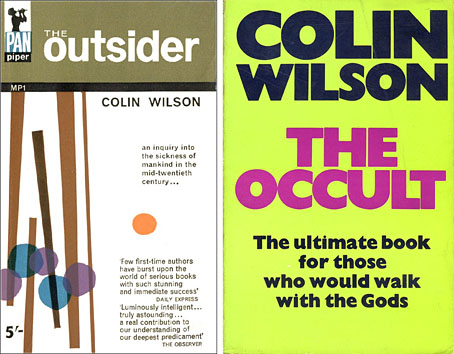
The Outsider (1956), 1963 edition; The Occult (1971), 1973 edition.

The cover of the 1973 UK paperback of Colin Wilson‘s mammoth overview of occultism can still be offered as a pinnacle of hyperbole. The book itself is a very serious and informative study but its success set Wilson on a path as a writer about the paranormal where he’d previously been concerned with literature, philosophy and psychology. For many critics this finished his already shaky reputation as a serious thinker. He continued to write about philosophy and literature in subsequent books but dubious speculations about Atlantis are always more commercially attractive than studies of Nietzsche, hence the proliferation of lost continents in the later part of a bibliography which the Wilson website lists at 114 titles. Wilson was a maverick intellectual whose curiosity ignored many of the boundaries that restrained his metropolitan contemporaries; he was also an autodidact of a type that seems to irritate the university-educated. Mentions of his name in British newspapers were frequently couched in sneering or dismissive terms. His current reputation can be measured by the lack of attention the news of his death has prompted in the UK at the time of writing. (That said, dying on the same day as Nelson Mandela was unfortunate timing.)

Savoy Books published an edition of Wilson’s crime novel, The Killer, in 2002. I designed that volume, rather badly, I think. In 2004 Robert Meadley wrote a book-length reaction to Wilson’s autobiography, Dreaming to Some Purpose, which can be downloaded for free from Savoy. In it Meadley mounts a robust defence of Wilson against the broadsheet termagants. Elsewhere: the only newspaper obituary so far is at The Times (subscription required); Colin Wilson on Desert Island Discs in 1978; Gary Lachman interviewing Wilson for Fortean Times in 2004; musician Anthony Reynolds discussing his collaboration with Wilson.

• “Art, music and a mind-blowing voyage of discovery”: Richard Neville on the late Martin Sharp. At Design Observer Rick Poynor looks back at Sharp’s book and magazine illustrations of the 1960s. Of particular note is Sharp’s contribution to the “Magic Theatre” issue of Oz magazine, a unique combination of collaged visuals and text which Alan Moore often refers to as a favourite work. (See issue 12 of Moore’s Promethea, “The Magic Theatre of the Mind“.)

• “The naked woman in art isn’t unusual, but we have trouble viewing the male body as a sexual, or artistic, object,” says James Polchin.

But how can anyone be bored when there’s always death to think about? Every day. Every hour. Don’t you? All the rest is just evading or glossing the real subject of our lives. Beckett, again, the maestro of death: Never but the one matter. The dead and gone. The dying and the going. From the word go. I too shall cease and be as when I was not yet, only all over instead of in store.

Jenny Diski on death and dying.

• A teaser trailer for The Dreamlands, a film by Huan Vu (Die Farbe) based on HP Lovecraft’s Dream Cycle.

• “On Watching Wages of Fear with my 11-Year-Old Daughter” by Debra Morris.

Abram Games’ “bat wings” BBC logo is 60 years old. See it in action here.

• At Strange Flowers: Romaine Brooks‘ portraits of her famous friends.

• At Front Free Endpaper: Mervyn Peake illustrates Treasure Island.

The Great God Pan (plus satyrs and fauns) at Pinterest.

Dan Wilson on “Electric Music” on the Victorian stage.

• Mix of the week: Fact Mix 414 by Julianna Barwick.

• The BFI chooses 10 great British rural horror films.

Dunwich – The search for Britain’s Atlantis.

The Grand Canyon filled with fog.

• The Bells of Dunwich (1975) by Stone Angel | O.O.B.E. (1992) by The Orb (feat. Colin Wilson) | Why We Make It Difficult On Ourselves (2010) by Anthony Reynolds & Colin Wilson

Weekend links 187

delia.jpg

Delia Derbyshire (2007) by Iker Spozio.

Whatever you think of Doctor Who, Delia Derbyshire’s recording of Ron Grainer’s theme tune is a landmark piece of electronic music. Those glassy electronic tones still sound unique today, not least for their having been created using rudimentary oscillators and much laborious tape editing. In Radiophonic Workshop: the shadowy pioneers of electronic sound, Joe Muggs looks at the history of the BBC’s electronic composers. If you’re a Radiophonic-head then the Alchemists of Sound TV documentary from 2003 is essential viewing.

There’s more (there’s always more): Delia Derbyshire – Sculptress of Sound: part one of a seven-part radio documentary about the great electronic music composer, and Blue Veils and Golden Sands, Martyn Wade’s radio play about Delia. Related: Delia-Derbyshire.org, Delia Derbyshire: An audiological chronology and A History of the Doctor Who theme. And don’t miss: Silence Is Requested In The Ultimate Abyss (1969) by Welfare State and White Noise, an incredible slice of electro-psychedelia from the John Peel Presents Top Gear album.

• “Why don’t books for grown-ups have illustrations any more?” asks Christopher Howse. Some of them do, this past week I’ve been finishing a new series of illustrations for a story anthology.

• From 2006: Ian Penman on cigarettes, espionage, and the masterful (and superior) television adaptation of Tinker, Tailor, Soldier, Spy.

It was Malcolm [McLaren] who suggested that the main characters be a boy who looks like a girl who looks like a boy and vice versa. What was strange was that, actually, in 1985 this was nobody’s vision of the fashion industry. Since then, fashion and fascism have crept closer: you’ve got John Galliano doing his promotional bits for the Third Reich, you’ve got Alexander McQueen killing himself, you’ve got Versace and that horrible, violent stalker coming for him. Since it was written, almost all of it has come true apart from the nuclear winter, but I think we’re working on that. The actual society that the story happens in is much more like the society we have now than culture was in 1985.

Alan Moore on Fashion Beast, Situationism, and why he hates superheroes.

• KW Jeter talks about his latest novel, Fiendish Schemes, and the “cultural juggernaut” that is steampunk.

• Grit and Social Dynamics in Smoke Ghost: Elwin Cotman on the weird fiction of Fritz Leiber.

The Secret Lives of the Vatican’s Gay Cardinals, Monks, and Other Clergy Members.

Don Cherry & Organic Music Theatre, live in the RAI TV studios, 1976.

• Otherworldly Art and Photography: Mlle Ghoul finds the best things.

• From 1998: Rahma Khazam on composer Bernard Parmegiani.

• Mix of the week: Marshland: The Mix by Hackneymarshman.

• “Let’s colonize the clouds of Venus,” says Ian Steadman.

J. Hoberman on David Cronenberg’s Visual Shock.

The Delian Mode (1968) by Delia Derbyshire | Tom Baker (1981) by The Human League | Doctor Who? (1984) by Doctor Pablo & The Dub Syndicate

Weekend links 183

doisneau.jpg

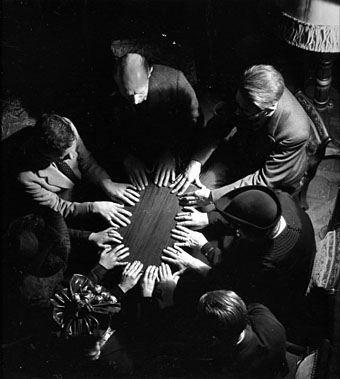
La table qui tourne (1943) by Robert Doisneau.

In [Gödel, Escher, Bach], Hofstadter was calling for an approach to AI concerned less with solving human problems intelligently than with understanding human intelligence—at precisely the moment that such an approach, having borne so little fruit, was being abandoned. His star faded quickly. He would increasingly find himself out of a mainstream that had embraced a new imperative: to make machines perform in any way possible, with little regard for psychological plausibility.

The Man Who Would Teach Machines to Think by James Somers.

Whenever the latest pronouncements about the imminent arrival of artificial intelligence are being trotted out I wonder what Douglas Hofstadter would have to say on the matter. You don’t hear much about Hofstadter despite his having been involved for decades in artificial intelligence research. One reason is that he’s always been concerned with the deep and difficult problems posed by intelligence and consciousness, subjects which don’t make for sensational, Kurzweilian headlines. Hofstadter’s essays on AI (and many other topics) in Metamagical Themas: Questing for the Essence of Mind and Pattern (1985) are essential reading. James Somers’ lengthy profile for The Atlantic is a welcome reappraisal.

• The end of October brings the spooky links: When Edward Gorey illustrated Dracula | Paula Marantz Cohen on Edgar Allan Poe | Yasmeen Khan revisits Werner Herzog’s Nosferatu | Roger Luckhurst on horror from the Gothics to the present day, and Michael Newton on Gothic cinema.

•  Magic Words: The Extraordinary Life of Alan Moore is a biography of the Northampton magus by Lance Parkin. The author talks about his book here, and also here where if you look carefully you can see my Lovecraft book on his shelf.

• A crop of Halloween mixes: Boo, Forever by Jescie | Samhain Seance 2: Hex with a Daemon by The Ephemeral Man | Wizards Tell Lies & The Temple of Doom by The Curiosity Pipe | Radio Belbury’s Programme 11.

The Book of the Lost is an album by Emily Jones & The Rowan Amber Mill presenting music from imaginary British horror films. Release is set for Halloween. More details here.

Laura Allsop on Derek Jarman’s sketchbooks. Jarman’s Black Paintings are currently showing at the Wilkinson Gallery, London.

Magick is Freedom! Existence Is Unhappiness: Barney Bubbles vs. Graham Wood.

• Soho Dives, Soho Divas: Rian Hughes on sketching London’s burlesque artists.

Jenny Diski on the perennial problem of owning too many books.

Equus through the years by Clive Hicks-Jenkins.

Virgin Records: 40 Years of Disruptions

• At BibliOdyssey: Chromatic Wood Type

Witches at Pinterest

The Witch (1964) by The Sonics | My Girlfriend Is A Witch (1968) by October Country | You Must Be A Witch (1968) by The Lollipop Shoppe

Weekend links 169

anderson.jpg

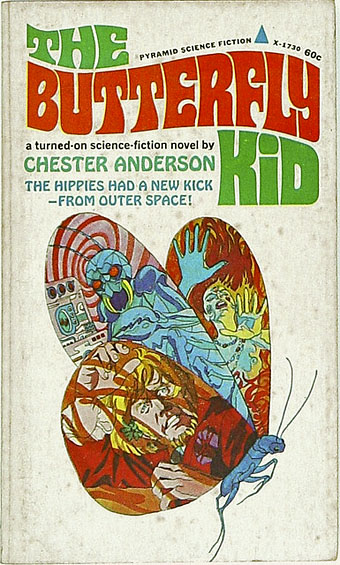
Cover illustration by Gray Morrow, 1967. One of the less exploitative examples from a collection of hippy book covers.

• Ten Photographs by Alain Resnais: Mise en scène of Memory, Aesthetics of Silence by Ehsan Khoshbakht. In the comments to that post someone shows an old Penguin book with cover photos by Chris Marker. This confirms that the “C. Marker” whose name I found on the back of another Penguin book was indeed Monsieur Chat.

• There’s more (there’s always more…): Cornelius Castoriadis interviewed by Chris Marker in 1989, the complete footage of an interview edited down for Marker’s TV series L’héritage de la chouette (The Owl’s Legacy). Watch the series itself at YouTube.

• “A generation of innovators want to change the way we have sex and consume porn, but Google, Apple, and Amazon won’t let them,” says Andrea Garcia-Vargas. Related: Sam Biddle on how Tumblr is pushing porn into an internet sex ghetto.

• Mix of the week: the Chop Quietus Mix, “a jagged journey all the way from Broadcast to the uneasy thrum of Suicide, kosmische flavours from Popol Vuh and Cluster, Alexander Robotnik and many more.”

Strange Flowers looked back at The Student of Prague: “the first art film, the first horror film and the first auteur film”, and now a century old.

Clive Hicks-Jenkins talked to animator Barry Purves about the pleasures and difficulties of creating animated films for adults.

• Mazzy Star released a song, California, from their new album which arrives in September. Can’t wait.

Suzanne Ciani, “American Delia Derbyshire of the Atari Generation” explains synthesizers, 1980.

Christer Strömholm‘s photos of Parisian transgender communities in the 1950s.

What are These Giant Concrete Arrows Across the American Landscape?

• How Kiyoshi Izumi built the psych ward of the future by dropping acid.

Alan Moore: The revolution will be crowd-funded.

Fuck Yeah Mazzy Star

• Suzanne Ciani: Lixiviation | The First Wave—Birth Of Venus (1982) | The Eighth Wave (1986)

Weekend links 165

smart.jpg

Cahill Expressway (1962) by Jeffrey Smart whose death was announced this week.

• “Russell Beale is awed by the beauty of the Roman silver Warren Cup showing men and youths making love, so startlingly erotic that the first time the British Museum was offered it in the 1950s, it turned it down flat. In 1999, when it came on the market again, the museum had to raise £1.8m to acquire it. ‘It’s just heaven, isn’t it?’ Russell Beale sighs.” Maev Kennedy on Same-Sex Desire and Gender Identity, a new exhibition at the British Museum.

• “The route to Tyburn Tree snaked through Holborn and St Giles, then went along Tyburn Road, today’s Oxford Street. It was dense with spectators.” Matthew Beaumont on the tiny memorial (Google view) for the estimated 50,000 people executed in the centre of London.

• Mixes of the Week: Bottoms Up by Staffan Lindberg for BUTT Magazine, and Electronic Ladyland, a collection of women with synths (and other instruments) from Bitch Media.

But the very thing that is valuable about diversity – the cultural and ideological clashes that it brings about – is precisely what many people fear. And that fear takes two forms. On the one hand you have the little Englander sentiment: immigration is undermining the national fabric, eroding our sense of British or Englishness, turning our cities into little Lahores or mini-Kingstons. And on the other you have the multicultural argument: that diversity is good, but it has to be policed to minimise the clashes and conflicts and frictions that diversity brings in its wake. And so we have to restrain speech, and police the giving of offence.

Kenan Malik on The Pleasures of Pluralism, The Pain of Offence.

L’Empire des Lumières is a great title for Anne Billson’s blog about Belgium. Tram-wire covered streets are one of my favourite things.

The Outer Church, 28 musical artists with an uncanny temperament collected by Joseph Stannard for Front & Follow.

His Heavy Heart, a film by Alan Moore & Mitch Jenkins, is looking for Kickstarter funding.

• In 1997 Quentin Crisp wrote about “Ten Wonderful Gangster Movies” for Neon magazine.

Raymond Chandler’s The Big Sleep redesigned for the Penguin Design Award, 2013.

• Out on DVD/Blu-Ray this month: The Curtis Harrington Short Film Collection.

A billion-pixel panoramic view of the planet Mars from the Curiosity Rover.

• In the TLS: Robert Craft on Stravinsky and The Rite of Spring.

Typophonic: Album cover typography.

The Owl Theremin is a thing.

LSD ABC

Spring Rounds From The Rite Of Spring (1975) by Alice Coltrane | Revenge Of The Black Regent (1999) by Add N To (X) | Sore Ga Afrirampo (2010) by Afrirampo