Burroughs at 100

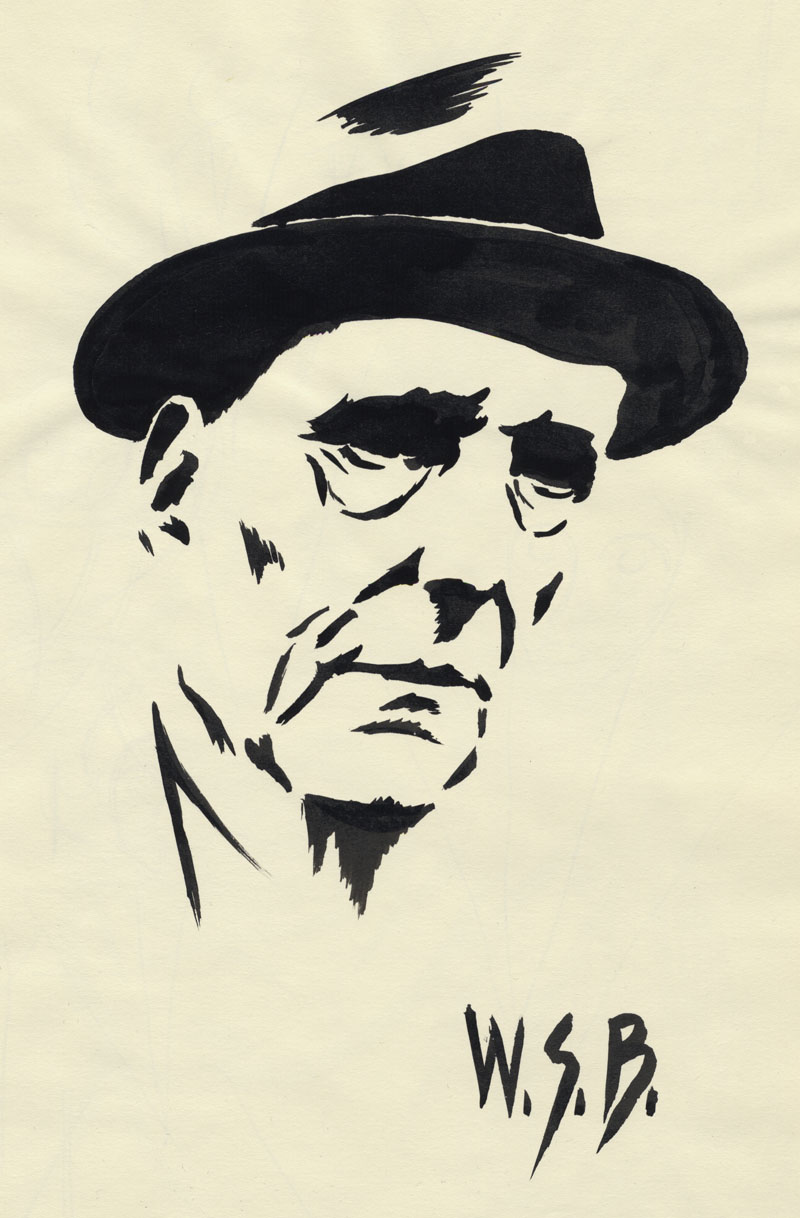
wsb.jpg

Something from 1994 I found in an old sketchbook. Ink on paper.

Happy birthday, Bill. To celebrate the Burroughs centenary I could have put together several very different mixes of Burroughs-related music—there’s been a lot of it, and he was blessed with some excellent collaborators—but in the end decided on a version of something I’ve been messing with on and off for about twenty years.

Seven Souls Resouled by Feuilleton on Mixcloud

Bill Laswell’s associations with William Burroughs go back to Laurie Anderson’s Mister Heartbreak (1984) album which Laswell played bass on and co-produced. Burroughs had a guest spot on the last track, Sharkey’s Night, and that session may have led to the 1989 album by Laswell’s Material project, Seven Souls, a seven-track album based around Burroughs’s readings of passages from The Western Lands. This has always been my favourite of all the albums which set Burroughs texts to music, not least because Laswell has always surrounded himself with exceptional musicians. I liked this album so much I used to try padding it out on cassette tape with other Laswell productions, many of which feature the same musicians, and even similar riffs and instrument sounds. I could never settle on a definitive mix, however, and even the one presented here doesn’t feel absolutely right although it works far better than all previous versions. Matters aren’t helped by there being much extraneous material (so to speak): Seven Souls was reissued in 1997 with remix tracks, and there’s also a related EP, The Road To The Western Lands, with further remixes. Then there are the many tracks which match the Seven Souls sound, not least on the 1994 Material album, Hallucination Engine, which also features a Burroughs reading. Laswell’s solo albums, and much of his Axiom label, is infected by Burroughs-like titles; for a while Axiom even promoted its world- and genre-spanning ethos with the slogan “Nothing is true; everything is permitted”. The Beatles may have put Burroughs’s face on the cover of the Sgt Pepper album but Bill Laswell has done far more to spread the virus of the man’s work. Below there’s a guide to the tracks followed by another visit to the Wild Boys.

William S. Burroughs – Word Falling, Photo Falling (1960s)
One of the numerous tape recordings from the 1960s which are like audio equivalents of the books Burroughs was writing at the time. This one is from Nothing Here Now But The Recordings (1981).

Material – Ineffect (1989)
The first track from Seven Souls.

Ginger Baker – Dust to Dust (1986)
Bill Laswell produced two Ginger Baker solo albums, Horses and Trees (1986), from which this track is taken, and Middle Passage (1990). Both feature Laswell’s core group of Material musicians including Nicky Skopelitis, Bernie Worrell and Aiyb Dieng. Baker was a member of a later incarnation of Material, and appears on the Live In Japan (1993) album.

Material – Seven Souls (1989)
The second track from Seven Souls.

Material – Ruins (Submutation Dub by Bill Laswell) (1994)
From Material’s other masterwork, the mighty Hallucination Engine.

Material – Soul Killer (1989)
The third track from Seven Souls.

Ginger Baker – Under Black Skies (1990)
From Baker’s Middle Passage album.

Material – The Western Lands (1989)
The fourth track from Seven Souls.

Mandingo – Lanmbasy Dub (Kora in Hell Mix by Bill Laswell) (1993)
A slight deviation from the Seven Souls tracklist. The first four Burroughs tracks were followed by two very different pieces: Deliver, featuring the voice of Gambian musician and kora player Foday Musa Suso, and Equation which combined a rock riff with Rammellzee’s vocals. Foday Musa Suso is another floating member of Material who also released an album, New World Power (1990) on Laswell’s Axiom label under the name Mandingo. This track is an extended remix of the first track from New World Power.

Bill Laswell (with William S. Burroughs, Techno Animal, Iggy Pop) – The Western Lands (1999)
Hashisheen : The End Of Law is one of many one-off Laswell projects, this one featuring a collection of readings about Hassan i Sabbah set to music. Burroughs appears briefly two years after his death reading what may have been a Seven Souls outtake. Iggy Pop then reads a piece from The Western Lands.

Material feat. Rammellzee & phonosycographDISK – No Guts No Galaxy (1999)
In place of Equation from Seven Souls there’s this rap number from Material’s Intonarumori album.

Bill Laswell – Flash Of Panic [Pipes Of Pan / Up Above The World / Under Black Skies / Out Of The Ether] (1994)
Part of a track from the Axiom Ambient album which blends some of Laswell’s recording of the pan pipes at Jajouka with strings from a Jonas Hellborg album, and Omar Faruk Tekbilek’s ney from Under Black Skies.

Material – Soul Killer (Remote Control Mix by Terre Thaemlitz) (1997)
The reissue of Seven Souls featured three remixes of which this has always been my favourite. Terre Thaemlitz subjects Burroughs’s voice to some granular distortion then cuts-up his words.

Material – The End of Words (1989)
The seventh and final track from Seven Souls.

Continue reading “Burroughs at 100”

Weekend links 194

roberts.jpg

Untitled glass sculpture by Richard Roberts.

Lord Horror: Reverbstorm, my collaboration with David Britton, makes The Quietus list of Literary Highlights of 2013. At the same site there’s Russell Cuzner talking to English Heretic. “His methodology takes in magick, psychogeography and horror film geekdom, along with firm roots in Britain’s industrial music culture of the early 1980s, to form potent, novel topographies of an otherwise unconnected world of occultists and psychopaths.”

• A slew of London links this week: Geoff Manaugh on how the capital was redesigned to survive wartime blackouts, a piece which inadvertently explains why you see so much black-and-white street furniture in post-war films | Bob Mazzer’s photos of the London Underground in the 1970s and 1980s | Philipp Ebeling’s photos of the capital and its inhabitants today.

• “Science has become an international bully. Nowhere is its bullying more outrageous than in its assault on the phenomenon known as subjectivity.” David Gelernter on “The Closing of the Scientific Mind”. Related: “When Science Becomes Scientism” by Stanislav Grof.

• My favourite book about Orson Welles is This is Orson Welles (1992), a collection of Peter Bogdanovich’s interviews with Welles edited by Jonathan Rosenbaum. Bogdanovich’s interview tapes can now be heard at the Internet Archive.

• Brian Dillon on Dada collagist Hannah Höch who he calls “art’s original punk”, and Sean O’Hagan talking to another collage artist, Linder Sterling, who says “Lady Gaga didn’t acknowledge I wore a meat dress first”.

• One Hundred Years Of Weird Fear: Daniel José Older on HP Lovecraft’s literature of genealogical terror. More fear (and Lovecraft): Will Wiles on the growth of Creepypasta.

The Last Alan Moore Interview? A lengthy discussion with Pádraig Ó Méalóid. Shunning interviews hasn’t done Cormac McCarthy any harm so if I was Alan I wouldn’t worry.

• And speaking of Cormac McCarthy, the headline of the week: “Cormac McCarthy’s ex-wife busted after pulling gun from vagina during alien argument“.

• Where the bodies are buried: Mick Brown presents a potted biography of Kenneth Anger who offers a few reluctant quotes.

• A short animation for gore-obsessed kids: Pingu’s The Thing by Lee Hardcastle.

Helen Yentus designs a 3D-printed slipcase for a novel by Chang-rae Lee.

Ralph Steadman‘s illustrations for Alice’s Adventures in Wonderland.

• Mix of the week: Secret Thirteen Mix 103 by Lustmord.

Collage art at Pinterest.

No Escape (1966) by The Seeds | Pushin’ Too Hard (1966) by The Seeds | No Escape (1979) by Cabaret Voltaire | Pushin’ Too Hard (1982) by Paul Parker

Wound Man

woundman.jpg

Wound Man from Feldbuch der Wundarzney (Field Book of Surgery, 1517).

For years I wondered about the precise appearance of Wound Man after reading the following in Red Dragon (1981) by Thomas Harris:

“It was a coincidence,” Graham said. “The sixth victim was killed in his workshop. He had woodworking equipment and he kept his hunting stuff out there. He was laced to a pegboard where the tools hung and he was really torn up, cut and stabbed and he had arrows in him. The wounds reminded me of something. I couldn’t think what it was.”

“And you had to go on to the next ones.”

“Yes. Lecter was very hot – he did the next three in nine days. But this sixth one, he had two old scars on his thigh. The pathologist checked with the local hospital and found he had fallen out of a tree-blind five years before while he was bow hunting and stuck an arrow through his leg.

“The doctor of record was a resident surgeon, but Lecter had treated him first – he was on duty in the emergency room. His name was on the admissions log. It had been a long time since the accident, but I thought Lecter might remember if anything had seemed fishy about the arrow wound, so I went to his office to see him. We were grabbing at anything then.

“He was practicing psychiatry by that time. He had a nice office. Antiques. He said he didn’t remember much about the arrow wound, that one of the victim’s hunting buddies had brought him in, and that was it.

“Something bothered me though. I thought it was something Lecter had said or something in the office. Crawford and I hashed it over. We checked the files and Lecter had no record. I wanted some time in his office by myself but we couldn’t get a warrant. We had nothing to show. So I went back to see him.

“It was Sunday, he saw patients on Sunday. The building was empty except for a couple of people in his waiting-room. He saw me right away. We were talking and he was making this polite effort to help me and I looked up at some very old medical books on the shelf above his head. And I knew it was him.

“When I looked at him again maybe my face changed, I don’t know. I knew it and he knew I knew it. I still couldn’t think of the reason though. I didn’t trust it. I had to figure it out. So I mumbled something and got out of there, into the hall. There was a pay phone in the hall. I didn’t want to stir him up until I had some help. I was talking to the police switchboard when he came out of a service door behind me in his socks. I never heard him coming. I felt his breath was all and then – there was the rest of it.”

“How did you know, though?”

“I think it was maybe a week later in the hospital I finally figured it out. It was Wound Man – an illustration they used in a lot of the early medical books like the ones Lecter had. It shows different kinds of battle injuries, all in one figure. I had seen it in a survey course a pathologist was teaching at G.W.U. The sixth victim’s position and his injuries were a close match to Wound Man.”

Wound Man, you say? That’s all you had?”

“Well, yeah. It was a coincidence that I had seen it. A piece of luck.”

With the proliferation of online archives mysteries no longer stay unresolved for very long. There’s more than one Wound Man to be discovered, but the one that’s reproduced most often is probably the same one to which Harris refers. Feldbuch der Wundarzney by Hans von Gersdorff features a number of illustrations which turn up in later textbooks, if only as examples of the hazards of medieval medicine. Wound Man is one of the more popular examples, as is this illustration showing the treatment of a head wound which I think I used somewhere inside The Thackery T Lambshead Pocket Guide to Eccentric and Discredited Diseases (2003). Wound Man has also seen service in one of my book designs, appearing on the contents pages of Lucy Swan’s The Adventures of Little Lou in 2007.

Eduardo Paolozzi at New Worlds

paolozzi00.jpg

I was working on this book throughout the autumn, and it could hardly be more different to some of the visual extravagance that came before and after. Eduardo Paolozzi at New Worlds is published by Savoy Books this month. Predominantly an examination by David Brittain (no relation to David Britton) of the connections between artists such as Paolozzi and Richard Hamilton with New Worlds magazine in the 1960s, the book is also a rare study of the science fiction magazine when it was making its greatest impact in the late 60s and early 70s.

Brittain highlights many examples of Paolozzi’s sf-influenced art of the period, and examines the development of the magazine under Michael Moorcock’s editorship during which time New Worlds evolved from being a slightly moribund sf title in the early 60s to what JG Ballard later called “one of the most exciting magazines of any kind in this country”. An appendix features interviews with some of the key creators and contributors: editor Moorcock, designer Charles Platt, art editor Christopher Finch, contributor Michael Butterworth, and critic John Clute. Writer and illustrator Pamela Zoline created some original artwork for the endpapers. The introduction is by Rick Poynor.

paolozzi01.jpg

Despite being pressured for time I was very pleased to be designing this book. I’d liked Paolozzi’s work since I first encountered it in the Tate Gallery in the 1970s; a couple of years later I was buying up anthologies featuring New Worlds stories (I was too young for the 60s magazine), so discovering that Moorcock had made Paolozzi the magazine’s “Aeronautics Advisor” made perfect sense. In the past I’ve said that New Worlds ruined my taste for hard sf but that’s not really true since I never really liked the stuff beyond a few Arthur C. Clarke books. Too much bad writing, too many cardboard characters shuffling around between chunks of explanation about made-up technology. The discovery of New Worlds merely demonstrated that there were other ways of approaching sf, and you didn’t have to put up with the rubbish.

I also enjoyed the magazine’s bolshy attitude, a quality shared by Harlan Ellison in his Dangerous Visions anthologies. Moorcock says in Brittain’s interview that NW sympathised with the Underground of the late 60s but also tried to be more disciplined in its approach, especially where the design was concerned. You couldn’t have treated fiction to the semi-legible printing that Oz and Frendz often deployed. But the radical attitudes of the Underground can be discerned in the stance NW adopted. Some of the reviews and polemical articles by Moorcock (often under his “James Colvin” pseudonym), M. John Harrison and John Clute are bracingly vitriolic to a degree which if delivered today would probably see them ostracised for life.

paolozzi02.jpg

With the design the main intention was to present the information clearly and let the visuals speak for themselves. The book is heavily illustrated throughout, with many examples of Paolozzi’s marvellous prints. The layout nods obliquely to the period; before getting started I spent some time looking at the work of Erik Nitsche. I like the way Nitsche laid out the books he designed in the 1960s, and there’s also a connection in his work as a designer for the General Dynamics corporation: one of Paolozzi’s print series of the period is entitled General Dynamics F.U.N.

Being full-colour throughout, the print run for this book is smaller than usual so anyone interested is advised to move swiftly. Official publication is December 16th but it’s on sale now at Savoy and at Amazon.

paolozzi03.jpg

Continue reading “Eduardo Paolozzi at New Worlds”

Steampunk Calendar

00steampunkcalendar.jpg

This one arrives two months late, the months of October and November being overly preoccupied with other work. I chose a steampunk theme for this year since this has been a productive area recently. The idea was one of those simple notions—rework some book covers into calendar pages—that in practice ended up taking much longer than anticipated. Larger copies of the pages may be seen here while the CafePress purchase page is here. My thanks to everyone who’s been buying things recently.

For those who dislike over-decorated 19th-century science fiction but may still want a Coulthart calendar there’s the Cthulhu Calendar (still a popular item), the Psychedelic Wonderland calendar, and the Through the Psychedelic Looking-Glass calendar. Note: Calendars at CafePress can now be purchased throughout the year so make sure that you select January as the starting month if you want the months to run for a single year only.

01steampunkcalendar.jpg

02steampunkcalendar.jpg

03steampunkcalendar.jpg

Continue reading “Steampunk Calendar”