Steampunk: The Art of Victorian Futurism

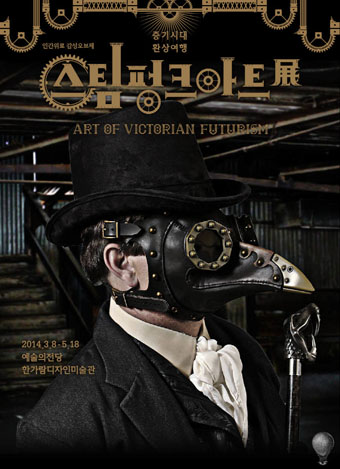
steampunk.jpg

Those who were wishing a few years ago that steampunk would crawl into a hole and quietly die must be gnashing their teeth at the way the sub-genre continues to flourish. (See Pinterest for examples from the increasingly wild world of steampunk fashion.) If anyone reading this is visiting Seoul in the next couple of months—or even living there—then they’ll find some of my book covers on display at Artcenter IDA. Steampunk: The Art of Victorian Futurism is a look at the wide range of steampunk aesthetics, from graphic works to three-dimensional constructions, clothing, and so on. I’d like to credit the promotional design above but I’m not sure who’s responsible. Good type design whoever it was.

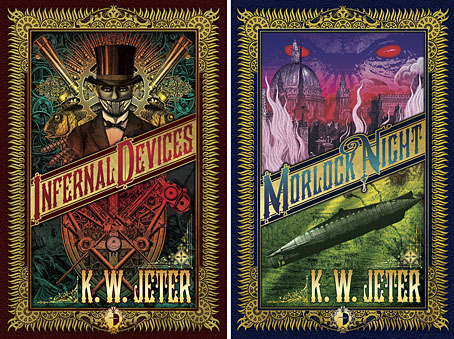
jeter.jpg

Five of my covers are on display, including the three I’ve done for KW Jeter’s novels. Mr Jeter, as mentioned before, is the man who first coined the term “steampunk” in the 1980s. This isn’t the first time my artwork has appeared in South Korea—when I was painting cards for Magic: The Gathering in the 1990s there were Korean editions printed—but it is the first time anything of mine has been exhibited there. The exhibition runs to mid-May.

Previously on { feuilleton }
Steampunk Calendar
Words and pictures
Nathanial Krill at the Time Node
Fiendish Schemes
Ghosts in Gaslight, Monsters in Steam
Steampunk Revolution
The Bookman Histories
Aether Cola
Crafting steampunk illustrations
SteamPunk Magazine
Morlocks, airships and curious cabinets
The Steampunk Bible
Steampunk Reloaded
Steampunk overloaded!
More Steampunk and the Crawling Chaos
Steampunk Redux
Steampunk framed
Steampunk Horror Shortcuts

Weekend links 202

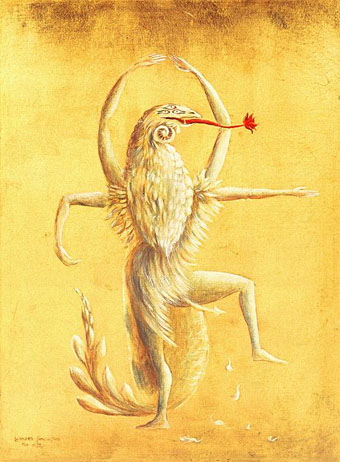
carrington.jpg

Figuras Miticas: Bailarin II (1954) by Leonora Carrington.

• The 26th Annual Lambda Literary Award Finalists have been announced. Ghosts in Gaslight, Monsters in Steam; Gay City: Volume 5 made the LGBT Anthology list, so congratulations to editors Evan J. Peterson & Vincent Kovar, and everyone else involved. I illustrated and designed the cover of that volume which also contains a piece of my fiction, Study in Blue, Green, and Gold.

Music in School (1969), episode 4: “A New Sound”. Amazing BBC TV programme for schools showing children playing avant-garde compositions using bowed metal sheets, tape loops, and primitive electronic equipment. I was at school then, and can’t help but feel a little jealous. Related: Delia Derbyshire Day approaches.

Voices Of Haiti (1953), recorded during ceremonials near Croix Des Missions and Petionville in Haiti by Maya Deren.

These days it’s hard to remember that Whistler’s Symphony in White, No. 1: The White Girl caused a bigger uproar at the Salon des Refusés of 1863 than Manet’s Déjeuner sur l’herbe, or that Monet was more influenced by Whistler than vice-versa. The delicacy of Whistler’s perceptions and his willingness to sacrifice everything for the sake of harmony make for an art less bracing than that of Degas or Pissarro. And yet how much life there is in his little Thames riverscapes. Perhaps we need another major exhibition—there hasn’t been one for twenty years—to re-evaluate him.

Whistler’s Battles by Barry Schwabsky

• Mix of the week (and a very good one it is): Abandoned Edwardian Schoolhouse by The Geography Trip.

Morton Subotnick tells Alfred Hickling how recording Silver Apples of the Moon blew his mind.

• The fantasy artwork of Ian Miller. A new book, The Art of Ian Miller, is published next month.

Queen for a Day by Alison Fensterstock. A look at the Mardi Gras Queens of New Orleans.

Tex Avery (1988): A 50-minute BBC documentary about the great animation director.

• The Gentle Revolutionary: Peter Tatchell talks to Joseph Burnett about Derek Jarman.

The Soaring and Nearly Forgotten Arches of New York City.

Dennis Hopper‘s photos of American artists in the 1960s.

Vodun at Pinterest.

Litanie Des Saints (1992) by Dr. John | Dim Carcosa (2001) by Ancient Rites | Far From Any Road (2003) by The Handsome Family

Heliotropic

heliotropic9.jpg

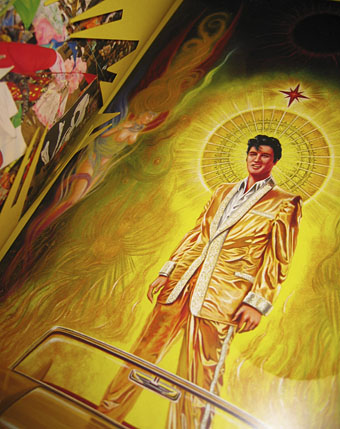
Arriving in the post this week was a catalogue for a Maison & Objet exposition of design and decoration which includes one of my paintings among the listed “Inspirations“. The event was held in Paris at the end of January but I’ve been so busy for the past few of months I forgot to see when it was on. Not that I could have said much about it since this is a showcase event you have to attend rather than experience remotely.

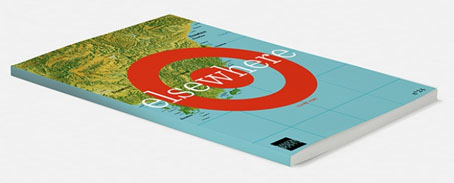
Catalogues for big art and design events often tend to the lavish and expensive but the Elsewhere book is the most lavish I’ve ever encountered. The production runs the gamut of the many expensive options which modern printing can provide: metallic inks, varnish effects, iridescent and translucent sheets, embossing, die-cutting, tipped-in inserts, and variable page sizes. The inflexible icing on the cake comes in the shape of a small square of polished marble glued to one of the pages. Excess aside, the print quality is excellent, and I’m very pleased with the way my Elvis painting appears.

sunking.jpg

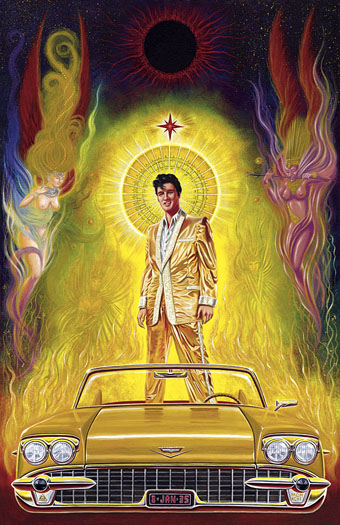
Sun King (1996).

Sun King was commissioned by Creation Books in 1996 as cover art for a Jeremy Reed novel which ended up being dropped by the company. The concept was the author’s, and while I’m pleased with the way it turned out I always felt it should have had more of a Gustave Moreau quality. This is the first time the picture been used anywhere although I did reuse the Elvis-in-a-Cadillac idea recently for one of the Alas Vegas Tarot cards.

heliotropic1.jpg

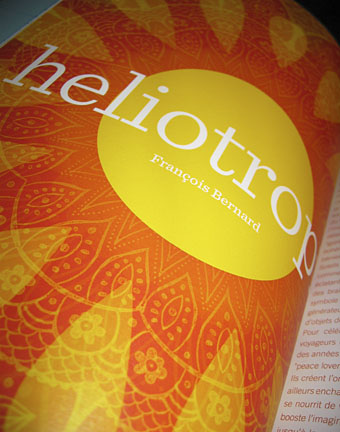
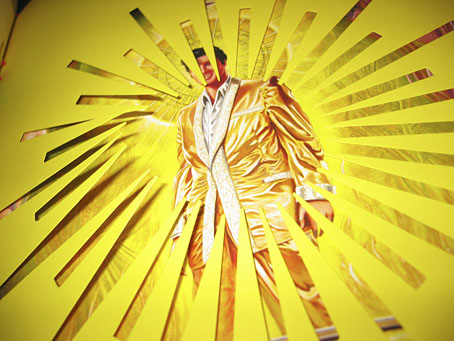
My painting is included in the Heliotropic section of the book which shows some of François Bernard’s inspirations. I’m pleased they placed one of the die-cut overlays before my piece. The photos below show some of the pages from the other sections which concern the inspirations of Elizabeth Leriche—her section includes the chunk of marble—and Vincent Grégoire whose section features futurism, space scenes, metallic effects, and Daft Punk.

heliotropic2.jpg

heliotropic3.jpg

Continue reading “Heliotropic”

Derek Jarman In The Key Of Blue

jarman.jpg

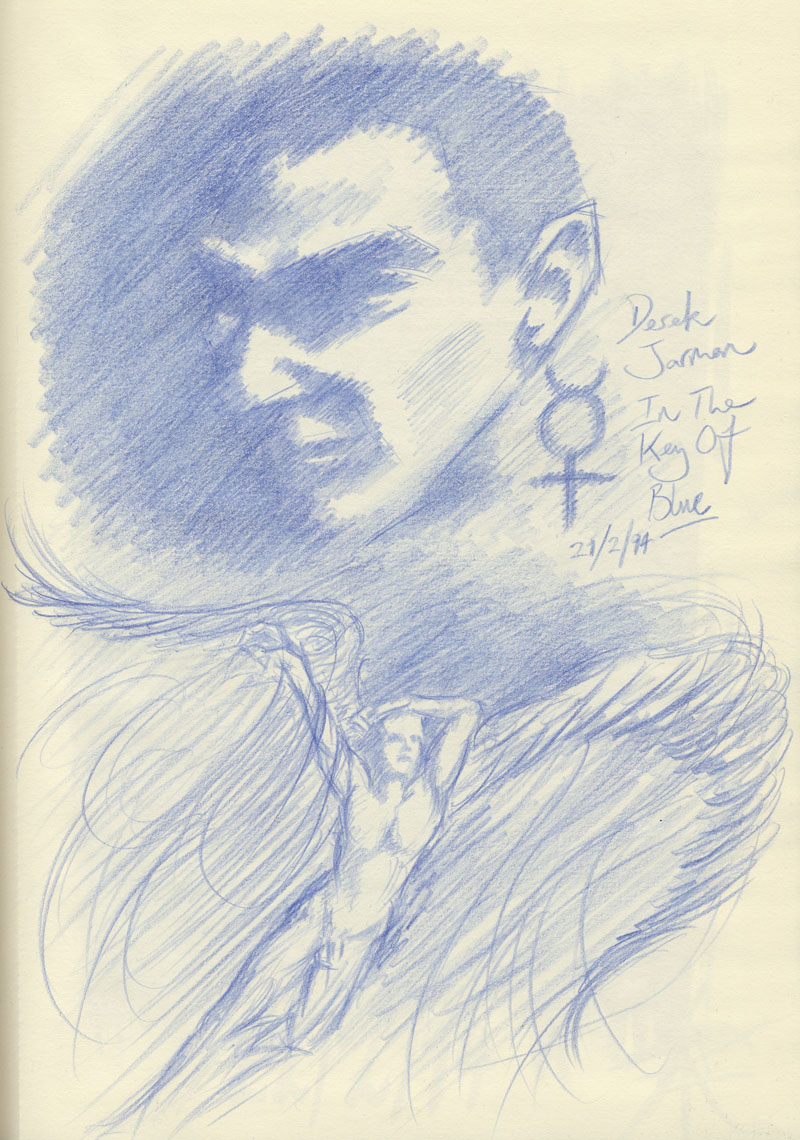
Derek Jarman died 20 years ago today. I was keeping a sketchbook at the time, something I’ve seldom bothered with before or since, and this was my reaction to the news a couple of days later, possibly drawn whilst watching one the TV documentaries which were being screened at the time.

Some current news items:
England’s alchemist, a piece by Philip Hoare
Unseen nightclub film to get London premiere
‘So Mum covered me in cooking oil. Then Dad came home’
Queer Pagan Punk, a season of films by Jarman and others, is currently running at the BFI Southbank.

Previously on { feuilleton }
The Dream Machine
Jarman (all this maddening beauty)
Sebastiane by Derek Jarman
A Journey to Avebury by Derek Jarman
Derek Jarman’s music videos
Derek Jarman’s Neutron
Mister Jarman, Mister Moore and Doctor Dee
The Tempest illustrated
In the Shadow of the Sun by Derek Jarman
Derek Jarman at the Serpentine
The Angelic Conversation
The life and work of Derek Jarman

Burroughs at 100

wsb.jpg

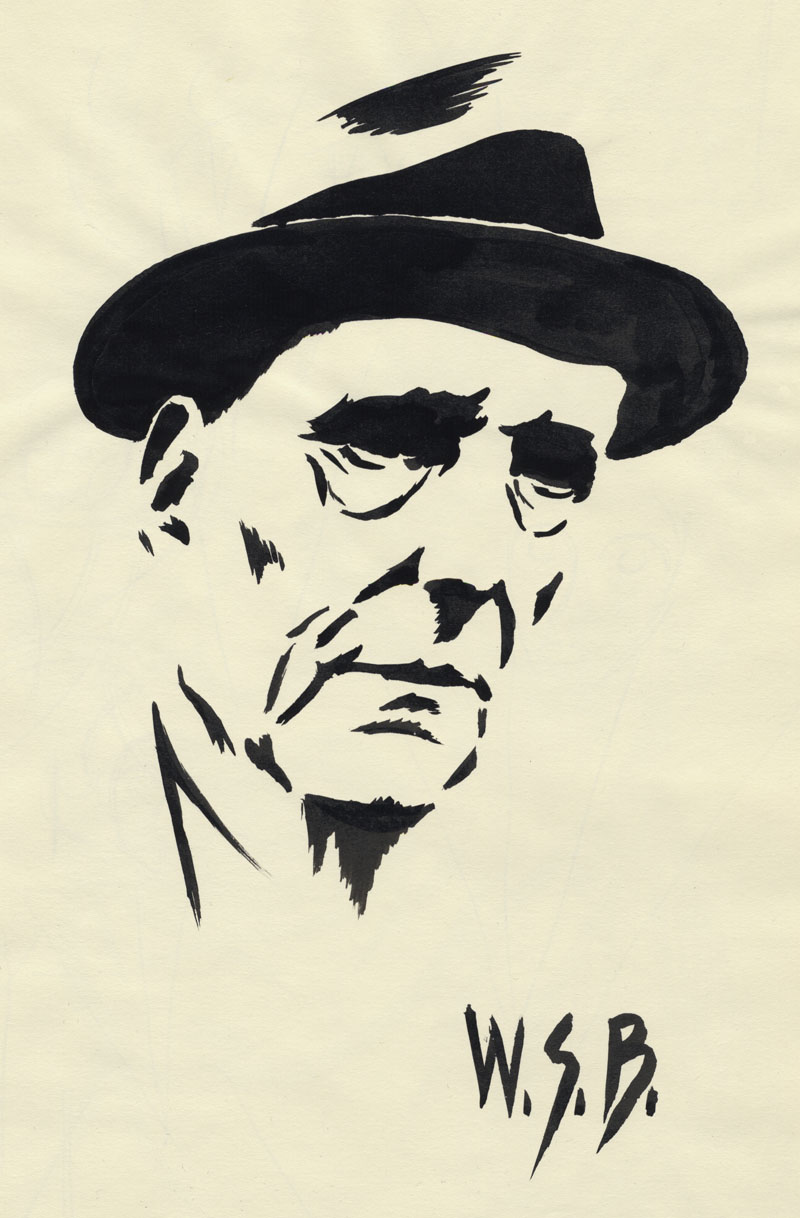
Something from 1994 I found in an old sketchbook. Ink on paper.

Happy birthday, Bill. To celebrate the Burroughs centenary I could have put together several very different mixes of Burroughs-related music—there’s been a lot of it, and he was blessed with some excellent collaborators—but in the end decided on a version of something I’ve been messing with on and off for about twenty years.

Seven Souls Resouled by Feuilleton on Mixcloud

Bill Laswell’s associations with William Burroughs go back to Laurie Anderson’s Mister Heartbreak (1984) album which Laswell played bass on and co-produced. Burroughs had a guest spot on the last track, Sharkey’s Night, and that session may have led to the 1989 album by Laswell’s Material project, Seven Souls, a seven-track album based around Burroughs’s readings of passages from The Western Lands. This has always been my favourite of all the albums which set Burroughs texts to music, not least because Laswell has always surrounded himself with exceptional musicians. I liked this album so much I used to try padding it out on cassette tape with other Laswell productions, many of which feature the same musicians, and even similar riffs and instrument sounds. I could never settle on a definitive mix, however, and even the one presented here doesn’t feel absolutely right although it works far better than all previous versions. Matters aren’t helped by there being much extraneous material (so to speak): Seven Souls was reissued in 1997 with remix tracks, and there’s also a related EP, The Road To The Western Lands, with further remixes. Then there are the many tracks which match the Seven Souls sound, not least on the 1994 Material album, Hallucination Engine, which also features a Burroughs reading. Laswell’s solo albums, and much of his Axiom label, is infected by Burroughs-like titles; for a while Axiom even promoted its world- and genre-spanning ethos with the slogan “Nothing is true; everything is permitted”. The Beatles may have put Burroughs’s face on the cover of the Sgt Pepper album but Bill Laswell has done far more to spread the virus of the man’s work. Below there’s a guide to the tracks followed by another visit to the Wild Boys.

William S. Burroughs – Word Falling, Photo Falling (1960s)
One of the numerous tape recordings from the 1960s which are like audio equivalents of the books Burroughs was writing at the time. This one is from Nothing Here Now But The Recordings (1981).

Material – Ineffect (1989)
The first track from Seven Souls.

Ginger Baker – Dust to Dust (1986)
Bill Laswell produced two Ginger Baker solo albums, Horses and Trees (1986), from which this track is taken, and Middle Passage (1990). Both feature Laswell’s core group of Material musicians including Nicky Skopelitis, Bernie Worrell and Aiyb Dieng. Baker was a member of a later incarnation of Material, and appears on the Live In Japan (1993) album.

Material – Seven Souls (1989)
The second track from Seven Souls.

Material – Ruins (Submutation Dub by Bill Laswell) (1994)
From Material’s other masterwork, the mighty Hallucination Engine.

Material – Soul Killer (1989)
The third track from Seven Souls.

Ginger Baker – Under Black Skies (1990)
From Baker’s Middle Passage album.

Material – The Western Lands (1989)
The fourth track from Seven Souls.

Mandingo – Lanmbasy Dub (Kora in Hell Mix by Bill Laswell) (1993)
A slight deviation from the Seven Souls tracklist. The first four Burroughs tracks were followed by two very different pieces: Deliver, featuring the voice of Gambian musician and kora player Foday Musa Suso, and Equation which combined a rock riff with Rammellzee’s vocals. Foday Musa Suso is another floating member of Material who also released an album, New World Power (1990) on Laswell’s Axiom label under the name Mandingo. This track is an extended remix of the first track from New World Power.

Bill Laswell (with William S. Burroughs, Techno Animal, Iggy Pop) – The Western Lands (1999)
Hashisheen : The End Of Law is one of many one-off Laswell projects, this one featuring a collection of readings about Hassan i Sabbah set to music. Burroughs appears briefly two years after his death reading what may have been a Seven Souls outtake. Iggy Pop then reads a piece from The Western Lands.

Material feat. Rammellzee & phonosycographDISK – No Guts No Galaxy (1999)
In place of Equation from Seven Souls there’s this rap number from Material’s Intonarumori album.

Bill Laswell – Flash Of Panic [Pipes Of Pan / Up Above The World / Under Black Skies / Out Of The Ether] (1994)
Part of a track from the Axiom Ambient album which blends some of Laswell’s recording of the pan pipes at Jajouka with strings from a Jonas Hellborg album, and Omar Faruk Tekbilek’s ney from Under Black Skies.

Material – Soul Killer (Remote Control Mix by Terre Thaemlitz) (1997)
The reissue of Seven Souls featured three remixes of which this has always been my favourite. Terre Thaemlitz subjects Burroughs’s voice to some granular distortion then cuts-up his words.

Material – The End of Words (1989)
The seventh and final track from Seven Souls.

Continue reading “Burroughs at 100”