Weekend links 78

carr.jpg

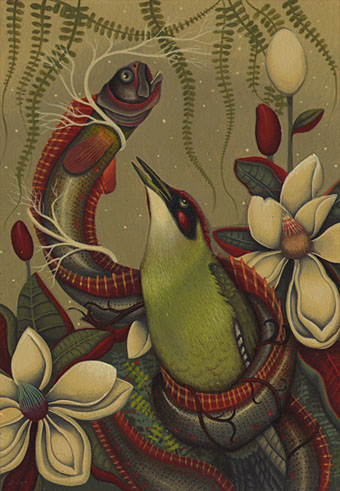
Struggle (2009) by Lindsey Carr.

• “Twilight Science is an imprint for sound, music and DVD editions initiated by artist Paul Schütze. We will progressively publish all back catalogue, new projects and collaborations. These will include works by Phantom City, NAPE, Schütze-Hopkins and others.” Related (because Paul Schütze remixed Main): Main Feed The Collapse, Neil Kulkarni talks to Robert Hampson.

• “You can’t really narrate or display this situation, you can only, endlessly, contemplate it. When the writer or director gets tired of the iterations, he tells us who the mole is.” Michael Wood on the novel, (superb) television series and recent film of Tinker, Tailor, Soldier, Spy.

• “Havin’ a dick is pretty fuckin’ awesome” says Horst, a new gay magazine limited to 1000 copies. Related (well, there’s a guy in and out of his underwear): Naked Lunch, a fashion shoot very tenuously based on David Cronenberg’s film.

“At first, I tried fighting bullies one-on-one, but they don’t fight fair; they fight two and three on one,” Bennett said. So the youths got together and “started carrying mace, knives, brass knuckles and stun guns, and if somebody messed with one of us then all of us would gang up on them.”

 “Gay black youths go from attacked to attackers” says the headline. A group of genuine Wild Boys; William Burroughs would have approved.

• Tor.com reminded me of Sally Cruikshank‘s amazing animated film Face Like a Frog (1987) which features a score and Cab Calloway-style song by Danny Elfman.

• It’s 1969, OK? Pádraig Ó Méalóid talks with Kevin O’Neill about the Swinging League of Extraordinary Gentlemen.

• In the Tumblr labyrinth this week: Fuck Yeah St Sebastian and Gender is Irrelevant.

• For when you need some motherfucking placeholder text: Samuel L Ipsum.

• “Study finds ‘magic mushrooms’ may improve personality long-term.”

Solar Megalomania: paintings by Leonora Carrington.

• It’s all fun and games until Charles Manson turns up.

Firmament II (1993) by Main | Firmament IV (1993) by Main | Reformation (1994) by Main.

Screening Kafka

kafka1.jpg

Kafka (1991).

This week I completed the interior design for a new anthology from Tachyon, Kafkaesque, edited by John Kessel and James Patrick Kelly. It’s a collection of short stories either inspired by Franz Kafka, or with a Kafka-like atmosphere, and features a high calibre of contributions from writers including JG Ballard, Jorge Luis Borges, Carol Emshwiller, Jeffrey Ford, Jonathan Lethem and Philip Roth, and also the comic strip adaptation of The Hunger Artist by Robert Crumb. When I knew this was incoming I rewatched a few favourite Kafka-inspired film and TV works, and belatedly realised I have something of a predilection for these things. What follows is a list of some favourites from the Kafkaesque dramas I’ve seen to date. IMDB lists 72 titles crediting Kafka as the original writer so there’s still a lot more to see.

wellestrial.jpg

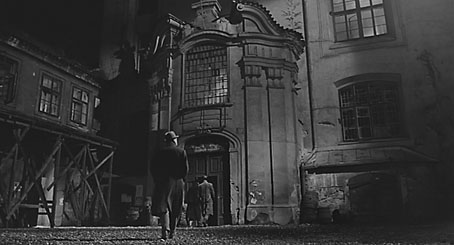
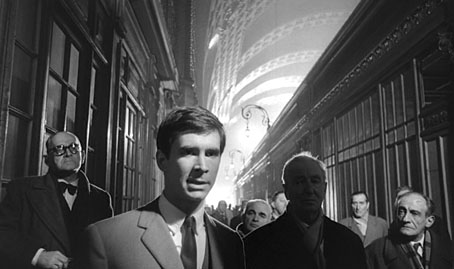
The Trial (1962), dir: Orson Welles.

Orson Welles in one of his Peter Bogdanovich interviews describes how producer Alexander Salkind gave him a list of literary classics to which he owned the rights and asked him to pick one. Given a choice of Kafka titles Welles says he would have chosen The Castle but The Trial was the only one on the list so it’s this which became the first major adaptation of a Kafka novel. Welles always took some liberties with adaptations—even Shakespeare wasn’t sacred—and he does so here. I’m not really concerned whether this is completely faithful to the book, however, it’s a first-class work of cinema which shows Welles’ genius for improvisation in the use of the semi-derelict Gare d’Orsay in Paris as the main setting. (Welles had commissioned set designs but the money to pay for those disappeared at the last minute.) As well as scenes in Paris the film mixes other scenes shot in Rome and Zagreb, with Anthony Perkins’ Josef K frequently jumping across Europe in a single cut. The resulting blend of 19th-century architecture, industrial ruin and Modernist offices which Welles called “Jules Verne modernism” continues to be a big inspiration when I’m thinking about invented cities. Kafka has been fortunate in having many great actors drawn to his work. Here with Perkins there’s Welles himself as the booming and hilarious Advocate, together with Jeanne Moreau, Romy Schneider and Akim Tamiroff.

brazil.jpg

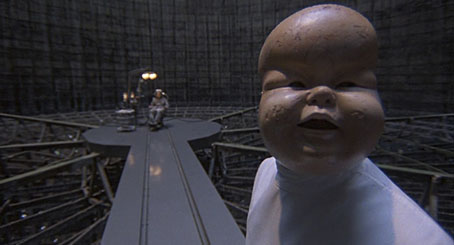
Brazil (1985), dir: Terry Gilliam.

Having watched Brazil again recently I was struck by how much it resembles the popular view of Kafka’s worlds rather than the Orwellian nightmare which Terry Gilliam first intended. The story is powered by a bureaucratic error caused by a crushed insect, after all, and Gilliam follows Welles in mashing up the styles and motifs of an authoritarian century to create a hybrid world he described as being “on the Belfast/Los Angeles border”. Tom Stoppard had a hand in the screenplay, and there’s another great cast with Jonathan Pryce, Katherine Helmond and Ian Holm. Also a nod to an Orson Welles role with the character named Harvey Lime.

insuranceman.jpg

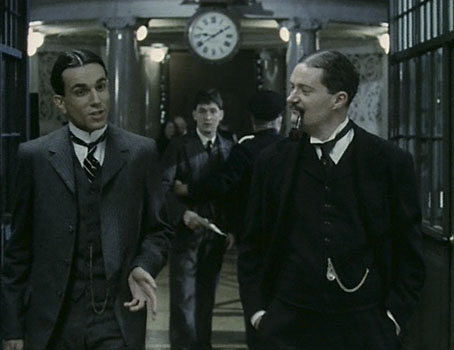
The Insurance Man: Daniel Day-Lewis, Robert Hines & Jim Broadbent.

The Insurance Man (1986), dir: Richard Eyre.

Jim Broadbent played a plastic surgeon in Brazil; here he’s a clerk in the offices of the Worker’s Accident Insurance Institute in Prague. Writer Alan Bennett was preoccupied with Kafka in the mid-1980s: his stage play, Kafka’s Dick (the title does indeed refer to the writer’s penis), was staged the same year as this TV film directed by Richard Eyre, a 70-minute drama which sees a young factory worker trying to find a cure for an industrial illness at the Insurance Institute where one “Doctor Kafka” is employed. Needless to say, his quest for health and some measure of justice becomes Kafkaesque. Kafka here is portrayed by Daniel Day-Lewis in a typically enthralling performance which is never mannered but makes him seem a stranger creature (and a more sympathetic clerk) than his fellow workers. Most of this was filmed in Liverpool in some wonderful old office buildings using a sombre blue/grey palette. As with all Bennett’s dramas the dialogue is a treat. The film is now available on DVD in the Alan Bennett at the BBC collection.

metamorphosis.jpg

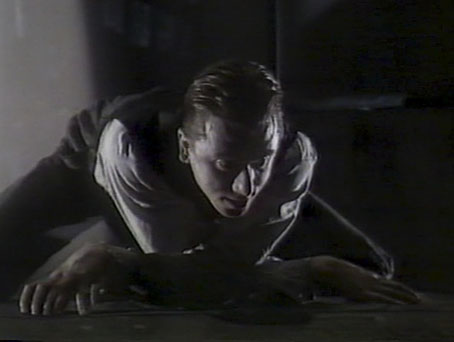
Tim Roth as Gregor Samsa.

Metamorphosis (1987), dir: Jim Goddard.

Another TV drama based on one of Steven Berkoff’s three stage adaptations of Kafka in which he also plays the part of Mr Samsa. Berkoff’s preference for physical theatre means there are no insect suits or special effects here, Gregor Samsa’s insectile nature is conveyed entirely through Tim Roth’s energetic performance, with shrieks, twisted limbs, and a climbing frame for when he needs to scuttle up the wall or hang from the ceiling. Not available on DVD but it’s scattered around YouTube if you can be bothered.

berkofftrial.jpg

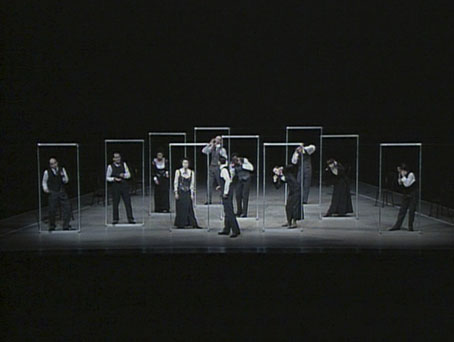
The Trial (1991), dir: Steven Berkoff.

Another Berkoff adaptation which is available on DVD from his own company. As with his Salome, this is a filmed stage performance and highly recommended for its fidelity to the book, although of the two I prefer the Oscar Wilde play. Berkoff’s great innovation is the bare stage where the only props are a couple of chairs and a number of tall metal frames, one for each performer, which the actors use to create doors, windows, picture frames and even a series of moving corridors. Berkoff himself plays Titorelli the painter as a hyperactive Dalí type.

kafka2.jpg

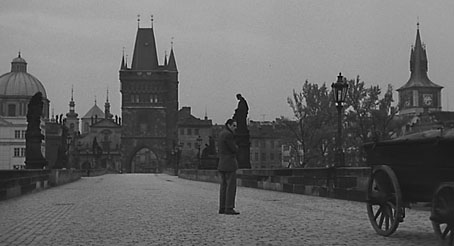
Kafka (1991), dir: Steven Soderbergh.

A cult film of mine which I’ve written about before so there’s no need to go into great detail. It’s a shame that Daniel Day-Lewis couldn’t have played Kafka in this one instead of Jeremy Irons who does a decent job but always seems slightly wrong for the part. Ian Holm in Brazil had a role named after Terry Gilliam’s MAD-magazine mentor Harvey Kurtzman; here Holm is named after one of the great silent film directors in the role of the enigmatic Doctor Murnau. Shot on location in Prague.

franzkafka.jpg

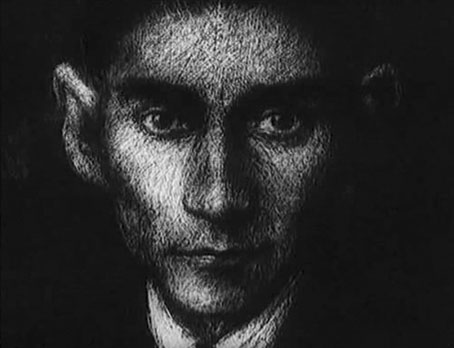
Franz Kafka (1992), dir: Piotr Dumala.

After all the fake Kafkas, something which is at least close to genuine article in a short and wordless animated film by Piotr Dumala. Can be watched in its entirety here.

zoetrope.jpg

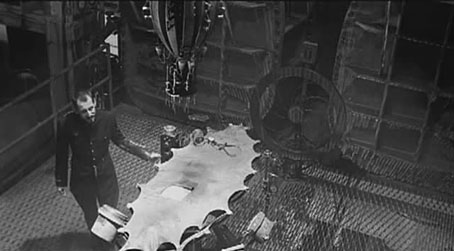
Zoetrope (1999), dir: Charlie Deaux.

Kafka’s In the Penal Colony is moved from its sun-blasted location to what looks like the interior of a power station in Charlie Deaux’s frenetic adaptation. The emphasis is very much on the industrial with the film nodding as much to David Lynch as Franz K. (And whatever happened to David Lynch’s proposed adaptation of The Metamorphosis?) The rumbling, clanging soundtrack by Lustmord provides the requisite Alan Splet-like atmospherics. Available on DVD from Soleilmoon.

Previously on { feuilleton }
Die Andere Seite by Alfred Kubin
Designs on Kafka
The Hourglass Sanatorium by Wojciech Has
Kafka’s porn unveiled
A postcard from Doctor Kafka
Alexandre Alexeieff and Claire Parker
Hugo Steiner-Prag’s Golem
Steven Soderbergh’s Kafka
Kafka and Kupka

Weekend links 68

dorosheva.jpg

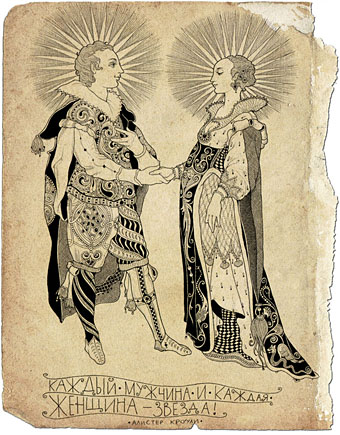
Every man and every woman is a star by Sveta Dorosheva.

• Matt Taylor (illustration) with Gregg Kulick and Paul Buckley (design) provide new Penguin covers for John Le Carré. I love the look which seems inspired by Daniel Kleinman’s title sequence for Casino Royale even if it doesn’t quite suit the shabby world of George Smiley and the Circus.

[Deborah Kass] told me that when she was going to art school in the ’70s, she tripped on LSD almost every week and she said she felt it was her “moral duty as an artist to take the trip.” […] I think psychedelic experience makes you think that there are multiple realities, that there isn’t just this one normal real world to which we’re supposed to conform, but that the reality changes depending on the state of consciousness that we’re in when we’re experiencing it. So, any different kind of art kind of posits a different reality. (more)

New York Times art critic Ken Johnson discussing his new book Are You Experienced?: How Psychedelic Consciousness Transformed Modern Art.

• “That got me thinking that evolution really isn’t survival of the fittest, when it comes to these things, it is more like survival of the interesting, survival of the beautiful, survival of the weird, cool stuff that managed to evolve.” Laurie Anderson and David Rothenberg discuss music and animals.

• Laura Cumming on the late Lucian Freud. And Stephen Heller on Alex Steinweiss, the originator in 1939 of the artistic record sleeve who also died last week.

• Alan Moore says “Think Locally: Fuck ‘Globally'”. He and Queen Calluz explain how Dodgem Logic magazine puts their ideas into practice.

Adam Curtis gets interviewed while Alan Bennett returns to Armley Public Library in Leeds.

Peacock’s Garden, a celebration of pavonine splendour.

• A visit to Seher Shah’s studio in Brooklyn, New York.

• Maximum androgyny at Epicenity, a Tumblr.

Does your god have a penis?

Chrysalide (1978) is an album of “cosmic” guitar instrumentals by Michel Moulinié which sounds at times like a French equivalent of Manuel Göttsching. It’s never been released on CD but a copy can be found here.

Hello Dali!

hellodali.jpg

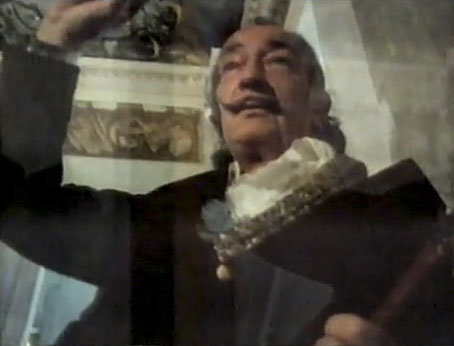
Russell Harty and Salvador Dalí, 1973.

This would have been a real find if the quality wasn’t so poor. Hello Dali! was a 50-minute documentary film about Salvador Dalí broadcast in the UK in 1973 as part of ITV’s Aquarius arts strand. The whole thing is on YouTube chopped into five parts and is unfortunately blighted by severe ghosting throughout. Apart from that it’s perfectly watchable.

hellodali2.jpg

Some conversations are subtitled so viewers are better able to make sense of Dalí’s English/Spanish/French dialect.

Brits who are old enough may remember Aquarius which was replaced in the late 70s by The South Bank Show, a programme using the same format of a short studio introduction followed by a self-contained film. In place of the SBS‘s Melvyn Bragg we have Humphrey Burton introducing a film directed by Bruce Gowers. Russell Harty is the front man, seen here in the days before he achieved greater fame as a gossipy chat-show host. I’d been wanting to see this for a long time, having lost a video tape of it years ago. I never saw the original broadcast but it was screened again after Dalí’s death in 1989, and I remembered it as being particularly good for showing a slightly more human side to the eccentric and occasionally annoying artist. So it is, giving us a brief portrait of Dalí in his 69th year, preoccupied at that time with the construction of his museum in Figueres. The nature of Harty and Gowers coup in getting the artist to allow a film crew into his home can be found in subsequent documentaries many of which use uncredited extracts from these interviews. It’s the brief moments of interview which make this even though they reveal little, it’s refreshing seeing Dalí talking conversationally rather than putting on a performance.

hellodali3.jpg

The early 70s saw the last flare of real interest in Dalí from the world at large. Dalí and Surrealism in general had a resurgence of popularity in the late 60s as a consequence of psychedelic culture: a number of books by or about the artist were published or reprinted, among them Peter Owen’s 1973 revival of the novel Hidden Faces which Dalí had written in 1944. About the same time Alejandro Jodorowsky was circling the Dalí camp trying to inveigle the artist into portraying the Emperor in his planned film adaptation of Dune. One detail worthy of note in the conversation with Russell Harty is mention of a golden toilet, something which Jodorowsky says Dalí wanted as his throne if he was going to be filmed. We never got to see Jodorowsky’s Dune but it’s good to find this documentary available once again. Here’s hoping a better copy turns up eventually.

Hello Dali! Pt 1 | Pt 2 | Pt 3 | Pt 4 | Pt 5

Previously on { feuilleton }
Dalí and the City
Dalí’s Elephant
Dalí in Wonderland
Alejandro Jodorowsky’s Dune
Dirty Dalí
Impressions de la Haute Mongolie revisited
Dalí and Film
Salvador Dalí’s apocalyptic happening
Dalí Atomicus
Impressions de la Haute Mongolie

Weekend links 66

kunz.jpg

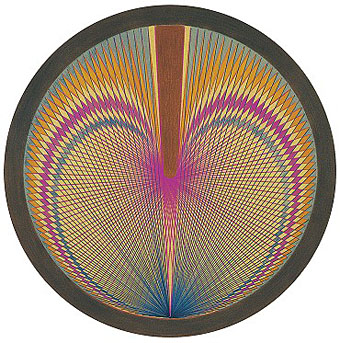
A design by Emma Kunz (1892–1963).

• Following the news this week it’s worth reminding people of a great post put together by Adam Curtis back in January, Rupert Murdoch—A portrait of Satan. One detail there concerns the death of chat show host Russell Harty in 1988. This week the London Review of Books posted an extract from Alan Bennett’s diaries referring to the Harty episode where he notes how the tabloid practice of getting private phone numbers from the police was common and widespread, not simply the actions of a single newspaper. For more about the deathbed hounding of Russell Harty (and Bennett’s loathing of Murdoch) see Writing Home. Related: Dennis Potter shortly before his death discussing his desire to kill Rupert Murdoch.

• Don’t get mad, get even: Hakim Bey’s Black Djinn Curse: “How to invoke a terrible curse on a malign institution.” See also: Black magic as revolutionary action.

Village Voice talks to Linda Manz about her experience as a young actor in Days of Heaven, The Wanderers and Out of the Blue.

Truth Wins Out infiltrates the “ex-gay” clinic run by Michelle Bachmann’s husband.

Free Situationist booklets by Larry Law. Related: films by Guy Debord at Ubuweb.

• Have tea with Doctor Dee in Mortlake, London, next Wednesday.

Publisher Peter Owen: Sixty years of innovation.

Wilhelm Reich: the man who invented free love.

A conversation with Brian Eno by Ben Sisario.

The mysterious minaret of Jam, Afghanistan.

Stereolab cover designs at Hardformat.

Orgone Accumulator (1973) by Hawkwind | Cloudbusting (1985) by Kate Bush | Orgasmatron (1986) by Motörhead | Orgasmatron (1993) by Sandoz | Orgone Donor (2004) by Deathprod.