Weekend links 389

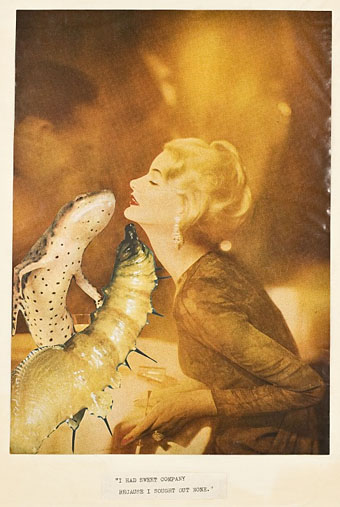
adam.jpg

I Had Sweet Company Because I Sought Out None. Collage by Helen Adam.

• Readers of The Library of Babel by Jorge Luis Borges continue to be compelled to either illustrate the impossible archive or create virtual equivalents. The Library of Blabber by nothke is a procedural version for home computers in which each volume on the shelves contains randomly-generated content.

• The Japanese American Toy Theatre of London presents: James Bonk in Matt Blackfinger (1987). Directed by Akiko Hada, with music by David Toop, and a song from Frank Chickens’ Kazuko Hohki (who also co-wrote the script).

• Music, Time and Long-Term Thinking—The Long Now Foundation (and a fair amount of Brian Eno) by Austin Brown, Alex Mensing and Ahmed Kabil.

• A Return to Normilcy: Bernie Brooks talks to post-punk group Normil Hawaiians about their 1982 album More Wealth Than Money which has just been reissued.

• Sound artist and theremin player Sarah Angliss has reworked music by Bernard Herrmann for an upcoming stage adaptation of The Twilight Zone.

• Does the world need another reissue of A Secret Wish by Propaganda? Not really but there’s a “deluxe” vinyl and CD edition on the way.

• “What Would [Bernard] Wolpe Do?” Talking Wolpe, Albertus and book cover design with the Faber & Faber Art Department.

• Mixes of the week: FACT mix 629 by Idle Hands/Chris Farrell, and XLR8R Podcast 518 by Cassy.

• At Phantasmaphile: Neglected collage artist Helen Adam (1909–1993).

Collectors’ corner: photos of book and music libraries

• The Black Meat (Deconstruction Of The Babel-Tower of Reason) (1994) by Automaton | Babel (2010) by Massive Attack feat. Martina Topley-Bird | Branching (2016) by The Library of Babel

Weekend links 388

nakayama.jpg

Still of an Alive Painting by Akiko Nakayama.

• “In what is a cross between performance art and installation, Nakayama uses a multitude of kitchen basters loaded with paint and water to add, mix, tilt, blow and add all sorts of extraneous effects to her paints, recording and projecting it all onto a large screen.” Continuously Changing “Alive Paintings” by Akiko Nakayama. There’s more performance video at the artist’s website.

• In January 2018 Song Cycle Records (UK) release Solaris, a “Collector’s Edition” of the Tarkovsky film and its soundtrack comprising vinyl/CD, blu-ray (no region details) and a book of photos, artwork and essays.

• Steve Davis may no longer be a snooker player but he’s still a Magma obsessive. This week he reviewed the new Retrospektiw collection for The Quietus.

What I was most thankful to TG for was leading me to Christopherson’s later band Coil with his partner, antagonist and lover John Balance (after they’d met in Genesis’ Psychic TV) whose music I fell for even harder. The arcane and homoerotic tragicomedy that underpinned their discography (and relationship) propelled me into new states, years before any first hand knowledge of the drug experiences they managed to intertwine so artfully with their music. Records like Scatology and Horse Rotorvator sexualised the male body for me for the first time—an awakening that’s hard not to find some amusement in when soundtracked by a romp called The Anal Staircase. From afar it seemed like their intense, exploration of electronic music as ritual was only possible as a result of the depth of the duo’s personal relationship and how it manifested spiritually, chemically and physically. The posture and machismo of the modern guitar music I listened to (and performed) with my friends could be tiring. The sound of Coil became a safe space in which to fantasise about manhood and Englishness and what it really meant, helping dismantle clichés I’d come to accept as reality. From medieval hymns to acid-house their music was unafraid and total. Though hard to define with any particular release I often play people their funereal takes on Tainted Love (of which all profits went to the Terrence Higgins Trust—a musical first in 1985 while AIDS was still very much taboo) and the Are You Being Served? theme tune, the basis of their transformative final track Going Up, completed by Christopherson after Balance’s death.

Fred Macpherson writing about Throbbing Gristle and Coil at new site The Queer Bible. This is the first appraisal of Coil I’ve seen on any site devoted to gay/queer issues, over ten years after the band expired following the death of John Balance. Better late than never, I suppose.

• Tom Phillips is helping support the National Campaign for the Arts by reworking a page of A Humument as a series of designs at CafePress.

• At Strange Flowers: The Secret Satan book list, a welcome alternative to the lists that fill the broadsheets at this time of year.

• Mixes of the week: Stephen O’Malley presents Acid Quarry Paris—A Hypnosis, and XLR8R podcast 517 by Davy.

• At the Internet Archive: 183 copies of Video Watchdog magazine (1990–2017).

• The TLS interview: Twenty Questions with M. John Harrison.

• At Unquiet Things: The solving of a family art mystery.

txt.fyi

The Hills Are Alive (1995) by Coil | Everyone Alive Wants Answers (2003) by Colleen | Only Lovers Left Alive (2014) by Jozef Van Wissem

Weekend links 383

nomata.jpg

Arcadia-24 (1988) by Minoru Nomata.

Dark Entries and Honey Soundsystem Records release a video of edited moments from gay porn film Afternooners to promote the release of the film’s electronic soundtrack by Patrick Cowley. The album, which is the third and final collection of Cowley’s porn soundtracks, is out now.

Emily Temple looks at some of the art inspired by Italo Calvino’s Invisible Cities. I explored the same subject a couple of years ago in a week of Calvino art posts. From 2014: Peter Mendelsund on designing covers for Calvino.

Jim Downes on the late Charley Shively, a gay liberation activist who wasn’t interested in equality. Not an uncommon attitude in some gay circles but it’s one you seldom see aired in the mainstream press.

Geeta Dayal on A Little Electronic Milky Way of Sound by Roland Kayn, a 14-hour composition of “cybernetic music” which has been released in a lavish 16-CD box set by Frozen Reeds.

• An introduction to Henri-Georges Clouzot in seven films by Adam Scovell. Clouzot’s masterwork, The Wages of Fear (1953), is released on blu-ray by the BFI next week.

• Ubu Yorker: Menachem Feuer interviews Kenneth Goldsmith, writer and the man behind Ubuweb.

• Why Oscar-winning cinematographer Vittorio Storaro thinks the film vs. digital debate is bullshit.

David Barnett on supernatural fiction’s “best kept secret”, Robert Aickman.

Michèle Mendelssohn on how Oscar Wilde’s life imitates his art.

• Mix of the week: Secret Thirteen Mix 233 by Mick Harris.

Invisible Limits (1976) by Tangerine Dream | Invisible Cities (1990) by Jah Wobble’s Invaders Of The Heart | Invisible Architecture (1995) by John Foxx

Weekend links 378

belbury.jpg

Outward Journeys, which will be released on November 3, is the second album on the Ghost Box label by The Belbury Circle (Belbury Poly with The Advisory Circle). As before, John Foxx is a guest vocalist, and as always, Julian House provides the graphic design.

• Music non-stop: Geeta Dayal in 2012 talking to Rebecca Allen about the challenges of turning Kraftwerk into computer animations.

• At the BFI: Jon Towlson on the sublimity of Close Encounters of the Third Kind; and Stephen King’s favourite films.

Bookogs is the Discogs concept applied to books. Stupid name (Bibliogs would be much better) but there it is.

belbury2.jpg

Julian House goes 8-bit. More artwork for The Belbury Circle.

Iain Sinclair‘s farewell to London. Sinclair talked to Alan Moore about his book earlier this month.

• At Dangerous Minds: Paul Gallagher on the occult art of Austin Osman Spare.

• The places where Cold War numbers stations broadcast spies’ secret codes.

• Rodney Brooks on the seven deadly sins of predicting the future of AI.

Nadja Spiegelman on the peculiar poetry of Paris’s Lost and Found.

• At Wormwoodiana: The rise of secondhand bookshops in Britain.

• RIP Grant Hart and Harry Dean Stanton. (And Dirge Magazine.)

• Mix of the week: FACT mix 618 by Tara Jane O’Neil.

• An introduction to Conny Plank in 10 records.

Reoccurring Dreams (1984) by Hüsker Dü | Canción Mixteca (1985) by Ry Cooder | You Don’t Miss Your Water (1993) by Harry Dean Stanton

Holger’s Radio Pictures

Turn the dials with your hand / Till you find the shortwave band

Kraftwerk

The sounds of the radio, especially the distant voices and atmospheric distortions of the shortwave band, were a continual presence in the work of the late Holger Czukay. The Canaxis piece on his first album outside Can (also known today as Canaxis) opens with a series of electronic bleeps reminiscent of (or maybe derived from) radio signals. In Czukay’s later TV appearances with Can he left the bass playing to Rosko Gee, preferring instead to stand at the side of the stage with a collection of radios and tape machines. On one of his first high-profile collaborations of the 1980s, David Sylvian’s Words With The Shaman, he’s credited solely with “radio”. The radio continued to provide source material for his subsequent collaborations and solo albums.

What you have here is my own mix of some favourite Czukay compositions all of which favour radio signals. The title is derived from the two tracks taken from the Full Circle EP, a collaboration between Czukay, Jah Wobble and Jaki Liebezeit; Full Circle and Mystery are both labelled “RPS” or “Radio Picture Series”. Being numbered pieces this has always begged the question of where the other six in the series might be. Now the composer is gone we may never know.

Tracks:
Jah Wobble, Holger Czukay & Jaki Liebezeit—Full Circle R.P.S. (No. 7) (1981)
Holger Czukay—Music In The Air (1987)
Jah Wobble, Holger Czukay & Jaki Liebezeit—Mystery R.P.S. (No. 8) (1981)
Holger Czukay—Radio In An Hourglass (1992)
Holger Czukay—Traum Mal Wieder (1984)
Holger Czukay—Mirage (1999)