Blood And Rockets by The Claypool Lennon Delirium

blood1.jpg

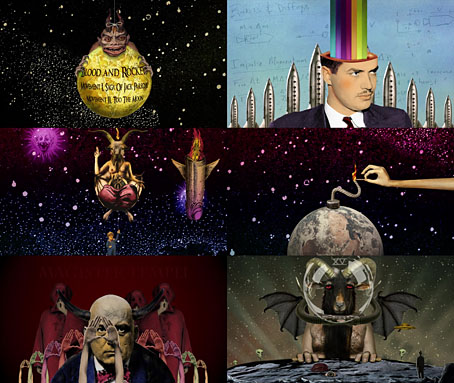
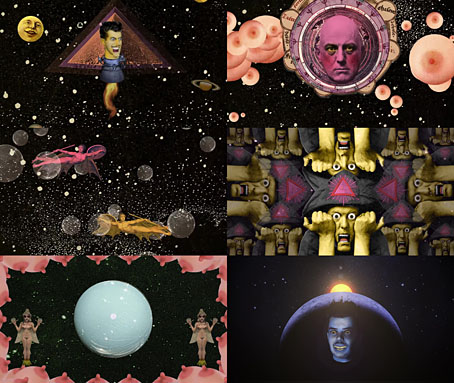
In an overburdened media landscape the words “Terry Gilliam-like animation” could easily mean some hastily-compiled film with a few nods to the collage style that Gilliam popularised in his interludes for the Monty Python TV series. Rich Ragsdale’s music video for The Claypool Lennon Delirium (Les Claypool and Sean Lennon) is much more than this, being a witty and inventive pastiche of the complete Gilliam style, replete with an abundance of sight gags, and familiar touches such as fizzing bombs, clutching hands and chattering heads.
blood2.jpg

The subject of the song is Jack Parsons, the ill-fated Californian rocket engineer whose wild life and entanglement with the West Coast chapter of Aleister Crowley’s Ordo Templi Orientis led to scandal and an untimely death. Parsons’ story is one of the more curious episodes in 20th-century occultism—a pre-Scientology L. Ron Hubbard was also involved in the Crowley shenanigans—but this must be the first time the history has been recounted in the form of a psychedelic ballad. Ragsdale is no slouch with the occult symbolism either, adding a number of Thelemic touches to the inevitable Satanic iconography. As befits the sex-obsessed Parsons the video also contains a fair amount of phallic imagery and boob constellations that somehow evaded the attentions of the YouTube Penis Police. Watch it here. (Thanks to Erik Davis!)

Previously on { feuilleton }
• Aleister Crowley: Wandering The Waste revisited
• Occult gestures
• Konx om Pax
• Aleister Crowley: Wandering The Waste
• Brush of Baphomet by Kenneth Anger
• Rex Ingram’s The Magician
• The Mysteries of Myra
• Gilliam’s shaver and Bovril by electrocution
• Aleister Crowley on vinyl
Weekend links 451

smith.jpg

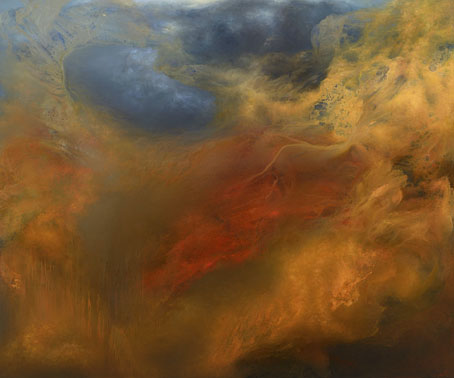
Manifold (2015), a painting by Samantha Keely Smith which will appear in April on the cover of Life Metal, a new album by Sunn O))).

• At Expanding Mind: Professor and queer historian Heather Lukes talks with Erik Davis about Silver Lake riots, gay bikers, house ball scenes, the nostalgia for repression, and the joys and challenges of working on the online archive The Grit and Glamour of Queer LA Subculture.

• A Stroke of Ingenious: Chatting Fear and Fantasy with Darius Hinks.  Also this week, Darius Hinks’ The Ingenious (for which I created the cover art) was featured in a Barnes & Noble list of seven attractive (if hazardous) fantastic cities.

• “From the late ’60s and through the ’70s broadcasters invested in home-grown kids’ television, and much of it was decidedly weird.” Paul Walsh on the vanished, thought-provoking strangeness of British TV.

That late surrealism still needs rescuing by curators and critics is perhaps not a sign of its defeat but of the breadth and pervasiveness of its triumph. Could we have Pablo Picasso or Jackson Pollock without surrealism? What about David Lynch, JG Ballard or Angela Carter? As an influence, it’s easy to give [Dorothy Tanning] a crucial place in the canon of feminist art. Louise Bourgeois was born just a year later than Tanning but only started to sew after Tanning had exhibited her first sculptures.

Lara Fiegel on the weird, wild world of Dorothea Tanning

• After its own death / Walking in a spiral towards the house by Nivhek, a new album from Liz Harris (Grouper) “recorded using Mellotron, guitar, field recordings, tapes, and broken FX pedals”.

• At Dangerous Minds: Michael Rother (Neu!/Harmonia) on the forthcoming reissue of his solo albums from the 1970s.

• Clesse by Clesse, another pseudonymous musical project by Jon Brooks (The Advisory Council et al).

• After Dark: The art of life at night—and in new lights by Francine Prose.

• Elena Lazic on where to begin with Gaspar Noé.

• Mix of the week: Headlands by David Colohan.

• Steven Heller‘s confessions of a letterhead.

• RIP Albert Finney.

• Void (2009) by Monolake | Void (2013) by Emptyset | Void (2014) by The Bug feat. Liz Harris

Weekend links 450

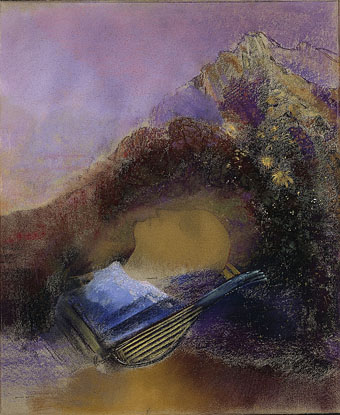
redon.jpg

Orpheus (c. 1903–1910) by Odilon Redon. One of 30,000 public-domain images from the Cleveland Museum of Art’s collection.

• Network DVD has announced the premiere home release of Orson Welles’ Great Mysteries, a British TV series that ran from 1973 to 74. Welles’ involvement was limited to introducing each episode but the series itself was one I enjoyed a great deal: 26 short adaptations of period mystery stories that featured a wealth of British and American acting talent. The theme by John Barry was an additional bonus.

• The trailer for Apollo 11, a documentary by Todd Douglas Miller which presents for the first time the 70mm footage recording the Earth-bound parts of the Moon mission. Related: Michelle Santiago Cortés on how NASA used art to shape our vision of the future.

• At Dangerous Minds: a preview of Third Noise Principle, the latest in an excellent series of electronic music compilations from Cherry Red, and Cosey Fanni Tutti talks about her first solo album since 1983.

“The way I understood theory, primarily through popular culture, is generally detested in universities,” Mark [Fisher] told me in 2005, when I interviewed him for the Village Voice. “Most dealings with the academy have been literally clinically depressing.” He darkly surmised that his blog, K-Punk, and the surrounding blogosphere, “seemed like the space—the only space—in which to maintain a kind of discourse that had started in the music press and the art schools, but which had all but died out, with appalling cultural and political consequences.” Mark and the Village Voice are both dead now, leaving unfathomable voids in their wake.

Geeta Dayal on Mark Fisher

• At The Witch Wave: Peter Bebergal and Pam Grossman discuss Bebergal’s latest book (also my current reading), Strange Frequencies: The Extraordinary Story of the Technological Quest for the Supernatural.

• At Bandcamp: another release from the retro-synth cosmos of Jenzeits, and Ufology , an investigation of Britain’s flying-saucer landscape by Grey Frequency.

• Surprising collaboration of the week: Beth Gibbons and Krzysztof Penderecki have made a new recording of Henryk Górecki’s Third Symphony.

• Alchemy (1969) the debut album by the Third Ear Band, receives an expanded reissue next month.

• The Burn: a science-fiction story by Peter Tieryas with illustrations by Arik Roper.

• Mix of the week: Self-Titled Needle Exchange 275 by Black To Comm.

• Amy Turk plays Bach’s Toccata and Fugue in D Minor on her harp.

• Chrismarker.org is seeking donations.

• Mystery Train (1955) by Elvis Presley | Mystery R.P.S. (No 8) (1981) by Holger Czukay, Jah Wobble, Jaki Liebezeit | Mystery Room (1985) by Helios Creed

Weekend links 449

orpheus.jpg

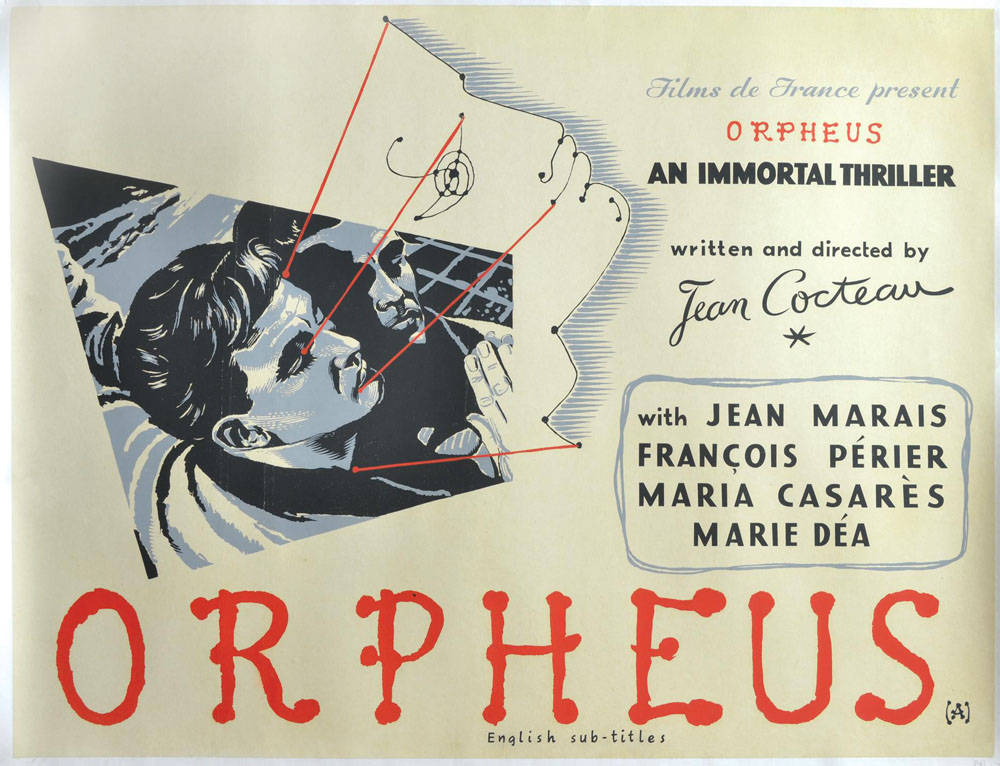
UK poster, 1950. Cocteau’s film receives a UK blu-ray release this week.

• Into the Zone: 4 days inside Chernobyl’s secretive “stalker” subculture by Aram Balakjian. (Again. There’s an implication in Balakjian’s piece that illicit Chernobyl tourism is a new thing even though people have been doing this for a while now.) Related: Jonathan’s visit to the Chernobyl reactor control room, and photos of Soviet-era control rooms (plus a couple of stray American examples).

• “He’s a very interesting author: a disabled, gay writer during the Third Reich…who somehow survived only to be shot by a Red Army patrol days before the end of the war.” At the Edge of the Night (1933) by Friedo Lampe will receive its first English-language publication via Hesperus Press next month.

• “The tradition of the painted still life has been reinvented by contemporary photographers with pictures that pose a puzzle and slow the viewer down,” says Rick Poynor.

• Comic artist Matt Howarth has been writing short reviews of electronic music for many years. Sonic Curiosity is his archive site.

• Bauhaus at 100: what it means to me by Norman Foster, Margaret Howell and others.

• RIP Jonas Mekas. Related: a conversation between Jonas Mekas and Jim Jarmusch.

• Beyond the Buzzcocks: Geeta Dayal remembers Pete Shelley‘s electronic side.

• Where to begin with Jean Cocteau: Alex Barrett goes through the mirror.

• Mix of the week: Secret Thirteen Mix 278 by Sarah Louise.

• At Dennis Cooper’s: Jud Yalkut Day.

• Undulating Terrain (1995) by Robert Rich & B. Lustmord | Darkstalker (2000) by Bohren & Der Club Of Gore | Stalker Dub (2012) by John Zorn

Weekend links 448

becher.jpg

Gas Tanks 1965–2009 by Bernd Becher and Hilla Becher.

• At Dangerous Minds: the drawings produced by Moebius for Maxwell House in 1989 are better than the coffee whose sales they were intended to assist.

• Jarman Volume 2: 1987–1994, the BFI’s second collection of Derek Jarman films, is now available for pre-order.

• More Gorey: Cara Giaimo on Edward Gorey’s hoards and collections.

That movie [Susan Slade]—and I even have the paperback novelization of it—is a moment. That’s a perfect example. They would never release that image as a still of the movie. Come see a baby catch on fire! To me, I’m kind of rewriting the films as these scenes. That was a real shock to me as a teenager when I saw that. And I thought, Did that just happen? Her baby caught on fire? I remember in Serial Mom I had a big fight with a film executive who said that you can’t have her set her kid’s friend on fire. You can’t do that. And I said, “Why, it’s been in movies forever.” And I’m thinking of Susan Slade, but I’m thinking there’s no point using that in the argument.

John Waters talking to Gina Telaroli about his films but mostly about his works for the art gallery

• Georgina Guthrie on how green became cinema’s loneliest colour.

• Tom Crewe reviews Edward Burne-Jones at Tate Britain.

• Mix of the week: FACT Mix 688 by Steve Hauschildt.

• At Strange Flowers: 19 books for 2019.

• Jenzeits Cosmic Worlds by Jenzeits.

• Green Onions (1962) by Booker T. & The MGs | Green (1966) by Ken Nordine | Green Fuz (1969) by Randy Alvey And The Green Fuz