Doublevision Presents Cabaret Voltaire

cvdv1.jpg

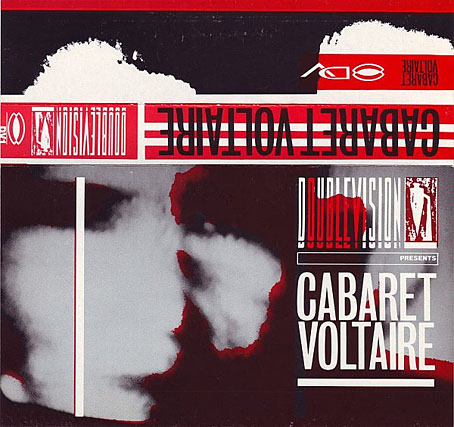
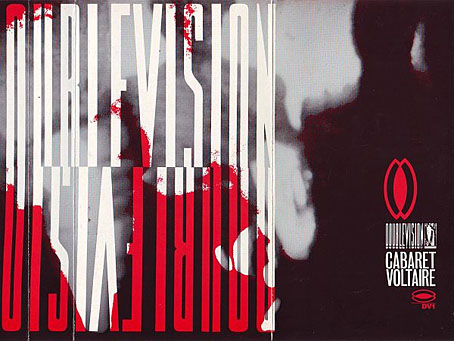
Videocassette box insert. Design by Neville Brody.

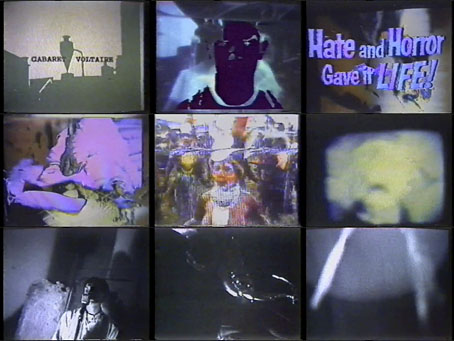
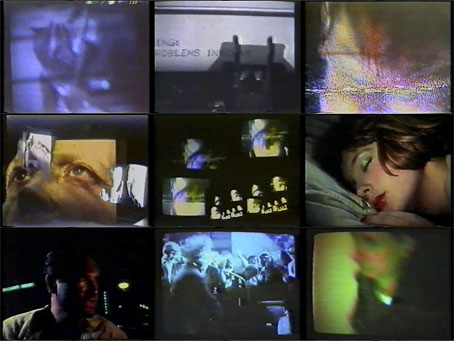
A couple of years back I tracked down some of the releases on Cabaret Voltaire’s Doublevision video label, the early titles of which have never been reissued on DVD. The first Doublevision release was the Cabs’ collection of their own music videos which Mute Records reissued on DVD 2004. That reissue seems to be deleted for the moment so it’s good to find a copy of the original tape release on YouTube. As with the other Doublevision releases I was well aware of this but didn’t have a VHS player at the time so wasn’t eager to buy anything I couldn’t watch. Unlike the other releases I did get to see several of the tracks during the Cabs’ Doublevision video night at the Haçienda in 1983, an evening that ended with the group performing for an hour.

cvdv2.jpg

It’s good to be reminded of these videos, however crude they appear today. As with any early use of technology you need to bear in mind the limitations of the time. The tape was released in 1982 but the group had been experimenting with video equipment from about 1979 onwards. At that time commercial music video was just getting started but most of the examples on TV were paid for by the big record companies. Cabaret Voltaire and some of their associates in the UK Industrial scene—notably Throbbing Gristle and 23 Skidoo—were ahead of the game in acquiring equipment to make their own video recordings and promos. These videos were seldom shown on mainstream TV; I recall being thrilled to see a clip from the Nag, Nag, Nag promo on a pop programme but that was a rare one-off moment. The music industry was being forced to accommodate the awkward DIY merchants but the gates of broadcast television remained heavily policed.

cvdv3.jpg

And speaking of heavy policing, you get some of that here, the Cabs’ obsessions with coercion and control being illustrated by footage of riot squads, together with religious mania, medical surgery, psychotronic films and much else, all of it processed, fragmented and distorted. Direction was by the group and by St. John Walker, with an extract from Johnny YesNo (recently reissued by Mute) directed by Peter Care. I’ve been listening to Seconds Too Late a lot this week so it’s great to see a video for that song. There’s also a slight conundrum in the tracklisting: if you’re familiar with the free four-track single that came with The Crackdown album it seems that Badge of Evil and Moscow have had their titles swapped. The Moscow video track, however, includes a shot of an Aeroflot passenger plane so it’s more likely that the tracks on one side of the single were mis-labelled when they appeared a year later, an error carried over to the CD release.

Tracklist: Diskono / Obsession / Trash (Part 1) / Badge Of Evil / Nag, Nag, Nag / Eddie’s Out / Landslide / Photophobia / Trash (Part 2) / Seconds Too Late / Extract From Johnny YesNo / Walls Of Jericho / This Is Entertainment / Moscow

cvdv4.jpg

Previously on { feuilleton }
Just the ticket: Cabaret Voltaire
European Rendezvous by CTI
TV Wipeout
Seven Songs by 23 Skidoo
Elemental 7 by CTI
The Crackdown by Cabaret Voltaire
Network 21 TV

Just the ticket: Cabaret Voltaire

cv01.jpg

The current issue of The Wire has a great appraisal by Keith Moliné of the musical history of Cabaret Voltaire, a well-timed piece given the recent announcement of forthcoming reissues from Mute Records. Having been a Cabophile from the start I’m rather biased, but the Wire piece has had me listening to the early albums and singles this week (between bouts of Zdenek Liska), and finding the passage of time has made those early recordings seem increasingly strange. Cabaret Voltaire were one of the few groups I liked obsessively enough to collect ephemera from newspapers and magazines. Knowing this, a friend gave me this curious fanzine/ticket from a gig the group played in Liverpool in February, 1981. The venue was Plato’s Ballroom at Pickwicks, and judging by the wording inside—”A Plato’s Publication”—it seems it was the venue’s idea to make the ticket a small (10.5 x 15 cm) booklet.

cv02.jpg

What’s surprising about this is that the fanzine the ticket is bundled with has nothing at all to do with music (or that other perennial of 80s post-punk culture, left-wing politics) but is a glimpse of life as a gay man in Liverpool. I’ve always found this fascinating for the daring it took to foist the thing on a bunch of unwitting Cabs fans, most of whom would have been straight men and not especially sympathetic to the subject matter. In the context of 1981 forcing people to look at grainy shots of naked men with accompanying text (by another man) declaring them to be a turn-on was a transgressive act. The only representations of anything gay in the popular media were a few camp (and therefore safe) comedians; Derek Jarman was still an underground figure, and as late as 1984 a BBC play about gay men was prefaced with a warning about its “contentious” subject.

cv03.jpg

I’ve no idea who was responsible for the fanzine, there are no credits, and it’s possible that the people involved didn’t want to be too easily identified. If the tone of the writing seems rather dramatic then, again, it’s important to see it in context of a country which wasn’t much more amenable to gay people than Russia is today. Saying things in public that most people didn’t want to hear was a challenging act; emotions often ran high.

cv04.jpg

Looking for information about the gig turned up this newspaper ad. (Who were Jell and Aardvarks, I wonder?) By an odd coincidence only the day before I’d found this upload from the same person of a very scarce compilation tape that happens to be from the same year, and which features contributions from Cabaret Voltaire’s Chris Watson and Richard Kirk. The Men With The Deadly Dreams was compiled by Geoff Rushton, aka John Balance of Coil, and was apparently limited to 200 copies. Among the other highlights there’s a track from Eyeless in Gaza, whose early work I like a great deal, and an electronic piece by Throbbing Gristle’s Chris Carter which I think is exclusive to this collection. Two artefacts—fanzine and tape—with brown paper covers that give a snapshot of Britain’s underground culture in 1981.

cv05.jpg

Continue reading “Just the ticket: Cabaret Voltaire”

Weekend links 173

orszag.jpg

Icarus (1974–75) by Lili Ország.

• The Cabaret Voltaire albums released on the Virgin label in the 1980s have suffered the same shoddy treatment on CD as other Virgin reissues, a situation to be rectified in November with an extensive revisiting of the CV back catalogue. The long-overdue reappraisal will also include the release of Earthshaker, a collection of previously unavailable recordings from the Virgin period.

• It’s that book again: Design Observer has the preface from Lolita — The Story of a Cover Girl: Vladimir Nabokov’s novel in art and design, a book by John Bertram and Yuri Leving. At The Millions John Bertram talks to designer John Gall about the problems Lolita poses for cover designers.

• Jerry Lewis’s The Day the Clown Cried (1972) has acquired legendary status over the years for the apparent tastelessness of its subject matter—a clown in Auschwitz—and the fact that its director/star has never allowed the film to be seen in public. This week some footage arrived on YouTube.

Candy Bullets And Moon (1967), a one-off psychedelic collaboration between Don Preston and Meredith Monk.

• What’s the collective term for many bookshops? Whatever it is, there’s a lot of them in this Pinterest collection.

• At Dangerous Minds: Artist Gail Potocki’s exploration of Alice in Wonderland and the passing of time.

Anne Billson on the late Karen Black and why horror movies deserve our respect.

Tobias Carroll on the Surreal life and fiction of Leonora Carrington.

More details emerge about The Wicker Man – The Final Cut.

• Issue 35 of Arthur Magazine is now available for order.

• Graphics, drawings and collages by Jan Švankmajer.

• Every film poster designed by Saul Bass.

• Cabaret Voltaire: Just Fascination (1983) | Sensoria (1984) | I Want You (1985)

Ralf and Florian

randf.jpg

Ralf and Florian, 1973. Back cover photo by Barbara Niemöller.

Kraftwerk’s third album, Ralf and Florian, is forty years old this year. It was recorded and mixed from May to July, 1973, and released three months later. As with the first two Kraftwerk albums, it still hasn’t been given an official CD reissue. When so many albums by the big names of the 1970s have been reissued multiple times Kraftwerk are pretty much unique in suppressing part of their catalogue.

raf.jpg

Photo by Robert Franck.

The reason usually given for this is that the fourth album, Autobahn (1974), was the first to adopt the conceptual style that became a hallmark of the group’s output. Well, yes and no. The celebrated sleeve design for Autobahn went through several variations, and the motoring theme only applies to the first side of the album. The second side doesn’t match the theme at all, and with its melodies and instrumentation (Florian was still using his flute) is much closer to the previous albums, especially the third one, than those that came after. What Kraftwerk prefer to see as a clean break is really more of a gradual evolution.

randf.jpg

The sleeve for the first UK release. No designer credited.

I’ve always liked the Ralf and Florian album, and don’t mind so much that it’s not been given a proper reissue. Bootleg copies circulate, and even the original vinyl isn’t so scarce. A couple of things related to the album are more difficult to find, however. The first German copies came with a large poster-insert illustrated by the group’s artist/designer Emil Schult. This item more than anything shows a charming, human side to Ralf and Florian which was later overshadowed by the machine-obsessed conceptualism. Large scans of the insert were recently posted at Mostly Retro.

kohoutek.jpg

Then there’s Kohoutek – Kometenmelodie, a 7-inch single released in December 1973 which forms a bridge between the third and fourth albums. Kometenmelodie subsequently appeared in two versions on Autobahn but the single sleeve is very much in the R&F zone with the faces from the album cover, while the back of the sleeve sports Emil Schult’s Kling Klang Verlag logo from the album insert. Kohoutek was a comet visible in the night skies in 1973. This was Kraftwerk’s debut single, presenting two unique versions of Kometenmelodie. It’s never been reissued but both tracks can be heard here. Elsewhere on YouTube there’s a performance of the R&F track Tanzmusik on a German TV programme, a clip which features new group member, Wolfgang Flür, playing his electronic drum pads.

Previously on { feuilleton }
Reworking Kraftwerk
Autobahn animated
Sleeve craft
Who designed Vertigo #6360 620?
Old music and old technology
Aerodynamik by Kraftwerk

Tonto’s expanding frog men

tonto.jpg

I wasn’t going to write about album cover art three times in a row but things keep catching my attention this week. Anyone interested in the history of electronic music knows the name Tonto’s Expanding Head Band, the duo formed by Malcolm Cecil and Robert Margouleff to create music with Cecil’s huge, custom-built TONTO (The Original New Timbral Orchestra) synthesizer. Cecil and Margouleff recorded two albums together: Zero Time (1971) and It’s About Time (1974), the latter credited to Tonto only. Zero Time was incredibly advanced for 1971, not classical adaptations like those being produced by Wendy Carlos and her many imitators, but all-original pieces created polyphonically, a feat that only the TONTO synth could easily achieve.

Given how successful the album is musically I’ve always thought it a shame that the sleeve art, inside and out, was the kind of amateurish “psychedelic” doodling that you find on many albums of this period. The design above was for a 1975 reissue, something I’d not seen before. The artist was illustrator Jeffrey Schrier who has a small, and no doubt incomplete, listing at Discogs with nothing similar to this in evidence. At a guess I’d say the evolving frog men are derived from the lyrics of Riversong, a meandering piece with singing processed via early vocoder-style technology, something that Wendy Carlos was also experimenting with. It’s not all hippy ambience: Jetsex sounds like an outtake from Kraftwerk’s Autobahn (albeit three years early) while Timewhys wouldn’t have been out-of-place on The Human League’s Travelogue album almost a decade later. Easy to see why Stevie Wonder and others were eager to work with Malcolm Cecil throughout the 1970s.

Elsewhere on { feuilleton }
The album covers archive

Previously on { feuilleton }
A Clockwork Orange: The Complete Original Score