Weekend links 181

eye.jpg

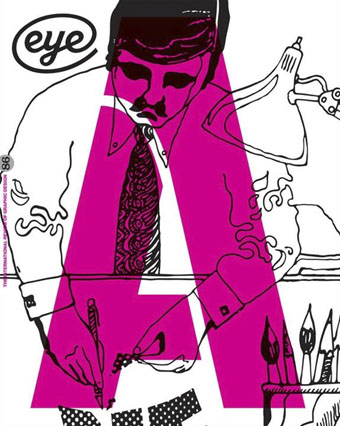
Cover of Eye no. 86 vol. 22, 2013, a type special. Detail from 1970s Letratone brochure, overprinted by character from the Marsh stencil alphabet.

The new edition of Eye magazine includes my essay on the evolution and aesthetics of steampunk. In the same issue Rick Poynor’s feature on the prints of Eduardo Paolozzi mentions a forthcoming book by David Brittain about the artist’s associations with New Worlds magazine in the 1960s. I designed the Paolozzi volume which will be published by Savoy Books in a few weeks’ time. More about that later.

Still on steampunk, KW Jeter notes its popularity among the younger crowd: “If some old fogey peering through his smudged bifocals can’t discern the cool and important stuff going on, such as the tsunami of anarchic multiculturalists using the steampunk scalpel to dissect the past and reassemble it like a two-dollar watch, that’s his loss; the readers are picking up on it.”

• Musicians interviewed: Rhys Chatham: “The reason I got into trumpet playing is because I wanted to play like [Black Sabbath guitarist] Tony Iommi.” | James Ginzburg: “One of the strongest feelings I had was that the act of sitting down and making dance music was like playing a video game…I felt disconnected from it…” | Julia Holter: “I love working with the voice, I love mystery, I love creating atmosphere.” | Roly Porter: “I sit at home and listen to folk and blues from before I was born. I listen to a lot of dub and reggae and classical music. These are all genres which to me seem really interlinked and influential.”

• At Kickstarter: From the director of Lovecraft: Fear of the Unknown, a short film entitled Do Not Disturb. “Two men are forced to share a motel room on a dark & stormy night. One man’s snoring starts to summon creatures into our world.”

The Notting Hill of the 1960s – with Moorcock’s marriage, children, celebrity, the editorship of New Worlds, the collaboration with JG Ballard, Brian Aldiss and the rest – became the proving ground for the shape-shifting Carnaby Street dandy Jerry Cornelius. But all the numerous Moorcock characters, those undying and born-again clones, have a part to play in his “multiverse”, a concept he developed alongside the earlier model suggested by John Cowper Powys. Moorcock’s astonishing catalogue of speculative fiction works to prove his key equation, which is based on meta-temporal parallel worlds drawn from HG Wells, Chaos Theory, String Theory, the Edgar Rice Burroughs of John Carter of Mars and the William Burroughs of Nova Express and the “Interzone”. Publishing all the strange rafts and pods of Moorcock’s prodigious science fiction and fantasy output, as Gollancz have done, is like assembling a ghost fleet, under the joint command of Dr John Dee and Admiral John Ford, with which to invade that uncertain continent we know as the past.

Iain Sinclair on the new series of Michael Moorcock editions from Gollancz.

• “What does science tell us about the relative dangers of drugs? Alcohol is by far the No. 1 most dangerous drug.” Some graphs from the American Enterprise Institute who no one would accuse of being a bunch of stoners.

• “I loved Eudora Welty, Flannery O’Connor, Katherine Ann Porter, Carson McCullers. There was a feeling that women could write about the freakish, the marginal.” Alice Munro at The Paris Review.

Elena Smith on Literary Parkour: @Horse_ebooks, Jonathan Franzen, and the Rise of Twitter Fiction. Related: Boris Kachka has a list of Everything Jonathan Franzen currently hates.

• Mixes of the week: Joseph Burnett compiles Adventures in Modern Jazz while Kier-La Janisse puts together a British Horror mix for Fangoria.

Explore the planet Mars, one giant image at a time.

• At BibliOdyssey: The Turner’s Manual.

A Crimson Grail (for 400 Electric Guitars) (2007) by Rhys Chatham | Arrakis (2011) by Roly Porter | City Appearing (2013) by Julia Holter | Debris (2013) by Faint Wild Light
Weekend links 180

andrew.jpg

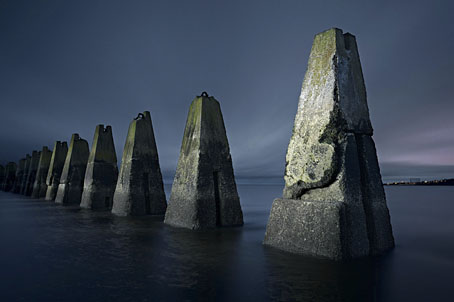
One of Jonathan Andrew‘s photos of coastal bunkers and concrete defences from the Second World War. In 2006 JG Ballard looked at the way these structures embody the functional nature of Modernist architecture.

• “Utamaro, whose prints of famous courtesans were regarded as the very models of sober beauty by 19th-century Western collectors, in fact produced more Shunga books and albums than non-erotic works.” Adrian Hamilton on the Shunga: Sex and Pleasure in Japanese Art exhibition.

• “…in Samoa, as in many traditional cultures around the world, androphilic males occupy a special transgendered category.” Alice Dreger on gay male couples and evolution.

• Robert Fuest’s film of Michael Moorcock’s first Jerry Cornelius novel, The Final Programme (1973), is out on (Region 2) DVD this month.

Masked by reticence and cloaked in tweeds, [Herbert] Read was the unexpectedly ardent and frighteningly prolific champion of nearly everything that was radical in the first half of the twentieth century: Imagism, Surrealism, abstraction, the Bauhaus, Marxism, anarchism, Freud and Jung, progressive education, Gandhian nonviolent resistance. Though now somewhat dimly remembered, he was, for decades, the Victoria Station of the arts, England’s primary explainer of the modern.

Eliot Weinberger introduces Herbert Read’s strange fantasy novel, The Green Child (1935).

• KW Jeter’s steampunk novel Fiendish Schemes is published (with my cover art) by Tor on the 15th. There’s an extract here.

• Mix of the week: An early Halloween mix (and interview) from Joseph Stannard of The Outer Church.

• At Dangerous Minds: Codex Seraphinianus: A New Edition of the Strangest Book in the World.

A trailer for the forthcoming Blu-ray release of Murnau’s Nosferatu: A Symphony of Horror.

• Kenneth Halliwell: lover, killer… artist? Philip Hoare on the collages of Joe Orton’s partner.

• Clive Hicks-Jenkins looks back at Cocteau’s La Belle et la Bête here, here and here.

Anastasia Ivanova‘s photo portraits of lesbian couples in Russia.

Christopher Fox on electronic music’s sound of futures past.

• At Strange Flowers: Melchior Lechter’s book designs.

Vaughan Oliver‘s favourite 4AD album covers.

Swinging Sixties Japanese film posters.

John Foxx’s favourite albums

Beauty And The Beast (1977) by David Bowie | Slow Motion (1978) by Ultravox | I Am The Green Child (2000) by Coil

Stone Tapes and Quatermasses

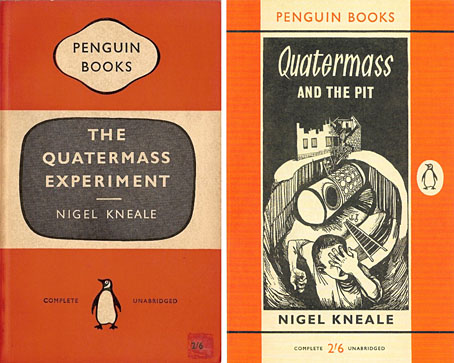
penguin.jpg

Quatermass paperbacks from Jovike’s Flickr pages.

This may be another occasional series in the making since there’s already been a post about Roadside Picnic/Stalker music, and one about music inspired by the cosmic horror of William Hope Hodgson. I was going to write something earlier this year about music derived from the works of Nigel Kneale after rewatching all of Kneale’s major works. The reappraisal was prompted by the publication in January of The Twilight Language of Nigel Kneale, an excellent anthology of essays/speculations (and a China Miéville interview) about Kneale’s film and TV dramas. The delay in writing was a result of having to wait several months after ordering a CD of the Tod Dockstader album (see below) which for some reason the distributors couldn’t manage to get in the post.

In the Twilight Language book there’s a piece by Ken Hollings about electronic music, some of which has material connections with Kneale’s work, notably the Radiophonic Workshop’s creation of sound effects for Quatermass and the Pit. Early copies of the book came with a bonus cassette tape of Kneale-inspired music; more about that below. The men and women of the Radiophonic Workshop are the godparents of the following Kneale soundworks, most of which are British, and inevitably tend towards the grinding, droning and doom-laden end of the electronic spectrum. Given the enduring influence of Kneale’s work, especially the Quatermass serials and their film equivalents, it’s surprising there isn’t more Knealesque music to be found. (I’m avoiding the obvious film soundtracks, and any bands such as Quatermass who may be named after Kneale’s work but whose music doesn’t reflect it.) If anyone can add to this list then please leave a comment.

quatermass.jpg

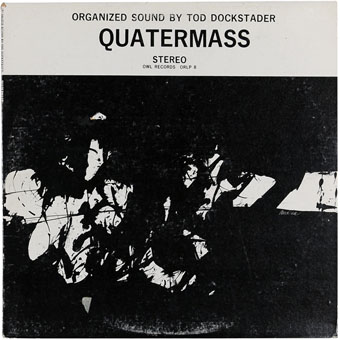
Quatermass (1964) by Tod Dockstader

The American master of tape manipulation here processes hours of recordings of cymbals, pipes, tone generators, a vacuum hose and rubber balloons to create what he calls “a very dense, massive, even threatening work”. Dockstader hadn’t seen any of the Quatermass films or serials when he chose the name but he said that it sounded right. It certainly does, as does the unnerving, shrieking morass of sound he manages to craft using the most primitive equipment. The Starkland CD containing the Quatermass suite includes two further edits of the source material entitled Two Moons of Quatermass.

seance.jpg

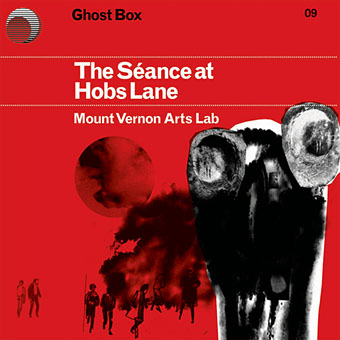
The Séance At Hobs Lane (2001) by Mount Vernon Arts Lab

Mount Vernon Arts Lab is Drew Mulholland and various collaborators. The Séance At Hobs Lane is an abstract concept album based on Mulholland’s lifelong obsession with Quatermass and the Pit (an idée fixe he writes about in the Twilight Language book), plus “Victorian skullduggery, outlaws, secret societies and subterranean experiences”. Among the collaborators are Coil, Norman Blake of Teenage Fanclub, Barry 7 of Add N to (X), and Adrian Utley of Portishead. The album was reissued in 2007 on the Ghost Box label.

ouroborindra.jpg

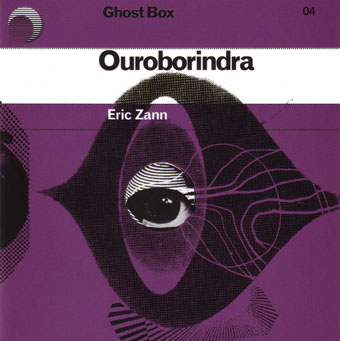
Ouroborindra (2005) by Eric Zann

And speaking of Ghost Box… This album has been mentioned here on several occasions, a one-off release that’s the most consciously horror-oriented of all the works in the Ghost Box catalogue. The artist “name” and track titles reference Lovecraft and Machen but it’s included here for the dialogue quote in the insert from Kneale’s ghost drama The Stone Tape. In addition to the Mount Vernon reissue other Ghost Box references to Kneale can be found in the samples from Quatermass and the Pit (TV version) on The Bohm Site from We Are All Pan’s People by The Focus Group, and the title of the track which follows: Hob’s Rumble. Continue reading “Stone Tapes and Quatermasses”

Weekend links 177

wickerman.jpg

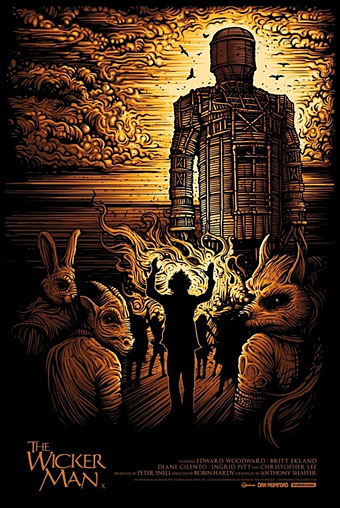
A new Wicker Man poster by Dan Mumford appears on the cover of the forthcoming DVD/BR reissues. Prints are available.

• The long-awaited release of a restored print of Robin Hardy’s The Wicker Man approaches. Dangerous Minds has a trailer while The Guardian posted a clip of the restored footage. The latter isn’t anything new if you’ve seen the earlier uncut version, but the sound and picture quality are substantially better. I’ve already ordered my copy from Moviemail.

• “It’s a fairly bleak place, and it has this eerie atmosphere. East Anglia is always the frontline when there’s an invasion threatening, so there are lumps of concrete dissolving into sand, bits of barbed wire and tank tracks that act as a constant reminder. I really love it.” Thomas Dolby talking to Joseph Stannard about environment and memory.

Dome Karukoski is planning a biopic of artist Tom of Finland. Related: Big Joy, a documentary about the life and work of James Broughton, poet, filmmaker and Radical Faerie.

The desire to be liked is acceptable in real life but very problematic in fiction. Pleasantness is the enemy of good fiction. I try to write on the premise that no one is going to read my work. Because there’s this terrible impulse to grovel before the reader, to make them like you, to write with the reader in mind in that way. It’s a terrible, damaging impulse. I feel it in myself. It prevents you doing work that is ugly or upsetting or difficult. The temptation is to not be true to what you want to write and to be considerate or amusing instead.

Novelist Katie Kitamura talks to Jonathan Lee.

Leonora Carrington: The Celtic Surrealist opens on Wednesday at the Irish Museum of Modern Art, Dublin.

Julia Holter turns spy in the video for This Is A True Heart.

Alexis Petridis talks to graphic designer Peter Saville.

hashim.jpg

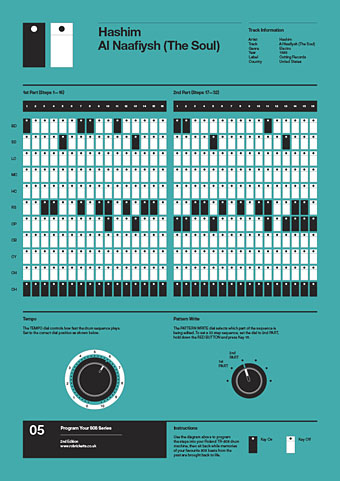
Al-Naafiysh (The Soul) by Hashim. From the Program Your 808 poster series by Rob Rickets.

Rob Goodman on The Comforts of the Apocalypse.

Post-Medieval Illustrations of Dante’s Sodomites.

• Annoy Jonathan Franzen by playing Cat Bounce!

Paolozzi at Pinterest

The Surrealist Waltz (1967) by Pearls Before Swine | The Jungle Line (1981) by Low Noise (Thomas Dolby) | Al-Naafiysh (The Soul) (1983) by Hashim

Weekend links 175

maeda.jpg

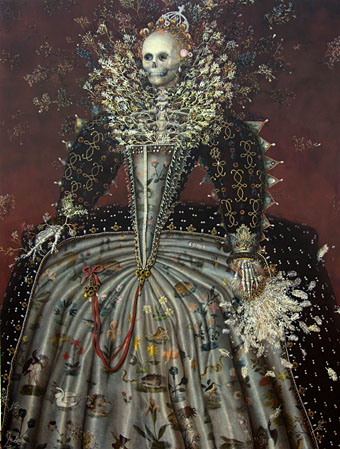
Heartbeat of the Death – Queen Elizabeth the First (2013) by Haruko Maeda.

• “The casual mixing of people from across the world at The Garden broke down many barriers. Its rich, beautiful, smart, and successful people were confident enough to exercise the kind of sexual freedom that would land you in jail elsewhere in the country.” Kate Webb on Alla Nazimova’s Hollywood estate, The Garden of Alla.

• “…from 1956 to 1970 Borges taught English literature at the University of Buenos Aires, and now, over half a century later, one of his courses is finally available in English in a slim, delightful volume.” Will Glovinsky on Professor Borges. Related: Jacob Mikanowski says “To Tlön: Let’s Invade Reality”.

• Mixes of the week: Secret Thirteen Mix 084 by Koen Holtkamp—Alice Coltrane, Alan Watts, John Cage, Popol Vuh, Faust and others—and Sequenze E Frequenze, “the rarefied outer limits of ‘stare at the sun, outsider peaked’ Italian music”.

Consider the fate of the concept of ‘futuristic’ music. The ‘futuristic’ in music has long since ceased to refer to any future that we expect to be different; it has become an established style, much like a particular typographical font. Invited to think of the futuristic, we will still come up with something like the music of Kraftwerk, even though this is now as antique as Glenn Miller’s big band jazz was when the German group began experimenting with synthesizers in the early 1970s.

Where is the 21st-century equivalent of Kraftwerk? If Kraftwerk’s music came out of a casual intolerance of the already-established, then the present moment is marked by its extraordinary accommodation towards the past. More than that, the very distinction between past and present is breaking down. In 1981, the 1960s seemed much further away than they do today. Since then, cultural time has folded back on itself, and the impression of linear development has given way to a strange simultaneity.

Mark Fisher on the present cultural moment, and the weirdness of Sapphire and Steel.

• At Front Free Endpaper: A Gay Library Thing and French Line Gay Pulp Cover Designs. Callum is also giving away books by Frederick Rolfe/Baron Corvo to anyone who asks. The proviso is you write a short review for his blog.

• Film director Ben Wheatley on Don’t Look Now: “I felt a great panic come over me”. Elsewhere it was announced this week that Wheatley is planning a film of JG Ballard’s High Rise.

• Brits may remember the wonderful Laurie Pike from the Manhattan Cable TV show in the early 1990s. These days she’s writing an online guide to the city of Paris.

Ben Frost has made three previously unreleased recordings available at Bandcamp.

The Media History Digital Library: 800,000 pages of film and radio periodicals.

• The results of three derives in London by Christina Scholz here, here and here.

• The late Seamus Heaney reads his own translation of Beowulf here and here.

High Rise (1979) by Hawkwind | Pop Sicle (1994) by High Rise | High Rise (2005) by Ladytron