Weekend links 29

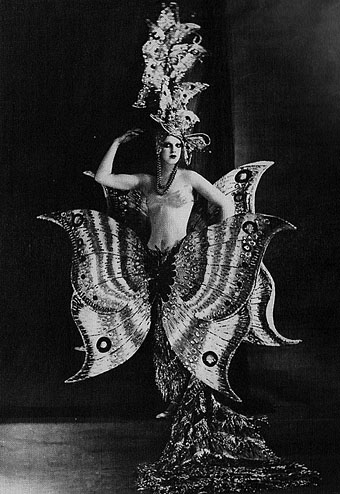
dancer.jpg

A Folies Bergère dancer, c. 1909.

Six Novels in Woodcuts: The Library of America publishes a boxed set of Lynd Ward’s works: Gods’ Man, Madman’s Drum, Wild Pilgrimage, Prelude to a Million Years, Song Without Words and Vertigo.

• RIP ace graphic designer Raymond Hawkey. Related: Raymond Hawkey: An eye for detail, and Hawkey’s James Bond cover designs from the mid-60s.

The Record: Contemporary Art and Vinyl, an exhibition at Duke University, North Carolina, features work by 41 artists from around the world, from the 1960s to the present, using vinyl records as subject or medium.

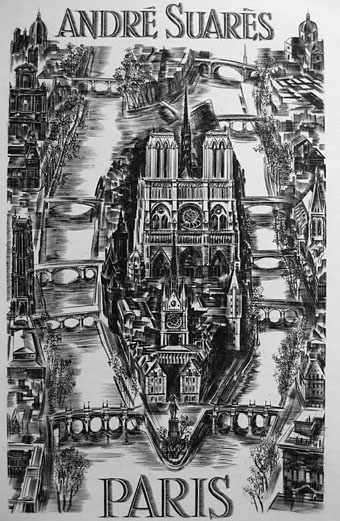
decaris.jpg

The Île de la Cité, a steel engraving by Albert Decaris (1950).

Fred Tomaselli will have a new exhibition of his work at the Brooklyn Museum next month.

Socialist Monuments in Bulgaria photographed by Linda Ferrari.

• What would Howard think of the Mythos Art Dildo?

Space is Process, a film about Olafur Eliasson.

Thurston Moore’s Indie Books.

Chris Colfer in a leather bar.

Ephemeral New York.

• Chrome! Helios Creed’s YouTube channel.

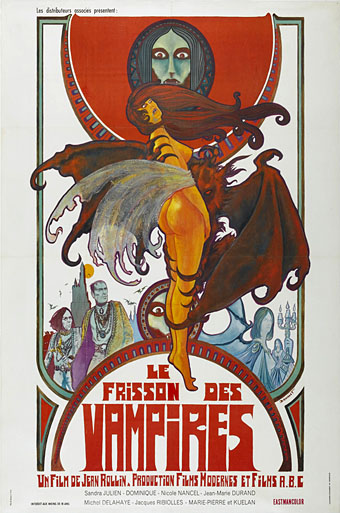
Druillet’s vampires

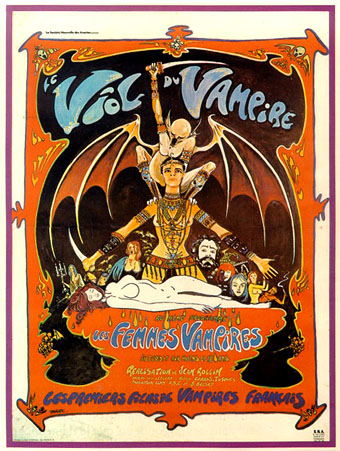
vampire3.jpg

Le Viol du Vampire (1968) or Rape of the Vampire (stay classy, Jean!); re-titled Queen of the Vampires for the Anglophone world.

We’re so inundated these days with vampires and—worse—fucking zombies, that I’ll be perfectly happy if I never see another bloodsucker or shambling corpse again. But let’s overlook the degrading of horror staples for a moment to consider Philippe Druillet‘s excursions into the art of the cinema poster.

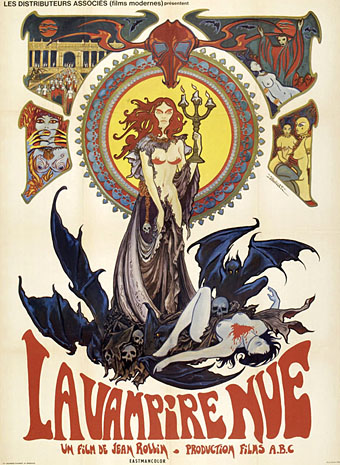
vampire1.jpg

La Vampire Nue (1969).

These pieces are for Jean Rollin‘s first three films, additions to the groovy-lesbian-vampire-with-false-eyelashes-and-bare-boobs sub-genre made at a time—the late 60s—when all the European film studios, Hammer included, were pushing the erotic content of their films more than had previously been dared. Rollin’s erotic comic strip from 1967, Saga de Xam, featured art contributions from Druillet, among others, which no doubt explains the choice of artist. As with David Palladini’s fantastic design for Werner Herzog’s Nosferatu the Vampyre (1979), these are further examples of how unique and distinctive film posters once were in a way they rarely are today. (Druillet, incidentally, produced his own adaptation of Nosferatu in 1989.)

vampire2.jpg

Le Frisson des Vampires (1970).

Pages from the fabulously rare Saga de Xam feature in the Art Nouveau catalogue that was the subject of yesterday’s post. So too does Druillet’s poster for Le Frisson des Vampires although any of these pieces would have made suitable inclusions. Even more than in his comic strips Druillet’s work here shows the overt influence of Alphonse Mucha.

Most of Rollin’s films seem to be available on DVD should you be desperate for some fangs and boobs. I’d much rather see Saga de Xam be reissued; it’s been out of print since 1967 and the copies available go for upwards of £200. This site has samples of the pages and there’s a post about the book (in French) here. For more about Jean Rollin, see Fascination: the Jean Rollin Experience.

Elsewhere on { feuilleton }
The illustrators archive

Previously on { feuilleton }
The Art Nouveau dance goes on forever
Salammbô illustrated
Druillet meets Hodgson
The music of Igor Wakhévitch
Nosferatu

The Art Nouveau dance goes on forever

nouveau1.jpg

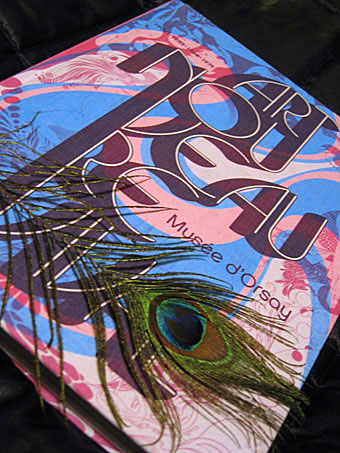
Catalogue for Art Nouveau Revival 1900 . 1933 . 1966 . 1974. Peacock feather not included.

Regular readers may recall my mention of the Musée d’Orsay exhibition Art Nouveau Revival which was launched late last year. I didn’t get to see the exhibition, unfortunately, but this week I finally ordered a copy of the catalogue, an expensive cloth-bound volume with essays (in French) by Philippe Thiébaut, Stephen Calloway, Irene de Guttry, Thierry Taittinger and Philippe Thieryre. Despite the ruinous postal charges incurred by the book’s weight this was worth every euro, it being the kind of polymorphous production which in solipsistic moments one can choose to believe was created solely for your own benefit.

nouveau3.jpg

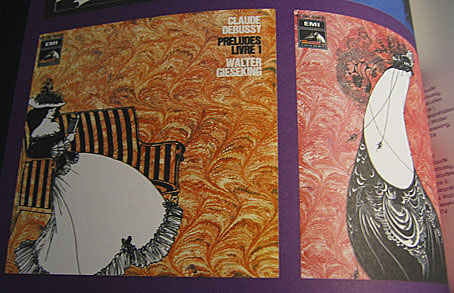
Aubrey again, album covers from 1974.

Much of the subject matter has been explored here in various small ways, with the curators following the influence of Art Nouveau through Surrealism (mainly Dalí) to the psychedelic art of the 1960s and on into the Pop Nouveau (for want of a better term) which flourished in the first half of the 1970s. Among the familiar Aubrey Beardsley graphics and psychedelic posters there are also some pleasantly surprising inclusions, including illustrations by Philippe Jullian (yes, I’m still intending on writing about him at some point), yet more Beardsley album covers, film posters, and even some of the sillier films of the late-60s such as Casino Royale. Being a French exhibition there’s a section devoted to comic strips which includes work by Moebius, Philippe Druillet and Guido Crepax.

nouveau2.jpg

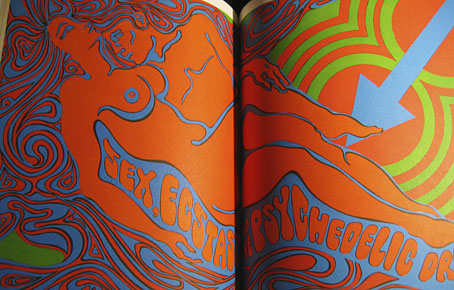
Sex and LSD, a spread from Playboy, 1967.

It’s common to see parallels drawn between the 1890s and the 1960s but the strange blooms of vulgarised fin de siècle style which burgeoned in the wake of psychedelia are seldom given much attention. One of the great things about this catalogue is the amount of ephemera the curators chose to include such as magazine ads and trend-chasing album sleeves. It was precisely this blend of 1890s + 1960s + 1970s I sought to capture in my recent cover for Dodgem Logic. As I said, it’s an expensive book but for anyone drawn to this aesthetic hothouse it’s also an essential purchase. Art Nouveau Revival can be ordered direct from the museum shop. Further samples follow.

Continue reading “The Art Nouveau dance goes on forever”

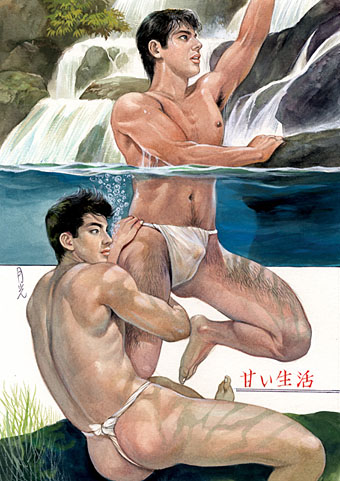
Gekko Hayashi: homoerotics and monsters

gekko1

Needless to say, it’s primarily the homoerotics which concern us here. Gekko Hayashi is the name under which Japanese artist Goji Ishihara (1923–1997) produced his gay erotica, and these examples are among a small handful to be found on the web. Far more common is his Ishihara work which included some spectacular grotesqueries for the Illustrated Book of Japanese Monsters (1972) and the Illustrated Book of Hell (1975). Sate your appetite for the monstrous at Pink Tentacle.

gekko2

Hayashi/Ishihara’s work may be scarce but you can read about both his personas thanks to ComiPress, who posted an overview of the artist’s career, and Comics212, who examined the gay side of his output. There is a book collection of Hayashi’s gay art but that appears to be out-of-print. This Japanese page has many samples from the Ishihara work.

The dual career of Hayashi/Ishihara brings to mind another artist equally adept at commercial illustration and gay art, Oliver Frey. As “Zack”, Frey gained an enthusiastic audience in UK gay mags while he was also popular with quite a different audience for his illustrations in computer game magazines throughout the 1980s. He was also no slouch at painting monsters as I recall. A collection of Zack comic strips, Bike Boy, is published this month by Bruno Gmünder.

Continue reading “Gekko Hayashi: homoerotics and monsters”

Weekend links 25

borgespesos

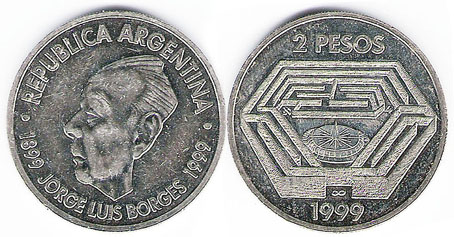
A commemorative Borges coin.

He says, “Two aesthetics exist: the passive aesthetic of mirrors and the active aesthetic of prisms. Guided by the former, art turns into a copy of the environment’s objectivity or the individual’s psychic history.” There, of course, he sums up all of realism, no? “Guided by the latter, art is redeemed, makes the world into its instrument and forges, beyond spatial and temporal prisons, a personal vision.” That’s Borges.

The Borges Behind the Fiction: Colin Marshall talks to translator Suzanne Jill Levine. Related: The Garden of Forking Paths.

• From The Quietus: Blondie in Conversation with William S. Burroughs by Victor Bockris, 1979; An Interview with Laurie Anderson by Robert Barry, 2010.

In 962 Abd-er Rahman III was succeeded by his son Al-Hakim. Owing to the peace which the Christians of Cordova then enjoyed […] the citizens of Cordova, Arabs, Christians, and Jews, enjoyed so high a degree of literary culture that the city was known as the New Athens. From all quarters came students eager to drink at its founts of knowledge. Among the men afterwards famous who studied at Cordova were the scholarly monk Gerbert, destined to sit on the Chair of Peter as Sylvester II (999–1003), the Jewish rabbis Moses and Maimonides, and the famous Spanish-Arabian commentator on Aristotle, Averroes.

Entry for The Diocese of Cordova from The Catholic Encyclopedia (1917).

Professor Newt’s Distorted History Lesson. A riposte to the ignorance of the wretched Gingrich. Related: the Mezquita de Córdoba.

borgeskat

Jorge Luis Borges and a cat. Via.

Joseph and His Friend—A Story of Pennsylvania (1870) by Bayard Taylor, America’s first (?) gay novel. Related: 20 classic works of gay literature.

Elegies For Angels, Punks and Raging Queens at the Shaw Theatre, London, from 10–28 August 2010.

• Tristan Perich’s 1-Bit Symphony is released later this month. Café Kaput’s first release, Electronic Music in the Classroom by DD Denham, appears in September.

• “Just relax and enjoy it.” k-punk on the ambition and vision of David Rudkin’s Artemis 81.

• Chris Watson explores Alan Lamb’s The Wires: three audio recordings to download.

• Jonathan Barnbrook: Tuxedomoon fan, 1988, and Tuxedomoon designer, 2007.

• Rob Young’s Electric Eden reviewed by Michel Faber.

Brian Eno gets the Warp factor.

No Tears (1978) by Tuxedomoon; Atomic (1979) by Blondie; Everything You Want (1980) by Tuxedomoon; Next One Is Real (1984) by Minimal Compact; Hologram (2010) by These New Puritans.