Gekko Hayashi: homoerotics and monsters

gekko1

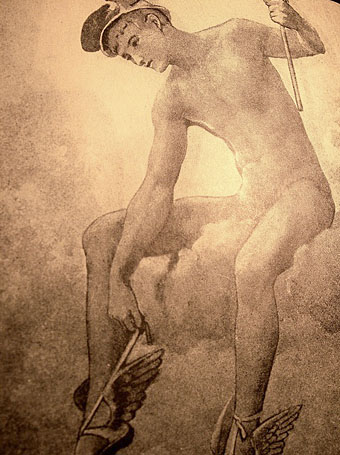
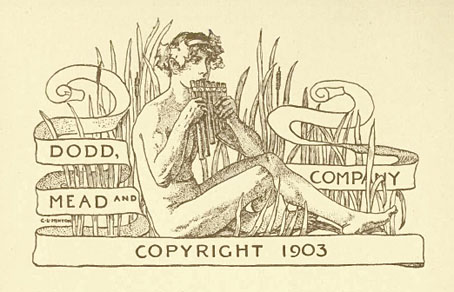
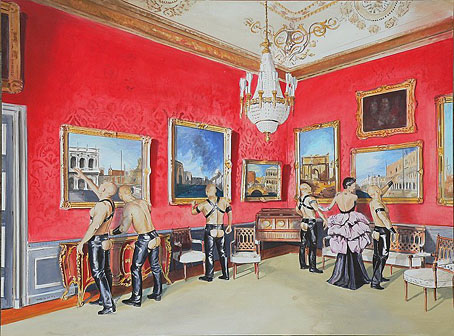
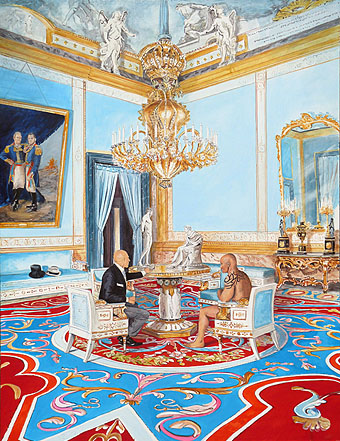
Needless to say, it’s primarily the homoerotics which concern us here. Gekko Hayashi is the name under which Japanese artist Goji Ishihara (1923–1997) produced his gay erotica, and these examples are among a small handful to be found on the web. Far more common is his Ishihara work which included some spectacular grotesqueries for the Illustrated Book of Japanese Monsters (1972) and the Illustrated Book of Hell (1975). Sate your appetite for the monstrous at Pink Tentacle.

gekko2

Hayashi/Ishihara’s work may be scarce but you can read about both his personas thanks to ComiPress, who posted an overview of the artist’s career, and Comics212, who examined the gay side of his output. There is a book collection of Hayashi’s gay art but that appears to be out-of-print. This Japanese page has many samples from the Ishihara work.

The dual career of Hayashi/Ishihara brings to mind another artist equally adept at commercial illustration and gay art, Oliver Frey. As “Zack”, Frey gained an enthusiastic audience in UK gay mags while he was also popular with quite a different audience for his illustrations in computer game magazines throughout the 1980s. He was also no slouch at painting monsters as I recall. A collection of Zack comic strips, Bike Boy, is published this month by Bruno Gmünder.

Continue reading “Gekko Hayashi: homoerotics and monsters”

Weekend links 25

borgespesos

A commemorative Borges coin.

He says, “Two aesthetics exist: the passive aesthetic of mirrors and the active aesthetic of prisms. Guided by the former, art turns into a copy of the environment’s objectivity or the individual’s psychic history.” There, of course, he sums up all of realism, no? “Guided by the latter, art is redeemed, makes the world into its instrument and forges, beyond spatial and temporal prisons, a personal vision.” That’s Borges.

The Borges Behind the Fiction: Colin Marshall talks to translator Suzanne Jill Levine. Related: The Garden of Forking Paths.

• From The Quietus: Blondie in Conversation with William S. Burroughs by Victor Bockris, 1979; An Interview with Laurie Anderson by Robert Barry, 2010.

In 962 Abd-er Rahman III was succeeded by his son Al-Hakim. Owing to the peace which the Christians of Cordova then enjoyed […] the citizens of Cordova, Arabs, Christians, and Jews, enjoyed so high a degree of literary culture that the city was known as the New Athens. From all quarters came students eager to drink at its founts of knowledge. Among the men afterwards famous who studied at Cordova were the scholarly monk Gerbert, destined to sit on the Chair of Peter as Sylvester II (999–1003), the Jewish rabbis Moses and Maimonides, and the famous Spanish-Arabian commentator on Aristotle, Averroes.

Entry for The Diocese of Cordova from The Catholic Encyclopedia (1917).

Professor Newt’s Distorted History Lesson. A riposte to the ignorance of the wretched Gingrich. Related: the Mezquita de Córdoba.

borgeskat

Jorge Luis Borges and a cat. Via.

Joseph and His Friend—A Story of Pennsylvania (1870) by Bayard Taylor, America’s first (?) gay novel. Related: 20 classic works of gay literature.

Elegies For Angels, Punks and Raging Queens at the Shaw Theatre, London, from 10–28 August 2010.

• Tristan Perich’s 1-Bit Symphony is released later this month. Café Kaput’s first release, Electronic Music in the Classroom by DD Denham, appears in September.

• “Just relax and enjoy it.” k-punk on the ambition and vision of David Rudkin’s Artemis 81.

• Chris Watson explores Alan Lamb’s The Wires: three audio recordings to download.

• Jonathan Barnbrook: Tuxedomoon fan, 1988, and Tuxedomoon designer, 2007.

• Rob Young’s Electric Eden reviewed by Michel Faber.

Brian Eno gets the Warp factor.

No Tears (1978) by Tuxedomoon; Atomic (1979) by Blondie; Everything You Want (1980) by Tuxedomoon; Next One Is Real (1984) by Minimal Compact; Hologram (2010) by These New Puritans.

Vintage swordplay #5

vintage.jpg

In honour of the overturning of Prop 8 in California—and because I haven’t posted one of these for a while—another piece of beefy weapon-handling. No idea who this fellow is but he can be seen a lot bigger (if not actually tumescent) at the Haunted Lamp, a place of assorted delights that you really ought to go and browse.

Elsewhere on { feuilleton }
The men with swords archive

Weekend links 24

early.jpg

Delta-Wing (2009) by Chloe Early.

• “Feted British authors are limited, arrogant and self-satisfied, says leading academic”. Stating the bleeding obvious but it still needs to be said, apparently, especially when the announcement of the Booker list this year caused the usual confusion when Amis Jr. and McEwan weren’t included, as though the mere existence of their novels makes them prize-worthy. And as someone pointed out, the word “male” is missing from that headline.

Hero of Comic-Book World Gets Real: Alan Moore again, in the NYT this time. Related: a review of Unearthing live.

• Announcing The Hanky Code by Brian Borland & Stephen S Mills, a 40-poem book to be published next year by Lethe Press. For an explanation of the Hanky Code there’s this, and there’s also an iPhone app.

Folk—the ‘music of the people’—is now hip again, says (who else?) Rob Young who can also be heard on the archived podcast here. Related: the folk roots of Bagpuss. Related to the latter: The Mouse Mill.

zvorykin.jpg

An endpiece from The Firebird and other Russian Fairy Tales by Boris Zvorykin.

‘Yes’ to Catastrophe: Roger Dean, Prog and SF. A lengthy and thoughtful analysis of Roger Dean’s early work.

Into the Media Web, the enormous Michael Moorcock book which I designed, is officially published this week.

Cassette playa: in praise of tapes. I’ve complained about tapes in the past but people continue to find them useful. Some technologies die harder than others.

Boy BANG Boy: “Quiet moments made suddenly very loud with the attitude and opinion of what it means to be a young male in an impossibly diverse world.” An exhibition opening at Eastgallery, London, on August 5th.

Empty your heart of its mortal dream: Alfred Kubin’s extraordinary novel, The Other Side.

Ghostly and Boym Partners devise a new way to deliver digital music.

Besti-mix #27: a great selection by producer Adrian Sherwood.

Agnostics are troublemakers. Amen to that.

• RIP Harry Beckett.

Acousmata.

Let Us Go In To The House Of The Lord by Pharoah Sanders (live, 1971): Part 1 | Part 2

The Lady Is Dead and The Irrepressibles

lady1.jpg

The lady may be dead but the art here is very much alive. The second great video of the week comes via the always essential Homotography, a short piece by director Roy Raz whose film features a pair of tattooed lesbians, a tennis match involving meat (or something), boys stripping out of their underwear to indulge in some peculiar—and for all we know, metaphysical—sexual congress, an elderly lady dancing round a piano, and a gang of luscious hunks who soap a car before sponging down their own bodies.

lady2.jpg

Do we have to worry about What It All Means? Of course we don’t, although the usual crowd of bewildered YouTube commenters struggle with comprehension like medieval rustics attempting to decipher so many signs and wonders. Think of it as the kind of thing Wes Anderson might create if someone dosed him with psychotropic chemicals that also turned him gay.

lady3.jpg

More important for me is the utterly fantastic song which Roy Raz uses, a number entitled In This Shirt by a ten-piece British group, The Irrepressibles, whose name I recognised but whose music I hadn’t heard until this. Lead singer Jamie McDermott’s voice is very reminiscent of Antony Hegarty which is no bad thing, although McDermott is probably weary of the comparison. Our musical culture would be greatly improved by more people taking their lead from Antony. The Irrepressibles’ site has a Soundcloud page where you can hear other songs from their recent Mirror, Mirror album, the CD of which is now on my shopping list. They also have a couple of videos showing their live performances which look rather spectacular. 2010 is turning out to be a good year for British music; when that music comes with cute guys attached it’s an added bonus.

lady4.jpg

Update: Roy Raz’s film is now also on Vimeo with other of his works.