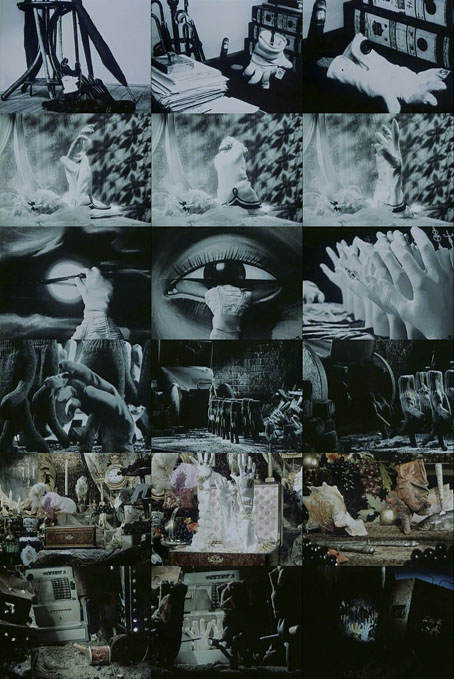
Dom by Walerian Borowczyk and Jan Lenica

dom.jpg

Dom.

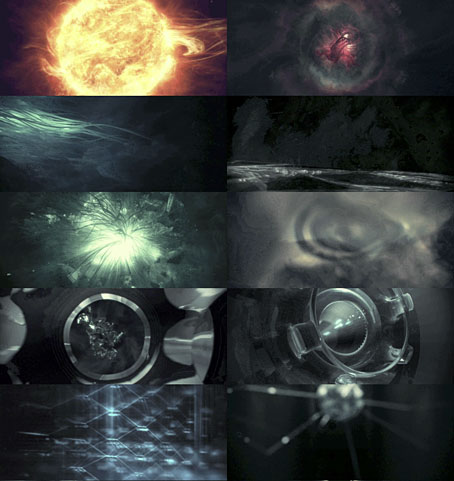
Having referred this week to individual animated films by Borowczyk and Lenica here’s their ten-minute collaboration from 1959. “Dom” means “house”, with the house in question providing a vague framing device for otherwise disconnected episodes, some of which repeat themselves. It’s more of a curio than anything, most interesting (again) for the moments that would be better explored by future directors. In addition to further collage animation there’s a short sequence which gives octopoid life to a human wig that’s very reminiscent of Jan Švankmajer. Watch the whole thing here.

Previously on { feuilleton }
Les Jeux des Anges by Walerian Borowczyk
Labirynt by Jan Lenica
Short films by Walerian Borowczyk

S. Latitude 47°9′, W. Longitude 126°43′

shipattack.jpg

Then, driven ahead by curiosity in their captured yacht under Johansen’s command, the men sight a great stone pillar sticking out of the sea, and in S. Latitude 47°9′, W. Longitude 126°43′, come upon a coastline of mingled mud, ooze, and weedy Cyclopean masonry which can be nothing less than the tangible substance of earth’s supreme terror—the nightmare corpse-city of R’lyeh, that was built in measureless aeons behind history by the vast, loathsome shapes that seeped down from the dark stars. There lay great Cthulhu and his hordes, hidden in green slimy vaults and sending out at last, after cycles incalculable, the thoughts that spread fear to the dreams of the sensitive and called imperiously to the faithful to come on a pilgrimage of liberation and restoration.

HP Lovecraft, The Call of Cthulhu (1928)

“Great Cthulhu and his hordes…” People never mention the hordes, do they? I’m pleased to say that the loathsome horde gathered in my forthcoming Cthulhu Calendar are in situ at last, since I’ve found the time this week to get everything finished. I still need to write a couple of new web pages then upload all the images to CafePress. I’ll be doing that over the weekend so Monday will be the launch day.

For the final piece I decided against doing another portrait in favour of a picture of an attack at sea as it might have appeared in a 19th-century newspaper. This kind of imagery will now make many people think of the Kraken scenes in the second Pirates of the Caribbean film but it predates cinema, of course, as it also predates Lovecraft. Despite Lovecraft’s indelible association with monstrous tentacles there are a lot more incidents of this nature in William Hope Hodgson’s stories and novels than in the Cthulhu Mythos. In which case this scene, which will be the page for December, can be regarded as a tip of the hat to William as much as to Howard.

Elsewhere on { feuilleton }
The Lovecraft archive

Les Jeux des Anges by Walerian Borowczyk

jeux1.jpg

Les Jeux des Anges.

Following yesterday’s post, we can be certain that Terry Gilliam had seen Les Jeux des Anges (1964) because in 2001 he included it in a list of ten favourite animated films. Jan Lenica co-directed Dom (1959) with Walerian Borowczyk but doesn’t work on this film which is the darkest and strangest of all Borowczyk’s works I’ve seen to date. Once again there’s some unavoidable subtext, although whether that applies to the Holocaust or to Stalinist repression is for the viewer to decide. What we see is a series of painted tableaux in which various mechanical processes are butchering angels. The atmosphere isn’t far removed from the cruelties of Roland Topor while the painted scenes are very similar to those that David Lynch would be animating a couple of years later. The soundtrack is credited to electronic composer Bernard Parmegiani. Watch it for yourself here.

jeux2.jpg

Previously on { feuilleton }
Labirynt by Jan Lenica
Les Temps Morts by René Laloux
Short films by Walerian Borowczyk

Labirynt by Jan Lenica

labirynt1.jpg

Labirynt.

One of the links at the weekend was to this post about the favourite Polish posters of the Brothers Quay, a piece which included an example by designer and illustrator Jan Lenica (1928–2001). Lenica, like the Quays, was also a filmmaker who started out by producing short animations, Labirynt (1963) being one of these works. I’d not come across this before but now that I’ve watched it I’d be very surprised if Terry Gilliam hadn’t seen it at some point in the 1960s, the animation of collaged illustrations and hand-tinted photographs from 19th-century sources is precisely the kind of thing that Gilliam was doing a few years later. So is the generally Surrealist atmosphere with a bowler-hatted protagonist being menaced in the street by a host of hybrid creatures, encountering the women one sees in old erotic postcards, being seized by a giant hand, and so on.

labirynt2.jpg

Many Eastern European animations from the Cold War period involve a degree of political allegory, and Labirynt is no exception. One of the menacing figures is a mechanical gentleman who captures Bowler Hat Man and subjects him to a series of forced operations, eventually building a cage inside the captive’s head. Given this, and some opening shots which show Bowler Hat flying over the city using self-powered wings, it’s not stretching a point to see this 13-minute film as Brazil in miniature. Watch it for yourself here.

Previously on { feuilleton }
Brothers Quay scarcities
Gilliam’s shaver and Bovril by electrocution
Short films by Walerian Borowczyk
The Brothers Quay on DVD

Thomas Beg’s Dorian Gray

dorian.jpg

Oscar Wilde’s story in this adaptation is shortened to a very brisk eight minutes which utilises 3D animation and makes some smart use of period photos. The film was an animation project by UCA Rochester student Thomas Beg who also has a brief rendering of Hieronymus Bosch’s Garden of Earthly Delights here.

The collage approach for Dorian Gray caught my attention since it’s not far removed from the collage style I used when adapting the story myself for the forthcoming second edition of The Graphic Canon. My version was in part a formal challenge which tried to use materials from Wilde’s time that also relate in some way to Wilde himself. More about that later. Thomas Beg’s version owes something to Albert Lewin’s 1945 film adaptation, especially in its views of the portrait, but it’s distinctive enough to stand alone. Watch it here.

Elsewhere on { feuilleton }
The Oscar Wilde archive