Watch Repair

watchrepair1.jpg

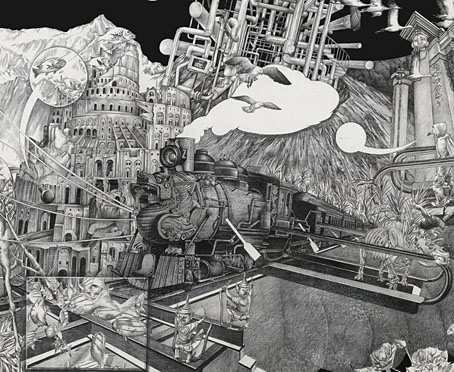
This recent design job is nearing its official release date so I can mention it here. Watch Repair is a limited CD-R release via Manchester’s Ono label. Ono releases tend to be small-run, hand-crafted productions so for this the brief was to design something to fill out a single sheet that would be Risograph-printed then folded around the disc. The music is 37 minutes of guitar improvisation and antique clock sounds wrapped in a reverberant sound design. The detailed attention to spacial effects benefits from headphone listening.

watchrepair2.jpg

The Watch Repair people (who only go by that name occasionally) have a lot more of this music waiting for release. Also waiting in the wings is a superb reworking of some rare recordings made in the 1980s by author Mark Valentine under the name The Mystic Umbrellas. The latter will be of great interest to those who appreciate Xenis Emputae Travelling Band or to anyone who prowls Bandcamp in search of spectral ambiences. Here’s hoping it receives a release soon. Watch Repair may be ordered from Piccadilly Records.

Moravagine book covers

moravagine01.jpg

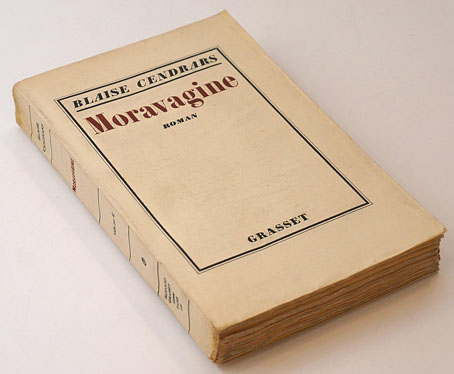
First publication, Grasset, 1926.

I should have liked to open all cages, all zoos, all prisons, all lunatic asylums, see the great wild ones liberated and study the development of an unheard-of kind of human life…

Recent reading was Moravagine (1926) by Blaise Cendrars, a novel that resists easy summary. It’s a Modernist work to some extent although the prose (a good translation from the French by Alan Brown) is never unorthodox in style; it’s also scabrous, amoral, misogynist and deeply misanthropic. The narrative is a picaresque affair narrated by a young doctor who frees the mysterious Moravagine from an asylum where he’s been imprisoned for many years. “Moravagine” is an adopted name whose origin and meaning is never addressed, although a French reader would find a rather unavoidable pun on “death by vagina”. Moravagine himself is an otherwise unnamed member of the Hungarian royal family, a dwarfish intellectual psychopath with a bad leg who goes on the run with the doctor, first to pre-revolutionary Russia, then to the United States and South America.

Reviewers have compared the book to Beckett, Céline and Burroughs although it’s much lighter reading than the first two, and the prose is more coherent than Burroughs in cut-up mode. Since we’ve been hearing a lot about the First World War this year it’s tempting to read the book as a kind of Dadaist reaction to Cendrars’ own experiences in the war, even though the entirety of the conflict is dispensed with in two pages. Cendrars appears as a character in the later chapters; he lost an arm in the war so he has his narrator lose a leg while Moravagine loses his reason altogether. At the end of the book he’s found imprisoned in another asylum where he believes he’s an inhabitant of the planet Mars, and where he spends his last months writing a huge, apocalyptic account of how the world will be in the year 2013.

All this, of course, presents a challenge for a cover designer. I have two Penguin editions, both with very different covers, neither of them unsuitable. Curiosity impelled me to see how the book has been treated since 1926. There aren’t many editions but their difference shows the difficulty of trying to encapsulate the contents of this strange novel in a graphic form. The selection here has avoided text-only treatments in favours of those using some form of illustration.
moravagine05.jpg

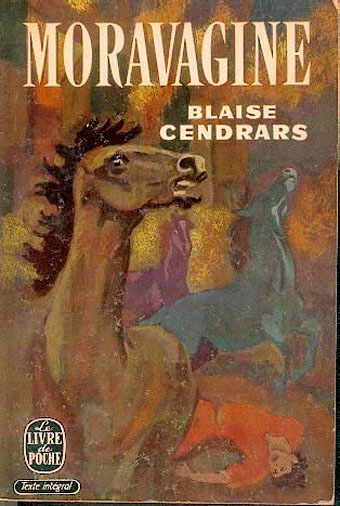
Le Livre de Poche, 1957.

In an early chapter Moravagine describes fleeing the imperial household by strapping himself to a horse. Without knowing this narrative detail the painting here seems bizarrely arbitrary.
moravagine02.jpg

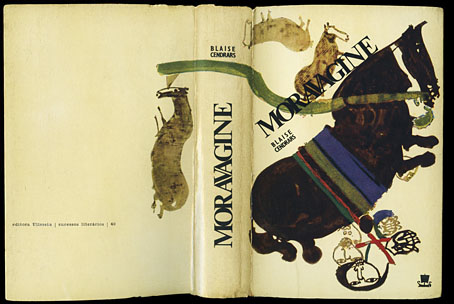
Editora Ulisseia, Portugal, 1966.

The horses again, with Moravagine strapped underneath one of them. I’d guess the illustrators of these two books didn’t read very far.
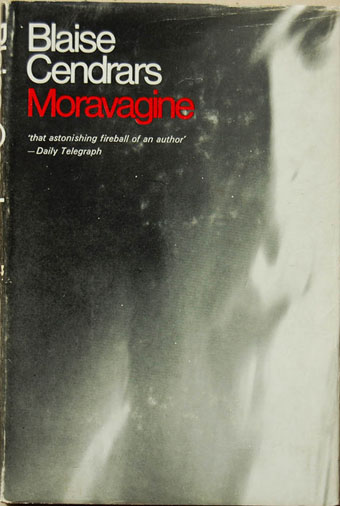
moravagine03.jpg

First UK edition, Peter Owen, 1968.

Peter Owen commissioned the first English translation which is still in use today.

Continue reading “Moravagine book covers”
Weekend links 226

na.jpg

Fly (2012, detail) by Zhao Na.

• This week in psychedelia: the UK now has its own Psychedelic Society (just in time for the mushroom season), and is using some of my psychedelic Wonderland/Looking-Glass artwork for its headers and things. Over at The Quietus John Doran asks what makes music psychedelic in 2014, while a number of the site’s writers offer suggestions for a survey of modern European psychedelia (bonus points for using the alien head from the cover of Heldon 6: Interface at the top of the page).

• Rick Poynor looks at posters by Hans Hillmann for Jean-Luc Godard’s films while at the BFI site four directors pay tribute to Hillmann. “…poster art has stagnated over the last 30 or 40 years,” says Peter Strickland. “It’s an embarrassment for film when one considers how the music industry has completely embraced the graphic form.” Related: lots of Hans Hillmann at Pinterest.

• More psychedelics (and more of the usual suspects), neurologist Andrew Lees on William Burroughs’ experiences with yagé and apomorphine, and DJ Pangburn on a word-search puzzle containing “every word Borges wrote”. The life and work of William Burroughs is celebrated in London next month with a one-day event, Language is a Virus from Outer Space.

• At Dangerous Minds: Kenneth Anger – Magier des Untergrundfilms (1970), a 53-minute documentary by Reinold E. Thiel. The subtitles are obtrusive but the material itself, which includes footage of Anger filming Lucifer Rising, is priceless.

• 73 minutes of Pye Corner Audio playing in Ibiza last month. More electronica: Colm McAuliffe talks to former members of the BBC’s Radiophonic Workshop.

• The Assassination of Margaret Thatcher – August 6th 1983, an excellent story by Hilary Mantel who talks about her own assassination fantasies here.

• Mixes of the week: Cosey Fanni Tutti‘s 2014 Mix for Dazed Digital, and Secret Thirteen Mix 128 by DSCRD.

• Pond i, a video for a new piece of music by Jon Brooks.

• Tomorrow Never Knows (1966) by The Mirage | Tomorrow Never Knows (1976) by 801 | Tomorrow Never Knows (1983) by Monsoon

Weekend links 225

mori.jpg

Still from The Shaman-Girl’s Prayer (1997), a video piece by Mariko Mori. This page has pictures of Mori’s futuristic/cosmic performances, films & environments.

• Time Out of Mind (1979) was a BBC TV series about science fiction writers, five short films concentrating on Arthur C. Clarke, John Brunner, Michael Moorcock, Anne McCaffrey and an sf convention. I was only interested in the Moorcock film at the time, not least because it featured a short clip of Hawkwind playing Silver Machine, and inserted scenes from the film of The Final Programme (1973) between the interviews. The Moorcock episode is less about his books than about New Worlds magazine and the so-called New Wave of sf in general, so you also see rare footage of M. John Harrison in a Barney Bubbles “Blockhead” T-shirt talking then ascending a limestone cliff, and bits of interviews with Brian Aldiss and Thomas Disch. Ballard isn’t interviewed but is present via a scene from the Harley Cokeliss film Crash! (1971) in which Gabrielle Drake slides in and out of a car while someone reads Elements of an Orgasm from The Atrocity Exhibition.

• “…there happened to be a book on Ritual Magick that talked about John Dee and summonings and Dr. Faust and all that kind of stuff. So then obviously at that age, too, I read HP Lovecraft and then Michael Moorcock and what they call fantasy literature. Through HP Lovecraft I discovered Arthur Machen, and I think that sort of percolated down inside…” Dylan Carlson of Earth talking to Steel for Brains. The Wire has the vinyl-only track from the new Earth album, Primitive And Deadly, and a track from Carlson’s solo album, Gold. Related: Artwork by Samantha Muljat, designer/photographer for the new Earth album.

• Phantasmaphile has details of the next two issues of deluxe occult magazine Abraxas. Issue 6 includes a major feature on Leonora Carrington while Luminous Screen is a special issue devoted to occult cinema.

• More Broadcast: Video of a performance at Teatro Comunale di Carpi, March 2010 (part 2 here), and “constellators and artifacts” at A Year In The Country.

• “Petition demands return of ‘Penis Satan’ statue to Vancouver.” There’s an uncensored photo of the contentious statue here.

• Literary Alchemy and Graphic Design: Adrian Shaughnessy on James Joyce’s writings among graphic designers.

• Frank Pizzoli talks to John Rechy about “the gay sensibility”, melding truth and fiction, and his literary legacy.

• Mixes of the week: Secret Thirteen Mix 127 by Roberto Crippa, and FACT Mix 459 by Craig Leon.

• Alan Moore has finished the first draft of his million-word novel, Jerusalem.

• Crazy pavings: Alex Bellos on Craig Kaplan’s parquet deformations.

• Noise Not Music: “Live recordings, obscure cassettes and more…”

• Pylon of the Month

• Zoot Kook (1980) by Sandii | Rose Garden (1981) by Akiko Yano | Telstar (1997) by Takako Minekawa

The beers of Pan

grebhans2.jpg

Bacchus has the wine so I suppose Pan can have the beer. Back in May the blog was stalled while I was contending with various computer problems but I did manage to do some work despite the turmoil. One job was a request from Grebhan’s, a small German brewery, who wanted help altering the design of their beer label. The results can be seen above. My contribution mostly involved making a neater arrangement of the Pan piper and symbols, and also changing the fonts. Once we had Futura selected as the main typeface I put a capital G behind the Pan figure. This was subsequently made into the minimal variant you see below, the head being the one from the Pan figure enlarged.

grebhans1.jpg

Earlier today Tobbi from Grebhan’s sent me a photo of the new labels. I’m very impressed with the way these have turned out, from the combination of matt and gloss to the diamond shape and the general minimal style. The black-on-black logo for the schwarzbier is a nice touch. I’m not a beer drinker (whisky, please) but if I was I’d want to try some of these.

grebhans3.jpg

Previously on { feuilleton }
• Green Pipes: Poems and Pictures
• The Piper at the Gates of Dawn
• The Great God Pan
• Peake’s Pan