Weekend links 315

knights.jpg

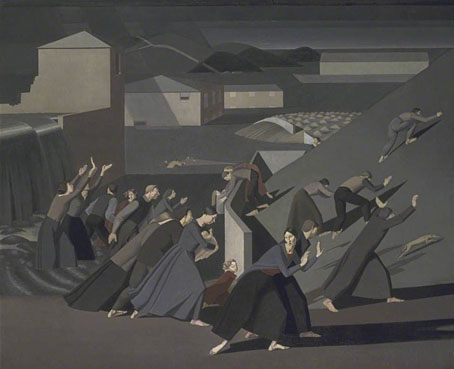
The Deluge (1920) by Winifred Knights.

• Dennis Cooper‘s favourite fiction, poetry, nonfiction, film, music, art & internet of 2016 so far. (Thanks again for the nod to this blog!)

• At Literary Hub: Jonathan Russell Clark on Jorge Luis Borges, and Jon Sealy on why indie presses [in the US] are opening bookstores.

• “It’s not just about the music.” A conversation on the occult practices in the arts between poet Janaka Stucky and Peter Bebergal.

• Daisy Woodward talks to Andreas Horvath about Helmut Berger, Actor, a documentary about Visconti’s muse and lover.

• More Fritz Leiber: Brian J. Showers on his decision to republish Leiber’s horror novel, The Pale Brown Thing.

• Mixes of the week: Sextape 4 by Drixxxe, and Radio Oscillations #96 (Richard Pinhas/Heldon) by Iron Blu.

• The 5th Young One: Pay No Attention to the Girl Behind the Sofa; John Reppion on a television mystery.

• More reading suggestions: Cheerless beach reads for gloomsters and saddies by S. Elizabeth.

• Never the same film twice: Seances by Guy Maddin, Evan Johnson, Galen Johnson.

• How painter Winifred Knights became Britain’s “unknown genius”.

• The Journey & The Destination: An interview with Hawthonn.

• Robert Latona goes in search of the grave of Constance Wilde.

• Invisible by Day: photos by Mikko Lagerstedt.

• A Queer Lit Q&A with Evan J. Peterson.

• RIP Michael Herr and Bernie Worrell.

• Bridget Riley: The Curve Paintings.

• The typography of Blade Runner.

• Japanese matchbox labels

• SOS by Portishead

• A Rainbow In Curved Air (1969) by Terry Riley | The Great Curve (1980) by Talking Heads | Dangerous Curves (2003) by King Crimson
Weekend links 314

alderslade.jpg

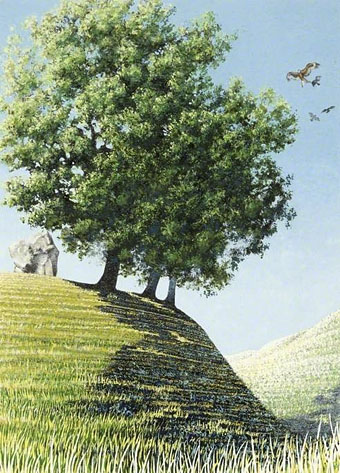
Avebury Kite (2006) by David Alderslade.

• “Klaus Mann, son of Thomas Mann, author of Mephisto, was one of the first in Germany to write gay novels and plays.” Walter Holland reviews Cursed Legacy: The Tragic Life of Klaus Mann by Frederic Spotts.

• The Pale Brown Thing, a shorter/alternate version of Fritz Leiber’s supernatural masterwork, Our Lady of Darkness, is given a limited reprinting by Swan River Press next month.

• “Not only is metal not directly harmful to adolescent minds, as the thinking goes, it may actually be helpful.” Christine Ro on the reappraisal of a once-suspect musical genre.

Something of that tension between past and future is visible in Beardsley’s work. It is the art of a dying era peering, with a mixture of excitement and trepidation, into the next. For all the prancing and bravado, Beardsley’s art was really about finding something in which to believe—and if Beardsley came to believe in anything it was the deep black line. Shading held little interest for Beardsley, and color fascinated him not at all. The black line and white space were all he needed.

Morgan Meis on Aubrey Beardsley

• More of my art for Bruce Sterling’s forthcoming Dieselpunk novella, Pirate Utopia, has been revealed. Tachyon will be publishing the book in November.

• “Secretly, though, I frequent junk shops because I am wishing for some kind of transcendence,” says Luc Sante.

• Mixes of the week: Gizehcast #28 by Christine Ott, and a mix for The Wire by Asher Levitas.

• “It took centuries, but we now know the size of the Universe.” Chris Baraniuk explains.

• Barnbrook Studios creates identity for Kubrick exhibition at Somerset House.

• Watch a haunting video from Subtext Recordings and Eric Holm.

• Folklore Tapes: A Rum Music Special by Joseph Burnett.

• Brion Gysin’s Dreamachine is on sale again.

• Rhys Chatham’s favourite albums.

• A Guide to Occult London

• Skulls and Bones

• Zero Time (1979) by Chrome | Zero-Gravity (1996) by Sidewinder |  Zero Moment (2016) by Contact

Weekend links 311

vasconcelos.jpg

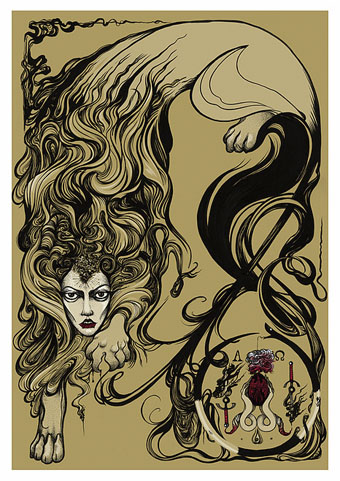
Sphinx (2015) by Lupe Vasconcelos.

• I’ve been reading my way through Patricia Highsmith’s Ripley novels for the past couple of weeks, and may well progress to some of her other books once I’m finished. Highsmith had a long career so there’s a lot to read on the web. Catching my eye this week were 10 Best Patricia Highsmith Books recommended by her biographer, Joan Schenkar; The Patricia Highsmith Recommendation Engine; Highsmith on Desert Island Discs in 1979 (the book she said she’d take, Moby-Dick, is the same one chosen by JG Ballard, albeit for different reasons); and a prickly interview late in her life with Naim Attalah.

• Discovering 20th-century literature: books, manuscripts and other documents in the collection of the British Library.

• Signed copies of Paul Gorman’s Barney Bubbles monograph, Reasons To Be Cheerful, may be ordered from the author.

• How a mysterious ghost ship brought cosmic disco to Cape Verde. Related: Quirino Do Canto by Mino Di Mama.

• Zombi drummer AE Paterra and composer Paul Lawler make prog-synth epics as Contact.

• Mix of the week: Secret Thirteen Mix 185, a locked-groove mix by Massimo Carozzi.

• In London next weekend: Alchemy and Magic at Brompton Cemetery.

• Die or DIY?: scarcities from the post-punk outer limits.

• More Penda’s Fen: a lengthy appraisal by Jerry Whyte.

• Dennis Cooper salutes James Coburn

• Bandcamp is good for musicians.

• Vladimir Nabokov’s butterfly art.

• This Heat: Rimp Ramp Romp (1977) | 24 Track Loop (1979) | Health And Efficiency (1980) | Makeshift Swahili (1981)

Weekend links 309

witch.jpg

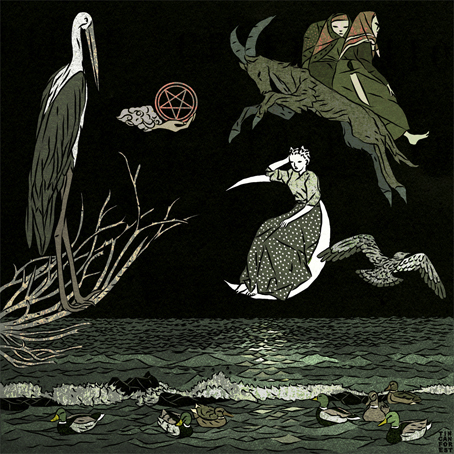
From What is a Witch, “an illuminated manifesto on witchcraft” by Pam Grossman and Tin Can Forest.

• “The other strand of influence for me from dance music was a production house called Savoy in Manchester, England. They were a super underground publishing house that printed cartoons and comic books, and they also released a series of underground dance records. And they were always being shut down by the police and all their stuff was being confiscated, because it was considered ‘anti-society’ in England.” Anohni giving a shout to my colleagues at Savoy Books in a new interview.

• Belladonna of Sadness (1973), a feature-length animated film by Eiichi Yamamoto, has been restored, and is being given a premier release in the US. There’s a review here and a trailer here. No news as yet of a UK release but Finders Keepers has the soundtrack album.

• Alejandro Jodorowsky talks to Daniel Kalder about his new novel, Albina and the Dog-Men, while Jodorowsky’s comic-book collaborator, Ladrönn, talks to Smoky Man about their new graphic novel, The Sons of El Topo.

Pretty little watercolours these are not. Made by bulldozers and dynamite instead of a paintbrush and easel, the works—often sited on baking sandscapes—fuse minimalism and modern industrial aesthetics to evoke the otherworldly structures of ancient civilisations, from Stonehenge to Mayan temples and the Egyptian pyramids.

Alex Needham on America’s land artists. A few years ago I tracked down some of the structures he describes using Google Maps.

• In every dream home a heartache: High Rise director Ben Wheatley on adapting Ballard, practical special effects and ’70s parenting.

• Tom Phillips: From Prequel To Sequel, an exhibition of pages from A Humument at Shandy Hall Gallery.

• From fresh food to magic mushrooms: Michael Pollan probes the medicinal uses of psychedelic drugs.

• “Let’s not forget graphic design is an artistic discipline,” says Jonathan Barnbrook.

• Supervert discusses censorship and related matters at SomethingDark.

• “I’ve sung gospel music when in great despair,” says Diamanda Galás.

• Mix of the week: FACT Mix 550 by James K.

• Boy Club is a new gay magazine.

• Gospel Trane (1968) by Alice Coltrane | The Gospel Comes To New Guinea (1981) by 23 Skidoo | Gospel Train (1990) by African Head Charge

Tomita album covers

tomita01.jpg

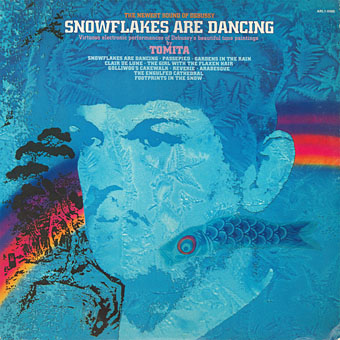
Snowflakes Are Dancing (1974); art direction; Joseph J. Stelmach; artwork: David B. Hecht.

The Japanese composer Isao Tomita died last week so I’ve been listening to some of his early recordings, and thinking—as usual—about their cover designs. Tomita was by far the best of the many electronic musicians in the 1970s who took advantage of the huge success of Wendy Carlos’s Switched-On Bach (1968) to create their own versions of classical music with Moog and other synthesisers. If this makes Tomita sound like an opportunist (and his 1972 collection of electronic pop covers was titled Switched On Hit & Rock), he quickly developed his own approach to electronic composition which ranged from quirky humour to his own brand of cosmic pictorialism. The latter was very different from the equally cosmic meanderings of Tangerine Dream which seldom strayed too far from the rock world. Tomita had a genius for taking very familiar pieces of classical music which he fashioned into synthesizer soundtracks for imaginary science-fiction films. (He also produced actual scores for a number of Japanese films but few, if any, of these were released outside Japan.) This approach is shown to great effect on The Bermuda Triangle (1979), an album that was subtitled “A Musical Fantasy Of Science Fiction”, and which filters Prokofiev and Sibelius through a library of crank paperbacks, with references to UFOs, undersea pyramids, Agharta, the Hollow Earth, Close Encounters of the Third Kind, and the Tunguska Event.

tomita02.jpg

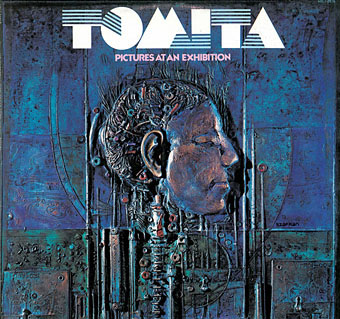
Pictures At An Exhibition (1975); artwork: bas-relief by Gene Szafran. The first appearance of the logo that became a fixture of Tomita’s albums. No designer is credited but I’d guess it was the work of Joseph J. Stelmach. The logo typeface is Sinaloa.

As for the covers, Tomita’s recordings may have been classical music but RCA targeted the albums at a rock audience so there’s no sign of the venerable composers heads that appear continually on the sleeves of orchestral recordings. The examples here are almost all the Western releases which, surprisingly, tended to have better covers than the Japanese originals. This is also a partial selection, favouring Tomita’s own releases (no soundtracks), and mostly the early albums. The later albums aren’t as impressive, and many of them were only released in Japan.

tomita03.jpg

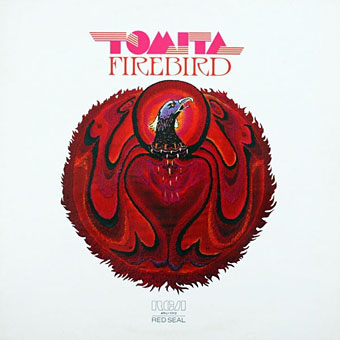
Firebird (1975). No design or art credit. I’d not noticed before that the logo evolves by degrees, here gaining some extensions.

Lastly, I’ll dedicate this post to my old friend Nik Green who died in March. Nik was a session musician of some note, and the first person I knew who owned a synthesizer (an ARP Odyssey). He was also a great Tomita enthusiast who shared Tomita’s sense of humour and relished the quirkier moments on many of these albums. I can’t listen to the opening of the Mars section of Tomita’s The Planets without remembering Nik shouting “That’s a Moog!” when a synthetic fanfare interrupts the sounds of a spacecraft lift-off.

Continue reading “Tomita album covers”