Weekend links 332

seamans.jpg

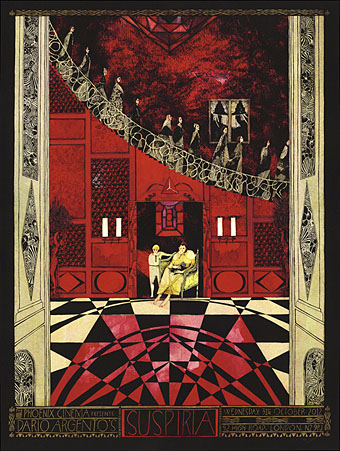
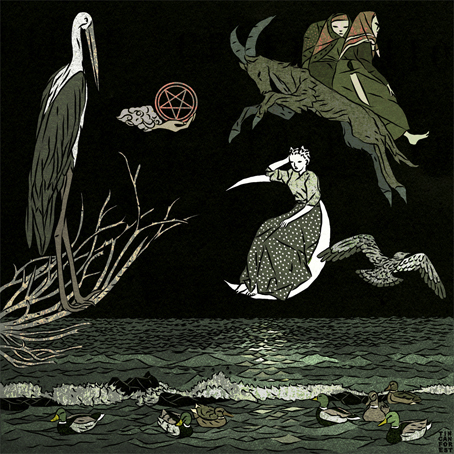
Suspiria (2012) by Jessica Seamans.

Matthew Sperling on Tom Phillips’ “treated Victorian novel” A Humument, which he calls “a multimedia masterpiece”. Phillips’ sixth and final edition of the book is published by Thames & Hudson next month.

Strange Flowers on Monsieur de Bougrelon (1897), a short novel by Jean Lorrain which will be published next month by Spurl Editions. The book is currently on my to-be-read-next pile.

Theodore Carter finds images of skulls by artists through the ages. I’d have included Giacometti’s almost abstract Head-Skull (1934) or his sketch of 1923.

• The horror stories of EF Benson contain “enough nastiness to give you just the right kind of frisson for the time of year,” says Nicholas Lezard.

• Covers for One, an American magazine of the 50s and 60s dedicated to “the homosexual viewpoint”.

Kelly Sullivan takes a close look at the illustrations and stained-glass work of the great Harry Clarke.

• Lost Moomins cartoon strips will be shown in the first UK Tove Jansson exhibition.

• The extravagant homes of Ludwig II of Bavaria are in urgent need of restoration.

• Mix of the week: The Nine Ten Never Sleep Again Mix by The Curiosity Pipe.

Ténéré Tàqqàl (what has become of the Ténéré), a new song by Tinariwen.

• The King of Weird: Joyce Carol Oates on HP Lovecraft.

• Charting the legacy of cult 1970s band, Big Star.

Falling (1992) by Miranda Sex Garden | Inferno (Version II) (1993) by Miranda Sex Garden | Peep Show (1994) by Miranda Sex Garden

Old Weird and New Weird

savdreams.jpg

Savoy Books, 1984.

A couple more recent arrivals that feature my work. These are of minority interest but worth noting since academic articles don’t always travel beyond a small audience of subscribers.

A recent issue of Foundation (The International Review of Science Fiction), Volume 45.1, number 123, contains an article by Mark P. Williams, Underground Assemblages: Savoy Dreams and The Starry Wisdom. This examines the legacy of New Worlds magazine under the editorship of Michael Moorcock (from 1964 to 1974) via two writing collections, Savoy Dreams (Savoy Books, 1984) and The Starry Wisdom (Creation Books, 1994). The two collections are very different: Savoy Dreams, edited by David Britton and Michael Butterworth, was an eclectic overview of Savoy’s publishing endeavours up to that point. Among the original writing there’s fiction by Butterworth, M. John Harrison (the first publication of the Viriconium story, Lords of Misrule) and others, plus a reaction by Michael Moorcock to William Burroughs’ Cities of the Red Night, a book that Savoy had contracted to publish before police harassment forced the company’s bankruptcy. The rest of the book is taken up with press reviews of Savoy books.
starrywisdom.jpg

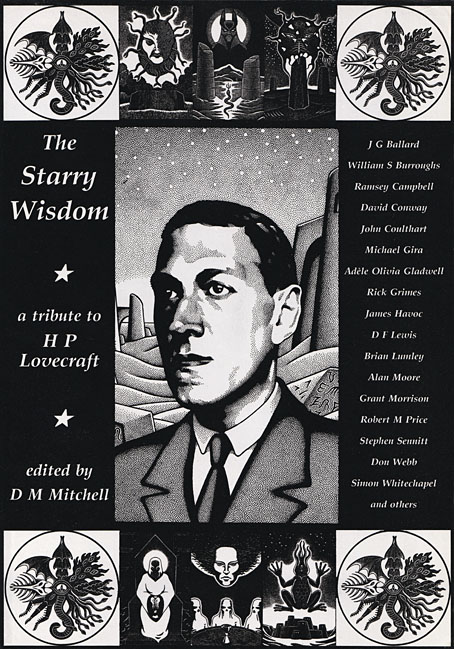
Creation Books, 1994. Cover art by Peter Smith.

The Starry Wisdom should require less of an introduction since the book has been in print since 1994, and has a small, possibly notorious, reputation among HP Lovecraft enthusiasts. Editor DM Mitchell felt that the assembling of post-Lovecraftian fiction up to that point had been too cosy and insular: too many story collections were being edited and written by groups of friends in the genre fiction “community”, with the result that the stories were often stale and complacent. The startling newness of Lovecraft’s imagination in comparison to many of his contemporaries in Weird Tales seemed to have been bled away into pastiche, a process that began soon after Lovecraft’s death. Mitchell’s solution was to commission original pieces of Lovecraft-inspired work from writers outside the genre world, notably Alan Moore, Grant Morrison, and newcomer David Conway; he also reprinted pieces that would never appear elsewhere as Lovecraftian fiction, including Wind Die. You Die. We Die. by William Burroughs, and Prisoner of the Coral Deep by JG Ballard. Burroughs and Ballard connect directly to New Worlds, of course (Ballard wrote about Burroughs for the magazine), while the pair cast a shadow over many of Savoy’s book productions. Both Savoy Dreams and The Starry Wisdom featured comic strips; Tales of the Cramps by Kris Guidio appeared in Savoy Dreams, while The Starry Wisdom contained strips by Mike Philbin & James Havoc, Rick Grimes, and the first publication of my own adaptation of The Call of Cthulhu.

I was surprised—and pleased—that my comic strip receives a fair amount of scrutiny in Williams’ piece. My Lovecraft strips have received almost no attention from the comics world, a consequence of having been printed by book publishers and distributed to book shops. (A rare exception was this recent piece by Matt Maxwell.) When you’ve been overlooked in this manner it’s a surprise to find your work receiving serious evaluation from an entirely different quarter. Mark P. Williams’ essay examines the contents of both collections, my strip included, as “assemblages”. This is a valid critique in the case of the Cthulhu strip since Lovecraft’s story is itself an assemblage of what seems at first to be unrelated data. The comic adaptation assembles a range of cultural references—some genuine, others invented—to parallel the narrator’s investigation, and even uses genuine documents in places, including columns from The New York Times. I don’t know if Williams has seen the blog post I made that points out many of the cultural references but he notes some of the more overt ones, such as Joseph Conrad appearing as the doomed Professor Angell, Arnold Böcklin’s The Isle of the Dead, and so on. While I was drawing the strip I was trying to imagine the story as an RKO production, a hybrid of two island films—The Most Dangerous Game and King Kong—and Orson Welles’ unmade Heart of Darkness. These references, many of which aren’t very obvious, were largely for my own amusement. The series I created with David Britton that followed the Lovecraft strips, Reverbstorm, puts assemblage and cultural reference at the forefront.
genre.jpg

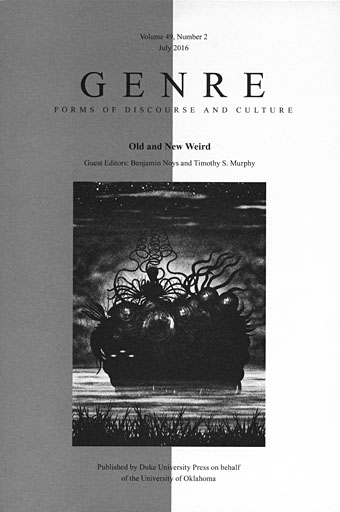
Cover art is my illustration for Remnants from Lovecraft’s Monsters, edited by Ellen Datlow.

The Cthulhu strip and the Reverbstorm series—now collected as Lord Horror: Reverbstorm—are the subject of a very perceptive piece by Benjamin Noys in the latest edition of Genre, an academic journal published by Duke University Press. This number of the journal is a kind of Weird special edited by Benjamin Noys and Timothy S. Murphy. Noys’ Full Spectrum Offence: Savoy’s Reverbstorm and the Weirding of Modernity is the final article in a publication that examines aspects of the “Old Weird” (ie: the Lovecraft-era Weird Tales) and contrasts it with the more recent “New Weird”. The latter was a short-lived label coined by M. John Harrison in 2003 for a range of fiction that was ignoring genre boundaries, and consciously developing the Weird as a project. China Miéville was one of the most visible proponents of the New Weird, and Harrison’s term emerged in part as a response to Miéville’s fiction. Miéville is interviewed in this issue of Genre where, as usual, he has some very worthwhile things to say. He prefers the term “haute Weird” for the original manifestation, possibly because it avoids the negative connotations of the word “old”.
reverbstorm.jpg

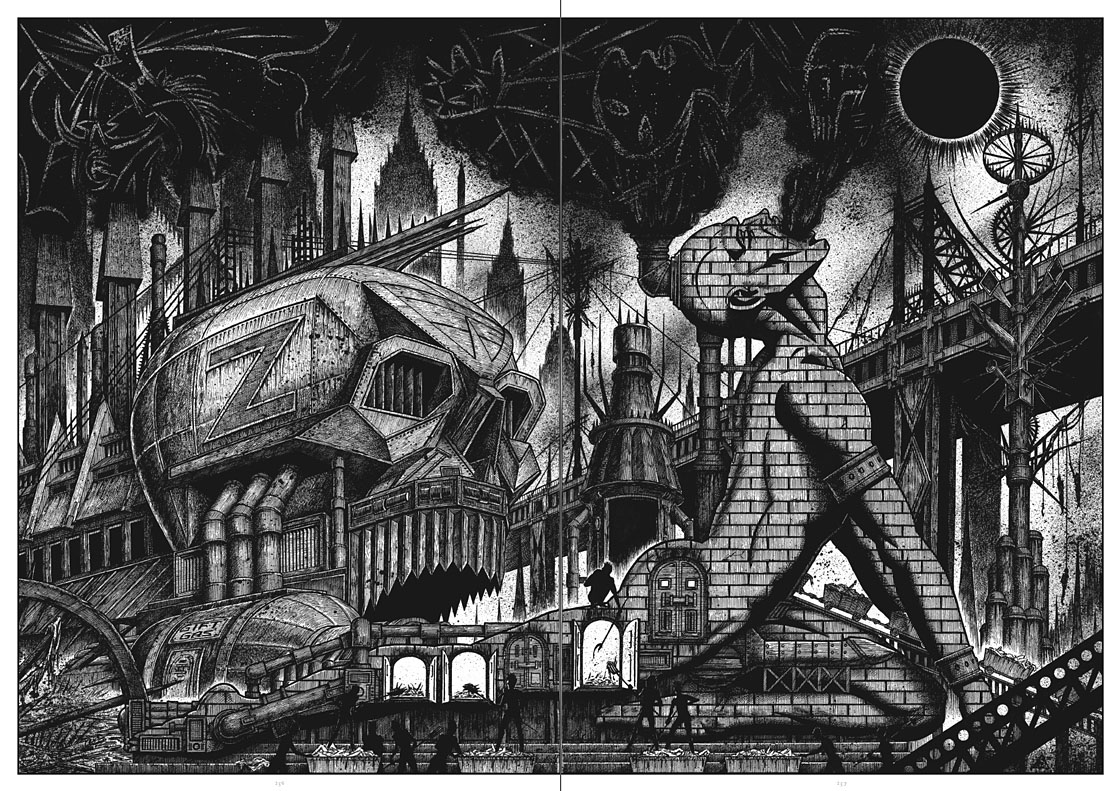
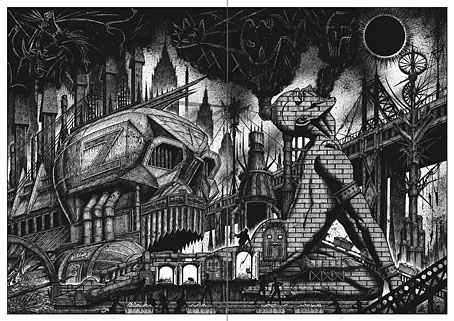
A spread from part 7 of Reverbstorm.

Benjamin Noys’ article is lengthy and resists easy summary, but it begins by investigating the way my work on the Lovecraft strips permeated the Lord Horror comics and dictated some of the imagery, in particular the architectural forms and eruptions of monstrosity. Later discussion concerns the way that Reverbstorm forces the Weird and Modernism together, a collision that I believe is still unique anywhere, never mind in the comics medium. Noys’ piece has given me a lot to think about, not least for its being the first substantial critical appraisal of Reverbstorm. The series is a difficult one, being deliberately excessive and avant-garde, and presenting the reader with a torrent of interrelating cultural references. Many of these are itemised in the appendix but the success (or not) of their working together, and the potential sparking of connections, depends very much on the prior knowledge of the individual reader. Noys is not only knowledgeable but adept at forging his own connections while situating the series in the larger context of the Weird, old (or haute) and new. Even without the inclusion of my work inside the journal and on the cover, I’d recommend this issue of Genre to anyone with an interest in the subject. One of the reasons I favour the Weird as a chosen work label is the way it evades (or ignores) generic boundaries. Years ago I realised that many of the things I liked the best in the arts were the chimeras, those works that transgress boundaries and created new hybrids. No surprise then that I enjoy a genre that refuses easy definition. There aren’t many masts I pin my colours to but the Weird is one of them.

Previously on { feuilleton }
The Weird

Weekend links 328

jamison.jpg

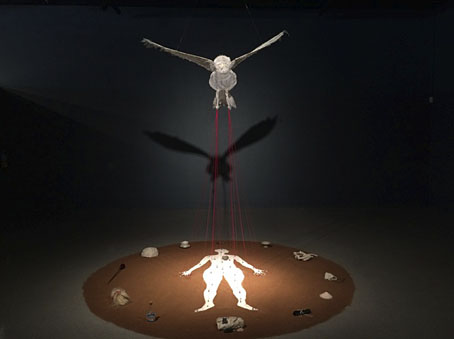
Feathers and Weights (2016) by Susan Jamison.

• The latest release from A Year In The Country is No More Unto The Dance, “a reflection of nightlife memories and the search for the perfect transportative electronic beat”.

Depero Futurista (1927), the bolted book showcasing the artistic work of Fortunato Depero, returns in a facsimile edition.

• This week in the occult: Sam Kean on 21st-century alchemists, and a second volume of The Occult Activity Book.

How could so many jazz critics have overlooked Davis’s powerful trumpet playing on Bitches Brew, and its continuities with his previous work? The reason for their bewilderment was, in large part, the brew, the music’s muddy electric bottom, which bore no resemblance to the jazz they knew. Davis had never been a pure bopper, but his music had always made allusion, however oblique, to the grammar of Parker and Gillespie. On Bitches Brew, Davis decisively broke with his roots in bop. As [George] Grella argues, building on the pivotal work of Greg Tate and Paul Tingen, the more revealing points of comparison were no longer to be found in jazz but in the psychedelic guitar of Jimi Hendrix, the warbled vocals of Sly Stone, and the bass lines of James Brown.

Adam Shatz on Miles Davis

Daniel Wenger on Bob Mizer, “the obsessive photographer behind America’s first gay magazine”.

The Hauntings at Tankerton Park, a book of words and very detailed drawings by Reggie Oliver.

• A 40-minute performance by Pentangle for Norwegian television in 1968.

Maisie Skidmore on ten things you may not know about René Magritte.

• Shirley Collins is the secret queen of England, says Nick Abrahams.

Eighth Climate: ethnographic recordings from the imaginal world.

Pasquale Iannone on five ways to recognise a Pasolini film.

The greatest record sleeves, as chosen by the designers.

Cosmic Horror, new comics work by Ibrahim R. Ineke.

• Mix of the week: FACT mix 569 by S U R V I V E.

• At Dennis Cooper’s: 47 unmade films.

Cosmic Dancer (1971) by T. Rex | Cosmic Slop (1973) by Funkadelic | Cosmic Tango (1973) by Ash Ra Tempel

Weekend links 320

liefhebber.jpg

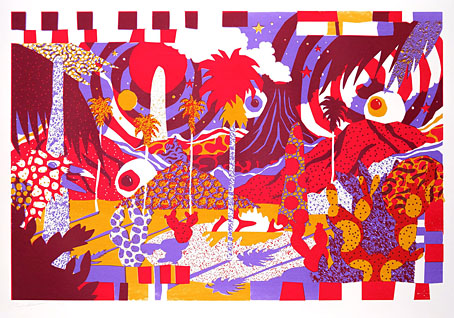
Palm Night (2016) by Nick Liefhebber.

• “Gortner includes reference to the little known Hollywood ‘sewing circles’ (code word for lesbian communities) of which Marlene became a part. This group included Ann Warner, Lili Damita, Claudette Colbert, and Dolores del Río.” Walter Holland reviewing Marlene, a “novelization” of the life of Marlene Dietrich by CW Gortner.

• “Challenges and all, Jerusalem ensures Moore’s place as one of the great masters of the English language.” Heidi MacDonald reviewing Alan Moore’s forthcoming novel. Photos of the slipcased paperback edition (a 3-volume set) appeared last week.

• “It’s unlikely that a gnawing sense of being unborn tops the neuroses of most writers these days, but I’d argue that Beckett’s Jungian insight is more commonly known today as anxiety.” Robert Fay on nihilism and the writing life.

• “So why would I be ‘great for this cover’? Good chance it’s because the book is aimed at a female audience and I am a female designer.” Jennifer Heuer on gendered book covers and being a woman designer.

• Mixes of the week: FACT mix 562 by M. Geddes Gengras, Secret Thirteen Mix 191 by Monica Hits The Ground, and a mix by Daniel Miller.

• Strange Flesh: The Use of Lovecraftian Archetypes in Queer Fiction, an ongoing series by The Punk Writer: part 1 | part 2 | part 3 | part 4.

• “For the Sake of the Prospect”: Lily Ford on the ways in which balloon flight transformed ideas about landscape in the 18th century.

• “Why did Google erase Dennis Cooper’s beloved literary blog?” asks Jennifer Krasinski.

• From Leeds to London: portraits of English cities in the 1970s by Peter Mitchell.

Phantasm is Dune

• RIP Jack Davis

Palm Grease (live, 1974) by Herbie Hancock & The Headhunters | Phantasm (1994) by Biosphere | Fizzy Flesh (1996) by Spacer

Weekend links 309

witch.jpg

From What is a Witch, “an illuminated manifesto on witchcraft” by Pam Grossman and Tin Can Forest.

• “The other strand of influence for me from dance music was a production house called Savoy in Manchester, England. They were a super underground publishing house that printed cartoons and comic books, and they also released a series of underground dance records. And they were always being shut down by the police and all their stuff was being confiscated, because it was considered ‘anti-society’ in England.” Anohni giving a shout to my colleagues at Savoy Books in a new interview.

Belladonna of Sadness (1973), a feature-length animated film by Eiichi Yamamoto, has been restored, and is being given a premier release in the US. There’s a review here and a trailer here. No news as yet of a UK release but Finders Keepers has the soundtrack album.

Alejandro Jodorowsky talks to Daniel Kalder about his new novel, Albina and the Dog-Men, while Jodorowsky’s comic-book collaborator, Ladrönn, talks to Smoky Man about their new graphic novel, The Sons of El Topo.

Pretty little watercolours these are not. Made by bulldozers and dynamite instead of a paintbrush and easel, the works—often sited on baking sandscapes—fuse minimalism and modern industrial aesthetics to evoke the otherworldly structures of ancient civilisations, from Stonehenge to Mayan temples and the Egyptian pyramids.

Alex Needham on America’s land artists. A few years ago I tracked down some of the structures he describes using Google Maps.

• In every dream home a heartache: High Rise director Ben Wheatley on adapting Ballard, practical special effects and ’70s parenting.

Tom Phillips: From Prequel To Sequel, an exhibition of pages from A Humument at Shandy Hall Gallery.

• From fresh food to magic mushrooms: Michael Pollan probes the medicinal uses of psychedelic drugs.

• “Let’s not forget graphic design is an artistic discipline,” says Jonathan Barnbrook.

Supervert discusses censorship and related matters at SomethingDark.

• “I’ve sung gospel music when in great despair,” says Diamanda Galás.

• Mix of the week: FACT Mix 550 by James K.

Boy Club is a new gay magazine.

Gospel Trane (1968) by Alice Coltrane | The Gospel Comes To New Guinea (1981) by 23 Skidoo | Gospel Train (1990) by African Head Charge