Alas Vegas Tarot cards

alasvegasdevil.jpg

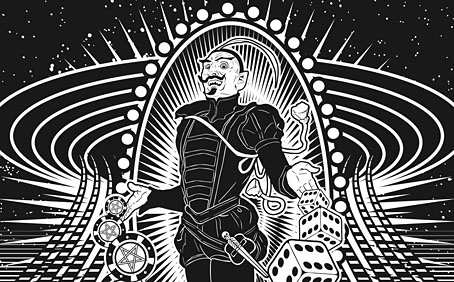
Back in February I bought a Wacom drawing tablet and said I’d show some proper results from its use later. For the past few months I’ve been working on this project using a combination of Wacom drawing and vector graphics. The initial brief from games designer James Wallis was for six Tarot-style card designs for his Alas Vegas role-playing game which has as its theme a fantasy extrapolation from Las Vegas and its gaudy mythology. The Kickstarter funding for the game turned out to be more successful than was anticipated so James asked me to expand the six cards idea into a full set of black-and-white Major Arcana designs.

This has been a fun series to work on although a number of the cards presented problems at first, the antique nature of the Tarot symbolism being a difficult thing to map across a very commercial American city. The symbolism from the Rider-Waite-Smith (RWS) deck was used as a rough guide although we deviated in a few places from the more traditional attributes. Las Vegas has changed over the years so rather than represent a single period of the city’s history there are references to different eras, from the huge casinos of today back to the buildings of the 50s and 60s with their distinctive “Googie” architecture. Notes for the cards follow below. The artwork can be seen at larger size here.
alasvegas00.jpg

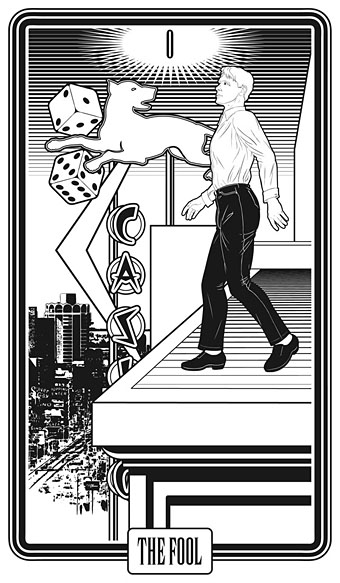
The Fool is usually a young man about to step off a cliff edge with a dog barking a warning at his heels, hence the dog on the sign.
alasvegas01.jpg

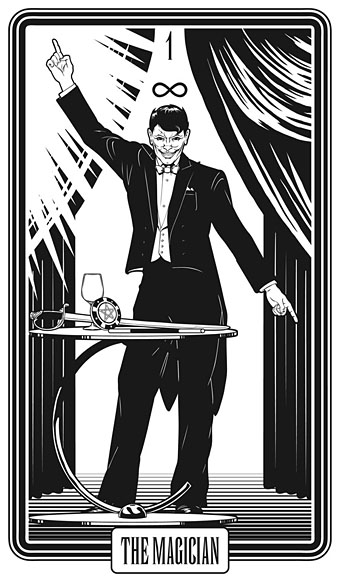
Several of the cards convert the Tarot characters into cabaret acts. This one was pretty inevitable, and I’m sure it’s not the first time a stage conjuror has appeared on this card.
alasvegas02.jpg

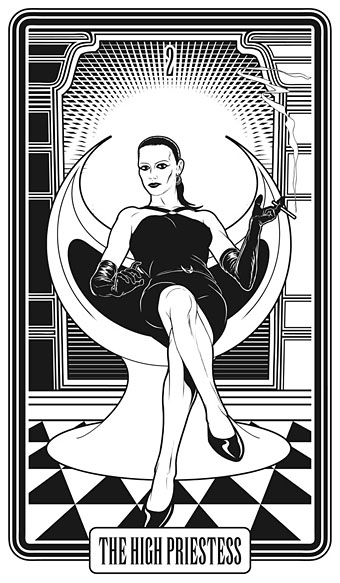
The chair is based on the 1965 “Ball Chair” design by Eero Aarnio (as seen in The Prisoner TV series), adapted here to resemble the Priestess’s crescent moon.
alasvegas03.jpg

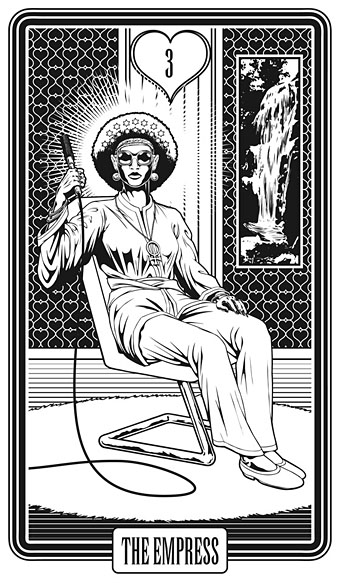
The style on this one is more 70s than 60s: patterned wallpaper (the hearts derive from the symbolism of The Empress, and from playing cards, of course), white rug, Kung Fu pyjamas.
Continue reading “Alas Vegas Tarot cards”

More Cameron

cameron3.jpg

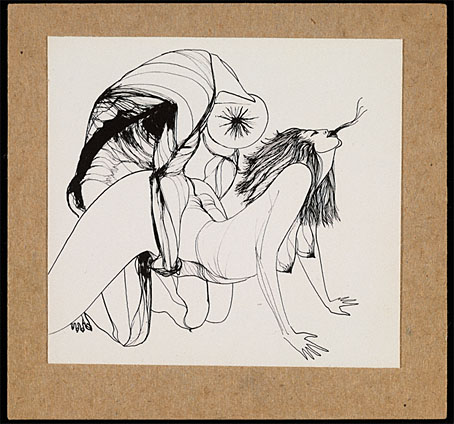
Untitled (Peyote Vision), 1955, Cameron (from Semina journal, no. 1).

Thanks to Erik Davis for drawing my attention to a small online exhibition of Marjorie Cameron artwork and documentary material. Semina was the magazine founded by Cameron’s artist friend, Wallace Berman. The exhibition note tells us that:

Wallace Berman’s only exhibition at Ferus Gallery in 1957 was raided by the LAPD vice squad because of the small reproduction of this sexually graphic work by Cameron that was part of Berman’s assemblage, Temple.

Allen Ginsberg’s Howl successfully fought off an obscenity charge in the same year but the immediacy of visual art means it always fares less well with disapproving authorities. We can assume that Cameron had personal experience of peyote given some verse written by her husband, Jack Parsons, that Robert Anton Wilson quotes in Cosmic Trigger (1977):

I hight Don Quixote, I live on peyote,
marjuana, morphine and cocaine,
I never know sadness, but only a madness
that burns at the heart and the brain.

cameron4.jpg

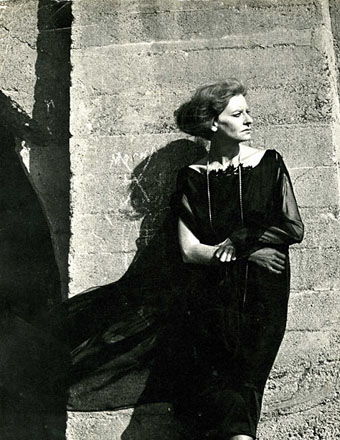
On the same site is this wonderful still (or is it a location photo?) from the shooting of Curtis Harrington’s Night Tide in 1961. Seeing this makes me want to watch the film again.

Previously on { feuilleton }
The Wormwood Star
Street Fair, 1959
House of Harrington
Curtis Harrington, 1926–2007
The art of Cameron, 1922–1995

Weekend links 172

thielker.jpg

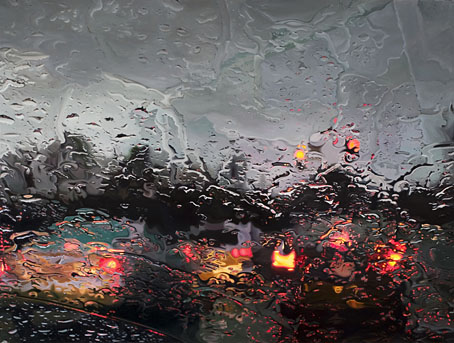
Complete Stop (2008), an oil painting by Gregory Thielker from his Under the Unminding Sky series.

• For Halloween last year I watched a very poor copy of a BBC Play For Today production, Robin Redbreast, a piece of rural horror by John Bowen which received a single screening in 1970. That poor copy—black-and-white, timecoded, multi-generation video—has been circulating for years, so it’s good to know that the BFI will be releasing Robin Redbreast on DVD in time for this year’s Halloween. This might be news enough but the following month the BFI also releases Leslie Megahey’s stunning adaptation of Schalcken the Painter in a dual DVD/Blu-ray edition. I wrote a short review of the latter film last October.

• Mixes of the week: August Sun High from The Advisory Circle, and John Wizards’ Quietus Mix “African music, R&B and chamber pop, filtered through gentle electronic arrangements that cross-pollinate with South African house, Shangaan electro and dub”.

• A trailer has surfaced for The Counselor, a film by Ridley Scott from an original screenplay by Cormac McCarthy. Trailers are too spoilerish so I’m refusing to watch it but for those interested Slate has the details.

Luckhurst makes an admirable attempt to link Lovecraft’s most frustrating writing tic to this theme of the unknown when he claims that Lovecraft’s “catachresis”—deliberate muddling of language through the use of mixed metaphors and the like—is a tool he uses to bolster the atmosphere of futility in the face of “absolute otherness.” The trauma of encountering something so far outside the realms of imagination triggers a collapse of logic in the language itself.

Cate Fricke reviews The Classic Horror Stories of HP Lovecraft, a collection from Oxford University Press edited by Roger Luckhurst.

• “Contemporary audiences found it too weird, too wonky and even borderline distasteful…” Xan Brooks goes looking for the locations from Powell & Pressburger’s 1943 film, A Canterbury Tale.

• Two songs from Julia Holter’s forthcoming album, Loud City Song: World and Maxim’s I. Also unveiled this week: Evangeline, a new track by John Foxx & Jori Hulkkonen.

• Have Ghost, Will Find: Colin Fleming on William Hope Hodgson’s Carnacki, The Ghost Finder.

• At PingMag: Urban Calligraphy: Turning the Streets into Big, Loud Canvases.

• Sex, Spirit, and Porn: Conner Habib talks to Erik Davis.

Serendip-o-matic: Let Your Sources Surprise You

The Pronunciation of European Typefaces

Twilight (2004) by Robin Guthrie & Harold Budd | Luminous (2009) by John Foxx & Robin Guthrie | Cling (2011) by Robin The Fog

The Wormwood Star

cameron1.jpg

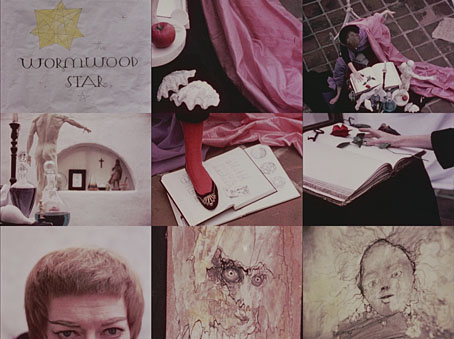
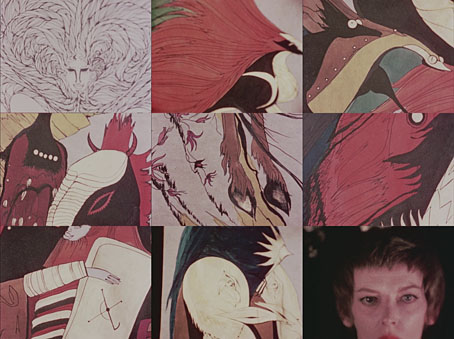
I’ve waited about 20 years to see this one, after first learning of it via a Curtis Harrington interview in Michael Weldon’s Psychotronic magazine in the 1990s. The Wormwood Star (1956) is a 10-minute study of the occult art and witchy persona of Harrington’s friend Marjorie Cameron (1922–1995), best known these days for her memorable incarnation as the Scarlet Woman in Kenneth Anger’s Inauguration of the Pleasure Dome (1954), a film in which Harrington also appeared. With her flame-red hair, green eyes and basilisk gaze, Cameron (as she preferred to be called) would have made an impression wherever she landed. Her presence in Anger’s film is so striking that stills of her face have often been used to stand for the entire Magick Lantern Cycle.

cameron2.jpg

In The Wormwood Star Harrington ramps up the mystique with oblique shots and at least half the running time given to Cameron’s strange drawings and paintings. The subtitle, “Concerning the Knowledge and Conversation of the Holy Guardian Angel” harks back to the 1940s and her husband, Jack Parsons, a rocket researcher and, for a time, the American head of Aleister Crowley’s Ordo Templi Orientis. Harrington later gave Cameron a wordless role as the “Water Witch” in his low-budget horror film, Night Tide (1961), where she drifts around Venice Beach looking suitably mysterious. Night Tide is out-of-copyright so can be watched in full at YouTube. The Wormwood Star appeared on a Curtis Harrington DVD only last month which is no doubt where this copy originates. It may not stick around so watch it while you can.

Previously on { feuilleton }
Street Fair, 1959
House of Harrington
Curtis Harrington, 1926–2007
The art of Cameron, 1922–1995
Kenneth Anger on DVD…finally

Tonto’s expanding frog men

tonto.jpg

I wasn’t going to write about album cover art three times in a row but things keep catching my attention this week. Anyone interested in the history of electronic music knows the name Tonto’s Expanding Head Band, the duo formed by Malcolm Cecil and Robert Margouleff to create music with Cecil’s huge, custom-built TONTO (The Original New Timbral Orchestra) synthesizer. Cecil and Margouleff recorded two albums together: Zero Time (1971) and It’s About Time (1974), the latter credited to Tonto only. Zero Time was incredibly advanced for 1971, not classical adaptations like those being produced by Wendy Carlos and her many imitators, but all-original pieces created polyphonically, a feat that only the TONTO synth could easily achieve.

Given how successful the album is musically I’ve always thought it a shame that the sleeve art, inside and out, was the kind of amateurish “psychedelic” doodling that you find on many albums of this period. The design above was for a 1975 reissue, something I’d not seen before. The artist was illustrator Jeffrey Schrier who has a small, and no doubt incomplete, listing at Discogs with nothing similar to this in evidence. At a guess I’d say the evolving frog men are derived from the lyrics of Riversong, a meandering piece with singing processed via early vocoder-style technology, something that Wendy Carlos was also experimenting with. It’s not all hippy ambience: Jetsex sounds like an outtake from Kraftwerk’s Autobahn (albeit three years early) while Timewhys wouldn’t have been out-of-place on The Human League’s Travelogue album almost a decade later. Easy to see why Stevie Wonder and others were eager to work with Malcolm Cecil throughout the 1970s.

Elsewhere on { feuilleton }
The album covers archive

Previously on { feuilleton }
A Clockwork Orange: The Complete Original Score