Weekend links 171

bossi.jpg

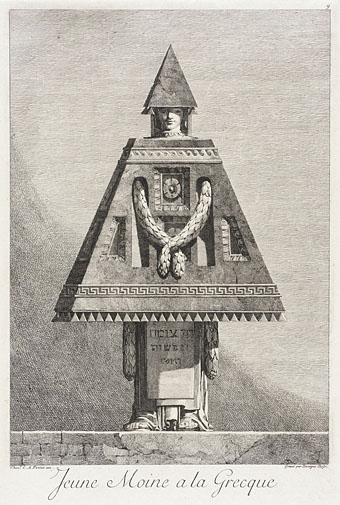
Jeune moine à la Grecque (1771) by Benigno Bossi. Via Monsieur Thombeau.

Victoriana: The Art of Revival is an exhibition which will run throughout the autumn at the Guildhall Art Gallery, London. Some of my steampunk work will be included. Related: Rick Poynor on Soft Machine’s Dysfunctional Mechanism.

• “The egg glows and hovers in the middle of a field of mesmerizing color. The spell is broken when the guard finally says, “Everybody up off the floor.'” Morgan Meis on Aten Reign by the amazing James Turrell.

• Mix of the week: a “heatwave mix” of psychedelic songs compiled by Jaime Williams. Anything that includes Vacuum Cleaner by Tintern Abbey gets my vote.

Because sex is so compartmentalized — it’s often considered separate from the rest of life and hidden away — porn performers, who have sex publicly, are in a unique position to consider and talk about integrating private and public aspects of life.

Writer and porn performer Conner Habib on the issue of nomenclature in the porn business.

• Still Hopscotching: Peter Mendelsund posts some unused cover designs for Julio Cortázar.

A Hymn For Megatron, an hour-long drone work, and a free download, by The Black Dog.

• Vagrancy and drift: Sukhdev Sandhu on the rise of the roaming essay film.

• A Flickr set of Peter “Sleazy” Christopherson’s musical instruments.
mwc.jpg

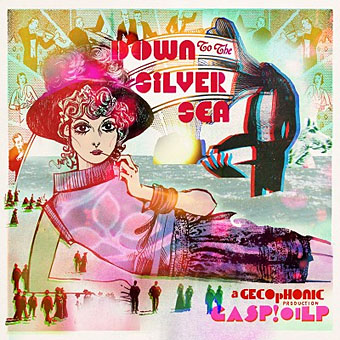
“Whether flower-pressing in the garden, hallucinating in the summerhouse, fainting inside stifling sites of historical interest, pirouetting along the promenade, or even sea-cruise thalassophobia complications, barely a moment will pass that isn’t made all the sweeter by obsessively listening to Down to the Silver Sea.”

The TM Research Archive: sate yourself on Swiss graphic design.

• A Lecture on Johnson and Boswell by Jorge Luis Borges.

• Words, sounds and robots from Sarah Angliss.

Never Built Los Angeles

Nautilus (2012) by Anna Meredith | Nature Of Light (2012) by Isnaj Dui | Popcorn (Ealing Feeder Mix) (2012) by SpacedogUK (Sarah Angliss)

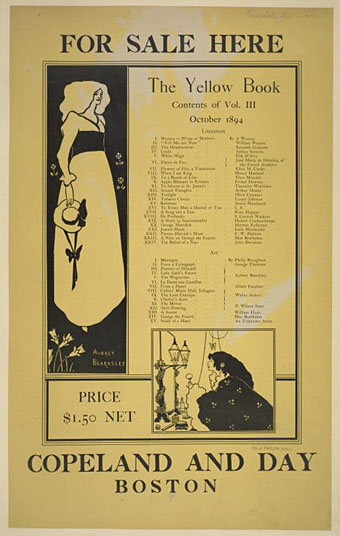
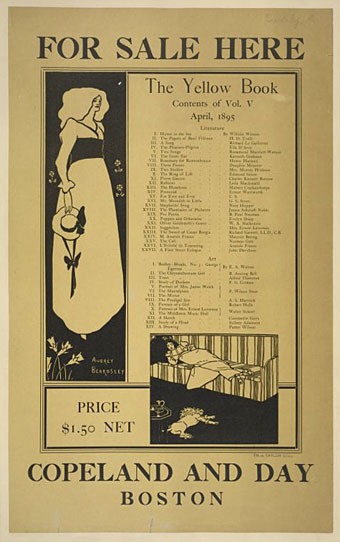
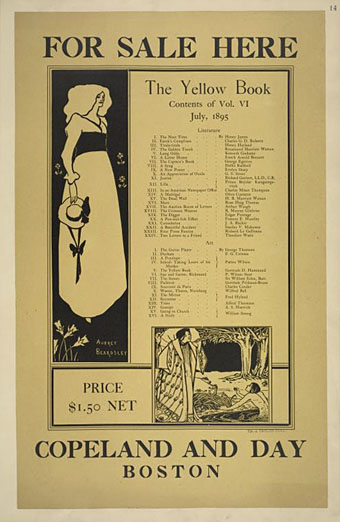
Ads for The Yellow Book

yb1.jpg

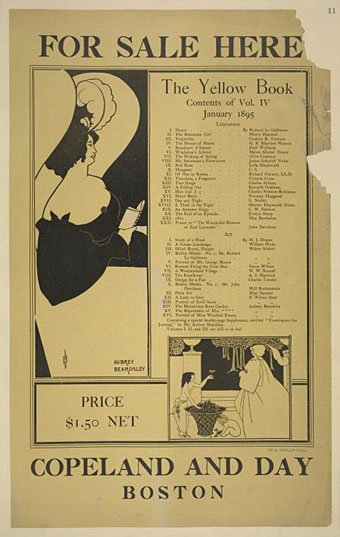
More Beardsley ephemera, and more from the recently upgraded NYPL Digital Collections. These US ads for The Yellow Book date from late 1894 to early 1895, a couple of months before Oscar Wilde was arrested and Aubrey Beardsley had to leave the magazine despite having no connection with Wilde’s activities.

What’s most interesting for me about these ads is the small vignettes, two of which I’m sure I haven’t seen before. This suggests that there’s still material in the pages of The Yellow Book which has been overlooked despite the many books which collect Beardsley’s art. The Internet Archive has several volumes of the magazine but I’ve been daunted in the past by its thousands of pages of not-so-interesting Victorian prose. (The Savoy was the superior publication where quality of writing was concerned.) Maybe it’s time to take a deep breath and dive in.

yb2.jpg

yb3.jpg

yb4.jpg

yb5.jpg

Elsewhere on { feuilleton }
The Aubrey Beardsley archive

One Way Street: Fragments for Walter Benjamin

benjamin1.jpg

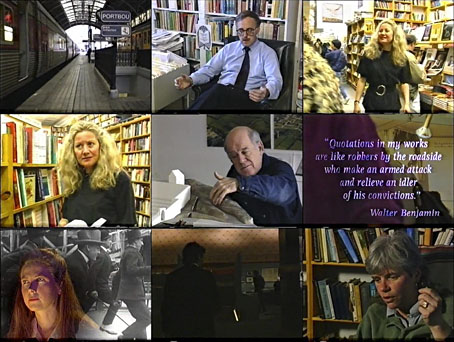
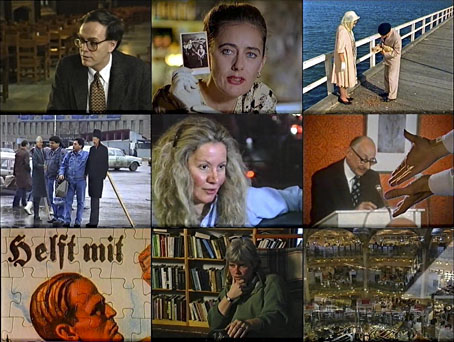
I thought I was going to intensely dislike One Way Street (1993) owing to the deployment of that bane of documentary film and television: the actor impersonating a historical figure. But these moments are sporadic, and John Hughes’ film is a reasonable introduction to Walter Benjamin’s elusive philosophies. It probably helps if you already know something of Benjamin’s life and work; there are several allusions, for example, to the famous “angel of history” thesis, and we even get to see the Paul Klee print to which the thesis refers (and which Benjamin owned); but there isn’t a reading of the thesis itself, an omission that the BBC in its documentary heyday wouldn’t have allowed. Various writers and academics do their best to convey something of Benjamin’s thought in sound-bite form, and the film as a whole can probably evade some criticism by claiming to be Benjaminesque in its disjointed and fragmented nature (although that would also be an evasion). I think if I hadn’t read any of Benjamin’s books there’d be enough to stimulate my curiosity, in which case the film would have succeeded. Watch it here. (Via Open Culture.)

benjamin2.jpg

Previously on { feuilleton }
Passage des Panoramas

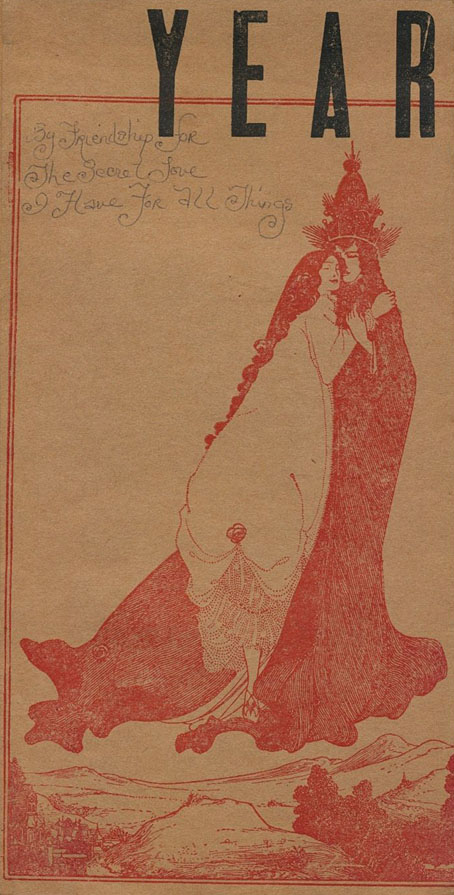
Year by Angus MacLise

beardsley.jpg

The Ascension of St Rose of Lima (1896) by Aubrey Beardsley.

There’s something about the idea of renaming the calendar that I find very attractive even if this is only workable on a personal level. When the Gregorian calendar is a reinvention of the Roman calendar based around Christian holidays (and with the days of the week still alluding to Norse gods), it’s easy to feel at liberty to start again.

maclise1.jpg

Year (1962) by Angus MacLise.

The most famous example of calendrical reinvention is the French Republican Calendar which called upon a gathering of scientists, a mathematician and a gardener to rename the months and days of the year. In this system the 29th of July would be “Panic” (ie: the plant Switchgrass) in the month of “Thermidor” which runs from July 19th to August 17th. (For the record, this is the year 221 in French Republic time.) The French Republican Calendar may have been an inspiration for the Pataphysical Calendar invented by Jarryites (or Ubuists) which is also French, and a sight more complicated:

The pataphysical era (EP) started on 8 September 1873 [Alfred Jarry’s birthday.] The week starts on a Sunday. Every 1st, 8th, 15th and 22nd is a Sunday and every 13th day of a month falls on a Friday. Each day is assigned a specific name or saint. For example, the 27 Haha (1 November vulg.) is called French: Occultation d’Alfred Jarry or the 14 Sable (14 December vulg.) is the day of French: Don Quichote, champion du monde.

The year has a total of 13 months each with 29 days. The 29th day of each month is imaginary with two exceptions:

• the 29 Gidouille (13 July vulg.) is always non-imaginary
• the 29 Gueules (23 February vulg.) is non-imaginary during leap years

So today, July 29th, would be 16th Tatane (“Shoe” or “Being worn out”), Transfiguration de St V. van Gogh, transmutateur, in the Pataphysical Year 140.

maclise2.jpg

Month XI from Year by Angus MacLise.

After the Pataphysical Calendar, Year by percussionist/composer/poet Angus MacLise (1938–1979) comes as a relief. This is a poetic renaming of the days of the year which MacLise published in a now very rare booklet edition in 1962. I’ve known about this for years but still haven’t seen a full text so it was a surprise to discover that the cover illustration was The Ascension of St Rose of Lima by Aubrey Beardsley, one of the artist’s later pieces which tends to Catholicism despite being used to illustrate his unfinished erotic novel, Under the Hill. It’s difficult to say why this was chosen by MacLise or his publisher, but it pre-empts the renewed attention that Beardsley’s work received from 1966 on. MacLise’s names for the days are beautifully evocative, and infinitely preferable to the many days which few in this country bother about:

smoke of the shore
day of the inner lid
day of the magic child
day of bessie smith
day of anna
rose over the cities
the fire is a mirror
hrungirs heart

The full text for November and December can be found on this page. If anyone knows of an online source for the full text of MacLise’s Year then please leave a comment. For those with Android phones, there’s a page here offering a Pataphysical Calendar app. Bosse-de-Nage says “Ha ha”.

Weekend links 170

macarthur.jpg

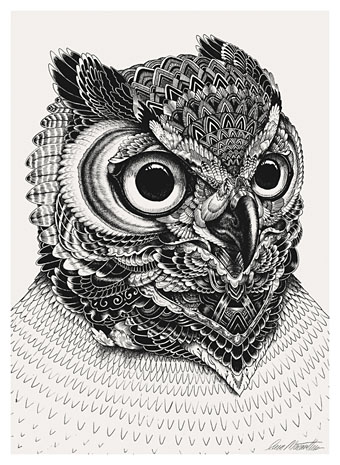
Owl portrait by Iain Macarthur.

• “Ghost Box is a glance through a window seeing something running alongside our version of reality. Like, what if Paul McCartney had made records with the Radiophonic Workshop?” Ghost Box designer and Mr Focus Group, Julian House is interviewed.

• “…that book with the girl with the hatchet in her head…” Dave Tompkins remembers Denis Gifford’s A Pictorial History of Horror Movies (1973), a formative influence of mine, and that of many other people, it seems.

Salvador Dalí’s 1946 illustrated edition of Macbeth. Related: From Macbeth to the Wizard of Oz: New exhibition explores the erotic side of witchcraft.

I do not want to live in a world where the government and a select few conservative feminists get to decide what we may and may not masturbate to, and use the bodies of murdered women or children as emotional pawns in that debate. It is supremely difficult to achieve radical ends by conservative means. Feminists and everyone who seeks to end sexual violence should be very cautious when their immediate goals seem to line up neatly with those of social conservatives and state censors.

Laurie Penny on the recent Tory policy of attempting to limit online pornography.

The Facebook page for The Wicker Man has details of the pursuit for a complete print of the film. A Blu-ray edition will be released in October.

Anne Billson visited the Hotel Thermae Palace in Ostend, the columnated location of Daughters of Darkness.

Kenneth Anger on how he made Lucifer Rising. The ICA in London is screening his films this weekend.

krenkel.jpg

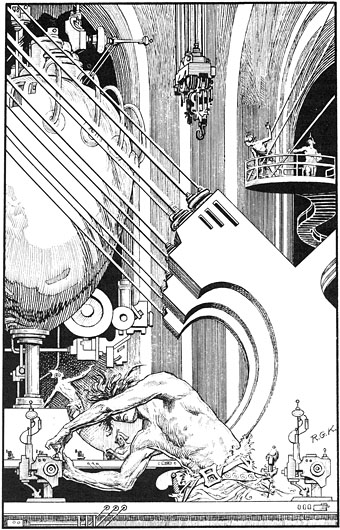
Roy Krenkel illustrates Tales of Three Planets by Edgar Rice Burroughs, 1964.

The Electric Banana Blows Your Mind: The soundtrack library alter ego of The Pretty Things.

• Mix of the week: an ambient (in the 90s’ sense of the word) DJ set by Surgeon.

Bernie Krause shares the happiest sounds he’s heard in nature.

• RIP Walter De Maria, sculptor and musician.

Sexodrome by Asia Argento with Morgan.

• Metabolist: Identify (1980) | Curly Wall (1980) | Ymuzgo/Pigface (1981)