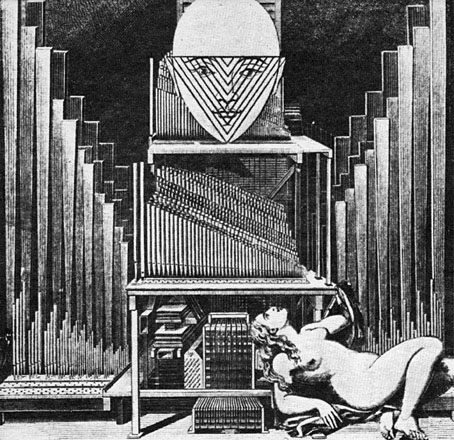
The art of Jindřich Štyrský, 1899–1942

styrsky1.jpg

From a late Surrealist to an early one. Jindřich Štyrský is a Czech artist best remembered today for his collages but he was also a painter, a photographer and a publisher of erotic material. He illustrated and published a Czech edition of Lautréamont’s Maldoror, and helped found the Surrealismus review in Prague.

styrsky2.jpg

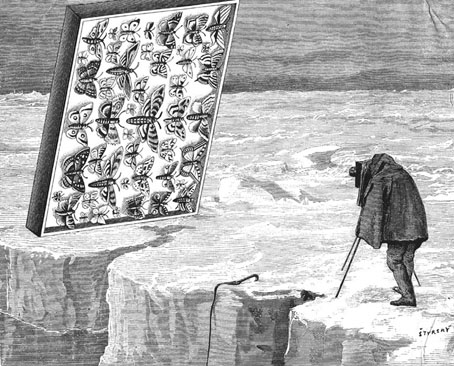
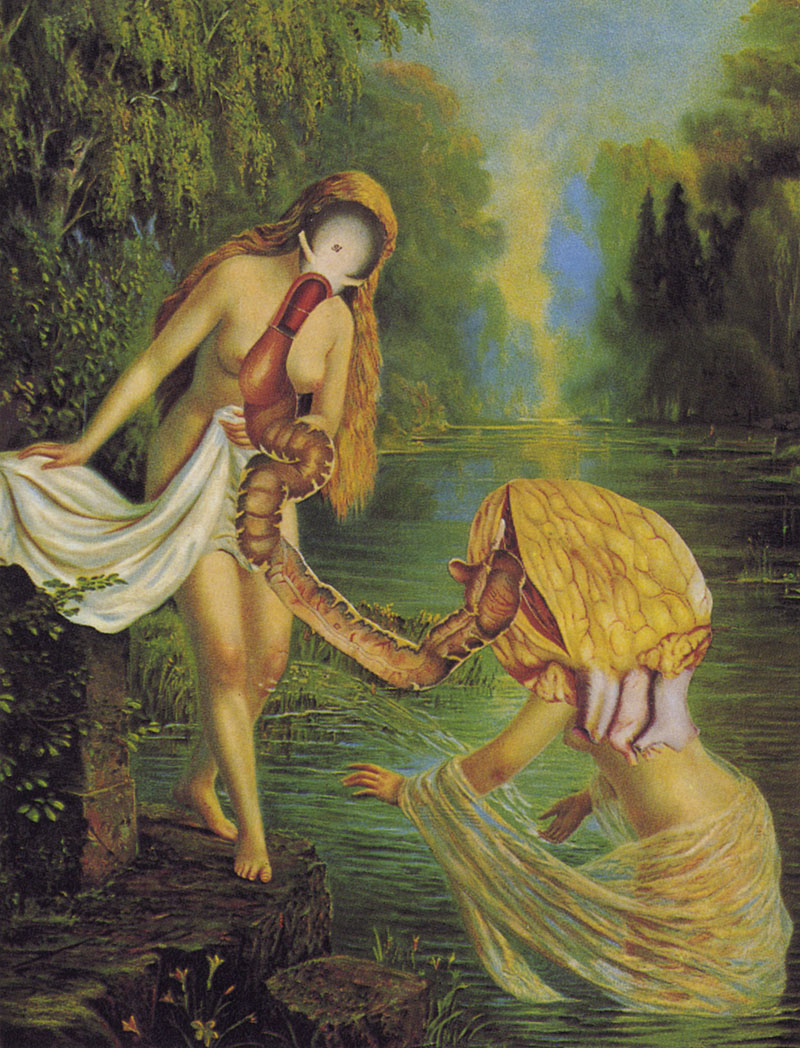
The Bathe (1934).

Regular readers won’t be surprised to hear that I’ve liked Štyrský’s collages for years, many of which subject sentimental Victorian illustration to processes of violent transmutation. Ever since seeing The Bathe I’ve found it impossible to look at one of Renoir’s fleshy nudes without wondering what happened to the exposed viscera. Weimar covered Štyrský’s career in some detail last year so that’s a good place to go for further information. There’s an extract from Štyrský’s dream diary here, and a substantial collection of the collage work and other material at this Flickr set.

styrsky3.jpg

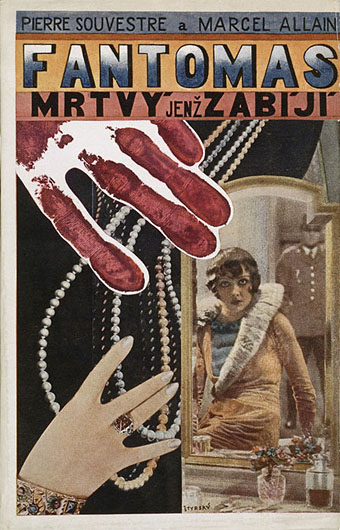
Cover for a Czech edition of Fantômas (1929).

Elsewhere on { feuilleton }
The fantastic art archive

Previously on { feuilleton }
Initiations in the Abyss: A Surrealist Apocalypse
Vultures Await
Wilfried Sätty: Artist of the occult
Illustrating Poe #4: Wilfried Sätty
Metamorphosis Victorianus
Max (The Birdman) Ernst
Gandharva by Beaver & Krause
The art of Stephen Aldrich

Weekend links 82

morris.jpg

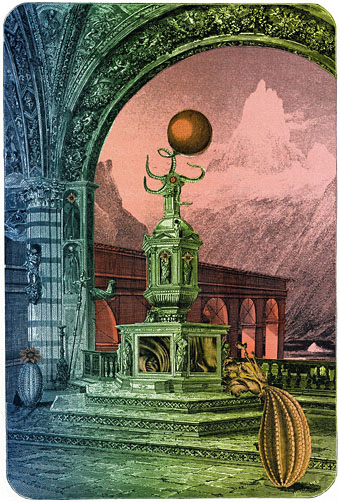
At the Mountains of Madness (1979) from Halloween in Arkham by Harry O. Morris.

• Golden Age Comic Book Stories always pulls out the stops in the run up to Halloween. In addition to a wonderful collection of Harry O. Morris collages, Mr Door Tree has also been posting Virgil Finlay’s illustrations for Edgar Allan Poe, Lynd Ward’s tremendous illustrations for a collection of weird tales entitled The Haunted Omnibus, Barry Moser’s woodcuts for an edition of Frankenstein, and Virgil Finlay’s illustrations for stories and poems by HP Lovecraft.

• “Eugene Thacker suggests that we look to the genre of horror as offering a way of thinking about the unthinkable world. To confront this idea is to confront the limit of our ability to understand the world in which we live – a central motif of the horror genre. In the Dust of This Planet explores these relationships between philosophy and horror.”

• “…the reader […] becomes a conscious participant in the process of imposing a linear sequence, while at the same time remaining aware that all narrative is an act of memory, and that memory is necessarily random.” Jonathan Coe reviews Marc Saporta’s book-in-a-box, Composition No.1, recently republished by Visual Editions.

• Nearly fifty years after its first performance, Peter Weiss’s Marat/Sade is still disturbing playgoers. And nearly ninety years after its release, Alla Nazimova’s silent film production of Oscar Wilde’s Salomé is touring the UK with live musical accompaniment.

Tom of Sinland at Homotography, in which illustrator Bendix Bauer portrays some of the fashion world’s notable male designers as Tom of Finland-style characters for Horst magazine.

Neil Gaiman Presents is a new audiobook imprint which launches with works by Jonathan Carroll, Alina Simone, Keith Roberts, M. John Harrison and Steven Sherrill.

• The Weird Wild West: Paul Kirchner has put all his Dope Rider comic strips online.

Leonora Carrington prints at Viktor Wynd Fine Art, London, from November 5th.

The Fall to Earth: David Bowie, Cocaine and the Occult.

Photos of New York City, 1978–1985.

Kathy Acker recordings at Ubuweb.

The Occupied Times of London.

The Golden Age of Dirty Talk.

Pushkin silhouettes.

• This week I’ve been lost in the Velvet Goldmine (again): John, I’m Only Dancing (1972) by David Bowie | The Jean Genie (1972) by David Bowie | Drive-In Saturday (1973) by David Bowie.

Weekend links 81

wittkamp.jpg

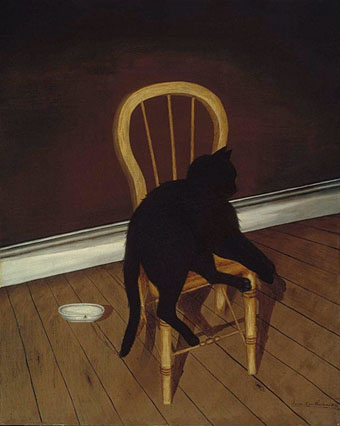
Black Cat on a Chair (1850–1860) by Andrew L Von Wittkamp.

• “A little bit of acid, lots of weed, and too much Castaneda and I was ready to move from the magical realm of Middle Earth into a world that was much stranger than any involving hairy dwarves and white wizards…” Too Much to Dream by Peter Bebergal, “a psychedelic American boyhood”.

This year’s Booker prize isn’t about the power of the new – there’s no experiment with form or strangeness of imagination. The winner may get on the bedside tables of middle England, but that’s not as important as changing the way that even one person dreams.

Jeanette Winterson throws the cat among the pigeons.

• 50 Watts continues to show us things you’d be hard-pressed to find elsewhere: illustrations by TagliaMani from a new edition of Les Chants de Maldoror, and War Is a Verb, collages by Allan Kausch.

• Don’t go in the swimming pool! Coilhouse directs us to Fantasy: music by French outfit DyE with a weird and nasty animation by Jérémie Périn.

• Ace album cover designer and photographic Surrealist Storm Thorgerson is having another exhibition at IG Gallery, London.

The Art of Leo and Diane Dillon, an art and illustration archive.

John Turturro reads a short story by Italo Calvino.

Spaceport America by Foster + Partners.

Your Body of Work by Olafur Eliasson.

Wonder-Cat cures all ailments.

Blogging Moby-Dick.

Krazy Kat (1927) by Frankie Trumbauer & His Orchestra with Bix and Lang | Pussy Cat Dues (1959) by Charles Mingus | Katzenmusik 5 (1979) by Michael Rother | Big Electric Cat (1982) by Adrian Belew | Purrfect (1996) by Funki Porcini.

Wroblewski covers Burroughs

cities-1982.jpg

Picador, 1982.

Being an occasional cover designer I naturally have a more than passing interest in how the books of favourite writers are packaged. I’ve mentioned a couple of times how much I liked the covers that Thomi Wroblewski produced in the 1980s for UK editions published by Picador and John Calder. Wroblewski is a designer who also creates his own artwork using a variety of media, with some form of collage being a common technique. Burroughs has had a number of decent designs over the years but Wroblewski is one of the few people loosed on his books who seemed to fully appreciate the tenor of the writing, and was able to convey something essential without ever being too abstract or too illustrative. I’d have been happy to see him design a complete range of the titles.

reader-1982.jpg

Picador, 1982.

Most of the covers here have been swiped from the excellent Burroughs page at Beat Book Covers where you can judge Wroblewski’s work against other editions. An exception below is the art for an unknown edition of The Wild Boys, a picture described as being from 1988 so it may have been on a Picador cover I’ve never seen. The only cover at Beat Book Covers using that art is a later Russian edition. If anyone can say when and where Wroblewski’s picture was first used, please leave a comment.

job-1984.jpg

Calder, 1984.

Also below is an album cover from Wroblewski’s parallel career as a music designer. Minutes was an audio magazine released in 1987 on the LTM label, and is included here since two of the tracks were Burroughs readings. The album has never been reissued but a copy from the vinyl can be downloaded here. Worthwhile mainly for WSB and Winston Tong of Tuxedomoon.

For more about the elusive Thomi Wroblewski, Momus wrote something about him a couple of years ago. There’ll be more about The Wild Boys, and Winston Tong, tomorrow.

Continue reading “Wroblewski covers Burroughs”

Malicious Damage

orton.jpg

I was going to title this post “Fucked by Monty” but thought that might give the wrong impression. The phrase was one of several titles added to the cover of The Collected Plays of Emelyn Williams by Joe Orton and Kenneth Halliwell when they were happily defacing the books of Islington Library, London, in the early 1960s. Despite the outrage of the librarians at the vandalism most of the defaced books were put aside and are now prized items in Islington’s collection. This week the library announced an exhibition of the books, Malicious Damage: The crimes of Joe Orton and Kenneth Halliwell. The Guardian has a gallery of the covers here (and there’s more at Joe Orton central), rare examples of what might be called “guerilla collage”.

In addition to tarting up boring cover designs, Orton and Halliwell also typed their own descriptions of some the books’ contents. Gollancz volumes were apparently good for this since the publisher left the inside of their famous yellow dust jackets blank. John Lahr in Prick Up Your Ears gives an example from a Dorothy L Sayers novel which is also read out in the 1987 film adaptation:

When little Betty Macdree says that she has been interfered with, her mother at first laughs. It is only something the kiddy has picked up off television. But when sorting through the laundry, Mrs. Macdree discovers that a new pair of knickers are missing she thinks again. On being questioned, Betty bursts into tears. Mrs. Macdree takes her to the police station and to everyone’s surprise the little girl identifies P.C. Brenda Coolidge as her attacker. Brenda, a new recruit, denies the charge. A search is made of the Women’s Police Barracks. What is found there is a seven inch phallus and a pair of knickers of the kind used by Betty. All looks black for kindly P.C. Coolidge…. What can she do? This is one of the most enthralling stories ever written by Miss Sayers.

It is the only one in which the murder weapon is concealed, not for reasons of fear but for reasons of decency!

READ THIS BEHIND CLOSED DOORS. And have a good shit while you are reading!

Alan Bennett wrote the screenplay of Prick Up Your Ears and that line about “It is only something the kiddy has picked up off television” could well have been one of his own. Orton said that when the pair ended up in court the greatest outrage was shown not towards their obscene amendments but to simple bits of Surrealism such as the adding of a monkey’s face to the cover of Collins Guide to Roses. Schoolboy humour is understandable but don’t dare do something that makes no apparent sense.

Malicious Damage is a free exhibition and runs until January, 2012.

Previously on { feuilleton }
Joe Orton Online
Joe Orton