Fantasmagie

fantasmagie01.jpg

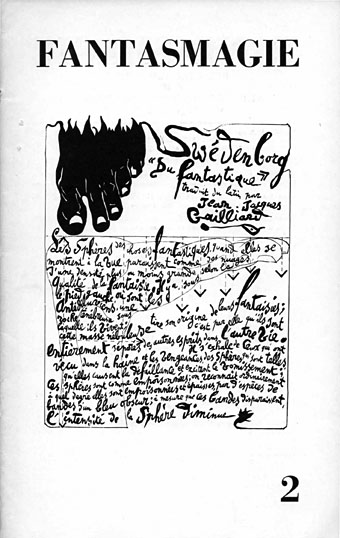
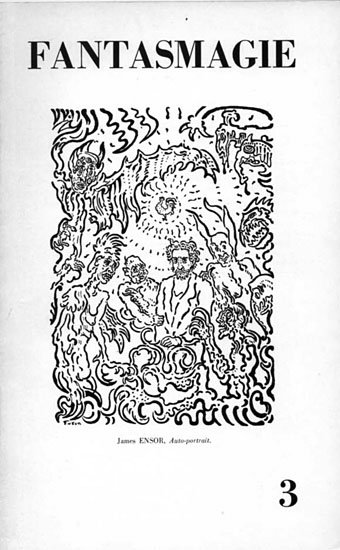
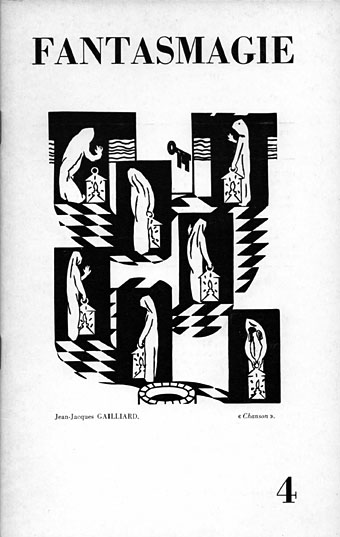
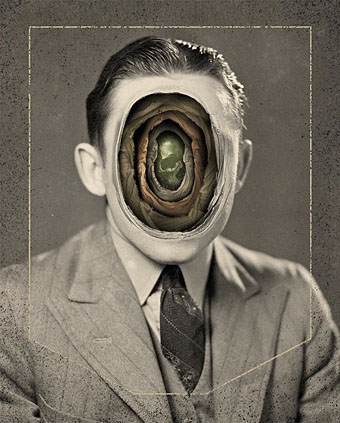
Another post with a Belgian theme (a coincidence despite my present preoccupation with Franco-Belgian culture), and another that has to be filed under “further research required”. The splendidly titled Fantasmagie was founded by author Serge Hutin and artist Aubin Pascale, and was the newsletter/review for the Centre International pour l’étude de l’Art Fantastique et Magique. 52 issues were published from 1959 to 1979 charting the Belgian continuation of the Surrealist project.

fantasmagie02.jpg

I’d been hoping there might be a collection of all the issues online somewhere but this isn’t the case to date. However, the first 11 issues may be browsed in full at Scribd or downloaded if you use one of the PDF scrapers (search for “Scribd free”). Each issue showcases art by contemporary Surrealists or practitioners of what Ernst Fuchs called Fantastic Realism, all of which was of little interest to the art establishment of the time so from our perspective the artists are fresh discoveries. Issue 8, which is a collage special, is especially good.

fantasmagie03.jpg

fantasmagie04.jpg

Continue reading “Fantasmagie”

Weekend links 466

maar.jpg

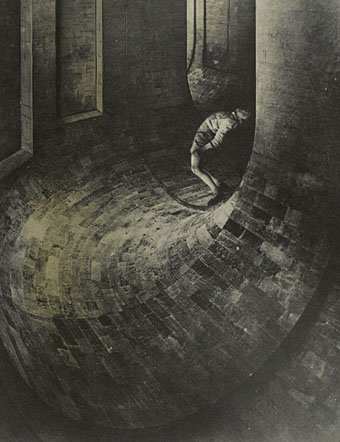
The Simulator (1936) by Dora Maar.

• Surprise of the week for me was the discovery of a new album, Kshatrya – The Eye Of The Bird, by cult French composer Igor Wakhévitch. This had been out for a while but I’d managed to miss the announcements. The music was recorded in 1999 so isn’t exactly new but it’s the first new Wakhévitch release (as opposed to a reissue or compilation) since Let’s Start in 1979. Very good it is too, almost completely electronic but not as discordant as his synth-dominated Hathor album.

• “Popol Vuh is a Mass for the heart.” Gerhard Augustin talks to Florian Fricke about Popol Vuh’s music in a “rare” (lost? previously unseen?) interview. Undated but the City Raga album is referred to as a recent release so it’s probably around 1995.

Brian Dillon on the voraciousness and oddity of Dora Maar’s pictures. Related: Rick Poynor on The Simulator by Dora Maar.

The Secret Ceremonies: Critical Essays on Arthur Machen, edited by Mark Valentine and Timothy J. Jarvis.

Juliette Goodrich on the tale of the Buchla synthesizer, the repair engineer, and a dormant drop of LSD.

Scott Tobias on Midnight Cowboy at 50: why the X-rated best picture winner endures.

• A Hidden History of Women and Psychedelics by Mariavittoria Mangini.

• Previews of Chords, the new album by composer Ellen Arkbro.

• Mix of the week: Secret Thirteen Mix 290 by Mark Stewart.

• “Somehow I became respectable,” says John Waters.

• At Dennis Cooper’s: Walerian Borowczyk Day.

• The Bandcamp Guide to Earth.

Gén #1 by Ray Kunimoto.

Secret Ceremony (Theme From Brond) (1987) by Scala (Bill Nelson & Daryl Runswick) | Healing Ceremony (1990) by African Head Charge | Ceremony Behind Screens (1995) by David Toop

Weekend links 464

picaud.jpg

13 Circles by Julien Picaud.

• The 50th anniversary of the Apollo Moon landing is only two months away so it’s no surprise that Brian Eno’s Apollo: Atmospheres And Soundtracks is being reissued. The latest release will include an additional disc of new music by Eno with his collaborators from the original sessions, Daniel Lanois and Roger Eno. Related: the Apollo 11 Command Module as an explorable (and printable) 3D model.

• From the real Moon to the presence of the satellite in myth and history, the next book from Strange Attractor will be Selene: The Moon Goddess & The Cave Oracle, a volume which is also the final work by the late Steve Moore. With a foreword by Bob Rickard, and an afterword by Alan Moore.

• Guitar-noise maestro Caspar Brötzmann released a handful of thrilling albums in the 1990s then disappeared from view. Spyros Stasis talked to Brötzmann about his hiatus and his recent resurfacing on the Southern Lord label.

• A year late, but I didn’t know Paul Schrader had written an updated introduction to his 1972 study of Ozu, Bresson and Dreyer, Transcendental Style in Film. I love the idea of “The Tarkovsky Ring” as a directorial event horizon.

• “Nothing written is utterly without value, as I proved to myself by reading two random works.” Theodore Dalrymple on the lasting worth of “worthless” books.

Cinemagician: Conversations with Kenneth Anger, a documentary by Carl Abrahamsson about the director/writer/magus.

• Mirror, Mirror: When Movie Characters Look Back at Themselves by Sheila O’Malley.

• From Susan Sontag to the Met Gala: Jon Savage on the evolution of camp.

• Mix of the week: Secret Thirteen Mix 289 by Mondkopf.

• Portrait of the Artist as a Consumer: Anne Billson.

• A video by IMPATV for Religion by Teleplasmiste.

Obscure Sound ~ Cosmic: a list.

Mira Calix‘s favourite records.

Transcendental Overdrive (1980) by Harald Grosskopf | Transcendental Moonshine (1991) by Steroid Maximus | The Transcendent (1999) by Jah Wobble

Born to be Posthumous: The Eccentric Life and Mysterious Genius of Edward Gorey

dery.jpg

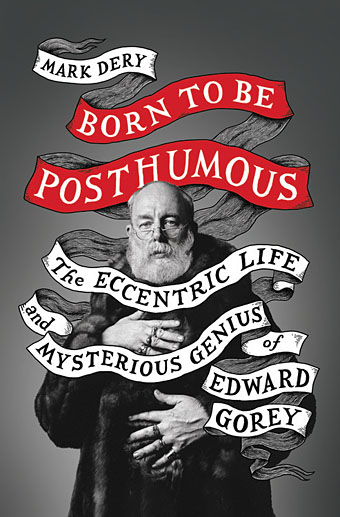
Cover design by Jim Tierney; photo by Richard Corman.

When so many current biographies are recounting the lives of those about whom we’ve already heard a great deal (see the new biography of Oscar Wilde by Matthew Sturgis), a book exploring the career of a previously undocumented yet worthwhile figure is especially welcome. Such is the case with Born to Be Posthumous, Mark Dery’s life of the elusive Edward Gorey: artist, writer, illustrator, book designer, book creator, bibliophile, theatre designer, cat lover and balletomane.
gorey5.jpg

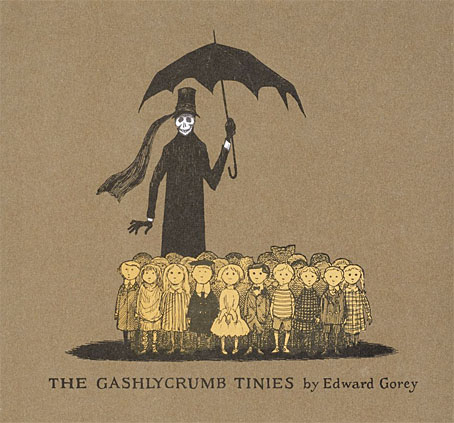
The Gashlycrumb Tinies (1963).

Gorey’s small books have long been one of the more curious fixtures of American culture: many of them look like children’s books but aren’t (unless the child is Wednesday Addams); others look like comic books but they aren’t comics either. The books are sometimes (but not always) Surrealist fables; or brief accounts of irreducible mystery; or sombre inexplicabilities; or camp ripostes to the pieties of Victorian morality; infrequently spiced with black humour and with lurches into outright horror. Gorey delivered his miniature tales in an idiosyncratic drawing style that combines a cartoon-like stylisation with the density of shading found in old wood engravings, a blend that would prove influential as his popularity grew. As Dery notes in his book’s introduction, without Edward Gorey’s work there would be no Lemony Snicket, while Tim Burton would be a skeletal shadow of his present self. (Given the latter’s current output, this might do him some good. But I digress.)
gorey4.jpg

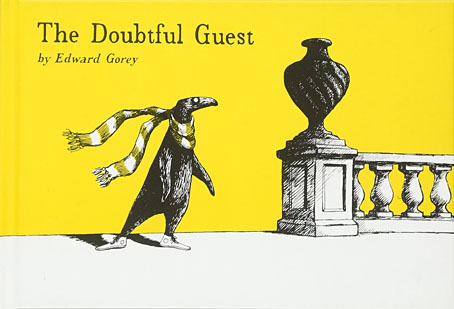
The Doubtful Guest (1957).

In Britain, however, Gorey remains a cult rather than cultural figure, still overshadowed by better-known contemporaries such as Maurice Sendak and Charles Addams. Until the publication of the Amphigorey story collections Gorey’s books were produced in small editions with such a limited availability you were more likely to encounter his art on the cover of another author’s book than within the pages of his own. I became aware of Gorey’s work by gradual osmosis. The first substantial piece I read about him was his entry in Philip Core’s Camp: The Lie that Tells the Truth (1984), in which Core’s mention of an art style “recollecting Victorian engravings” marked Gorey as an artist to be investigated. Two years later he received a longer entry in The Penguin Encyclopedia of Horror and the Supernatural edited by Jack Sullivan. (Camp and horror: how many other artists sit so easily in both worlds?) But Gorey is absent from many books about 20th-century illustrators, and despite the sequential nature of his work you won’t find him in histories of comic art.
gorey6.jpg

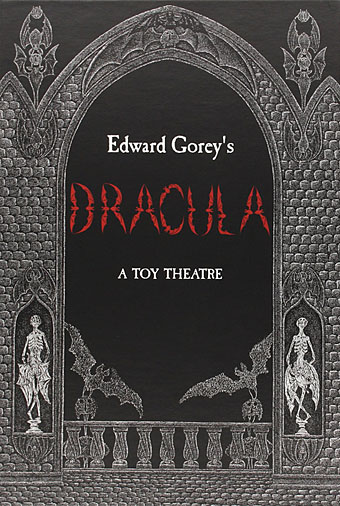
Edward Gorey’s Dracula: A Toy Theatre (1979).

In a way it’s fitting that the work of a man who was adamant in his determination to avoid being pinned down should be so difficult to find. But it’s also a shame that the work of an ardent Anglophile should be hard to find in the country that fuelled his imagination. Among Gorey’s literary favourites Dery lists Jane Austen and Agatha Christie together with Ronald Firbank, Saki, and EF Benson’s Mapp and Lucia novels. (The latter trio are all present in Core’s book on camp, which no doubt makes Gorey camp to the core. Whether he would have approved of being labelled as such is another matter.) I wasn’t surprised by the mention of Saki when so many of Saki’s story titles (The Secret Sin of Septimus Brope) sound like Gorey books, while many of the stories themselves are like Gorey scenarios in prose. Not all Gorey’s work is camp or comic, however; the 32 drawings that comprise the wordless masterpiece of The West Wing (1963) are closer to David Lynch or the “strange stories” of Robert Aickman, the latter an author that Gorey illustrated on several occasions. Dery emphasises how Gorey’s love of silent cinema contributed to The West Wing and other pieces, especially the serials of the Surrealists’ favourite filmmaker, Louis Feuillade.

Continue reading “Born to be Posthumous: The Eccentric Life and Mysterious Genius of Edward Gorey”

Weekend links 431

eckman-lawn.jpg

Postcard collage by Alex Eckman-Lawn.

• “He deserves to be a major figure not only in the history of Japanese music, but in popular music writ large.” Geeta Dayal on Haruomi Hosono, a musician whose solo albums from the 1970s are reissued this month by Light In The Attic.

Erica X Eisen reviews Black Light: Secret Traditions in Art since the 1950s, an exhibition of occult art at the Barcelona Contemporary Culture Centre. Related: Gary Lachman‘s talk from the same exhibition.

• Mixes of the week: Jesús Bacalão’s Light Entertainment Programme 2, Secret Thirteen Mix 265 by Alexander Tucker, and FACT Mix 672 by Rian Treanor.

Whenever horror is criticised, it is criticised for staging a dark carnival of physicality. Perhaps the only sort of media we moralise more than we do horror is that other mainliner of bodily response, pornography.

Horror’s historical ghettoisation has meant that weightier, smarter horror reliably gets labelled as something else. The finest films of our current golden age have been dubbed “elevated horror” and “post-horror”. In literary circles, works of horror seen as sufficiently cerebral get relabelled “Gothic”. It’s certainly true that great horror is always about more than gore. But we should be careful not to gentrify the genre by cleansing it of everything but the philosophy.

MM Owen on the perennial attractions of a perennially despised genre

• “Netflix is a woeful service,” says Jeremy Allen who prefers DVD/Blu-ray to streaming video (as do I). Related: The problem with film aspect ratio on Netflix.

• The Thought Gang album, a Twin Peaks-related collaboration between David Lynch & Angelo Badalamenti from 1993, will be released next month.

Tangerine Dream: Sound From Another World: a TV documentary from 2016. In German but with auto-translated subtitles.

The Thing’s Incredible! The Secret Origins of Weird Tales by John Locke.

Haute Macabre Staff Favorites: Tarot Decks

First Light (1980) by Harold Budd & Brian Eno | Blue Light (1993) by Mazzy Star | Black Light (1994) by Material