Eduardo Paolozzi’s Jet Age Compendium

paolozzi.jpg

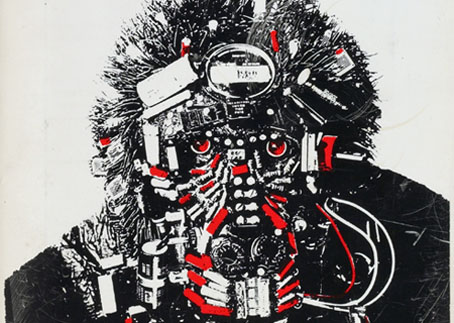
Detail from the cover of Ambit # 40, 1969.

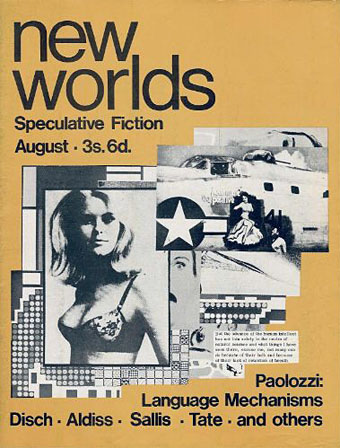
A teenage enthusiasm for Pop Art meant I was familiar with the paintings and collages of Eduardo Paolozzi (1924–2005) long before I became aware of his association with sf magazine New Worlds, and his friendship with JG Ballard. Paolozzi was famously credited on the masthead of New Worlds as “Aeronautics Advisor”, a listing which impressed the relevant authorities when Brian Aldiss petitioned for an Arts Council grant and saved the magazine from collapse. Paolozzi’s work was featured in New Worlds now and then, and he provided a cover for issue 174, but it was to Ambit magazine one had to turn to see regular work by the artist.
paolozzi2.jpg

New Worlds #174, Aug 1967.

My favouritism towards New Worlds has always led me to see Ambit as NW-lite; frequent NW contributor JG Ballard was Ambit‘s fiction editor, and both stood to the side of the British literary scene, although Ambit editor Martin Bax didn’t share Michael Moorcock’s preference for pursuing generic or experimental means to Romantic or visionary ends. Quibbles aside, it’s good to see Paolozzi’s work for the magazine is now the subject of an exhibition, The Jet Age Compendium, at Raven Row, London, and also a book, The Jet Age Compendium: Paolozzi at Ambit from Four Corners Books. If you can’t see the former, the latter is priced £12.95 which strikes me as very reasonable.

The Jet Age Compendium runs until 1 November 2009. For an insight into the artist’s interests and attitudes, there’s a great Studio International interview here from 1971 with Paolozzi and Ballard talking to art critic Frank Whitford.

Previously on { feuilleton }
Sculptural collage: Eduardo Paolozzi
Revenant volumes: Bob Haberfield, New Worlds and others
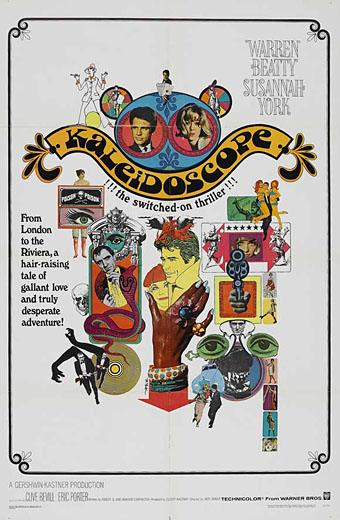
Kaleidoscope: the switched-on thriller

kaleidoscope1.jpg

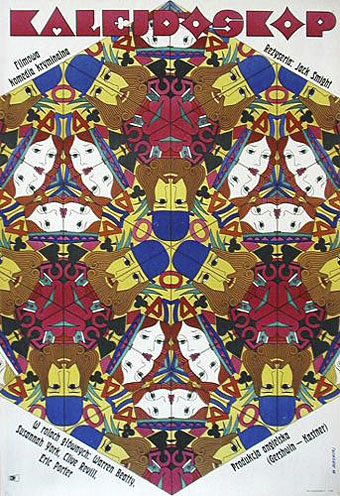
I’ve not seen Jack Smight’s 1966 caper movie for years, and don’t remember much about it beyond Maurice Binder’s kaleidoscopic title sequence. But I like this collage poster, a suitably frenetic piece for one of Hollywood’s many attempts throughout the 1960s to capitalise on modish fashion. I can’t find a credit for the designer so if anyone knows who was responsible, please leave a comment.

kaleidoscope2.jpg

This Polish poster, on the other hand, is the work of Witold Janowski who successfully combines the film’s title with its playing card theme. Too arty and cerebral for Hollywood (No girls!…no guns!) but that’s how it is with all those great Polish poster artists.

Update: the US poster was by the great Bob Peak.

Previously on { feuilleton }
The Robing of The Birds
Franciszek Starowieyski, 1930–2009
Dallamano’s Dorian Gray
Czech film posters
The poster art of Richard Amsel
Bollywood posters
Lussuria, Invidia, Superbia
The poster art of Bob Peak
A premonition of Premonition
Metropolis posters
Film noir posters

Max (The Birdman) Ernst

birdman.jpg

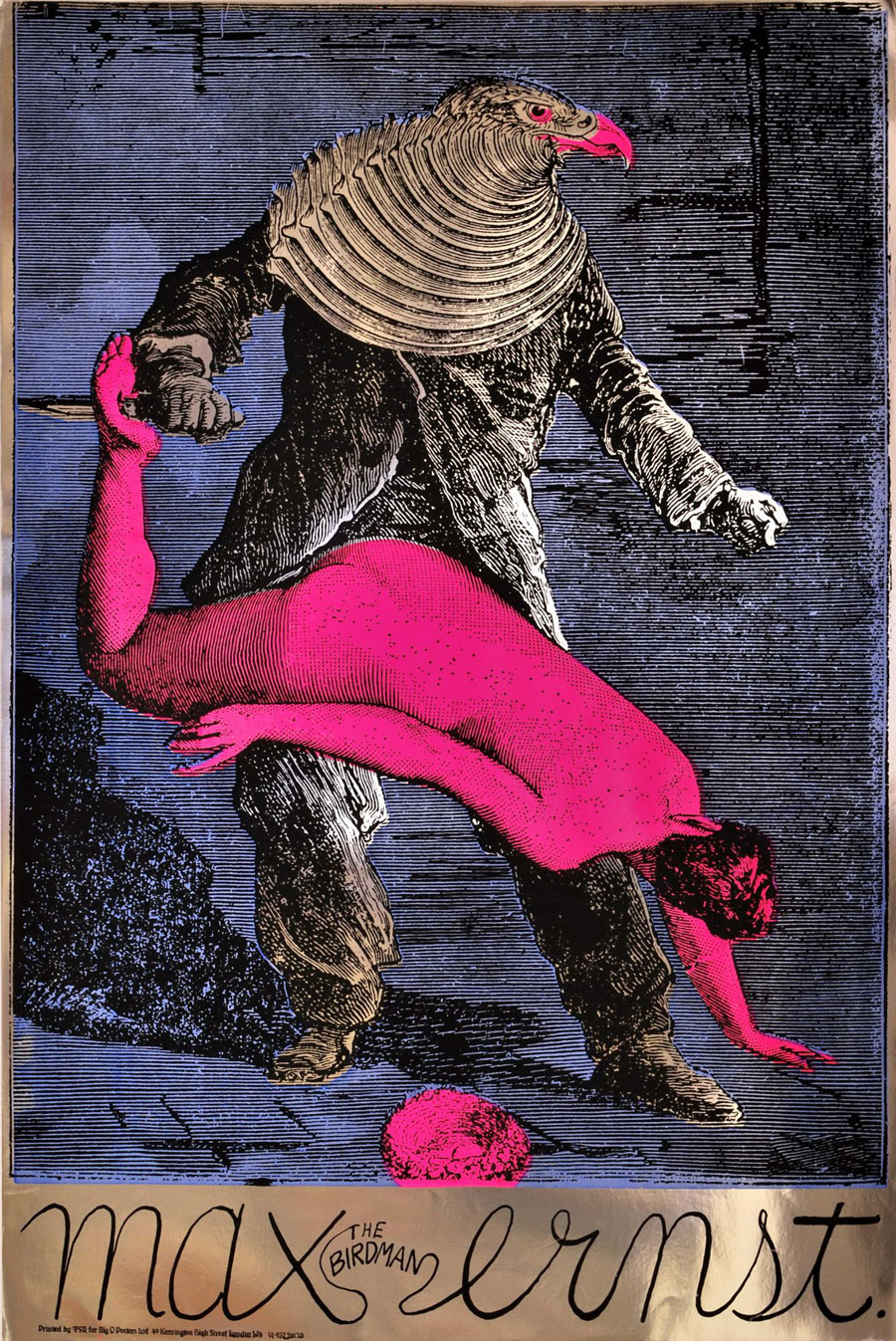
Max (The Birdman) Ernst (1967).

Psychedelia is never far away here at { feuilleton }. Yesterday’s film poster reminded me of this work from the psychedelic era by Martin Sharp, an Australian artist who moved to London and became closely-associated with Oz magazine and London’s other leading psych poster designers, Michael English and Nigel Waymouth, aka Hapshash & the Coloured Coat. Sharp’s homage to the great Max was one of a number of his designs produced on metallic foil sheets, the reflective nature of which often presents difficulties for reproduction in other media.

performance.jpg

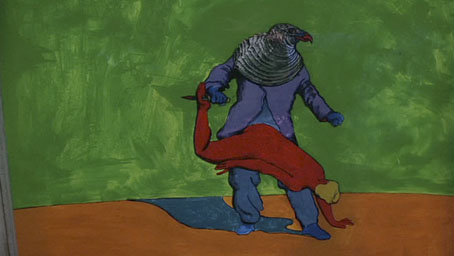
Performance (1970).

I wonder how many people who admired Sharp’s poster puzzled over the meaning of the image, one of twenty-eight similar collages from the fourth chapter of Ernst’s 1934 “collage novel” Une Semaine de Bonté. Chapter four—Wednesday; Blood—concerns the criminal travails of a series of bird-headed individuals (or possibly the same individual in different guises) which end in abduction, possible rape/murder, and suicide. This picture of Ernst’s has always struck me as a very obvious rape metaphor with the woman stretched over the birdman’s lap and the knife piercing her foot. Ernst’s dark imagination—informed by Freudian concerns, as were most of his fellow Surrealists—separates the picture from the more lightweight Art Nouveau/Beardsleyesque stylings of the other London artists. Martin Sharp was producing collages of his own during this period so it’s easy to see why he was attracted to Ernst. And the popularity of his poster may explain why the birdman turns up in a painted version in Donald Cammell & Nicolas Roeg’s Performance, seen when Pherber (Anita Pallenberg) goes to pick mushrooms in the greenhouse. Ernst’s sinister birdman suits Performance very well, a token of the film’s atmosphere of weirdness and violence. (“A heavy evil film, don’t see it on acid” warned underground newspaper International Times.)

sharp_dylan.jpg

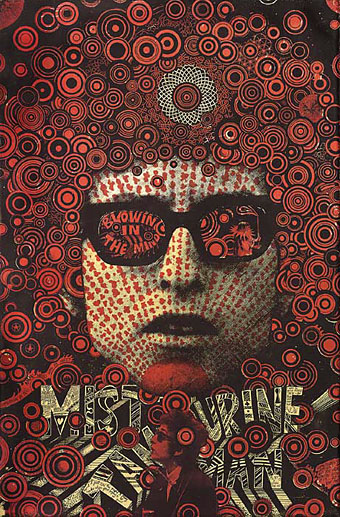
Bob Dylan: Blowing in the Mind (1967).

And to compound the connections a little more, Sharp’s famous Bob Dylan collage portrait (another foil sheet production) also turns up in Performance as part of the collage-covered screen in one of Turner’s rooms. Unlike his fellow Hapshash artists, Sharp’s work is under-documented on the web beyond pages such as this one. The same goes for Ernst’s collage novel but then the best way to experience that is to buy the Dover book edition.

Previously on { feuilleton }
The Robing of The Birds
Gandharva by Beaver & Krause
The Look presents Nigel Waymouth
The New Love Poetry
Judex, from Feuillade to Franju
Further back and faster
Quite a performance
Borges in Performance

Gandharva by Beaver & Krause

gandharva.jpg

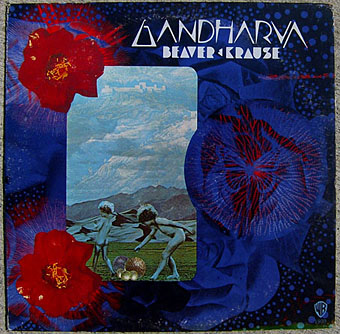
I mentioned Wilfried Sätty’s collage work last week and this album sports one of his few cover designs. A cult object for several reasons, not least Sätty’s involvement. The title lettering was by fellow psychedelic artist David Singer who I had the good fortune to meet in California in 2005 whilst researching Sätty’s career. That chunky Seventies lettering style now looks distinctly contemporary having come back into fashion over the past couple of years.

Beaver & Krause were among the pioneers of Moog-based electronic music in the 1960s and notably provided the throbs and drones which Jack Nitzsche mixed into the soundtrack for Donald Cammell & Nicolas Roeg’s Performance. Gandharva was released in 1971 and one of the few all-electronic pieces on the album, Nine Moons in Alaska, is an outtake from those sessions. The first side is very uneven, with a blues jam and a gospel piece that don’t sit well with each other, never mind with the Moog tracks. Side two, however, is a far more successful suite of improvisations with organ, electronics, guitar, harp and saxophone (played by Gerry Mulligan) recorded live in Grace Cathedral, San Francisco.

Cover photo from the Psychedelic Music Flickr pool which features many fine examples of cover design from the late Sixties on.

Elsewhere on { feuilleton }
The illustrators archive

Elsewhere on { feuilleton }
The album covers archive

Previously on { feuilleton }
Ginsberg’s Howl and the view from the street
Further back and faster
Quite a performance
Borges in Performance

A Clockwork Orange: The Complete Original Score

aco_sleeve.jpg

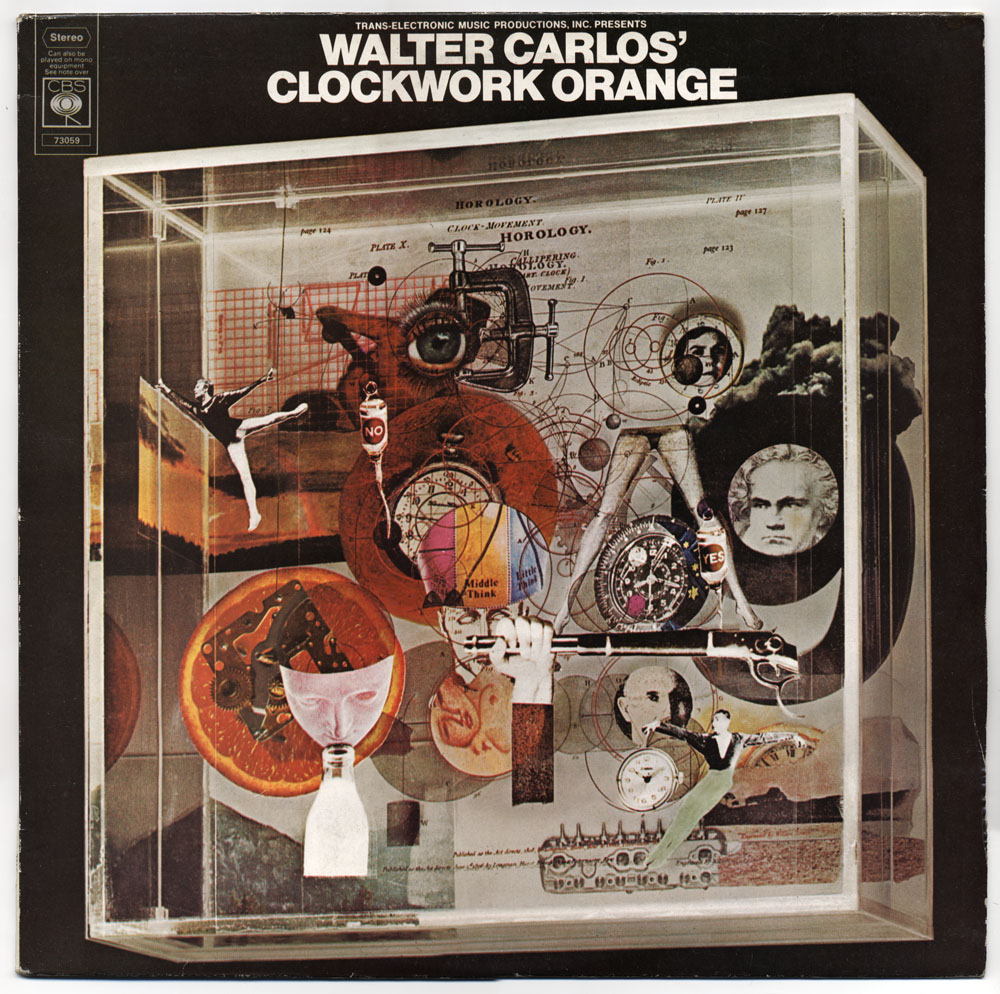
CBS 73059; construction by Karenlee Grant, photo by David Vine (1972).

A1 Timesteps (13:50)
A2 March From A Clockwork Orange (7:00)
B1 Title Music From A Clockwork Orange (2:21)
B2 La Gazza Ladra (5:50)
B3 Theme From A Clockwork Orange (1:44)
B4 Ninth Symphony: Second Movement (4:52)
B5 William Tell Overture (1:17)
B6 Country Lane (4:43)

Viddy well the stuff of obsessions, O my brothers: Kubrick, cover design and electronic music in one convenient 12-inch package. Those of us in Britain who were too young to see A Clockwork Orange during its initial run had to wait a long time for its re-release after Stanley K withdrew the film from circulation. Until bootleg VHS copies started to turn up in the 80s I knew the film mostly from the MAD Magazine parody and the soundtrack album which was ubiquitous in secondhand record shops. Having become familiar with the score, an additional layer of frustration was added when it became apparent that two soundtrack albums had appeared in the 1970s, the “official” one, which was a mix of the orchestral and electronic music used in the film, and another which contained all the music Walter (later Wendy) Carlos recorded.

The Wendy Carlos music was the principal attraction for this electronic music obsessive and I fretted for a long while trying to find a copy of her Complete Original Score album which was paraded in all its elusive glory on old CBS vinyl inner sleeves. Half the tracks are present on the official release but the omissions are crucial: Timesteps, the incredible composition which accompanies Alex’s first deprogramming session was edited down from thirteen to five minutes, there was Carlos’s Moog version of Rossini’s La Gazza Ladra (an orchestral version is used in the film) and also an original piece, Country Lane, intended to accompany Alex’s police brutality session at the hands of his former droogs. The score was one of the first projects to successfully incorporate a vocoder into electronic compositions; Rachel Elkind, Carlos’s regular collaborator, provided the vocalisations. Finally securing a copy was no disappointment, in fact I was overwhelmed. This is still my favourite Wendy Carlos album and one of my top five favourite analogue synth albums. The transcription of La Gazza Ladra is nothing short of miraculous, thundering away with the power of a full orchestra yet created by laboriously recording one note at a time. (Wendy Carlos’s very thorough website goes into detail about the recording process.)

Continue reading “A Clockwork Orange: The Complete Original Score”