Death and the maiden

kausch.jpg

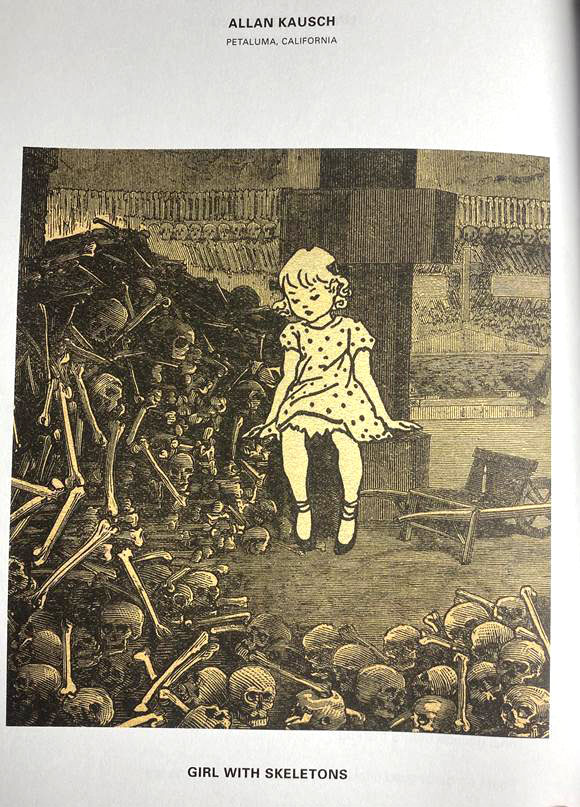
Allan Kausch sent me his collage contribution to Maintenant 14: A Journal of Contemporary Dada Writing and Art last week (thanks, Allan!). I don’t know if this was meant to be a comment on current events but it’s difficult to avoid such an interpretation, especially regarding the USA where people continue to behave like children while the corpses pile up around them.

By coincidence, Strange Flowers notes today that the First International Dada Fair was staged in Berlin 100 years ago this week. The efflorescence of Dada was a brief one thanks to contradictory impulses, conflicting personalities and a hostile social reaction, so the participants might be surprised that their ethos lives on in magazine form a century later. They might also be satisfied that the site of the First International Dada Fair is now an empty plot in a rebuilt street. What better memorial for the Death of Art than a hole in the ground?

Previously on { feuilleton }
The original Cabaret Voltaire

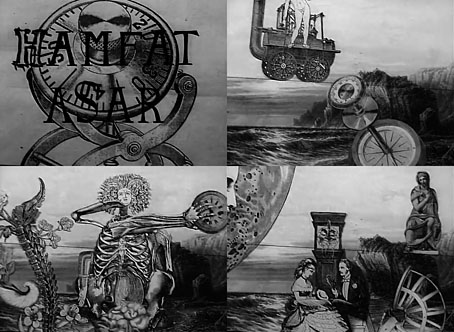
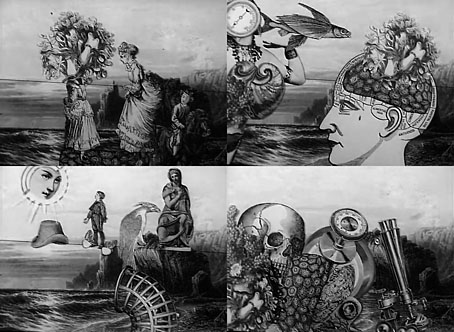
Hamfat Asar, a film by Lawrence Jordan

jordan1.jpg

I was reminded of Lawrence/Larry Jordan recently when reading Deborah Solomon’s biography of Joseph Cornell, Utopia Parkway, in which Jordan receives passing mention for helping Cornell with some of his film work in the 1960s. One of Jordan’s short films was featured here in 2014 but I’d not been very diligent in looking for more, a considerable oversight when he was an early and accomplished practitioner of animation using collaged engravings and illustrations. He wasn’t the only animator producing work like this in the 1960s, Harry Smith, Jan Lenica and Walerian Borowczyk also used these methods, but Jordan seemed to favour the idiom more than others.

jordan2.jpg

Hamfat Asar dates from 1965, and is immediately notable for moving its collaged figures over a shoreline landscape which remains fixed for the entire running time. The narrative, such as it is, concerns a stilt-walking figure attempting to cross from one side of the screen to the other but whose progress is continually impeded by a succession of figures, creatures and bizarre assemblages. The film has been described as representing “a vision of life beyond death” although this isn’t very evident at all. Jordan’s films are much more Surreal in the true sense of the word than many other collage animations which tend towards satire or comedy, Terry Gilliam’s work for Monty Python being an obvious example of the latter. The combination of Surreal engravings with black-and-white film stock gives Hamfat Asar a distinct Max Ernst flavour, which is no bad thing. Watch it here.

Previously on { feuilleton }
Carabosse, a film by Lawrence Jordan
Labirynt by Jan Lenica
Science Friction by Stan VanDerBeek
Heaven and Earth Magic by Harry Smith
Short films by Walerian Borowczyk

The Bomb Squad

bombsquad.jpg

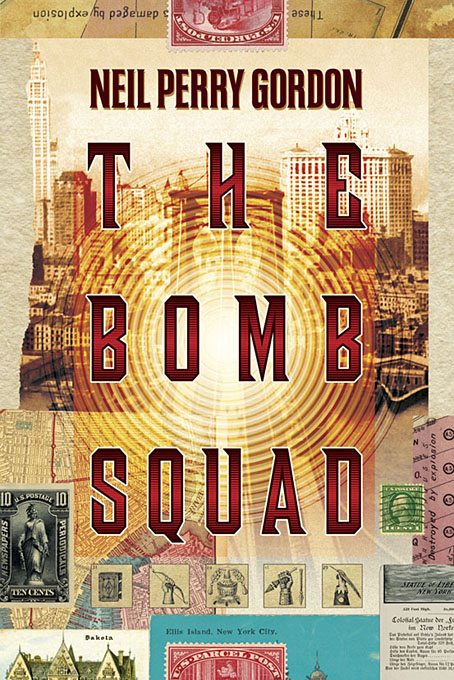
This is the second book cover I’ve designed for Neil Perry Gordon, the first being for The Righteous One which was published in August last year. Both novels have New York City as a location but The Bomb Squad differs substantially from the metaphysical drama of The Righteous One by opening with a real event, the bomb attack in 1916 by German agents on US munitions being stored on Black Tom Island in New York harbour; the bomb squad of the title is the group of men who lead an investigation to prevent further outrages.

Rather than take a figurative approach with this design I opted for a collage of historical details. This seemed a good way of immediately establishing the period and location as well as reflecting the piecemeal nature of police investigations, the accumulation of evidence and so on. Collage also made it possible to include references to some of the locations in the story such as Black Tom Island (from a map at the Library of Congress showing the extent of the bomb damage), the Dakota Building, Ellis Island, etc. The five symbols below the title are from a book of heraldic designs, and relate to the Jungian archetypes which one of the detectives assigns to each member of the squad. The symbols aren’t labelled so the reader can decide which symbol relates to which character.

The Bomb Squad is available now from the usual outlets.

Previously on { feuilleton }
The Righteous One

Weekend links 508

lee-nova.jpg

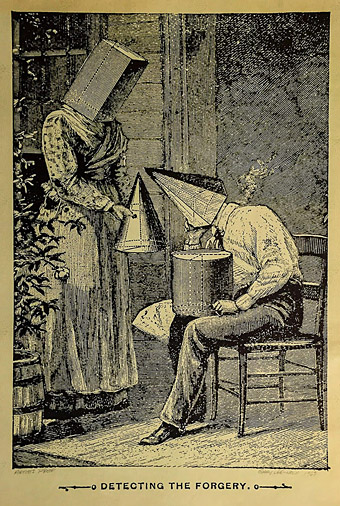
Detecting the Forgery (1967), a collage print by Gary Lee-Nova.

• Nigel Kneale’s adaptation of Susan Hill’s The Woman in Black was given a UK TV screening in 1989, followed by a brief video release after which it was buried for years, and subsequently overshadowed by the later (inferior) big-budget feature film. Network will be releasing the Kneale version on blu-ray in May. I wrote about the TV film a while ago.

• At the BFI: David Parkinson on 10 essential films featuring the late Max von Sydow, a welcome riposte to obituaries that headlined the often mediocre Hollywood fare that Von Sydow elevated with his minor roles. And at the same site, John Berra on where to begin with the martial arts films of King Hu.

• “Enthusiasts Archive, an artistic project by Neil Cummings and Marysia Lewandowska, is the result of extensive research amongst the remnants of amateur film clubs in Poland under socialism. It is a critical archive of amateur films found, restored and made available online.”

Stephen Calloway, co-curator of the Tate Britain Aubrey Beardsley exhibition, and drag performer Holly James Johnston sit down to tea to discuss the “dos and don’ts” of dandyism according to the artist.

• Mutinous Jester: The Collage Novels of Akbar Del Piombo by Gregory Stephenson. Related: Fuzz Against Junk: The Saga of the Narcotics Brigade (1959) by Akbar Del Piombo.

• Michael Richey on chindogu, the useless inventions of Kenji Kawakami.

• From farting to fornication: John Boardley on early print censorship.

Douglas A. Anderson on a case of plagiarism in Weird Tales.

• Mix of the week: mr.K’s Soundstripe vol 3 by radioShirley.

How To Get To Spring is a new album by Jon Brooks.

Rufus Wainwright‘s favourite music.

• At Dennis Cooper’s: Occultists.

Spring Rounds From The Rite Of Spring (1975) by Alice Coltrane | Springlight Rite (1981) by Irmin Schmidt & Bruno Spoerri | Spring Returns (1999) by Isao Tomita

The poster art of Josef Vyleťal

vyletal11.jpg

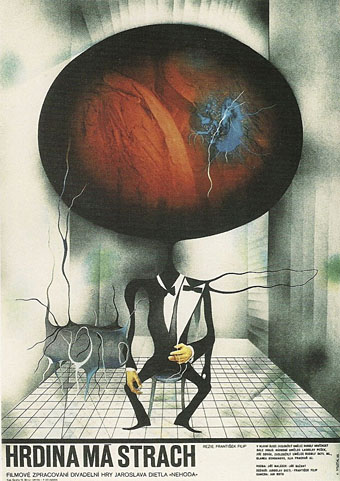
The Hero is Afraid (1965).

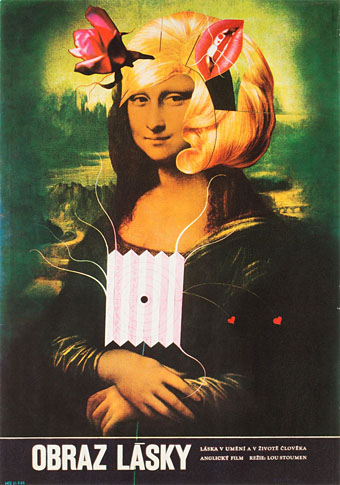
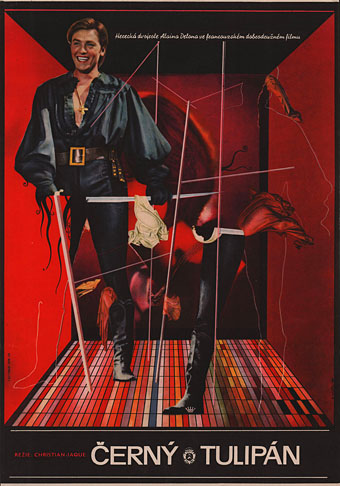
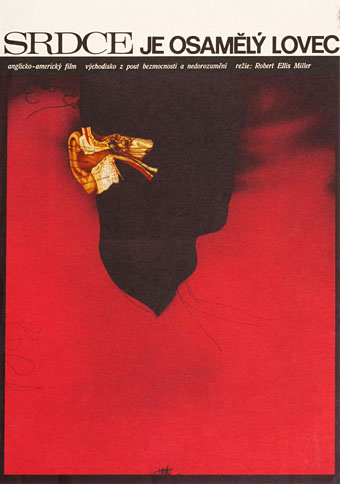
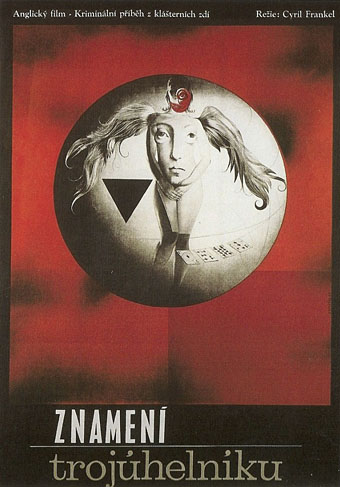
Film posters by Czech artist Josef Vyleťal (1940-1989) have appeared here in the past, but after watching Juraj Herz’s gloomily Gothic Beauty and the Beast (1978) at the weekend—a film for which Vyleťal not only created a poster but also provided the title sequence and paintings seen within the film—I thought the artist deserved a post of his own.

Josef Vyleťal was a prolific poster artist and designer—the Terry Posters website states that he created 115 designs for the cinema—who also worked as a book illustrator. Between commercial assignments he produced paintings in a macabre Surrealist style that filtered into his commercial work, the Herz titles included. The absence of barriers between private obsessions and commercial imperatives is what makes the film posters created by Czech and Polish artists so attractive, as well as so surprising to Anglophone viewers. There’s no sense of these works being produced by committee, of a gaggle of marketing executives fretting over details behind the scenes. Some of Vyleťal’s interpretations are so extreme and uncompromising by Hollywood standards it’s impossible to imagine even an adventurous chain like Alamo Drafthouse commissioning them, never mind a risk-averse studio. One of the designs I singled out for an earlier post is an ideal example, a poster for Alfred Hitchcock’s The Birds which dispenses with any visual reference to the film in favour of a liberal borrowing of the bird-headed figures from Max Ernst’s The Robing of the Bride. It’s a commonplace when discussing the films of Jan Švankmajer to situate the director in the history of Czech Surrealism which remained a clandestine movement during the Communist years. But Vyleťal’s paintings demonstrate a confidence that the average Czech filmgoer could accept Surrealist imagery when being tempted by the latest fare from Hollywood.

vyletal07.jpg

The Naked Eye (1966).

Given my own tastes for Surrealist imagery many of the examples shown here tend in this direction. Vyleťal was a versatile artist who utilised a number of different styles, including collage and a bold graphic style of black shapes on coloured backgrounds. In addition to borrowing from Ernst he also borrowed (or swiped) figures from Aubrey Beardsley on at least two occasions (see below). Most of the examples here are collages augmented by or combined with paint, collage being a quicker solution when faced with deadlines. Terry Posters has many more examples.

vyletal13.jpg

The Black Tulip (1967).

vyletal01.jpg

The Heart is a Lonely Hunter (1968).

vyletal12.jpg

The Trygon Factor (1968).

Continue reading “The poster art of Josef Vyleťal”