Cornell, 1965

cornell1.jpg

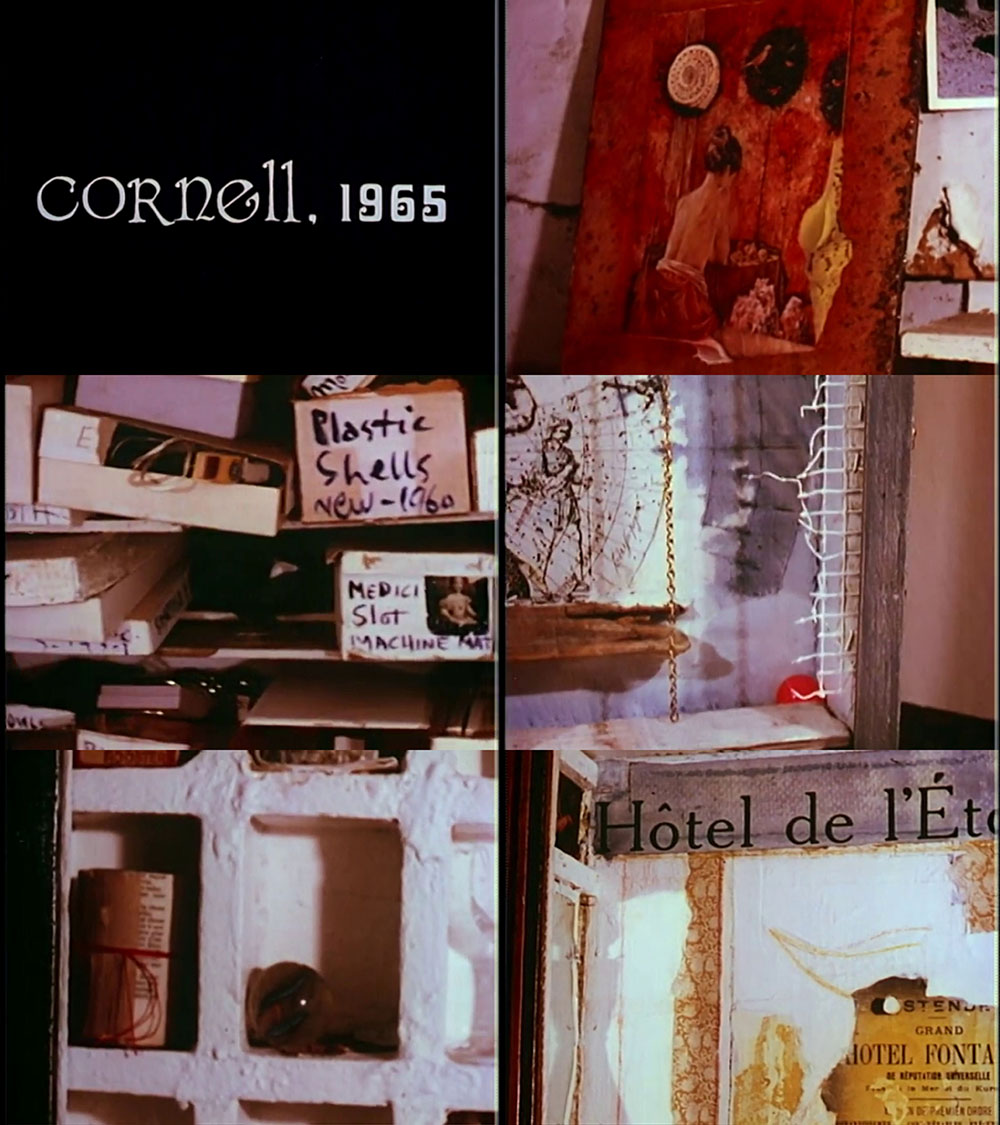
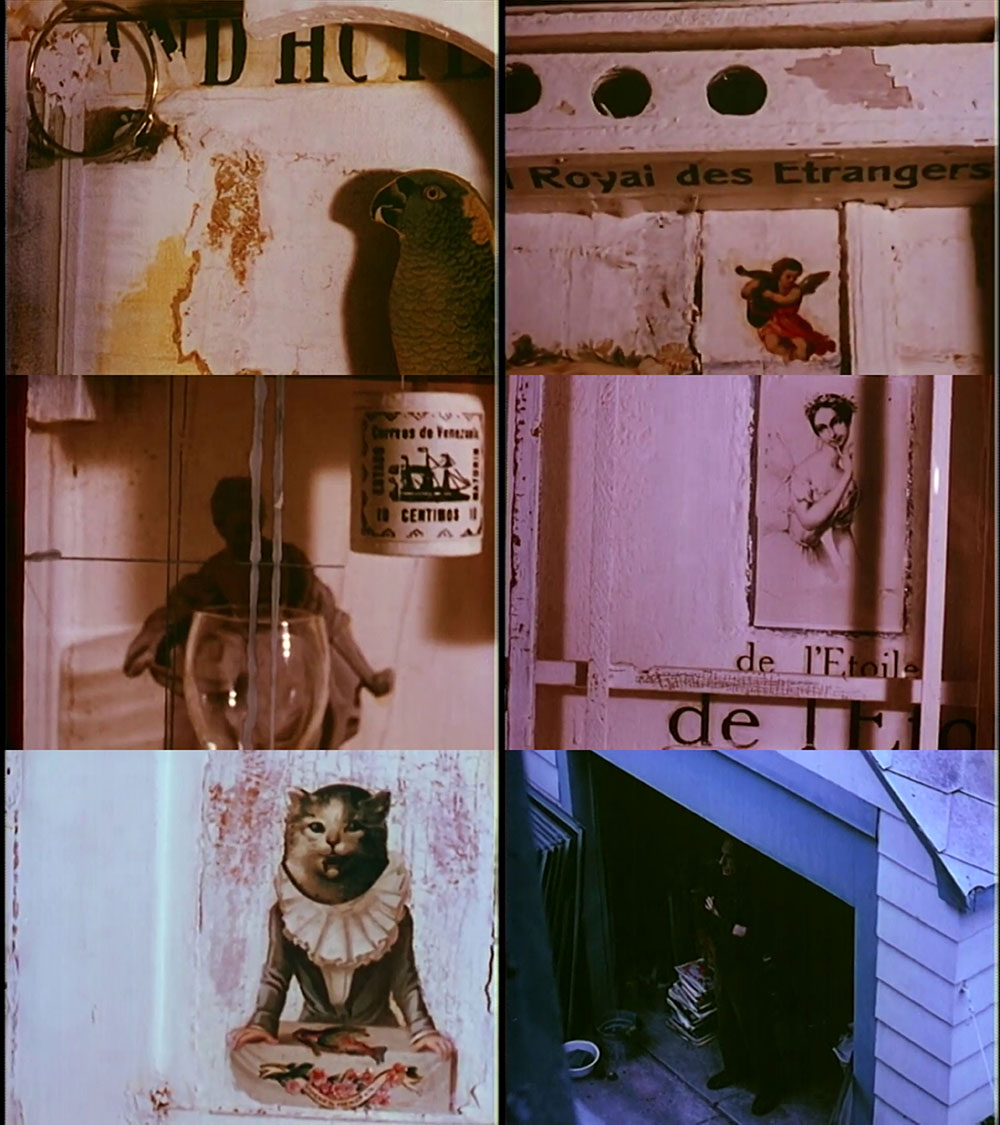
It’s the magus of Utopia Parkway again. As the title suggests, Cornell, 1965 was shot in the 1960s, although the footage wasn’t assembled as a film until 1978 when director Lawrence Jordan added his narration and a Debussy soundtrack. Jordan had been Joseph Cornell’s assistant in the 1960s, and his footage was meant to document details in the workroom where Cornell made so many of his boxes. The details are mostly of the boxes that didn’t get sent to the galleries, half-finished or damaged works which the camera explores in close-up. Jordan also managed to capture a few surreptitious shots of the camera-shy artist from an upstairs window. Cornell didn’t like to see himself on a screen but he loved the medium of cinema, using it to fuel his imagination—an early issue of View includes his star-struck paean to Hedy Lamarr—while also making short films of his own. Many of the latter, including the celebrated Rose Hobart, may be seen at Ubuweb.
cornell2.jpg

Elsewhere on { feuilleton }
The Surrealism archive

Previously on { feuilleton }
Cosmic Alchemy, a film by Lawrence Jordan
Hamfat Asar, a film by Lawrence Jordan
Cornell’s Constellations
Carabosse, a film by Lawrence Jordan
Joseph Cornell: Worlds in a Box
Joseph Cornell, 1967
Rose Hobart by Joseph Cornell

Phantom Canyon, a film by Stacey Steers

phantom1.jpg

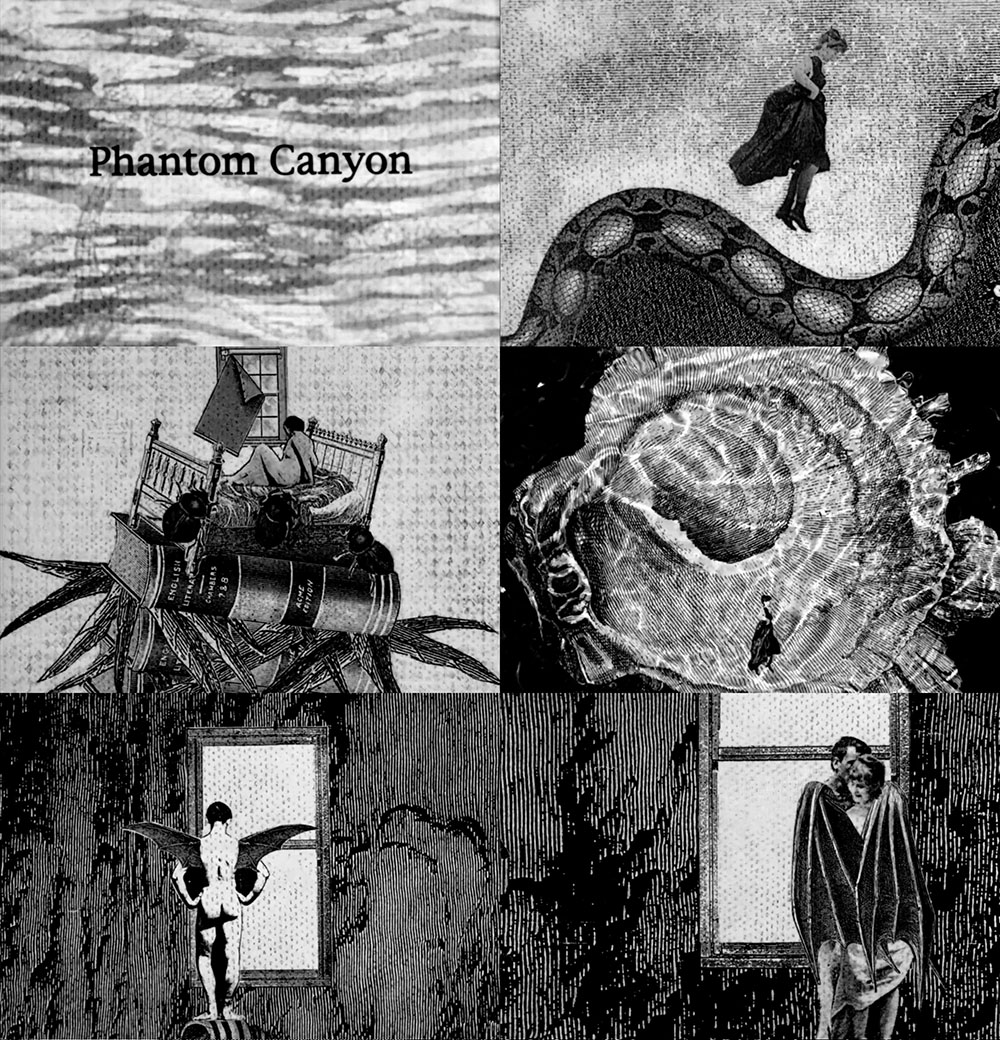
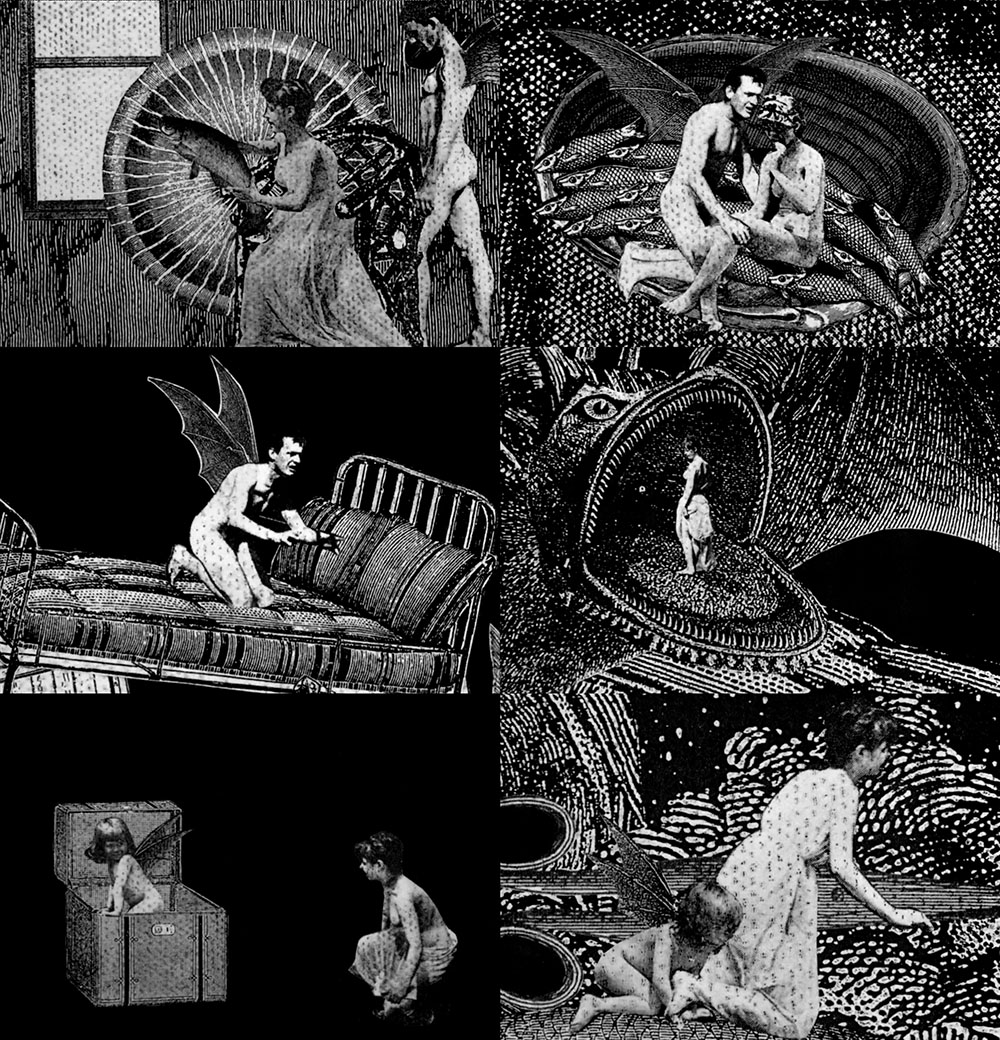
Phantom Canyon (2006) is another short animated film by Stacey Steers where many of the backgrounds and other details are collaged pieces from old engravings. There are so many of these films by Steers and older directors like Lawrence Jordan that I’m starting to think they should be considered a sub-genre inside the general body of film animation, just as engraving collage is almost a separate class of paper collage.

phantom2.jpg

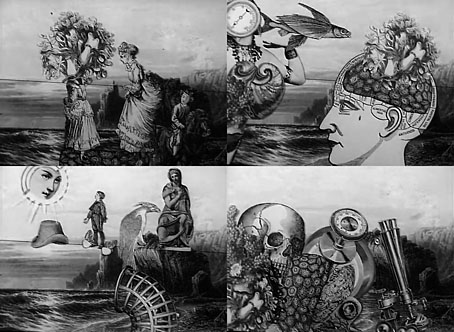
In Stacey Steers’ The Edge of Alchemy the human character was animated from repurposed footage of Janet Gaynor and Mary Pickford. For this earlier film the humans have been borrowed from Eadweard Muybridge’s pioneering motion studies. Muybridge is popular with animators for the obvious reason that his photographs were early forms of film animation (or cinema) in themselves; his photo experiments are even the subject of at least two animated films: Le Cheval de Fer (1984) by Gérald Frydman, and Muybridge’s Strings (2011) by Koji Yamamura. In Phantom Canyon a Muybridge woman travels through a surreal landscape where she’s assailed continually by monstrous insects and other objects while being pursued by a bat-winged Muybridge man. “A true story” says a subtitle, but it’s left to us to decide how much this may be metaphorical.

Previously on { feuilleton }
Cosmic Alchemy, a film by Lawrence Jordan
Edge of Alchemy, a film by Stacey Steers
Still Life, a film by Connor Griffith
Hamfat Asar, a film by Lawrence Jordan
Carabosse, a film by Lawrence Jordan
Labirynt by Jan Lenica
Heaven and Earth Magic by Harry Smith

Cosmic Alchemy, a film by Lawrence Jordan

cosmic1.jpg

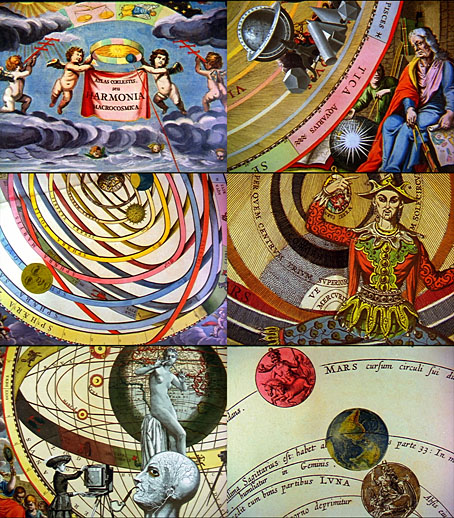
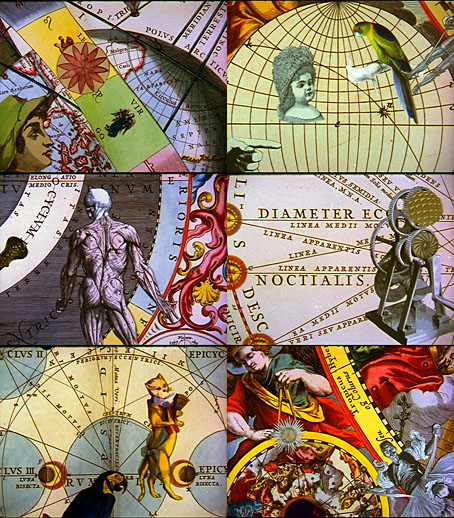
More alchemical collage animation, this time by one of the earliest practitioners of the form. Lawrence Jordan has been creating collage films since the 1950s, and is still doing so today. Cosmic Alchemy which dates from 2010, is a 24-minute piece that immediately attracted my attention for its use of cosmological charts and other maps of the heavens. The alchemy here is more astronomical (or astrological) than chemical, exploring a cosmos where the celestial spheres are populated by a variety of orbs and glittering stars, together with familiar figures from the Dover Publications Pictorial Archive. The droning soundtrack is by John Davis. There are more collaborations between Jordan and Davis at Davis’s Vimeo page.

cosmic2.jpg

Previously on { feuilleton }
Edge of Alchemy, a film by Stacey Steers
Still Life, a film by Connor Griffith
Hamfat Asar, a film by Lawrence Jordan
Carabosse, a film by Lawrence Jordan
Labirynt by Jan Lenica
Heaven and Earth Magic by Harry Smith

Hamfat Asar, a film by Lawrence Jordan

jordan1.jpg

I was reminded of Lawrence/Larry Jordan recently when reading Deborah Solomon’s biography of Joseph Cornell, Utopia Parkway, in which Jordan receives passing mention for helping Cornell with some of his film work in the 1960s. One of Jordan’s short films was featured here in 2014 but I’d not been very diligent in looking for more, a considerable oversight when he was an early and accomplished practitioner of animation using collaged engravings and illustrations. He wasn’t the only animator producing work like this in the 1960s, Harry Smith, Jan Lenica and Walerian Borowczyk also used these methods, but Jordan seemed to favour the idiom more than others.

jordan2.jpg

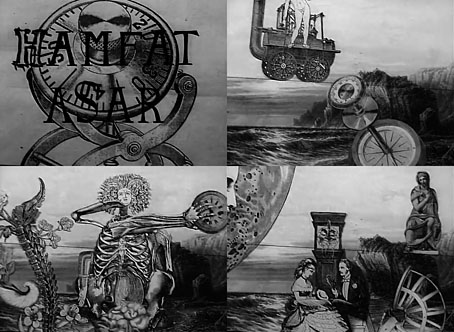
Hamfat Asar dates from 1965, and is immediately notable for moving its collaged figures over a shoreline landscape which remains fixed for the entire running time. The narrative, such as it is, concerns a stilt-walking figure attempting to cross from one side of the screen to the other but whose progress is continually impeded by a succession of figures, creatures and bizarre assemblages. The film has been described as representing “a vision of life beyond death” although this isn’t very evident at all. Jordan’s films are much more Surreal in the true sense of the word than many other collage animations which tend towards satire or comedy, Terry Gilliam’s work for Monty Python being an obvious example of the latter. The combination of Surreal engravings with black-and-white film stock gives Hamfat Asar a distinct Max Ernst flavour, which is no bad thing. Watch it here.

Previously on { feuilleton }
Carabosse, a film by Lawrence Jordan
Labirynt by Jan Lenica
Science Friction by Stan VanDerBeek
Heaven and Earth Magic by Harry Smith
Short films by Walerian Borowczyk

Carabosse, a film by Lawrence Jordan

carabosse.jpg

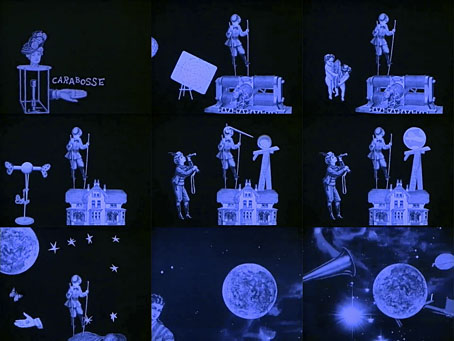
Collage animators may not be as plentiful as collage artists but this branch of filmmaking has attracted a number of heavyweight talents including Harry Smith, Jan Lenica, Walerian Borowczyk and Terry Gilliam. Lawrence Jordan worked for a time as an assistant to Joseph Cornell but he’s been making short films since the 1950s, many of which involve animated collage. Carabosse (1980) is a brief and distinctly Surreal piece set to Erik Satie’s Gnossienne No. 4. (An earlier film is titled Gymnopédies.) Watch it here. (Thanks to Erik Davis for the tip!)

Previously on { feuilleton }
Labirynt by Jan Lenica
Science Friction by Stan VanDerBeek
Heaven and Earth Magic by Harry Smith
Short films by Walerian Borowczyk