Weekend links 201

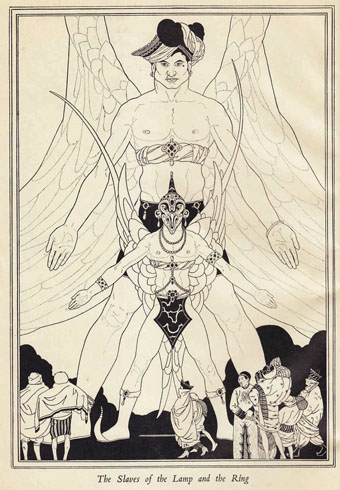
kettelwell.jpg

An illustration by John Kettelwell for The Story of Aladdin and the Wonderful Lamp (1928).

• “The strain in everything I write, of not being taken with the bounteousness of humankind, was also the attitude of both my parents.” Jonathan Meades talking to James Kidd about his forthcoming memoirs.

• 7 Trumps From the Tarot Cards and Pinions (1969), and album of electronic music by Ruth White, is being given a limited vinyl reissue. Related: Ruth White—An American Composer.

• 82 minutes of Michael Moorcock talking in 1972 to Jean-Pierre Turmel, co-founder of the Sordide Sentimental record label.

If Verne’s protagonists often seem to stop short of revelation, it’s because the revelation is not meant to be known. Revelation has a way of putting man back at the front of the evolution chart, moving neatly toward a happily progressing future, out of the darkness and into the light. The characters who embark upon the Voyages Extraordinares move backward and forward and all about, spun around like blindfolded children trying to pin the tail on the donkey. The point of the adventure, after all, is not to have a conclusion; it is to get knocked off your feet.

Stefany Anne Golberg on Journey to the Center of the Earth at 150.

• Photographs of pre-Haussmann Paris by Charles Marville, and photographs by Amy Heiden of industrial ruins.

• Mixes of the week: FACT Mix 427 by Wild Beasts, and Secret Thirteen Mix 108 by Kangding Ray.

• Hear Italo Calvino read selections from Invisible Cities, Mr Palomar and others.

William S. Burroughs in Dub conducted by Dub Spencer & Trance Hill.

• Cycles, Returns & Rebirth: Alexander Tucker on Derek Jarman.

Harold Budd: the composer with no urge to make music.

The Museum of Imaginary Musical Instruments.

• 80 minutes of Monolake playing live in 1999.

• At 50 Watts: Dyl’s Dance.

Owls And Flowers (2006) by Belbury Poly | Learning Owl Reappears (2011) by The Advisory Circle | The Owls (2013) by Félicia Atkinson

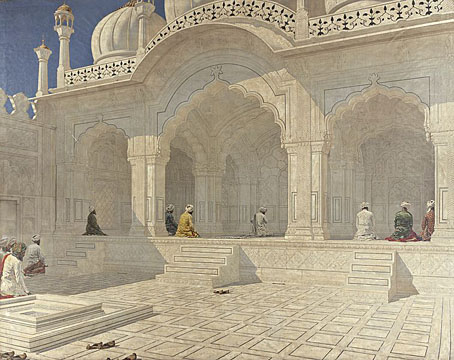
Vasily Vereshchagin’s temples

vereshchagin14.jpg

Pearl Mosque, Delhi (late 1880s).

I have a recurrent fascination with the paintings of historical and academic artists simply because their work has often been neglected, disdained, and rendered unavailable for so long. When art books and the critics who write them are mainly concerned with following avant-garde trends anyone who doesn’t come up to par is completely ignored, at least until critical fashion begins to change. As I’ve said in the past, one of the positive things about the Web is the way that this imbalance is redressed by the bringing to light of paintings by artists which have been sitting forgotten in museum storerooms for years.

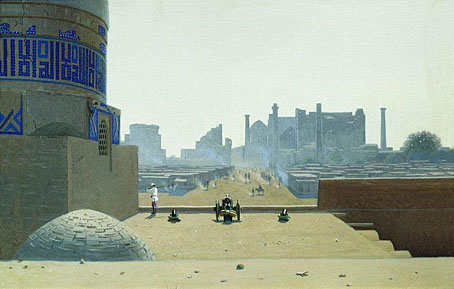
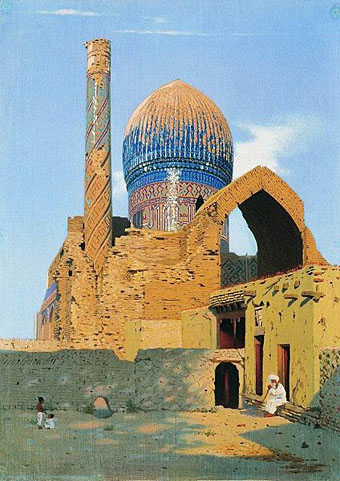
Vasily Vereshchagin (1842–1904) was a Russian war artist whose The Apotheosis of War (1871) is sufficiently symbolic to make it the most reproduced of his pictures. Among his canvases of various campaigns there are several paintings resulting from his travels through central Asia. Wikipedia has recently added to its store of Vereshchagin paintings so I’d not seen any of these before. Many are striking compositions with unusual perspectives, and a photographic attention to light and shade. Some of the details are so accurate, and the shadows so precise, I wonder whether Vereshchagin used a camera to capture a scene which he would have also sketched in colour before painting a finished version later on. Most of the titles and dates of all these works come via Wikipedia and Google Translate so the usual caveats apply.

vereshchagin01.jpg

Main Street in Samarkand, from the height of the citadel in the early morning (1869–1870).

vereshchagin05.jpg

Gur-Emir Mausoleum. Samarkand (1869–1870).

Continue reading “Vasily Vereshchagin’s temples”

Weekend links 200

fukaya.jpg

Untitled etching by Etsuko Fukaya, 2005.

• “By the time Scorsese met Powell, in 1975, the British director had fallen on hard times and was largely ignored by the UK film establishment.” A London office used by Michael Powell and Emeric Pressburger is given the Blue Plaque treatment.

• Ambient reminiscences at The Quietus: Wyndham Wallace on the genesis of Free-D (Original Soundtrack) by Ecstasy Of St Theresa, and Ned Raggett on Aphex Twin’s Selected Ambient Works II.

• “Even Queen Victoria was prescribed tincture of cannabis,” writes Richard J. Miller in Drugged: the Science and Culture Behind Psychotropic Drugs. Steven Poole reviewed the book.

I don’t relate to standard psychologizing in novels. I don’t really believe that the backstory is the story you need. And I don’t believe it’s more like life to get it—the buildup of “character” through psychological and family history, the whole idea of “knowing what the character wants.” People in real life so often do not know what they want. People trick themselves, lie to themselves, fool themselves. It’s called survival, and self-mythology.

Rachel Kushner talking to Jonathan Lee

Sound Houses by Walls is a posthumous collaboration based on a collection of “weird sonic doodles” by electronic composer Daphne Oram. FACT has a preview.

The skeletal trees of Borth forest, last alive 4,500 years ago, were uncovered in Cardigan Bay after the recent storms stripped the sand from the beach.

Stephen O’Malley talks to Jamie Ludwig about Terrestrials, the new album by Sunn O))) and Ulver. There’s another interview here.

• At BibliOdyssey: Takushoku Graphic Arts—graphic design posters by contemporary Japanese artists.

• The Unbearable Heaviness of Being: Dave Segal on the rumbling splendour of Earth 2.

So Much Pileup: “Graphic design artifacts and inspiration from the 1960s – 1980s.”

• Lots of illustrations by Virgil Finlay being posted at The Golden Age just now.

• Mix of the week: Episode #114 by Lustmord at Electric Deluxe.

Lucinda Grange’s daredevil photography. There’s more here.

Experimental music on Children’s TV

Kazumasa Nagai at Pinterest.

• Teeth Of Lions Rule The Divine (1993) by Earth | He Who Accepts All That Is Offered (Feel Bad Hit Of The Winter) (2002) by Teeth Of Lions Rule The Divine | Big Church (megszentségteleníthetetlenségeskedéseitekért) (2009) by Sunn O)))

Weekend links 199

cordal.jpg

Follow the Leader (London, 2011) by Isaac Cordal.

• “Brutalism is the decor of dystopian films, literature and comics, just as gothic is for horror.” Jonathan Meades‘ A-Z of brutalism.

Vitaly Shevchenko on the urban explorers of the ex-USSR. Related: Photos by Vitaliy Raskalov from the top of the Shanghai Tower.

Joe Banks reviews the throbbing, hissing, minatory pulses of the Black Mill Tapes 1–4 by Pye Corner Audio.

Walter Benjamin is the only one among the commentators who attempts to pin down the anonymous, evanescent quality of Walser’s characters. They come, he says, “from insanity and nowhere else. They are figures who have left madness behind them, and this is why they are marked by such a consistently heartrending, inhuman superficiality. If we were to attempt to sum up in a single phrase the delightful yet also uncanny element in them, we would have to say: they have all been healed.” Nabokov surely had something similar in mind when he said of the fickle souls who roam Nikolai Gogol’s books that here we have to do with a tribe of harmless madmen, who will not be prevented by anything in the world from plowing their own eccentric furrow.

Le Promeneur Solitaire: WG Sebald on Robert Walser

Drink The New Wine, an album by Kris Force, Anni Hogan, Jarboe, Zoe Keating and Meredith Yayanos.

• At 50 Watts: Illustrations by Fortuné Méaulle for Alphabet des Insectes by Leon Becker.

Lawrence Gordon Clark, Master of Ghostly Horror. An interview by John D’Amico.

• Chapel Perilous: Notes From The New York Occult Revival by Don Jolly.

• Mix of the week: Secret Thirteen Mix 107 by Ernestas Sadau.

• An Occult History of the Television Set by Geoff Manaugh.

• Was Ist Das? The Krautrock Album Database.

• First dérive of the year by Christina Scholz.

John Waters’ Youth Manifesto.

Gardens of Earthly Delights

Psychedelic Folkloristic

Water Music I / Here Comes The Flood / Water Music II (1979) by Robert Fripp & Peter Gabriel | After The Flood (1991) by Talk Talk | Flood (1997) by Jocelyn Pook

Conversations with Beckford

beckford.jpg

My thanks once again to Sidney Blackmore for sending me this new publication from The Beckford Society. Conversations with Beckford reprints in facsimile Cyrus Redding’s memoirs of William Beckford, a series of essays which were published in 1844 after Beckford’s death.

beckford2.jpg

Of particular interest to this folly enthusiast is a chapter entitled The Tower of the Caliph, in which Redding relates a visit to the newly-constructed Lansdown Tower which stands on Lansdown Hill outside the city of Bath. Beckford’s Tower, as it’s known today, is only half the height of the unsound structure which the fabulously wealthy Beckford built at Fonthill Abbey but it has at least survived, unlike the constructions on his old estate. The Tower and its grounds have had a chequered history since 1844 so Redding’s piece is valuable for the impression it gives of the place shortly after it was built. (The “Caliph” of the title refers to Beckford’s celebrated Gothic novel, Vathek, an Arabian Tale.) The Tower today is a museum housing some of Beckford’s art collection and furniture. Flickr has a great selection of views of the place showing how impressive the gold belvedere can be even on gloomy winter days.

Previously on { feuilleton }
The Beckford Journal
Vathek illustrated
Fonthill Abbey